Most everyone has something to sell. Your business idea, your product, your book, even yourself. Modern selling has moved a long way from cheesy infomercials and pushy car lots. At its best it’s a few very human things:
- Building rapport
- Solving real problems
- Having conversations worth having
- Adding value to someone’s life
Here are the science-backed sales techniques that close more deals without feeling gimmicky. Further down, you’ll see how selling actually works in an AI-shaped, screen-first world.
The Science of Selling (and Who Lands The Most Deals)
The people who close consistently tend to share a few habits:
- Stay curious: An analysis in Harvard Business Review1 found that top salespeople tend to be highly curious. They ask customers as many questions as possible to understand their needs better.
- Translate features into benefits: Top sellers spend less time reciting features and more time solving the buyer’s problem and spelling out the payoff.
- Be ambivert: The best salespeople aren’t necessarily introverts or extroverts. The best sellers often fall in the middle2, comfortable both listening and talking. Ambiverts tend to have that balance.
- Exude confidence: Without confidence in yourself and your product, customers will unlikely believe you have the best offer. According to research3, confidence and enthusiasm are top predictors of sales presentation success.
21 Killer Sales Tips
No matter what industry you’re in, you can close more consistently by honing your craft. Here are the tips that sharpen your sales strategy.
#1 Start on a high
Whether you’re pitching investors or initiating a conversation with a customer, always start with a bang. Research described in the book 59 Seconds by Richard Wiseman looked at how restaurant servers could increase their tips.
They found there was a super easy thing service providers could do to increase their tips. All they had to do was start with a positive comment. A server wrote a short note on the back of customers’ checks: either nothing, an unfavorable weather forecast, or a favorable one. The favorable forecast lifted average tips from about 18.7% to 22.2%.
How does this help you? Never start a sales meeting or pitch by talking about bad weather, traffic, or being busy. Always begin with a positive comment or anecdote, like:
- Great weather
- Fun weekend plans
- Favorite sports team winning a game
- Compliments
- Excitement for the future
#2 Contact leads at a rapid speed
A classic MIT/InsideSales study4 found you are roughly 100 times more likely to actually reach and qualify a lead if you respond within 5 minutes rather than 30. It won’t guarantee the close, but you can’t close a lead you never connect with.
In the age of instant gratification, attention is short and options are endless. When someone is ready to buy, they usually want it now.
No matter what you are selling, you need to have a quick response time to get ahead of competitors. Often, someone will buy the first product available even if it isn’t the best.
Whether in-person or online, you can maximize your response time by:
- Responding to buyer calls and emails as quickly as possible
- Turning on notifications for your business accounts (email, social media, etc.)
- Strategically placing “impulse buy” items near checkouts
- Creating automated responses to web inquiries
- Always having an online chat agent available during business hours
#3 Don’t self-sabotage with this mistake
The biggest self-sabotage mistake is to speak ill of a competitor. Research has found something called Spontaneous Trait Transference5. Whenever you say bad things about someone else, people can’t help but put those same traits on you.
The brain can’t help but associate your gossip with you, even if, logically, we know you are talking about another person. If you say your competitor is low-quality and unreliable, your potential client can’t help but associate those traits with you.
No matter what, when it comes to gossip, always say “no comment.”
#4 Be crystal clear about your UVP
Your Unique Value Proposition (UVP) is a quick statement that encompasses what you have to offer. Concise language and enticing details are key to explaining how your product or service will add value to someone’s life.
The best value propositions include:
-
The specific problem that your product/service solves
-
How your product or service differs from similar offers
-
Key benefits and advantages (modern customers are especially attuned to anything that makes their life easier and faster!)
-
The value you add to a customer’s life
-
Why should someone choose your product over another
Clarify your UVP using our quick guide, How To Effectively Pitch Your Ideas In 6 Easy Steps.
#5 Let your body language do the talking
Study after study shows that nonverbal communication is essential to be an effective salesperson. The way you carry yourself constantly tells your customer how confident and trustworthy you are, often before you say a word. Open, confident body language can make your pitch go more smoothly.
Thankfully, confident body language is super easy to learn. Upgrade your nonverbal communication with these quick shifts:
- Before changing your body language, recognize that your stature is about the dynamics between you and the other person. Carefully analyze the situation to ensure you come across as friendly and confident rather than cocky, arrogant, or pushy.
- Roll your shoulders back and down to straighten your spine. This demonstrates confidence and competence.
- Maintain eye contact for about 60% of the conversation. Well-judged eye contact builds warmth and trust.
- Keep your hands visible to build trust. Don’t cross your arms or put your hands in your pocket. This could imply that you’re hiding something.
- Keep your knees and feet facing the other person. This shows you are interested and present. If parts of your body face away from them, it may send the message that they don’t matter or you are trying to escape the conversation.
Learn more in this full guide to Nonverbal Communication in Business: 17 Tips to Boost Sales.
#6 Use awesome labels
When you assign someone a positive label, like having high intelligence or being a good person, that actually cues them up to live up to that label.
A meta-analysis of Pygmalion studies in workplaces6 found the pattern holds up: when people are treated as though they will do well, their performance tends to rise toward the expectation.
We live up to our positive labels.
When you are with a client or potential customer, give them genuinely good labels. I never want you to be fake or manipulative. So be sure to stick to positive truths. You can say:
- “You are one of our favorite customers.”
- “You’re such a pleasure to do business with.”
- “You picked the best [color/option/style].”
- “I really enjoy working with you.”
In that way, they will actually want to be one of your best customers and try even harder to be a pleasure to do business with.
#7 Relate to your customer’s values
Research suggests7 that a large share of consumers pick brands and products that match their values. Younger buyers especially gravitate toward brands known for being eco-friendly, sustainable, and socially conscious, whether that is a company famous for its recycling program or one that donates a share of every sale.
Be sure to speak to your customer’s core values and make your company’s commitment to doing good clearly visible. You can:
- Have conversations about your brand’s charitable contributions or passion for giving back to the community.
- Connect with value-led social media influencers and thought leaders in your industry.
- Write a compelling personal or business mission statement.
- Attain green certifications like USDA Organic, One Percent for the Planet, Rainforest Alliance, Forest Stewardship Council, or Greenguard Certified.
- Demonstrate social accountability with labels like Certified B Corporation, Fair Trade, or Certified Sweatshop-Free.
Not sure how to enunciate your values? Use this Core Values List: The Only 216 Values You’ll Ever Need.
#8 Be Buoyant
Buoyancy is the ability to withstand negativity, and no’s. You have to be able to have a positive outlook but still take the knocks without falling down.
For the best example of buoyancy, think of Brush salesman Norman Hall. He answered an ad to be a Fuller Brush salesman and promptly quit four times in the first seven days.
The problem? Rejection. He “found door-to-door selling especially brutal.” But Hall learned and adapted.
Rejection is something that every one of us has experienced in a number of forms in our lives: having a crush say no to a date, getting told you weren’t a great fit for that new job, hearing that manuscript you worked on wasn’t quite ready for primetime.
The key is how to withstand it, and that’s where buoyancy comes into play. To Sell Is Human describes three components of it, covering before, during, and after any sales attempt:
- Before: Interrogative Self Talk: The key here is not to declare “I will nail this presentation,” but rather ask as the question: “Will I nail this presentation?” Asking helps you “summon the resources and strategies to accomplish the task.”
- During: Keep your positivity realistic. Too little optimism drags you down, but so does forced, unrealistic cheer. Negative emotions can flag real problems worth solving.
- After: Explanatory Style: A good example of this is looking at your self-talk; when something bad happens, how do you see it? For buoyancy, it’s best to understand the reasons behind rejection as a temporary issue and be optimistic.
#9 Personalize
How can you solve someone’s problem if you don’t know anything about them? Make it a point to know your customers in the same way you would want to get to know a potential date. You don’t need to stalk them online, but you want to get an idea of the type of person they are.
Try to take a customer-centric approach, which means you tailor your sales approach to each customer’s unique preferences and needs. You can use customer data, past interactions, and insights into someone’s personality to customize their experience.
Thoroughly research your target customer and gain a comprehensive understanding of:
- What they like
- What they care about
- How old they are
- Where they hang out (online or in real life)
- Where they shop
- How much money they make
- Who they admire or look up to
- Why they need your product
- How they talk (bonus points if you catch onto niche lingo!)
You can get these insights through:
- Social media
- Market data
- Focus groups
- Customer surveys and feedback
- Reviews
- Conversation
- Direct questions
#10 Create a referral incentive
In a survey of 760 B2B buyers, 73% said they prefer to work with sales professionals referred by someone8 they know. No matter how much technology infuses our daily life, social trust9 will always drive people’s decision-making.
When someone we trust (even a social media influencer) refers us to a company or individual, we are more likely to buy from them.
Referrals work for both in-person and online businesses. Consider using:
- Influencer marketing
- Testimonials from high-profile customers like celebrities
- Referral incentives
- Affiliate marketing through a website like ShareASale or CJAffiliate
Word-of-mouth marketing isn’t going anywhere. Maintain the best reputation possible, and your customers are sure to tell their friends, family, and colleagues about you or your products/services.
#11 Use SPIN selling (ask questions!)
SPIN Selling is a sales method that focuses on asking specific, effective questions to uncover pain points and close a sale. Developed by Neil Rackham, this structured approach to sales is all about open-ended questions.
SPIN is an acronym that stands for:
- Situation: Ask open-ended questions like “Can you tell me about your current setup?” or “What are your main goals in this area?” to gather information about the customer’s context.
- Problem: Dig deeper to find the customer’s pain points and challenges. Ask, “What issues are you currently experiencing with this [process/product/goal]?” or “What major challenges are you facing?”
- Implication: Prompt them to think about potential consequences if they don’t address this problem. Ask, “What impact is this having on your business?” or “What would happen if that continues to be a problem?”
- Need-Payoff: Shift the conversation focus to a positive outcome and subtly highlight the value of your product or service in solving their problem. Ask, “What benefits could you see from this solution?” or “How would solving this problem improve your [productivity/weight loss/happiness/efficiency]?”
Take your expertise in SPIN Selling to the next level with the Spin Selling Sales Certification from Huthwaite International.
#12 Build rapport
Rapport is simply a harmonious bond between two people. When you build rapport with someone, they feel like you understand and value them. To avoid coming off as a sleazy salesperson, you must establish trust and a genuine connection.
Improve your rapport-building by:
- Integrating positive nonverbal communication, like a handshake, a genuine smile, or a pat on the shoulder.
- Leading with compliments about their energy, outfit, accessories, or overall vibe (avoid any compliments that could be perceived as flirty or inappropriate).
- Asking questions about their hobbies, interests, family, or weekend plans. Here are some great conversation starters to initiate a connection.
Want more? Here are 8 Ways to Build Rapport with Clients (Professional and Fun!).
#13 Remember prospects’ names
Dale Carnegie famously said, “Remember that a person’s name is, to that person, the sweetest and most important sound in any language.”
Psychologically, studies have found10 that forgetting someone’s name could make them lose a sense of belonging or meaning. Yikes!
If you want a prospect to feel like you really care about them, remember their name!
You don’t want to miss this name hack! When you correlate a new person’s name with a physical attribute, accessory, or setting, your brain is more likely to remember it. Here is How to Remember Names with a Simple Trick that ALWAYS Works.
#14 Position yourself as a premium seller
Do you want to be generic or premium? Do you want to blend in or stand out? If you’re anything like me, you’re aiming for the latter!
To position yourself as a premium seller, you have to do things differently. Whether consciously or subconsciously, customers pay attention to every detail of a company, from branding colors to language to the way sales reps present themselves.
To position yourself as a premium seller, emphasize:
- Exclusivity: People like to feel like they are special or part of an exclusive group. Highlight how your offering is limited edition, difficult to find, rare, luxurious, or otherwise unique.
- Expert knowledge: If you have credentials, use them. People trust experts. If your company has decades of experience or an industry award behind it, put that expertise front and center.
- Personalized experiences: Your product/service is not generic, so your customers should not feel generic either. Tailor each prospect’s experience to their specific wants, needs, and interests. Don’t repeat a rehearsed script.
- Impeccable presentation: Ensure that every interaction is professional, positive, and pristine. From how you dress to how you talk (or type), consider every detail of how you present yourself and your product/service.
#15 Visualize your sales cycle
A sales cycle follows the buying journey of a single customer. When you look at all current sales cycles, you can create a sales funnel that explains the average customer’s journey.
Most sales cycles follow a similar pattern:
- Leads: Where do they first hear about you or your product/service?
- Connections: How does the customer connect with you or the company?
- Qualifications: Can the lead afford your product/service? Do they genuinely need the product/service? A lead may be interested but not have the current resources to purchase. However, a prospect has both interest and the resources to purchase your offer.
- Presentation: How will you introduce yourself and present your UVP to the customer?
- Overcome Objections: What questions or skepticism do they have? How will you reassure them?
- Close the Deal: Will you use an urgency close (limited-time offer) or purchase suggestion to close the sale?
- Nurture New Leads: Can you check in with the customer 1-2 months after the purchase? Will you use a referral program or other incentive to gain new leads from happy customers?
Action Step: Draw a circle with 7 smaller circles around it. Think of a recent sale you closed, answer the questions above in detail, and spot where you can improve the customer journey.
#16 Copy the pros
Imitation is the sincerest form of flattery. If a pro has already developed a masterful sales technique, why not use it?
We don’t mean copying someone’s sales pitch word-for-word (that’d be awkward). Instead, think of someone successful in your industry and take note of their formula. Integrate your unique flair and UVP into their framework and find ways to specifically tailor it to your customer.
Learn the Secrets Behind the Best Shark Tank Pitches of All Time and How To Effectively Pitch Your Ideas In 6 Easy Steps.
#17 Avoid burnout with these tips
If you don’t feel like your most confident, energized, and motivated self, it’s difficult to convince anyone to buy anything. It’s easy to get burned out in the intense and high-pressure sales environment. Continuous interactions with people can lead to social fatigue. If you’re an introvert, social burnout can add more challenges to an already difficult job.
Prevent burnout with these tips:
- Take time for yourself: Self-care is a vital piece of the sales equation. Use your evenings and days off to fill your own cup with wholesome meals, movie nights, solo dates, exercise, meditation, skincare, or anything that makes you feel good.
- Go on a team retreat: Sales team leaders should be attuned to how their employees are feeling about workflows. After intense pushes, deadlines, or loss in team morale, consider scheduling a work retreat. Here are the 27 Best Team Retreat Ideas for any budget.
- Give and receive positive feedback: Keep your team motivated with frequent positive feedback, and don’t forget to hype yourself up! Offer words of encouragement and recognition to your coworkers and managers. Ask your supervisors, “Where am I excelling?” or “What should I do more of?”
- Sharpen your communication skills: Sales and communication are inextricably linked. If dull conversations and unclosed deals are wearing you down, brushing up your people skills is often the fastest way to get your spark back.
#18 Follow the data
Imagine throwing a dart with a blindfold on. You’re unlikely to hit the bullseye because you cannot see where you’re aiming. Sales data gives you direction. If you don’t know your current numbers and where you are aiming, you could be randomly throwing darts into outer space.
Use these ideas to make data-informed decisions that improve your sales strategies:
- Define clear objectives: What are your current sales numbers, KPIs, and ROIs? How do you want to improve them in the next quarter? Set SMART Goals to get crystal clear on where you want to go with your business.
- Know your website traffic: What is your conversion rate? How many of your hyperlinks lead to click-throughs? What is your abandoned cart rate? Use tools like Google Analytics or KissMetrics to gain a better understanding of your web performance.
- Run the social media numbers: Use business account tools on Instagram, Linkedin, Facebook, and TikTok to understand more about your customer’s interactions with your content.
#19 Stories sell
Research shows that narrative stories are highly effective at changing behavior11 or attitudes. Stories capture attention with emotion. When someone can relate to a story, your sale becomes humanized rather than robotic.
To connect with customers on a deeper level, you can use:
- Personal stories
- Stories from other customers
- Your company founder’s story
- Stories related to a cause or charity that you support
Not sure where to start? Try a simple story-selling shape: set the scene, share the struggle, then show what changed.
Learn How to Tell a Great Story: Learn Science of Storytelling.
#20 Add some spunk
If you know how to make people laugh, you are more likely to sell successfully. Humor takes the edge off any interaction and reminds customers that we are all just humans, after all.
Show off your personality by infusing each sale with some spunk or humor. You can joke about your own mistakes or make a silly pun about your product.
However, it’s best to avoid inappropriate jokes related to sex, politics, race, or anything that insults your customers. If you want to engage in witty banter, be sure to stay lighthearted and professional.
Do you feel awkward about cracking jokes? Me too! Thankfully, you can learn How to Be Funny: 7 Easy Steps to Improve Your Humor.
#21 End on a high note
Lastly, end on a high note. Let me explain a really gross but fascinating study involving one of my least favorite topics: colonoscopies…
I’ve only ever heard one thing about colonoscopies. They are super unpleasant. And doctors know that they have a bad rap. They wanted to do research to find a way to give colonoscopies a better reputation.
A little background: in the randomized trial on this12 a colonoscopy averaged around 27 minutes, and it is uncomfortable throughout. Leaving the scope still for up to three minutes at the end made those final moments less painful, and patients remembered the whole experience as more tolerable.
In other words, even if it takes a bit longer, ending on a better note makes someone recall the entire experience better.
Before someone leaves your pitch, end on a high note:
- Gift a final perk
- Offer them a mint
- Pay them a compliment
- Thank them
It will make the entire time with you even better.
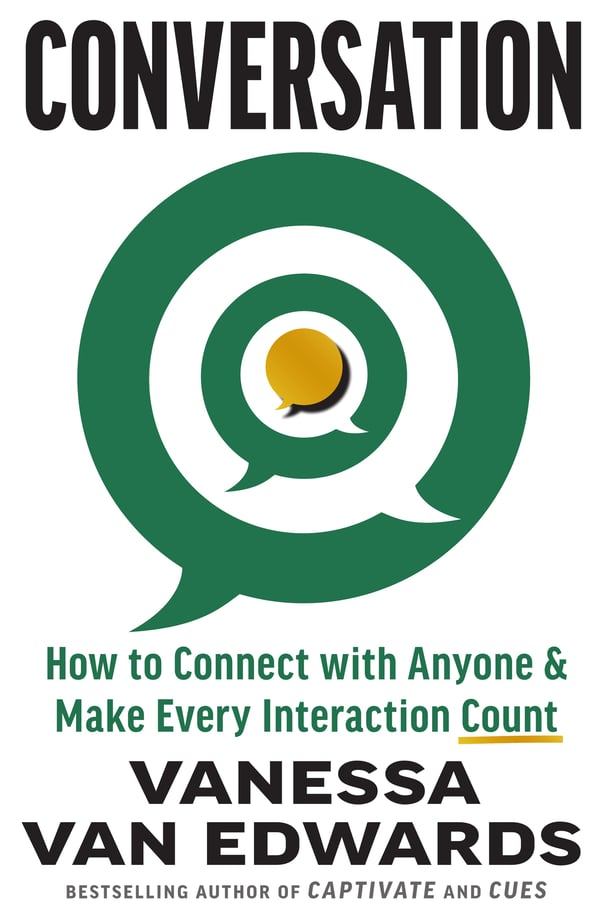
A new book by Vanessa Van Edwards
Every conversation is an opportunity.
If conversations have gotten harder, more awkward or less satisfying, you’re not imagining it. We’re simply out of practice. It’s time to find the joy in talking to each other again.
Sell to the Buyer Who Already Googled You
The bulk of the decision now happens before you enter the conversation. In a 2025 Gartner survey of B2B buyers, 45% said they used generative AI to research vendors and products during a recent purchase, drawing on an average of seven different sources13.
So what are you actually for? You’re the person who tells the buyer whether what they found is true. In that same research, 69% of buyers said they still turn to a sales rep to validate the insights AI handed them13. They trust you, but cautiously. About half expect to run into misleading information from AI, and just under half expect the same from a salesperson.
That skepticism is your opening. Here’s how to sell to someone who did their homework before you said hello:
- Assume they’ve researched you. Don’t open with a feature rundown they’ve already read three times. Ask what they’ve found so far and what still worries them.
- Be the honest validator. When an AI summary gets something wrong about your category (it happens constantly), correct it gently and show the evidence. Accuracy is your edge.
- Be there in the research phase. Reviews, comparison pages, and short demo videos are doing your first sales call for you now. Make sure the version of you that buyers meet online is a good one.
Action Step: Before your next call, search your own product the way a buyer would: ask an AI assistant to compare you to your top competitor. Whatever it gets wrong is exactly what you’ll want to be ready to address.
Selling Through a Screen
Remember tip #5, all that advice about open body language and pointing your knees and feet toward your customer? Most sales don’t happen in the same room anymore, and your feet are off camera. Research from McKinsey describes a “rule of thirds”: at any given point in the buying journey, about a third of customers want to meet in person, a third want to talk remotely, and a third would rather serve themselves online14. Buyers now use up to ten channels before they commit, double the number they used five years ago15.
That means your charisma has to travel through a webcam and a shared doc. A few adjustments go a long way:
- Fix your camera first. Your posture matters less than your framing here. Put the lens at eye level and talk to the lens itself. Looking at the face on your screen makes you seem to gaze down and away. Light your face from the front and clear the clutter behind you.
- Send an async video when a call won’t fit. A busy buyer will watch a tight three-minute recorded walkthrough on their own schedule long before they’ll book another meeting. Keep it short, personal, and made for them.
- Learn to sell in writing. More and more, deals move forward over email, Slack, and a proposal doc while everyone’s cameras are off. Make your writing skimmable, lead with the answer, and never bury the price.
Try this: Record a 60-second video introducing yourself to your next prospect instead of sending a plain email. It’s about the closest thing to a handshake you’ve got through a screen.
Your Sales Techniques Takeaway: Close More Sales With Positive and Powerful Communication
It doesn’t matter if you’re pitching Mark Cuban on Shark Tank, selling a new makeup product, or convincing your social media followers to buy your book. Sales skills are people skills, no matter the context.
If you want to close more deals, remember to:
- Research: Study your customers in advance. Use data and observation to get to know them, what they like, and what problems they are facing.
- Ask lots of open-ended questions to understand the driving forces behind a person’s decision-making.
- Be optimistic: Maintain positive energy at all times. Begin and end every conversation on a high note. Exude optimism with your nonverbal communication, like good posture, a joyful smile, and a positive tone of voice.
- Connect: Build rapport with customers by taking a genuine interest in their lives. Nobody wants to feel “used” by a sleazy salesman trying to make a commission. People are more likely to support businesses that care about people and important causes.
- Meet them where they are: Your buyer has probably already researched you with AI and made up half their mind before you speak. Be the honest human who confirms what’s true, and make your charisma work through a webcam and a chat window.
Want more? Here are the top sales training programs and the 8 sales skills to learn.
- Harvard Business Review
- CloserIQ
- ERIC
- Lead Response Management Study
- APA PsycNet
- Pygmalion in work organizations: a meta-analysis, Journal of Organizational Behavior (2000)
- IBM Institute for Business Value
- LinkedIn/IDC
- ScienceDirect
- SAGE Journals
- European Journal of Social Psychology
- Memories of colonoscopy: a randomized trial, Pain (2003)
- Gartner
- McKinsey & Company
- McKinsey & Company