
We are so honored to help you find authentic connections! If you are struggling to find the help you need, please note that all content found on this website is not to be considered professional medical advice. It is always best to consult a doctor or licensed therapist with any questions or concerns in regards to your physical or mental health. For a good resource for therapists, you can check out Mental Health America’s helpful list.
Struggling through a layoff is hard enough. Talking about it shouldn’t be as hard.
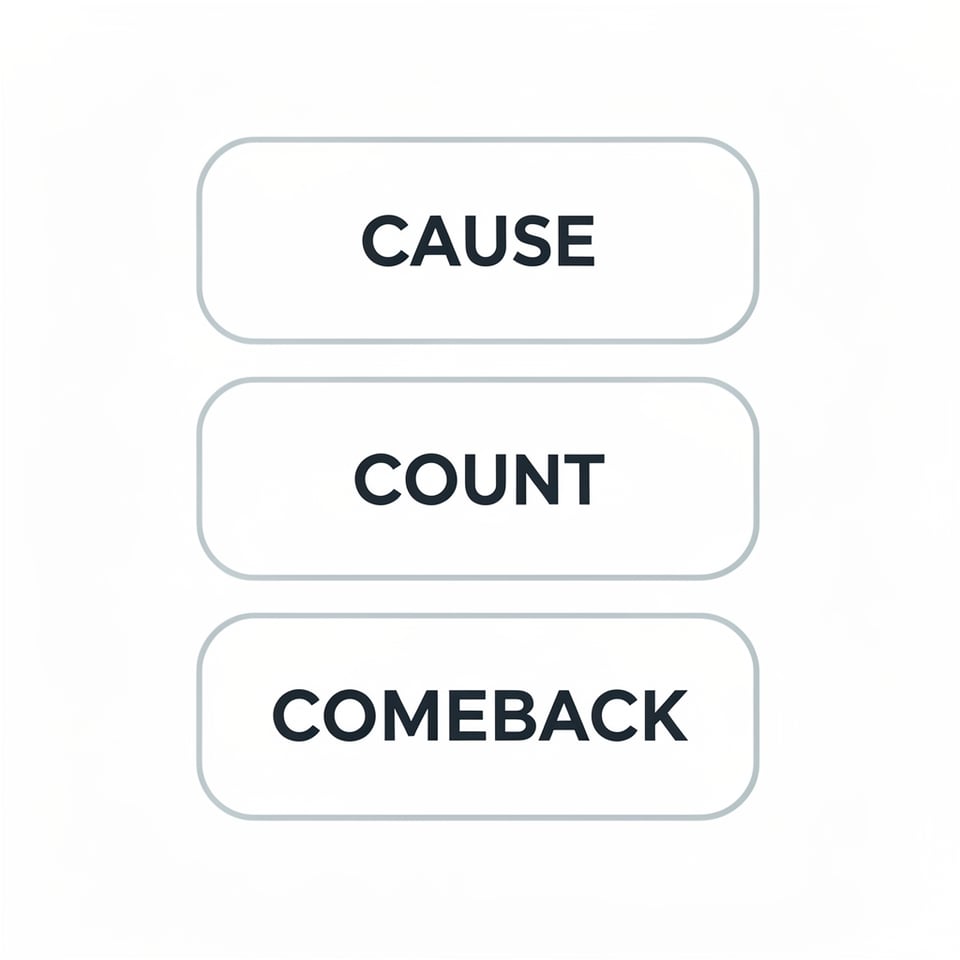
Say the Cause, the Count, and the Comeback
So what do you actually say? Your answer could have three jobs, and it can do all three in about twelve seconds.
Try this formula:
Cause. Why the company cut roles. Restructuring, a lost contract, funding that didn’t come through, an office that closed. Something that happened above your head.
Count. How many people went with you.
Comeback. What you’re after now.
Cause, count, comeback. That’s the whole thing. (Yes, really. That’s all of it.)
A 2023 study in PLOS ONE showed people one of two versions of the same CV, identical except for whether the candidate was currently working. The unemployed version drew fewer interview offers and fewer hires. The difference came down to how competent the candidate seemed1.
So the person across from you isn’t waiting to hear that you’re a good egg. They’re quietly filling in a blank about whether you’re good at the work. And if you leave that blank open, they’ll fill it themselves, usually with something worse than the truth. (We are all a little too good at imagining the worst version of somebody else’s story.)
That’s the cause sentence’s only job. It hands them the reason before they invent one.
Pro Tip First impressions are a whole skill of their own. If you want to go deeper than one answer, that’s exactly what we practice in People School.
The comeback handles the other half. It moves the conversation off a thing that happened to you and onto a thing you want, quickly enough that nobody has to sit in the uncomfortable part.
Put together, it sounds like this:
“We lost our biggest client in March and the company cut about a fifth of the staff, my team included. I’m looking for a marketing role where I can own the whole funnel again.”
Thirty-four words, about twelve seconds, two sentences. That’s it! For a question that tends to loom a great deal larger than twelve seconds.
All three parts depend on one thing: it has to be true. Not the most flattering version of true, but true. Whatever you say here can be checked by a recruiter with your old manager’s phone number.
Why “200 of Us Went” Beats “My Role Was Eliminated”
“My role was eliminated” is technically true and tells the listener almost nothing. Eliminated by whom, and in favor of what? Was it just you?
That last one is the question they’re actually asking. So why does a plain number work so well? Because it answers that question before anyone has to say it out loud.
| What you say | What they’re left wondering |
|---|---|
| “My role was eliminated.” | Eliminated, or engineered? |
| “There were layoffs.” | How big, and were you unlucky or were you chosen? |
| “They cut about 200 of us, including everyone on my team.” | Nothing. That’s a business decision. |
See the difference? A number gives them something adjectives can’t. “Big layoff” is a judgment they have to take your word for. “200 people” is a fact they can picture, and it quietly moves you from the center of the story to one of two hundred.
If you don’t know the number, use the shape instead.
My whole team.
The entire Seattle office.
Everyone hired after 2024.
Each of those tells them the line wasn’t drawn around you personally.
Two things to keep out of the sentence.
The first is the word “fired,” unless it’s the right word. A layoff means the job went away. A firing means you did something. People blur the two when they’re nervous, and blurring them costs you the one advantage the count sentence just bought you.
The second is editorial. “They cut 200 people” is a fact. “They cut 200 people because leadership panicked” is a fact plus a grievance, and the grievance is the only half anyone remembers. (We have all wanted to add that second half. It never pays.)
A new book by Vanessa Van Edwards
Every conversation is an opportunity.
If conversations have gotten harder, more awkward or less satisfying, you’re not imagining it. We’re simply out of practice. It’s time to find the joy in talking to each other again.
Rehearse Out the Nerves
Ready for the least glamorous advice in this article? The goal here is boring. Your two sentences should come out about as flatly as your own phone number. We need to rehearse out any anxiety or prickliness.
That sounds like odd advice until you see what a hesitation does to a listener.
In one set of experiments, people listened to a speaker tell them where a prize was hidden and had to decide whether to believe it. When the speaker spoke smoothly, listeners leaned toward the spot they’d named. When the speaker hesitated, they leaned away from it, and they did it within a moment of hearing the word2.
So what does that mean for your two sentences? A stumble quietly suggests that whatever you just said, the real story is somewhere else. None of us gets to opt out of being read that way.
So how much rehearsing are we talking about? Less than you’d think. Here are six ways to practice, none of which take longer than a coffee break.
Tell It to the Dog First
Say it out loud to something that won’t react. The dog, the car, the empty kitchen at 7am.
Reading it in your head skips the part of your mouth that’s going to fumble. (You’ll probably trip in the same spot twice, which is exactly the useful part.)
Run It at Every Red Light
Spread the reps out. Ten runs across three days will do more than fifty in one sitting, and a red light is a free thirty seconds you were going to waste anyway.
Three lights on the way to work, three on the way home. That’s your week, done.
Record One Run and Play It Back
Play it back listening for one thing only: where you slowed, restarted, or reached for a filler word that wasn’t in the plan.
A playback usually turns up something like this:
“We lost our biggest client in March and the company cut, sorry, cut about a fifth of the staff, um, my team included.”
Two stalls, both around the same clause. (Did you catch both? The “um” is the easy one. The “sorry, cut” is the one that costs you.) So cut it:
“We lost our biggest client in March and the company cut about a fifth of the staff, including my team.”
Text It to Your Bluntest Friend
Send that recording as a voice memo to the friend who tells you the truth about your haircut. Ask them one question: did I sound like I was hiding something?
You want the answer from someone who owes you honesty before you get it from someone who owes you nothing.
Get Ambushed on Purpose
Ask your partner or a friend to spring the question on you at a completely random moment. In the kitchen, mid-episode, while you’re carrying groceries.
Rehearsed answers hold up beautifully until the wording changes. An ambush finds that out for you, cheaply.
Take the Boring Test
You’re finished when you’re bored of it. Not when it’s word-perfect, which is a different goal, and one that breaks the moment somebody asks the question slightly differently.
Boring is the POINT. Bored means your mouth knows it without your brain helping.
Your 3-Day Rehearsal Plan
| Day | What you do | What you’re listening for |
|---|---|---|
| Day 1 | Write the two sentences. Say them to the dog five times. | Where your mouth trips |
| Day 2 | Five runs at red lights. Record one. | Slowdowns, restarts, filler words |
| Day 3 | Voice-memo it to your blunt friend. Get ambushed once. | Whether it holds when the question changes |
Three days, about fifteen minutes total. Then you never have to think about it again.
Is It Ready Yet?
Say your two sentences out loud one more time. Check off anything that’s true:
- You had to glance at your notes.
- You said “basically,” “kind of,” or “I guess” somewhere in there.
- You explained why the decision was unfair.
- It ran past twenty seconds.
- You used the word “fired.”
- You slowed down in the same spot you slowed down last time.
- You wanted to add one more sentence at the end.
- Someone asked a follow-up and you improvised.
Nothing checked? You’re done. Go do something else.
One or two checked? That’s a fifteen-minute fix, and you already know which sentence it is.
How Long Can You Be Out of Work Before It Hurts?
Take a guess before you read on.
a. One month b. Three months c. Six months d. About a year
If you said a year, you’re right! And if you guessed one month, you’re in good company. That’s roughly what the standard advice assumes too.
Research bringing together hiring experiments from a lot of different countries found that the harm from being out of work only becomes noticeable after about twelve months3. Before that, something stranger happens. Spells of up to six months actually helped people’s hiring chances.
Wait. Helped?
Why would that be? The likely reason is dull and practical. Someone who isn’t working can start on Monday.
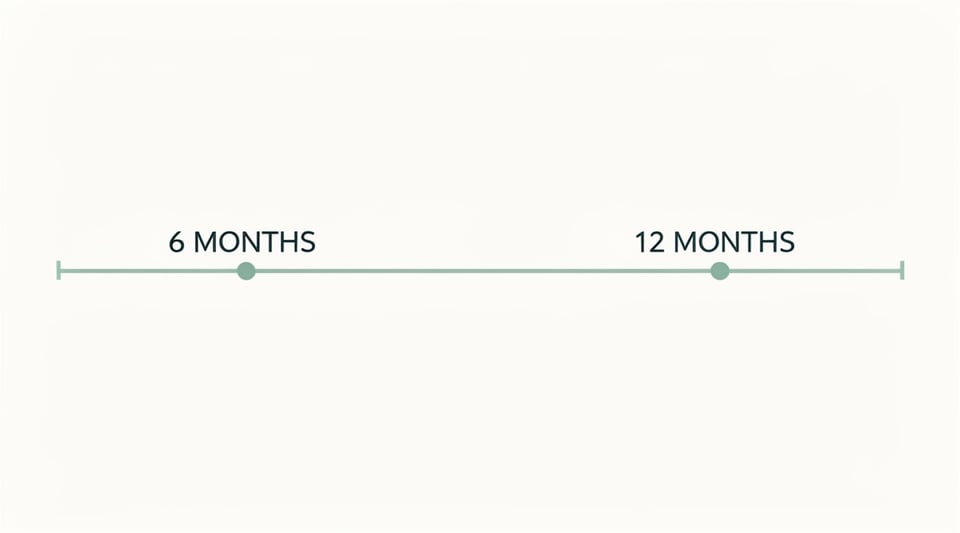
Up to about six months out of work, hiring prospects helped. The adverse effects became noticeable after about twelve.
There’s an older US experiment that points the other way. Fake résumés went out to real job ads across 100 US cities, and callbacks fell the longer someone had been out of work, with most of that fall inside the first eight months4.
The same review confirms employers treat people who are out of work less favorably than people who aren’t. But in month two, the clock is still on your side, which is worth knowing before your next interview.
So if you were laid off eight weeks ago, the thing you’re bracing for hasn’t arrived yet. It’s easy to assume the clock starts counting against us on day one. It doesn’t. If you’re dreading the question, right now it’s nothing worse than a question.
Which changes what your two sentences have to do. Early on, they only have to be clear. Closer to a year, they need a second half about what you’ve been doing with the time.
Write the Angry Version First (Then Never Send It)
Now, what about everything you actually want to say? Before you write the two sentences, open a document nobody will ever see and put the whole thing in it. The all-hands about being one team in January, the person who kept their job, the thing your manager said that’s hard to stop replaying.
Then leave it there. (Nobody is ever going to read it. That’s the point.)
Writing about a hard experience does help, and the honest size of the help is small. Research pulling together 146 trials found a real but modest average benefit5. Worth ten minutes. It won’t fix your week.
The reason to do it here has little to do with healing. So what are we actually looking for? The sentences you can’t say yet without your voice changing.
The read-back is where you find them. They’re the ones that will leak into the calm version if they don’t have anywhere else to be.
The first pass usually comes out something like they gave us a “we’re one team” speech in January, cut my team in March, and nobody even told my manager. All of that is true. None of it is sayable.
Stripped to what a stranger actually needs, it comes back to the sentences you already wrote: the client, the cut, your team. Every fact survives. What’s gone is the half that was only ever for you.
If you want a structured version of this, with an actual writing routine attached, post-traumatic growth covers it. For the layoff, you only need it ONCE, and only for yourself.
What About the Nosy Neighbor at the Barbecue?
The SAME two sentences. That’s the whole answer.
Maybe you’ve already had this one. Maybe it was a cousin at a barbecue and you gave the long version…all of it. Maybe it was someone at school pickup and you gave no version at all and changed the subject.
Okay, you might be wondering why the guy by the grill gets the same careful line as a hiring panel. He isn’t deciding anything. He’s making conversation with a paper plate in his hand…and yet.
It turns out the judging isn’t confined to interview rooms. US adults were shown applicants for one job opening who differed in one way only, whether they had a gap in their work history during the pandemic years. They picked the ones with a gap about 20% less often, and described them as less hardworking, less dedicated, and less professional6.
Twenty percent. Same résumé otherwise.
It made no difference which reason was attached to the gap.
Surprising, isn’t it? We would all like to think the reason is what people weigh.
So the neighbor is making the same judgment as the hiring panel, with worse information and no job to offer.
Which is why one version works better than three. If you keep a work version, a friends version, and a family version, you have to pick one in the half second after somebody asks, usually while you’re holding a drink and they’re already watching your face. That’s the moment you flinch. (And a flinch is louder than the sentence it interrupts.)
There’s a quieter cost to having no line ready. If you dread the question, it’s easy to start skipping the places where it gets asked. The birthday party, the industry meetup, the group chat that’s gone quiet on your end.
And those are the rooms where someone mentions an opening, or introduces you to somebody worth knowing. Having a line ready is what keeps you in them!
Give the neighbor the hiring-panel version. It’s shorter than whatever you’d improvise, and by then you’ll have said it twenty times.
But What If They Keep Digging?
It starts innocently enough.
“So…why you, exactly?”
And if you haven’t planned for that one, the next three minutes can disappear into the second phase of the reorg, a reporting line that changed in 2024, and something your skip-level said back in April.
Yikes.
What happened? The first answer was planned and the second one wasn’t.
So plan the second one. It’s one sentence, and it’s roughly the same sentence whatever they ask.
“Why you?” “Seniority and cost, as far as I could tell.”
“Were you surprised?” “Yes. And I’d rather spend the time on what I’m looking for next.”
“Couldn’t they have moved you somewhere else?” “There wasn’t another team hiring at the time.”
Can you just say you don’t know? You bet. “I never got a full explanation” is a complete answer, and it beats a guess you’ll have to defend later.
Notice what those have in common? They’re short, and they hand the conversation back. Nobody expects a laid-off candidate to have forensic detail about a decision made two levels above them.
There’s one version of this the script doesn’t solve. If your whole team stayed and you were the only one cut, there’s no count sentence available to you. You can say the role was cut and that you were in it, and then you’re leaning on your references and your work to do the rest. That’s slower and less comfortable than a number, and there isn’t a way around it.
Layoff Conversation Takeaway
- Write your two sentences tonight. Company-level cause, the size of the cut, and what you want next. Thirty-four words is plenty.
- Say them out loud ten times, spread across three days. Silent runs won’t find the word you trip on.
- Record one run and play it back. Listen for one thing: where you slow down, restart, or add a word that wasn’t in the plan. Then cut the clause that keeps causing it.
- Put the angry version somewhere private first. Read it back and mark the sentences you’d never say to a stranger. Those are the ones to keep out of the calm version.
- Use the same two sentences on your neighbor. One version means you never have to choose one mid-question.
- Decide your follow-up sentence now. One short line for “why you?” that answers and moves on, so a probe doesn’t turn into three minutes.
So write the two sentences before you close this tab. It takes about five minutes, and you’ll use them for months.
Twelve seconds of material. That’s all this question ever needed!
When you’re ready for the part that comes after the question, 14 ways to get your confidence back after a hard time picks up from here.