Last week on The Diary of a CEO I said something I’d been thinking for a while and hadn’t said out loud.
This is the last generation that will learn conversation the way every generation before it did, from other people.
A few weeks before that episode aired, an MIT faculty committee published its report on AI in education. It didn’t come across my desk until after we recorded DOAC. When I read it, I expected a document about cheating or declining critical thinking.
But what I found was a document about connection.
The committee’s own words1
AI is “increasing isolation,” “undermining student mastery and confidence,” and “eroding the ‘social contract’ between instructors and students.”
Less than three years after ChatGPT, MIT documented lower attendance at office hours, reduced participation in online discussions, and, anecdotally, fewer in-person study groups in dorms and libraries.
Nobody Taught You How to Have a Conversation
You and I learned conversation by having thousands of them over many years. Some were memorable, exhilarating. Some were awkward and we tried to forget them as soon as we could. In MIT’s case this looks like arguing with a friend over a problem set at 11pm. Working up the nerve to ask a professor something in office hours. Standing around after class. Getting cut off, getting bored, getting it wrong, trying again.
Nobody scheduled any of that. Nobody taught it. It just happened. It was an accidental byproduct of learning something new. Learning something new is hard. Learning with others ends up teaching far more than just the material being studied.
Now that AI is omnipresent on campus and used daily, it turns out there’s a casualty. Not the ability to talk to people. But the thousands of ordinary, low-stakes moments where the conversational reps got done without anyone noticing.
Nobody at MIT decided to stop learning conversation. The higher education behavioral patterns rather suddenly stopped producing the moments students used to learn conversation from.
Fewer Conversations Mean Each One Counts More
There’s a second order effect. For this I want to turn to one of my least favorite university subjects: microeconomics.
The rarer conversation becomes, the more each remaining one is worth.
When something is scarce, it gets expensive.
Think about interviews. When you interview every week, you don’t prepare. When you interview once a decade, you prepare like your life depends on it. That would be my advice anyway. Human conversation is moving from commonplace and low value to rare and high-stakes.
Which means conversation can no longer be something you accidentally pick up along the way. It has to be something you learn on purpose, study, and even schedule practice time for.
MIT reached the same conclusion. The committee recommends that every course include a regular in-person social component, deliberately structured by the instructor, “not just sitting in lecture or recitation and quietly taking notes.”1 They are putting conversation on the syllabus because it no longer happens by itself.
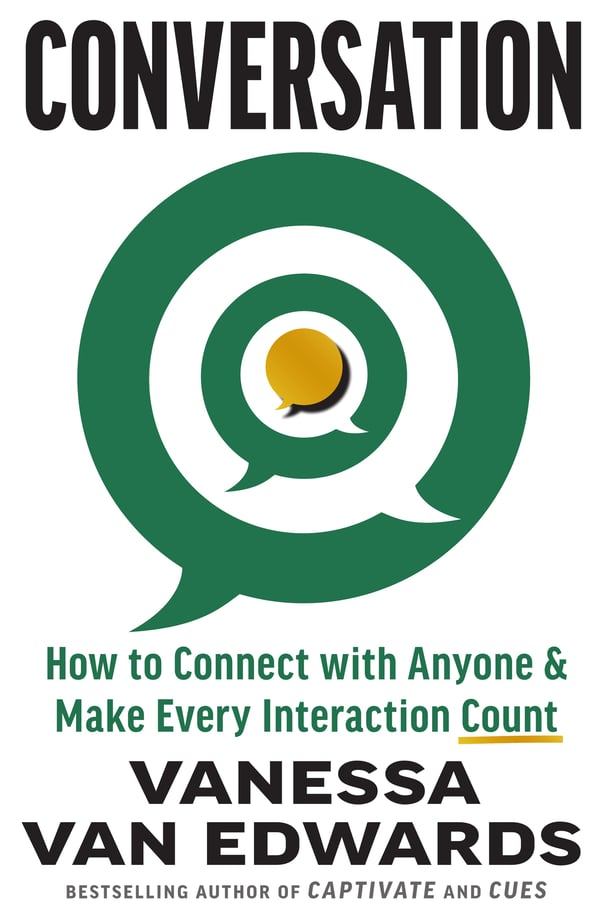
A new book by Vanessa Van Edwards
Every conversation is an opportunity.
If conversations have gotten harder, more awkward or less satisfying, you’re not imagining it. We’re simply out of practice. It’s time to find the joy in talking to each other again.
What The Report Found
1. Employers Want Connection Along With Competence
The report says employers prize MIT graduates for problem-solving and technical skill, “but they also want people with the skills of human connection.” It names collaboration, communication, problem-solving, and emotional intelligence as the durable human skills employers prize most.1 Fewer people are building those skills, and employers want them as much as ever. That is good news for anyone who still has them.
Action Step: Count the conversations this week you routed through a screen that a year ago would have gone through a person.
2. The Struggle IS the Training
The report borrows the term “cognitive surrender” for reaching for AI at the first hint of difficulty,2 and it notes early signs that overreliance on chatbots can diminish critical thinking, weaken memory, and erode confidence.1
How many times have you read the meeting summary instead of paying attention? Avoided offering pointed feedback? Stayed quiet in the meeting and never sent the follow-up? We might think passing everything through the great AI filter serves productivity, but are we just avoiding difficult or uncomfortable human interaction instead?
Action Step: Before you prompt, ask whether this is hard because it’s tedious or hard because it’s human. Automate tedious. Practice human.
3. Practice With AI, Then Show Up for People
One MIT instructor teaching future mediators gave students a personalized AI coach to practice public speaking. It removed the awkwardness of rehearsing in front of peers, so students practiced more, and their skills improved.1 The report’s principle for this is “augmentation not automation,” borrowing from three MIT economists who argue for AI that makes people better at their existing work instead of replacing them.3
This same thesis is why I invested in ProSocial earlier this year. As interpersonal interactions become higher-stakes we need to hone our skills, warm-up, and simply put in the reps. Just as we would for any sports team or artistic skill.
The mistake is using AI for practice AND delivery. You rehearse the hard conversation with a chatbot - no stakes, gentle feedback, unlimited retries. But when you then have the chatbot send it you never uttered the words or hit send, so you never learned anything. Imagine if we were having ChatGPT do our squats for us.
Action Step: For your next difficult conversation, role-play it with AI first. Then close the laptop and do it in person.
Why I Wrote a Book Called Conversation
I started writing Conversation before this report existed, because I could see the changes it describes coming in the people we train every day. It’s comforting, and a little scary, to see MIT come to similar conclusions even amongst the sharpest minds in the country.
One of the values of higher education was always the people, the exchange of clashing ideas in a shared space, and the slow, unplanned practice of becoming someone who can think out loud, disagree well, and connect. Those skills were never on any syllabus, but they were among the most valuable once those students graduated and started their careers and navigated the big wide world.
Without these reps built in to our day to day lives we never hit that conversational gym. We lose the thousands of interactions that teach us, through trial and error, how to change someone’s mind (in an ideal world at least).
The answer is to treat conversation as something worth learning deliberately, because the conversations you have left are rarer, more valuable, and the wrong place to find out you’re out of practice. That’s what you’ll find in Conversation. It’s also why I invested in ProSocial.
The Conversation Takeaway
- Prepare for rare conversations like interviews. Pick the one meeting this month that nobody will want to summarize, and walk in with the same preparation you’d give a job interview.
- Put conversation on your own syllabus. MIT is adding a regular in-person component to every course. Add one to your week: a standing lunch, a walk with a colleague, or an open office hour for your team.
- Hand the next generation a conversation. If you have a student, a new hire, or a teenager in your life, ask them the question instead of sending the summary, and wait for the answer.