Do you know the right questions to ask your significant other?
I mean, have you really, truly, deeply asked the best questions to get to know them as a person?
I’m a victim of the How Trap. The How Trap is when you are stuck only asking “How are you?” and nothing more. In the How Trap you get caught up in day-to-day logistics and check-ins.
Put simply: I don’t want to know just how you are. I want to know who you are.
You know you are in the How Trap if:
- Most of your questions start with “how.” Like “how are you?” or “how are the kids?” or “how are you feeling?” or even, “how was your day?” These only touch the surface.
- You don’t make eye contact while you speak. You are doing the dishes, driving or cleaning up the house when you speak. This means your attention is not going deep.
- You rely on social media posts to check-in. Do you feel like you already know everything that is going on in your people’s lives because you follow them on social media? Sometimes this gets you caught in the how trap.
Sometimes we feel like we really know someone, but on the surface we are only familiar with the day-to-day.
For example, when my husband and I get really busy, we can go days without asking any questions beyond logistics-type questions. We see each other at the end of the day and ask “How was your day?” and we go through what we did and what happened. We talk about plans for the weekend and updates from friends we saw on Facebook.
The other day, I had this big Aha moment…
I realized we were talking, but we weren’t sharing.
I think this happens with couples, friendships, and especially parents and their kids. We get so wrapped up in the day-to-day that we are lucky to get to the ‘how are you?’ but we very rarely get to the ‘who are you?’ Especially when you have known someone for a long time, we forget to ask how they have changed. We let the deeper questions fade away.
Psychologist Arthur Aron built a set of 36 questions for exactly this problem, and they can generate real closeness between two people in under an hour.

The Science Behind the 36 Questions
In 1997, psychology professor Arthur Aron and his team at Stony Brook University published a study called “The Experimental Generation of Interpersonal Closeness.”1 They wanted to know whether two strangers could build genuine closeness in a lab.
Aron paired strangers together and had them spend 45 minutes asking and answering 36 questions that gradually escalated in vulnerability. A control group spent the same amount of time making small talk.
Pairs who completed the 36 questions reported feeling much closer than the small talk group. In fact, after just 45 minutes, the average pair rated their brand-new relationship as closer than 30% of similar students rated the closest relationship in their entire lives.1
And one pair from an earlier, longer version of the procedure went on to get married!1
In 45 minutes, two strangers built a bond closer than some people’s closest relationship.
Researchers call this escalating reciprocal self-disclosure. You share something personal, your partner shares something back, and each round goes a little deeper… and gets a little easier to say out loud.

How to Ask the 36 Questions
Grab a Partner
Find your significant other, friend, parent, sibling, or anyone you want to get closer with. These questions work for romantic partners, but they work with friends and family too. Make sure your partner is interested in doing the exercise with you.
Find Your Space
Choose a quiet place where you won’t be interrupted for at least 45 minutes. Put your phones AWAY. The last thing you want is a notification buzzing right when things get meaningful!
Pro Tip You do NOT have to do all 36 questions in one sitting. Sometimes intimacy takes time to build. Try one question per dinner, one per car ride, or one per week with a close friend. Savor them, expand on them, and see where they take you. One of my friends and I answer one of these each week.
Want it on paper? The Greater Good Science Center keeps a printable version of the 36 questions with the timing for each set.
Take Turns and Listen
The questions are organized in three sets, with each set more personal than the last. Take turns asking and answering every question. Don’t skip ahead… even if you THINK you already know the answer.
Here’s how it works:
- Person A asks the first question.
- Person B answers.
- Discuss, and let the conversation breathe.
- Person A answers the same question.
- Discuss again.
- Person B asks the second question.
- Continue alternating.
Both people should answer every question. In a get-acquainted experiment, pairs who took turns sharing liked each other more than pairs where one person did all the sharing first while the other listened.2
So trade answers question by question, even when one of you is on a roll!
How to Respond Well
What you ask is only half of it… how you respond matters just as much.
In one study, people logged their everyday conversations for one to two weeks. The talks that felt most intimate were the ones where someone opened up and felt the other person understood and cared, and sharing feelings counted for more than sharing facts.3
Here’s what responsive listening looks like:
- Maintain eye contact while your partner speaks. Put down whatever you’re holding.
- Ask follow-up questions instead of jumping to your own answer: “What was that like for you?” or “How did that change you?”
- Validate before you advise. If your partner shares something painful, say “That sounds really hard” before offering perspective.
- Resist the urge to fix. Sometimes the best response is simply: “Thank you for telling me that.”
Action Step: Before your next deep conversation, agree on one ground rule: “We’ll respond with curiosity instead of judgment.”
What If Your Partner Passes on a Question?
Some questions will hit a nerve.
Question #24 asks about your relationship with your mother. For some people that’s a 30-second answer… and for others it’s a 30-year one.
It helps to settle a pass rule BEFORE you start. Something like: “Either of us can say ‘pass,’ no explanation needed.”
When your partner passes, a quick “Totally fine!” and the next question is all it takes. No sigh, no “Are you sure?”
You can still share your own answer. Sometimes that makes it easier for them to come back to it later.
A week or two later, you might offer a gentle reopening: “Last time you passed on the mother question. Want to try it now, or keep it on the shelf?”
Either answer is a GOOD answer.
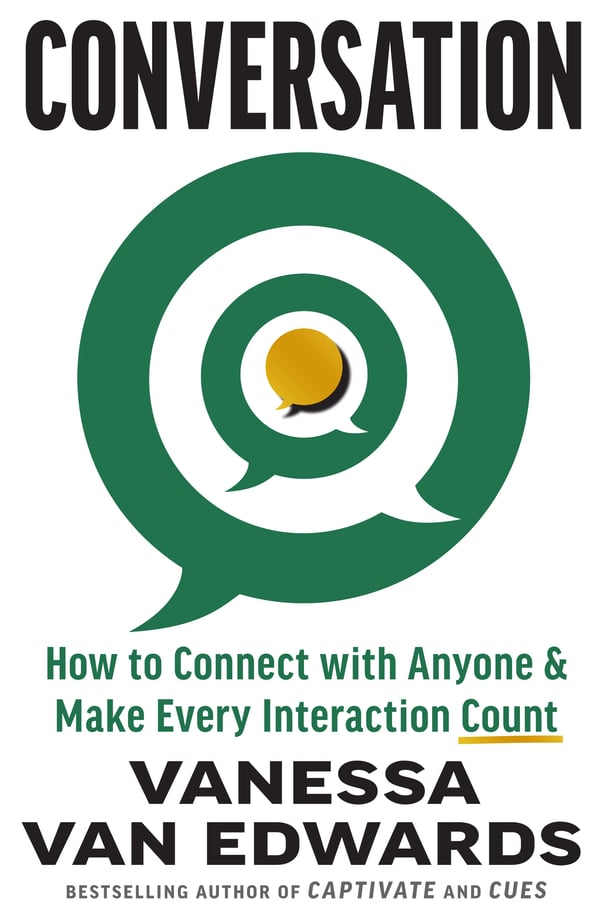
A new book by Vanessa Van Edwards
Every conversation is an opportunity.
If conversations have gotten harder, more awkward or less satisfying, you’re not imagining it. We’re simply out of practice. It’s time to find the joy in talking to each other again.
The 36 Questions
These are the 36 questions from Aron’s study, in order, from light to deep. You can use them with your partner, friends, or family. I highly recommend them to parents and teens!
Set 1: Getting Started
- Given the choice of anyone in the world, whom would you want as a dinner guest?
- Would you like to be famous? In what way?
- Before making a phone call, do you ever rehearse what you’re going to say? Why?
- What would constitute a perfect day for you?
- When did you last sing to yourself? To someone else?
- If you were able to live to the age of 90 and retain either the mind or body of a 30-year-old for the last 60 years of your life, which would you choose?
- Do you have a secret hunch about how you will die?
- Name three things you and your partner appear to have in common.
- For what in your life do you feel most grateful?
- If you could change anything about the way you were raised, what would it be?
- Take four minutes and tell your partner your life story in as much detail as possible.
- If you could wake up tomorrow having gained any one quality or ability, what would it be?
Set 2: Going Deeper
- If a crystal ball could tell you the truth about yourself, your life, the future, or anything else, what would you want to know?
- Is there something that you’ve dreamed of doing for a long time? Why haven’t you done it?
- What is the greatest accomplishment of your life?
- What do you value most in a friendship?
- What is your most treasured memory?
- What is your most terrible memory?
- If you knew that in one year you would die suddenly, would you change anything about the way you are living now? Why?
- What does friendship mean to you?
- What roles do love and affection play in your life?
- Alternate sharing something you consider a positive characteristic of your partner. Share a total of five items.
- How close and warm is your family? Do you feel your childhood was happier than most other people’s?
- How do you feel about your relationship with your mother?

Set 3: Deep Vulnerability
- Make three true “we” statements each. For instance, “We are both in this room feeling…”
- Complete this sentence: “I wish I had someone with whom I could share…”
- If you were going to become a close friend with your partner, please share what would be important for him or her to know.
- Tell your partner what you like about them: be very honest this time, saying things that you might not say to someone you’ve just met.
- Share with your partner an embarrassing moment in your life.
- When did you last cry in front of another person? By yourself?
- Tell your partner something that you like about them already.
- What, if anything, is too serious to be joked about?
- If you were to die this evening with no opportunity to communicate with anyone, what would you most regret not having told someone? Why haven’t you told them yet?
- Your house, containing everything you own, catches fire. After saving your loved ones and pets, you have time to safely make a final dash to save any one item. What would it be? Why?
- Of all the people in your family, whose death would you find most disturbing? Why?
- Share a personal problem and ask your partner’s advice on how he or she might handle it. Also, ask your partner to reflect back to you how you seem to be feeling about the problem you have chosen.
The Eye Contact Challenge
After finishing the 36 questions, there’s one more step you can try… and it didn’t come from Aron’s original study.
In 2015, writer Mandy Len Catron published a viral New York Times Modern Love essay called “To Fall in Love With Anyone, Do This.” She described trying Aron’s 36 questions with a university acquaintance at a bar, then walking out to a bridge and finishing with four minutes of sustained eye contact.4
The stare has research of its own.
In a 1989 study, strangers who held each other’s gaze for two unbroken minutes reported stronger feelings of passionate love for each other.5
As Catron described the experience: “I’ve skied steep slopes and hung from a rock face by a short length of rope, but staring into someone’s eyes for four silent minutes was one of the more thrilling and terrifying experiences of my life.”
And yes, she and her partner fell in love. In 2025, more than a decade after that night, they got married!
This step is completely optional! Want to try it after the questions? Sit facing each other and set a timer for four minutes. Then simply look into your partner’s eyes without speaking.
Just remember to blink.
Do the 36 Questions Actually Work?
Aron’s research shows the questions generate closeness. Romance is a different thing, and the study never promised it.
What you do with the closeness is up to you!
Mandy Len Catron, the New York Times writer who tried the questions at a bar with a university acquaintance, answered the question everyone asks: “You’re probably wondering if he and I fell in love. Well, we did.” She was careful about the credit, too: “Although it’s hard to credit the study entirely (it may have happened anyway), the study did give us a way into a relationship that feels deliberate.”
How about couples in a long-term relationship? When I asked my husband these questions on a Friday date night, it was immediately a step up from the usual “how was your day” spiel. We were both hooked as we fired off these questions back and forth! And the best part?
We both learned something new about each other.
That night, after dinner, we said to each other, “Wow! I didn’t know that about you!”
The Harvard Study of Adult Development has followed a group of Harvard students since 1938. That makes it one of the world’s longest studies of adult life. The people who were most satisfied in their relationships at age 50 were the healthiest at age 80.6
Deep questions are a simple way to build that kind of relationship.
Why Deep Questions Build Real Intimacy
Most conversations stay shallow. You ask “How was your day?” and get… “Fine.”
You talk about weekend plans, scroll through social media updates, and call it catching up. (We’ve all been there!)
But the depth of your conversations tends to go hand in hand with how happy you are.
In one study, college students wore a small recorder that captured snippets of audio throughout their day. The happiest participants had twice as many substantive conversations as the unhappiest ones.7
The happiest people had twice as many substantive conversations as the unhappiest ones.
Likability works the same way.
In live get-to-know-you conversations, people who asked more questions, especially follow-up questions, were better liked by their partners. In speed dating, the people who asked more follow-ups were more likely to land a second date.8
A question tells the other person you actually WANT their answer!
That’s exactly what Arthur Aron’s 36 questions are built for. They make a structured path from casual to deeply personal, so both people feel safe going there together.
Why Deep Questions Feel Scarier Than They Are
So if deep talk is this good for us, why do we keep asking “How was your day?” Because we guess wrong about the other person!
In a series of experiments, pairs of strangers were given either deep topics or shallow ones to talk about. Beforehand, people expected the deep conversations to feel more awkward and less connecting than they actually did. Why? They expected their partner to care less about what they shared than that partner really did. Afterward, they felt more connected to their deep-conversation partners than to their small-talk ones.9
So that little voice whispering “Too much… too weird… keep it light” is usually a BAD forecaster.
With a stranger, it underestimates how interested they are. With your partner, you’ve got the one listener you already KNOW cares… which makes it the easiest place to start!
Someone on our team once sat on a Set 2 question for an entire car ride because it felt too heavy. When they finally asked it, the conversation kept going long after they’d parked!
(It’s the same nerve that makes people rehearse a phone call before dialing. That’s question #3 on Aron’s list, by the way.)
Action Step: Pick the Set 2 question above that makes you most nervous. Ask it this week, then compare how the conversation actually went with how you expected it to go.
How Well Do You Really Know Your Partner?
In The Seven Principles for Making Marriage Work, relationship researcher John Gottman uses the term “Love Maps” to describe the detailed mental picture you carry of your partner’s inner world: their fears, dreams, daily stresses, and what makes them feel loved.10
When life gets chaotic (a new baby, a job loss, a move), the couple who knows what the other one is carrying has a head start.
Love Maps need regular updating, though.
People change! What your partner dreamed about five years ago may not be their dream today.
Deep questions keep that map current.
Personality psychologist Dan McAdams describes three levels of knowing someone11
- Level 1: General Traits. You know their personality. Are they introverted or extroverted? Organized or spontaneous?
- Level 2: Personal Concerns. You understand their goals, values, and what motivates their decisions.
- Level 3: Self-Narrative. You know the stories they tell themselves about who they are, and how they’ve made sense of their journey and purpose.
A lot of relationships stall at Level 1 or 2. Deep questions get you to Level 3.
How to Use the 36 Questions With Friends, Family, and Coworkers
Aron tested his questions on strangers, so they don’t need romance to work. What changes from one relationship to the next is how deep you go, and how fast.

With a Partner You’ve Known for Years
Long-term couples have the opposite problem from strangers. If you’ve been together a while, you probably know the Set 1 answers… or think you do.
Try this: Before your partner answers, guess their answer out loud. “You’d pick your grandma as your dinner guest.”
Every wrong guess is a spot on your Love Map that’s out of date… and those make the BEST conversations. One of us missed the dinner-guest question by a mile on the first try… and it got the biggest laugh of the night!
For more prompts built for couples, try these conversation starters for couples.
With a Friend
Friends don’t need a 45-minute sit-down.
One question per coffee or one per text thread works fine, and Set 1 is made for texting. Here’s how a single question can turn into a real exchange:
You: Random question for your Tuesday. If you could wake up tomorrow with any one new ability, what would it be?
Friend: Honestly? Falling asleep in five minutes.
You: Ha! Mine’s speaking Italian. Wait, why sleep? What’s been keeping you up?
Want a bigger pool? Grab a few from these questions to ask your friends.
With Your Parents or Kids
With teens, a formal sit-down can feel like a quiz. Car rides tend to work better, since nobody has to hold eye contact and the ride has a built-in end!
Questions with a story inside them make a good start, like #9 (what you feel most grateful for), #15 (your greatest accomplishment), or #17 (your most treasured memory). And it helps to let your kid ask you first!
With your own parents, try pointing a question at a time before you existed: “What’s your most treasured memory from before I was born?” It’s question #17 with a small twist, and it often turns up stories you’ve never heard.
With Coworkers

At work, Set 1 and the lighter end of Set 2 are usually plenty. Anything about family, death, or crying is best saved for friends. Most of Aron’s early questions translate with a small tweak:
| Aron’s question | Work-friendly version |
|---|---|
| #1: Whom would you want as a dinner guest? | “Who would you most want to have lunch with, from any field?” |
| #4: What would constitute a perfect day for you? | “What does a perfect workday look like for you?” |
| #12: One quality or ability you’d gain overnight? | “What’s one skill you’d love to be instantly great at?” |
| #14: Something you’ve dreamed of doing? | “Is there a project you’ve wanted to try here but haven’t pitched yet?” |
| #15: The greatest accomplishment of your life? | “What piece of work are you proudest of?” |
| #16: What do you value most in a friendship? | “What do you value most in a teammate?” |
If you lead a team, try opening an offsite with two or three of these, going around the table. Go first yourself, and it gets easier for everyone else. For more ideas, see how to start a conversation with coworkers.
How to Write Your Own Deep Questions
Remember the How Trap?
Every “how” question has a deeper cousin… and you can find it with three small moves.
- Swap “how” for “what” or “when.” “How was your day?” becomes “What was the best five minutes of your day?”
- Ask for a moment. “How’s work?” gets you “Fine.” “When did you feel most like yourself at work this week?” gets you a story.
- Add a little time travel. Point the question at the past or the future: “What would 10-year-old you think of your life right now?”
Here’s what that looks like on the questions we all ask every day:
| How Trap question | Deep version |
|---|---|
| “How are you?” | “What’s been taking up the most room in your head this week?” |
| “How was your day?” | “What was the best five minutes of your day?” |
| “How are the kids?” | “What’s something the kids did lately that surprised you?” |
| “How’s work?” | “What part of your work are you most excited about right now?” |
| “How was the trip?” | “What moment from the trip do you think you’ll still remember in 10 years?” |
A teammate tried the “best five minutes” swap at dinner and got a story they’d never heard before!
Move three is a shortcut to Level 3 of knowing someone, because stories are how people explain who they are. For more ways to open a question up, see our guide to open-ended questions.
Action Step: Tonight, catch yourself asking one “how” question. Then ask its deeper cousin right after.
Bonus: 15 More Deep Questions to Try
Aron’s 36 questions are a strong starting point. If you want to keep going, or want questions on one particular topic, here are 15 more, organized by theme.

Childhood and Earliest Memories
- What’s your earliest memory? What do you think it says about you?
- Who was your childhood hero, and do you still admire them?
- What’s one thing from your childhood you wish every kid could experience?
Dreams, Fate, and Beliefs
- Do you believe in soulmates, or do you think great relationships get built along the way?
- If you could have any superpower, what would it be and what would you do first?
- What’s on your bucket list that you haven’t told anyone about?
Love and Relationships
- How do you most like to receive love: through words, actions, time together, or something else?
- What’s the best piece of relationship advice you’ve ever received?
- What’s your biggest pet peeve in a relationship, and why does it bother you so much?
Vulnerability and Honesty
- What’s something you learned the hard way that you’re grateful for now?
- What’s your biggest insecurity, and how does it show up in your daily life?
- If you could make amends with anyone from your past, who would it be?
The Big Questions
- What do you think happens after we die?
- What’s the biggest challenge you’re facing right now that you haven’t talked about?
- If you could send a message to your younger self, what would you say?
Pro Tip Use these as follow-ups to Aron’s 36 questions, or mix them into your regular conversations. Stay curious about your partner, and treat them as someone who keeps changing. (Greater Good has a nice roundup of why curious people have better relationships.) Want even more? Try these deep icebreaker questions.
Bonus: The 36 Questions in Action
Check out these real-life strangers asking each other the deep stuff. You won’t believe what happens at the end!

Frequently Asked Questions
What are some super deep questions to ask someone?
Some of the deepest questions focus on identity, mortality, and vulnerability. From Arthur Aron’s research: “If you were to die this evening with no opportunity to communicate with anyone, what would you most regret not having told someone?” and “If a crystal ball could tell you the truth about yourself, your life, the future, or anything else, what would you want to know?” Questions about childhood, regret, and what someone values most in life tend to go the deepest.
What are the best questions to ask to get to know someone at a profound level?
The best deep questions move beyond facts (“Where are you from?”) and into values, stories, and emotions. Ask about formative experiences: “What’s something you learned the hard way?” Ask about dreams: “What have you dreamed of doing for a long time but haven’t done yet?” And ask about identity: “What do you want people to remember about you?” Questions that invite a story tend to build the strongest connections.
Do the 36 questions work for friends as well as romantic partners?
Yes. Aron’s original study paired strangers rather than romantic partners, and the questions generated real closeness whatever the relationship. The questions work with friends, siblings, parents, and even coworkers. What matters is that both people share openly and listen without judgment.
What is a good flirty question to ask?
From Aron’s list, question #1 is surprisingly flirty in the right context: “Given the choice of anyone in the world, whom would you want as a dinner guest?” It invites imagination and reveals values. For something more direct, try: “What would constitute a perfect day for you?”, then listen for what you could plan together. Follow-up questions like “What was the best part of that?” beat a clever opener.
How long does it take to do all 36 questions?
Aron’s original study allotted 45 minutes, but most couples find it takes longer when the conversation flows naturally. You can spread the questions across multiple sessions: one set per date night, or even one question per day. There’s no rush. The gradual build is part of what makes the process work.
What if my partner doesn't want to answer a question?
Let them pass, and make that easy before you even start: agree that either of you can say “pass” with no explanation. Move on without a sigh or an “Are you sure?” You can offer your own answer anyway, and if it feels right, come back to that question on another night.
Can you do the 36 questions over text or video?
You bet, with one adjustment. Set 1 works well over text, one question at a time. Save Set 3 for a video call or in person, where you can see each other’s face while you answer. The eye contact challenge works best in the same room.
Deep Questions Takeaway
- Start with Aron’s 36 questions. They build closeness even between two people who met an hour ago, and that’s been tested in a lab.
- Don’t skip the easy ones. The gradual escalation from light to deep is what makes the process feel safe.
- Both people answer every question. Trade answers question by question, so nobody does all the sharing.
- Ask a follow-up before you answer. “That sounds really hard” comes before your perspective.
- Try the eye contact challenge. Four minutes of silent eye contact after the questions can deepen the experience.
- Keep going. Use the bonus questions to continue exploring your partner’s inner world over weeks and months.
- People change. Ask again in six months. Last year’s dream may not be this year’s.
- Agree on a pass rule first. “Either of us can say ‘pass’” makes the hard questions easier to try.
- Rewrite one “how” question tonight. Swap “How was your day?” for “What was the best five minutes of your day?”
Ask the follow-up. It tells the other person you actually want their answer.
Want lighter prompts for date night? Try these conversation starters for couples.
- Aron, A., et al. (1997). "The Experimental Generation of Interpersonal Closeness." *Personality and Social Psychology Bulletin*, 23(4), 363-377.
- Sprecher, S., & Treger, S. (2015). "The Benefits of Turn-Taking Reciprocal Self-Disclosure in Get-Acquainted Interactions." *Personal Relationships*, 22(3), 460-475.
- Laurenceau, J.-P., Barrett, L.F., & Pietromonaco, P.R. (1998). "Intimacy as an Interpersonal Process: The Importance of Self-Disclosure, Partner Disclosure, and Perceived Partner Responsiveness in Interpersonal Exchanges." *Journal of Personality and Social Psychology*, 74(5), 1238-1251.
- Catron, M.L. (2015). "To Fall in Love With Anyone, Do This." *The New York Times*.
- Kellerman, J., Lewis, J., & Laird, J.D. (1989). "Looking and Loving: The Effects of Mutual Gaze on Feelings of Romantic Love." *Journal of Research in Personality*, 23(2), 145-161.
- Mineo, L. (2017, April 11). "Good Genes Are Nice, but Joy Is Better." *Harvard Gazette*.
- Mehl, M.R., et al. (2010). "Eavesdropping on Happiness." *Psychological Science*, 21(4), 539-541.
- Huang, K., et al. (2017). "It Doesn't Hurt to Ask: Question-Asking Increases Liking." *Journal of Personality and Social Psychology*, 113(3), 430-452.
- Kardas, M., Kumar, A., & Epley, N. (2022). "Overly Shallow?: Miscalibrated Expectations Create a Barrier to Deeper Conversation." *Journal of Personality and Social Psychology*, 122(3), 367-398.
- Wilde, E. "The Sound Relationship House: Build Love Maps." The Gottman Institute.
- McAdams, D.P. (1995). "What Do We Know When We Know a Person?" *Journal of Personality*, 63(3), 365-396.