Conversation games can be a great way to get to know old friends better, bond with colleagues, or break the ice with new acquaintances. Try one of the games from this list the next time you’re in a group of people you want to get to know better.
Research shows that structured social games trigger a psychological loop called reciprocal self-disclosure, where sharing personal information back and forth builds trust and closeness faster than ordinary conversation.1 Psychologist Arthur Aron proved that strangers who answered escalating personal questions felt as close as long-term friends in just 45 minutes.2
Whether you’re hosting a dinner party, surviving a long road trip, or breaking the ice at a team offsite, these conversation games give you a ready-made structure for real connection. For a complete science-backed framework for conversation beyond games, see Vanessa Van Edwards’ book Conversation (Portfolio/Penguin Random House).

Why Conversation Games Work (The Psychology)
They lower the stakes of sharing. Games give people “permission” to reveal things about themselves they’d never volunteer in normal conversation. Psychologists call this self-disclosure, and research links it to stronger relationships, increased trust, and reduced loneliness.1
They trigger real bonding chemistry. Oxford researcher Robin Dunbar found that genuine shared laughter releases endorphins, the brain’s natural feel-good chemicals, and raises pain tolerance by about 10%.3 Games that produce belly laughs (like Speak Out or rapid-fire Categories) are chemically bonding the group.
They create a turn-taking structure. A 2023 study found that turn-taking reciprocal disclosure, where people alternate sharing, generates higher trust and liking than one-sided sharing.4 That’s exactly how most conversation games are designed.
Playing a game together actually builds up bonds and trust and cooperation.
As game designer Jane McGonigal explained in her TED Talk: “Playing a game together actually builds up bonds and trust and cooperation. And we actually build stronger social relationships as a result.”
Pro Tip Start with low-vulnerability games (like Categories or the Alphabet Game) before moving to higher-vulnerability ones (like 21 Questions or Better Than Before). This mirrors the escalation principle from Aron’s research: gradual increases in openness feel natural, while jumping straight to deep questions can backfire.
Conversation Games to Get to Know Someone Better
These games spark genuine conversation and help you learn things about people that small talk never reveals.
Two Truths and a Lie
This game lets you get to know the people you’re speaking with and learn about their life experiences.
To play, one person tells two truthful facts about themselves and one lie. Everyone else then guesses which is the made-up statement.
For example, a person might say something like…
- “I went skydiving before.”
- “My favorite food is canned meat.”
- “I have two dogs and a cat.”
Then, the others would have to guess which one is the lie. If you already know the people you’re playing with well, you may have to get creative when thinking of facts to share, which builds deeper rapport.
Why it works psychologically: The presence of the lie creates a safety net. It makes the truths feel less exposing, because nobody knows which statements are real. This activates Theory of Mind, the mental skill of predicting what others are thinking, which deepens engagement for everyone involved.
Variation—Two Truths and a Dream: Replace the lie with a dream or aspiration. This removes the deception element and gives deeper insight into people’s goals. It works especially well with introverted groups.
Action Step: Make your truths surprising and your lie boring. People tend to assume the most outlandish statement is the lie, so flip their expectations.
Hot Takes
A “hot take” is an unpopular opinion a person feels strongly about. This game is played by people randomly calling out their hot takes and then everyone else weighing in on the debate.
You’re bound to find out some strong, niche opinions your friends hold.
Some examples of hot takes are:
- Oatmeal raisin cookies are better than chocolate chip cookies
- The Lord of the Rings movies are better than the books
- Omelets are the best way to eat eggs
- Universal Studios is better than Disneyland
- Bacon doesn’t taste good
- The Beatles are overrated
- ASMR is stressful
This game is incredibly entertaining when you get creative with your hot takes!
Beware: Set some ground rules before playing to avoid politics, religion, or other sensitive topics. The goal is laughter and lighthearted debate.
Would You Rather…
A classic word game that you can make as goofy as you want. Present two scenarios and see which one people would choose if given a choice.
They can both be positive, negative, or just plain unbelievable.
Here are ideas to get you started:
- Would you rather travel 100 years in the future or 100 years in the past?
- Would you rather be Ironman or Captain America?
- Would you rather lose your keys or your phone?
- Would you rather live in Paris or Bangkok?
- Would you rather see a spider in your house every day or have a mosquito bite you once a week?
- Would you rather never listen to music or never be able to read another book?
As people answer, they can explain their reasoning for choosing one scenario over the other. The real fun starts when someone’s reasoning reveals something unexpected about their personality.
High, Low, and Buffalo
If you want more details than “How are you?” try asking your loved ones to share their highs, lows, and buffalo.
- High: Something that’s going well in life
- Low: Something in life that’s been bumming them out
- Buffalo: Something random, funny, or interesting that’s going on in life
For example, someone might say:
- High: I finally got my raise last week!
- Low: It’s not as much as I hoped.
- Buffalo: I asked them to put a second microwave in the breakroom as a job perk. Do you think they will say yes?
This game works as a daily or weekly ritual with families, roommates, or teams. It gives people a framework to share what’s really going on, past the polished version.
Variations to try:
- Rose, Thorn, Bud: Rose (high), Thorn (low), Bud (something you’re looking forward to)
- High, Low, Hero: Hero is someone who did something kind for you
- The Memory Jar: Write the “Buffalos” on slips of paper and read them at the end of the month. It turns a daily game into a long-term bonding ritual.
- The Popcorn Rule: Instead of going in order, the person who finishes “pops” to someone else by calling their name.
Compliment Circle
Participants take turns saying what they appreciate about one another in this sweet, uplifting game.
Sit in a circle and have everyone say something nice about the person next to them. After going around the circle, mix up where everyone is sitting, so you now say something nice about a different player.
Try playing this game if you’re navigating conflict in the workplace or with loved ones. It can remind you that despite your differences, you genuinely care about the people you’re with.
Pro Tip Be specific. “You’re nice” is forgettable. “You always remember to ask how my mom is doing, and that means a lot” is the kind of compliment people carry with them for years.
Better Than Before
In close relationships, it can be easy to get stuck in a rut of asking “How are you?” or “How was [event]?” over and over again. This game allows participants to deepen relationships, and get to know them better than before!
Invite a friend, partner, parent, or coworker to share dinner or a cup of coffee with you. Then, ask them questions that will give you new insights into their dreams, hopes, and thoughts.
Here are some questions to get you started:
- When did you last sing to yourself or someone else?
- What would your perfect day look like?
- What is an accomplishment in your life that you’re proud of?
- What do you value most in friendship?
Don’t rush through the questions! As they answer, follow any interesting threads that strike your fancy. One great way to do this is to ask variations of “why?”
Let’s take the first question as an example.
Person 1: “When did you last sing to yourself or someone else?”
Person 2: “Yesterday I was stuck in traffic on my way to work, so I sang along with the radio. I don’t like singing around other people, so I only really sing in the shower or car.”
Person 1: “That’s great. I love singing in the car! Why don’t you like singing around other people?”
Person 2: “Oh, I don’t know. I guess I get nervous that people are judging me.”
Person 1: “I’m sorry to hear that. Is the possibility of people judging you hard for you?”
Person 2: “Yeah, I grew up in a very high-achieving family and felt like if I couldn’t be perfect at something, I should give it up.”
From there, you can dive more into the family culture and the challenges you faced growing up. Once the conversation has run its course, turn back to your list of questions and jump to the next one.
Pro Tip Encourage them to share more by pointing out things you have in common!
This game is based on the same principle behind psychologist Arthur Aron’s famous “36 Questions” study. In 1997, Aron demonstrated that pairs of strangers who asked each other escalating personal questions felt as close as long-term friends in just 45 minutes.2 Gradual vulnerability plus genuine curiosity is what does it.
Check out this list of 36 Deep Questions for a list of great questions to use.
Strangers who asked each other escalating personal questions felt as close as long-term friends in just 45 minutes.

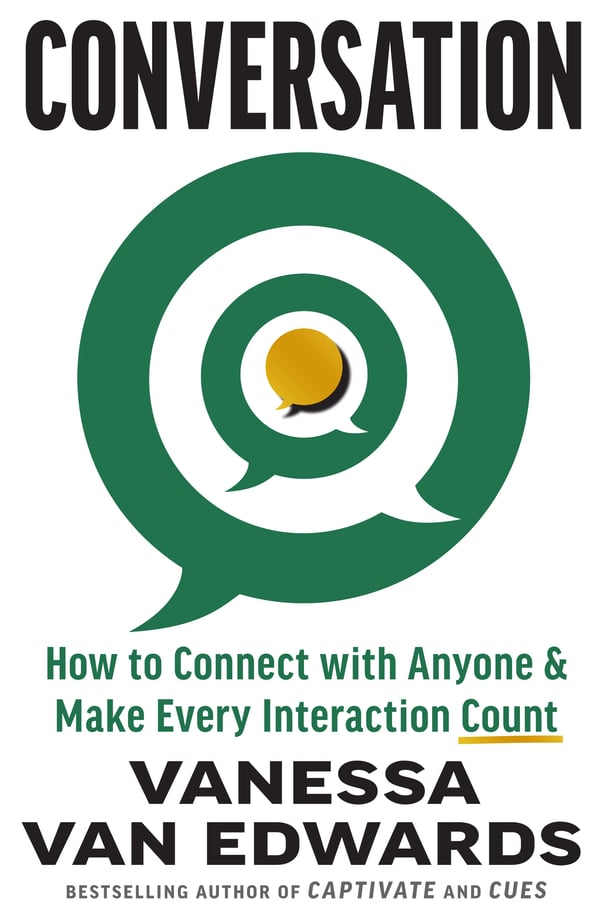
A new book by Vanessa Van Edwards
Every conversation is an opportunity.
If conversations have gotten harder, more awkward or less satisfying, you’re not imagining it. We’re simply out of practice. It’s time to find the joy in talking to each other again.
Conversation Games for Big Groups
When you have 10 or more people, you want games that keep everyone involved without requiring people to wait too long for their turn.
Never Have I Ever
In “Never have I ever,” participants start the game with all ten fingers up. Then, going around in a circle, people share one thing they’ve never done. If someone has done that thing, they must put down a finger. The last person with fingers still up wins.
The magic of this game is that it rewards unusual life experiences. The person who has done the most unexpected things loses first, but they also become the most interesting person in the room.
Ten Things in Common
In this group conversation game, your goal is to find ten things that everyone present has in common. Get creative! What’s your favorite late-night snack? Has anyone gone skydiving? The obvious answers (“We all breathe oxygen”) don’t count, push for specifics that actually reveal something about the group.
The Alphabet Game
To play the alphabet game, agree on a topic or a theme, like ice cream flavors, countries, or movie titles. Then, starting from “A,” everyone takes turns calling out a word going in alphabetical order. If you can’t think of one within 5 seconds, you’re out. The winner is the last person standing.
My Name Your Name Game
This is a rhythm-based icebreaker that helps groups learn each other’s names fast.
How to play:
- Sit in a circle and establish a four-beat rhythm: slap knees twice, clap hands twice, then snap right and snap left. Everyone maintains this rhythm throughout.
- Round 1 (Learning Names): The leader says their own name during the two snaps. The group repeats the name in unison. Go around the circle until everyone has been introduced.
- Round 2 (The Real Game): Now instead of just saying your own name, you say YOUR name on the first snap and SOMEONE ELSE’S name on the second snap. That person must immediately continue the chain, saying their name and passing to another person, all while keeping the rhythm going.
- If you break the rhythm, call a wrong name, or freeze up, you’re out.
The game starts easy but gets chaotic fast as the rhythm speeds up. It’s one of the best name-learning games for groups of any size.
Ask Me Anything
In this game, participants are allowed to ask any question. For the right price, the person receiving the question can skip it, but there’s a catch. Set a limit on skips (two or three per round) so people can’t dodge everything. The best questions are specific and surprising: “What’s the most money you’ve ever wasted?” beats “What’s your favorite color?” every time.
Categories
Players take turns naming items within a chosen topic, animals, ice cream flavors, countries, 90s sitcoms, whatever the group picks. Each player has about 3-5 seconds to respond. If you hesitate, repeat an answer, or name an invalid item, you’re out. The winner is the last person standing.
Variations:
- Speed Round: Cut the timer to 2 seconds.
- Alphabetical Order: Items must be named in A-B-C order, adding a memory and sequencing challenge.
- Team Play: Split into teams and alternate. The team with the last valid answer wins.
Categories is one of the best games for large groups because there’s zero setup, everyone stays engaged, and the time pressure generates the kind of genuine belly laughs that Robin Dunbar’s research links to endorphin release and social bonding.3
The 3-6-9 Game
This Korean counting game (called Sam Yuk Gu) is deceptively simple and wildly entertaining.
How to play:
- Players count sequentially around a circle: 1, 2, 3, 4, 5…
- When a number contains 3, 6, or 9, you clap instead of saying it.
- Numbers with two of those digits (like 33, 36, or 69) require two claps. Three instances require three claps.
- If anyone says a forbidden number, forgets to clap, or claps the wrong number of times, they’re out.
It starts easy. 1, 2, clap, 4, 5, clap, 7, 8, clap, 10… But once you pass 30, nearly every number requires a clap, and the mistakes come fast.
Best for: Parties, road trips, large groups. No materials needed.
Word and Verbal Games
These games require nothing but words and quick thinking. They’re perfect when you have zero props and need entertainment fast.
The Movie Game
One player names an actor. The next person names a movie that actor appeared in. The next person names a different actor from that movie. And so on.
For example: “Tom Hanks” → “Forrest Gump” → “Gary Sinise” → “Apollo 13” → “Kevin Bacon.”
If you get stumped, you’re out. The last person standing wins. Based on the “Six Degrees of Kevin Bacon” concept, this game rewards movie knowledge and quick recall.
Variation: Limit it to a specific genre (90s movies, superhero films, horror) to level the playing field.
Ghost
Players take turns adding one letter to a growing word fragment. The catch: you lose if you complete a real word (of four or more letters), and you can be challenged if another player thinks you’re bluffing: that no real word starts with those letters.
For example: Player 1 says “P.” Player 2 adds “L.” Player 3 adds “A.” Player 4 is stuck, “PLAN” and “PLAY” and “PLATE” are all words, so adding almost any letter completes one. The strategy is to steer the word toward letters that leave the next person trapped.
Best for: 2-4 players, road trips, anyone who loves word puzzles.
Just a Minute
Players receive a random topic they’re asked to speak on for a whole minute. If you repeat yourself, hesitate for more than a few seconds, or stop talking, you’re out. Topics can range from “Why cats are better than dogs” to “The history of sandwiches” to “Your worst vacation.”
This game rewards quick thinking and creativity. The funniest moments happen when someone gets a topic they know nothing about and has to improvise.
Fortunately / Unfortunately
Players build a story together, alternating between fortunate and unfortunate plot twists.
Example:
- Player 1: “Fortunately, I found a treasure map in my attic.”
- Player 2: “Unfortunately, the map was written in a language nobody could read.”
- Player 3: “Fortunately, my neighbor turned out to be a linguistics professor.”
- Player 4: “Unfortunately, she said the map leads to the bottom of the ocean.”
The story gets increasingly absurd, and the constraint of alternating good/bad news forces creative thinking. This is a cooperative game. There’s no winner, just a group that builds something funny together.

Conversation Games for Road Trips
These games require zero materials and work perfectly when everyone is stuck in a car together.
The Superlative Game
This game reveals what your friends think of you. Take turns calling out random superlatives, “Most likely to survive on a deserted island,” “Most likely to accidentally become famous,” “Most likely to befriend a stranger at a gas station”, and have everyone vote by pointing.
I Spy
“I spy with my little eye…” Players take turns being the “spy-er.” They notice something around them and say the first letter: “I spy something that starts with B.” Everyone else asks yes-or-no questions or guesses until someone gets it right.
Twenty Questions
Have one person think of a person, place, or thing. Everyone else asks yes-or-no questions to determine what it is. You get 20 questions total, use them wisely.
Strategy: Start broad to narrow down fast. “Is it alive?” “Is it bigger than a car?” “Is it something you’d find in a house?” These binary splits eliminate half the possibilities with each question.
The correct answer often surprises everyone. The best picks are specific enough to be guessable but unusual enough to resist easy deduction, think “the Eiffel Tower” rather than “a dog.”
One Line at a Time
Tell a story with each person only contributing one line at a time. The fun comes from the unexpected directions people take the narrative. One person starts with a dramatic opening (“The detective opened the envelope and gasped”), and each person builds on whatever came before.
Something in Common
If you’re looking for a game to help pass the time, give “Something in common” a try. The first person says a statement like “I’ve been to Mexico.” The next person connects a new fact to it: “Mexico reminds me of tacos, and I once won a taco-eating contest.” The next person picks up from there: “Contests remind me of the spelling bee I lost in fourth grade.” The chain keeps going, revealing surprising connections between topics and people.
The best conversation games don’t just pass time. They create structured excuses for the kind of sharing that builds real relationships.
Conversation Games About Dating
These games are perfect for date nights, couples’ gatherings, or any group that wants to explore the messy, hilarious reality of modern romance.
Orange Flags
Orange flags aren’t necessarily a deal-breaker but make you stop and think, “Hmm, we’ll see about that.” Once one person says something they consider an orange flag, everyone else can chime in with whether they agree or disagree.
Examples: “They have a pet tarantula.” “They don’t own a single book.” “They eat cereal for dinner three nights a week.” The debates get heated fast.
Love, Like, Leave
In this game, one person calls out three people or items in a similar category, and everyone present has to assign “love, like, or leave” to each one.
For example: “Ryan Reynolds, Timothée Chalamet, Oscar Isaac.” Or: “Beach vacation, mountain cabin, European city trip.” Everyone assigns their love, like, and leave, and then defends their choices.
They’re Perfectly Perfect, But…
Start by thinking of a hypothetical person who is perfect except for one single flaw. Everyone present then says if that flaw is a big enough deal-breaker.
Examples: “They’re perfectly perfect, but they chew with their mouth open.” “They’re perfectly perfect, but they never text back for at least 24 hours.” “They’re perfectly perfect, but they talk during movies.”
This game reveals a lot about people’s values and non-negotiables, and generates some of the best debates you’ll have all night.
Virtual Conversation Games
Virtual conversation games are a great way to connect with friends, family, or colleagues, even when you’re miles apart. These games are designed to be played online, making them perfect for video calls or virtual gatherings.
Online Trivia Games
Online trivia games test knowledge across various topics and stimulate friendly competition.
How to Play:
- Choose an online platform that supports trivia games, such as Kahoot!, Quizizz, or Jackbox Games.
- The host creates a trivia quiz with questions covering different categories like history, pop culture, science, and more.
- Share the game link or code with all participants.
- Players join the game using their devices and answer questions in real-time.
- The platform scores the answers, and the player or team with the highest score at the end wins.
Pro Tip Personalize the trivia questions to include fun facts or inside jokes about the participants to make the game more engaging and relatable!
Virtual Escape Rooms
Virtual escape rooms are great if you’re looking for a challenge! Escape rooms often combine puzzles such as finding the odd-image-out or navigating a maze-like puzzle.
How to Play:
- Choose an online escape room provider, such as The Escape Game, Enchambered, or Lock Paper Scissors.
- Select a themed escape room adventure. Options range from classic mystery and detective themes to more fantastical settings like space stations or ancient temples.
- Share the access link with all participants.
- Work together to solve puzzles, find clues, and complete the mission within the given time frame.
- Communicate effectively using video call platforms like Zoom, Skype, or Google Meet.
Pro Tip Assign roles such as puzzle solver, clue tracker, and timekeeper to ensure everyone is involved and the team works efficiently.
Video Call Icebreakers
Video call icebreakers are ideal for starting virtual meetings or gatherings on a fun and interactive note. They help ease participants into the conversation and build rapport.
How to Play:
- Choose a simple icebreaker game such as “Two Truths and a Lie,” “Would You Rather,” or “20 Questions.”
- Each participant takes a turn sharing their answers or responding to prompts.
- Encourage everyone to participate and share their thoughts, so nobody sits out.
- Use the chat feature for additional interaction and fun.
Pro Tip Keep the icebreakers short and sweet to maintain energy levels and engagement during the virtual call.
Online Pictionary
Online Pictionary is a creative and hilarious way to bring out the artist in everyone. It involves players drawing prompts while others guess what the drawings represent.
How to Play:
- Use an online drawing platform like Skribbl.io, Drawize, or the built-in whiteboard feature in Zoom.
- The host sets up a game and shares the link with participants.
- Players take turns drawing a word or phrase while others guess what it is.
- Points are awarded based on the accuracy and speed of the guesses.
- The player with the most points at the end of the game wins.
Pro Tip Choose categories for the drawings that are relevant to the group, such as movies, animals, or famous landmarks.
Guess the Emoji
Guess the Emoji is a fun and modern twist on classic guessing games, perfect for virtual settings. Players guess phrases, movies, or songs based on sequences of emojis.
How to Play:
- The host prepares a list of phrases, movies, songs, or famous quotes and translates them into emoji sequences.
- Share the emoji sequences one by one on the video call screen or chat.
- Participants guess the correct answer based on the emojis.
- The first person to guess correctly earns a point.
- Continue with different emoji sequences, and the player with the most points at the end wins.
Pro Tip Use an emoji generator tool like Emojipedia to create challenging and creative emoji sequences.
Texting Conversation Games
These games work over text message, making them perfect for long-distance friends, new connections, or anyone who wants to have fun while texting.
21 Questions (Texting Edition)
This is different from 20 Questions. Instead of guessing an object, players take turns asking 21 open-ended questions to learn about each other. There’s no right answer, just honest ones.
How to play over text:
- One person asks a question. The other answers, then asks their own question back.
- Alternate until you’ve each asked and answered 21 questions.
- Start light (“What’s your go-to comfort food?”) and gradually increase depth (“What’s something you’ve never told anyone?”).
The No-Skip Rule: Each player gets only one pass. This prevents people from dodging every interesting question.
Is 21 Questions a flirty game? It can be. When played over text, it’s often adapted into an intimate Q&A format. Pace it: start with lighthearted questions and let the depth build naturally. Set boundaries on how personal questions can get, especially with someone new.
Word Unscramble
One person sends a scrambled word (like “ENPHO” for “PHONE”) and the other person tries to unscramble it. Take turns sending increasingly difficult words. Set a time limit per word to keep the pace fast.
Emoji Translation
Translate a movie title, song, or famous phrase into emojis and send it to the other person. They guess what it means, then send one back.
Examples:
- 🦁👑 = The Lion King
- 🌊🏄♂️ = Surf’s Up
- 👻👻👻 = Ghostbusters
This game rewards creativity and works especially well in group chats.
Party Games That Spark Conversation
These games use simple props or apps and are designed for gatherings where you want maximum laughter.
Speak Out
Players wear dental-grade mouthpieces and try to say phrases while teammates guess what they’re saying. Teams of equal size take turns; each turn lasts 60 seconds. The team with the most correctly guessed cards wins.
Important logistics:
- Assign one mouthpiece per player for hygiene.
- Have tissues and napkins nearby (drool is inevitable).
- Don’t wear the mouthpiece longer than your turn.
This game generates the kind of genuine, uncontrollable laughter that Dunbar’s research connects to endorphin release and group bonding.3 It’s nearly impossible to play without crying from laughter.
NYT Connections
A daily word puzzle from The New York Times where you sort 16 words into 4 groups of 4, each sharing a hidden connection. Play it together on a phone or tablet and debate the groupings as a team.
How to play:
- Look at the 4×4 grid of 16 words.
- Select 4 words you think share a common theme and hit “Submit.”
- If you’re right, the group is revealed and color-coded by difficulty: Yellow (easiest) → Green → Blue → Purple (hardest, often wordplay).
- You get 4 mistakes before the game ends.
Strategy tip Start with the most obvious grouping to reduce the grid. If the game says “One Away,” three of your four picks were correct, swap one word at a time.
Connections is free to play daily at nytimes.com/games/connections. It’s become the NYT’s second-most-played game after Wordle, with millions of daily players.
Apples to Apples
A party card game where a rotating judge flips an adjective card (like “Dangerous” or “Hilarious”), and everyone else plays a noun card from their hand that they think best matches. The judge picks the winner each round based on logic, humor, or creativity.
The built-in “haggling” phase, where players argue why their match is the best, creates natural conversation and debate. “How is ‘my grandmother’ not the most hilarious option here?” is the kind of argument this game generates.
Best for: 4-10 players, parties, family gatherings.

Trivia and Quiz Games for Fun Gatherings
Team Trivia Challenge
How to Play: Divide the group into teams of 3-5 people. Prepare a list of trivia questions across categories (history, pop culture, science, geography). Read questions aloud, give teams 30 seconds to confer, and have them write down answers. The team with the most correct answers wins.
Speed Quiz
How to Play: Form two teams. The host asks a question, and the first team to buzz in (slap the table, raise a hand, or use a buzzer app) gets to answer. Correct answers earn a point; incorrect answers give the other team a chance to steal.
Themed Trivia Night
How to Play: Choose a theme for the trivia, such as movies, music, TV shows, or a specific decade. All questions relate to that theme. This works especially well when you know your group’s interests.
Picture Quiz
How to Play: Prepare a slideshow of images related to a theme, famous landmarks, celebrity baby photos, album covers, or movie stills. Show each image and ask participants to identify it. First correct answer gets the point.
Trivia Bingo
How to Play: Create bingo cards with answers to trivia questions. The host asks trivia questions, and players mark off the corresponding answer on their card. First to get five in a row wins.
Strategy-Based Conversation Games for Team Building
These games challenge groups to think strategically while communicating under pressure. They’re ideal for work teams, retreats, and group settings where you want to build collaboration.
The Scenario Solver
Teams collaboratively devise a strategy to handle hypothetical but plausible work-related scenarios. Example: “Your biggest client just posted a negative review on social media. You have one hour before the press picks it up. What do you do?” Each team presents their plan, and the group votes on the most effective approach.
The Resource Allocator
This game challenges teams to allocate limited resources efficiently to achieve a common goal. Give each team a fictional budget, a list of resources with prices, and a mission (like “launch a new product in 30 days”). Teams must negotiate internally about what to prioritize.
The Innovation Incubator
Pose a challenge that your company faces and ask teams to brainstorm unique solutions within a 10-minute window. Each team then pitches their best idea to the group. The constraint of time forces creative thinking and prevents overthinking.
The Negotiation Table
Split the team into groups representing different companies. Each group receives secret objectives they must achieve through negotiation with the other groups. The catch: some objectives directly conflict, so creative problem-solving and persuasion are required.
The Project Pitch
Each team develops a project idea and presents it Shark Tank-style to “investors” (the rest of the group or designated judges). Teams get 10 minutes to prepare and 3 minutes to pitch. The investors ask tough questions, and the best pitch wins.
The Strategy Shuffle
Teams start with an original strategy for a given challenge. Then, every 5 minutes, the host introduces a new “event” (budget cut, new competitor, key team member leaves) that impacts the strategy, requiring teams to quickly adapt their plan.
Mafia (Werewolf)
This classic social deduction game is one of the best conversation-driven strategy games. Players are secretly assigned roles: most are “villagers,” but a few are “mafia” members (or “werewolves”).
How to play:
- A moderator assigns roles secretly (cards work well).
- During the “night” phase, everyone closes their eyes. The mafia silently selects a villager to eliminate.
- During the “day” phase, everyone opens their eyes, learns who was eliminated, and debates who the mafia members are.
- The group votes to eliminate one suspected mafia member.
- Repeat until either all mafia members are caught (villagers win) or the mafia outnumbers the villagers (mafia wins).
The game runs entirely on conversation, persuasion, and reading people. Mafia members must lie convincingly; villagers must detect deception through verbal and nonverbal cues. It’s a masterclass in social observation.
Best for: Groups of 7-15 people, team building events, parties.
Games that generate genuine laughter trigger your brain’s endorphin system, the same chemistry behind a runner’s high, and bond the group at a neurological level.
Frequently Asked Questions
What is the 3-6-9 game?
The 3-6-9 game (also called Sam Yuk Gu) is a Korean counting game where players count sequentially in a circle, but clap instead of saying any number containing 3, 6, or 9. Numbers with two of those digits (like 33 or 69) require two claps. If you mess up, you’re out. It starts easy but gets chaotic past 30.
How does the game 20 Questions work?
One person thinks of a person, place, or thing. Everyone else asks up to 20 yes-or-no questions to figure out what it is. Start with broad questions (“Is it alive?” “Is it bigger than a car?”) to narrow down quickly, then get specific. If nobody guesses correctly in 20 questions, the thinker wins.
What is the 21 Questions game?
Unlike 20 Questions, the 21 Questions game is not a guessing game. Players take turns asking 21 open-ended questions to learn about each other. It’s commonly played between two people (especially over text) as a getting-to-know-you game. Players alternate asking questions until they reach 21 total.
How do you play the Connections game?
NYT Connections gives you a 4×4 grid of 16 words. Your goal is to sort them into 4 groups of 4 that share a hidden theme. You get 4 mistakes before the game ends. Categories are color-coded by difficulty: Yellow (easiest) through Purple (hardest). A new puzzle drops daily at nytimes.com/games/connections.
How do you play the game Speak Out?
Players wear dental-grade mouthpieces that hold their mouths open, then try to say phrases printed on cards while teammates guess what they’re saying. Each turn lasts 60 seconds. The team that correctly guesses the most cards wins. Assign one mouthpiece per player for hygiene and keep napkins nearby.
What games can you play with your friends online?
Two Truths and a Lie, Would You Rather, 20 Questions, Online Pictionary (via Skribbl.io), virtual escape rooms, Guess the Emoji, and online trivia (via Kahoot! or Jackbox Games) all work over video calls. Most require nothing more than a screen and a willingness to play.
How to have fun while texting?
Play texting games like 21 Questions (take turns asking open-ended questions), Word Unscramble (send scrambled words to decode), Emoji Translation (translate movie titles into emojis), or the “Lightning Fast” word association game where you each reply with the first word that comes to mind within 30 seconds.
Is 20 Questions a flirty game?
It can be. When played over text, 20 Questions is often adapted into an open-ended Q&A format where players alternate asking increasingly personal questions. Start light (“What’s your favorite dessert?”) and gradually go deeper. Setting boundaries on how personal questions can get keeps it fun without making anyone uncomfortable.
What are some verbal games to play?
Categories (name items in a topic before time runs out), Ghost (add letters without completing a word), the Movie Game (alternate naming actors and movies), Word Association, the Alphabet Game, Fortunately/Unfortunately, and Just a Minute are all verbal games that require zero materials.
Conversation Games Takeaway
Conversation games activate the same psychological mechanisms that build genuine human connection: self-disclosure, reciprocal sharing, and laughter that releases endorphins.13
Here’s how to put these games to work:
- Start low, go deep. Begin with low-vulnerability games like Categories or I Spy, then progress to higher-vulnerability ones like 21 Questions or Better Than Before.
- Match the game to the group size. Use Never Have I Ever or the 3-6-9 Game for big groups. Save Two Truths and a Lie or Better Than Before for smaller settings.
- Use the Popcorn Rule. Instead of going in a circle, let the person who just finished “pop” to someone else by calling their name. This keeps everyone alert.
- Set ground rules early. For games like Hot Takes or Ask Me Anything, agree to avoid sensitive topics before you start.
- Try one game this week. Pick the game that fits your next social situation (a road trip, a team meeting, a dinner party) and test it. The best game is the one you actually play.