The talk went great. The slides worked, the joke on slide three got a real laugh (not a pity laugh), and people nodded in all the right places.
Then the dreaded question comes: “So… why should we trust ANY of these numbers?”
Oof. Those next four minutes are the ones you’ll think about in the shower that night.
Luckily, Q&A is more predictable than it feels. The same few tricky moments tend to come up, and each one has a script to deal with them.
Here’s how to handle them like a pro.
Figure Out Who’s Really Asking
Ever watched a speaker treat a perfectly fair question like a personal attack? It’s an easy mistake. In the moment, a sharp question can sound hostile even when it isn’t.
Let’s say a finance lead has just walked through next year’s budget, and a voice from the back says, “Did anyone actually check these numbers?” It sounds like an accusation.
But it might also be someone who wants the source tab and worded it badly at 4:45 on a Thursday. (We’ve all been that person at 4:45 on a Thursday.)
So while they’re still talking, sort which kind you got. Here’s how to tell them apart, and what to say first:
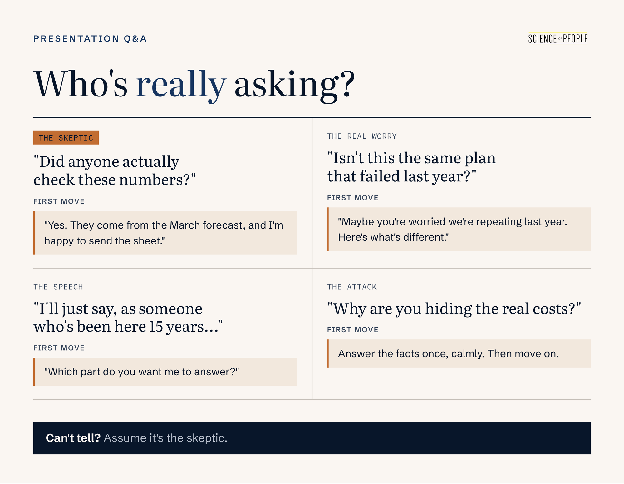
Not sure what they’re actually asking? Ask before you answer: “Can you say more about what you mean by ‘checked’?” or simply “What makes you ask?”
Don’t Let Your Pause Sound Like a Fib
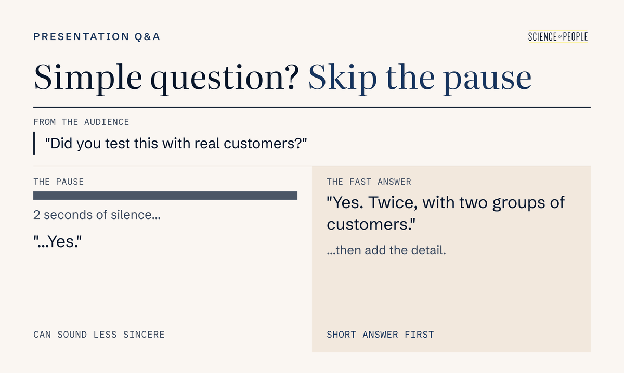
Someone asks, “Did you test this with real customers?” You did! But you pause before saying “Yes” because you’re deciding which test to mention.
To the room, that little gap can sound like you’re making something up.
Researchers edited silent gaps into recorded answers like “Yes, I did” (to whether someone liked a friend’s cake). The longer the gap, up to about five seconds, the less sincere listeners rated the answer. About two seconds was enough to make a noticeable difference.1 (That’s less time than it takes to read this sentence out loud!)
Wait… what about “always pause before you answer a tough question”? That advice is everywhere. But the pause cost less when there was an obvious innocent reason for it. In a written version of the study, when someone was asked about something small from 10 years ago, the penalty mostly disappeared, likely because people read the pause as remembering.1
So… it depends on the question.
When the question is simple and factual, answer inside the first second. “Is this live in Europe yet?” “Not yet. Germany goes first, in May.” Then add the detail. The quick part is what the delay hurts.
When the question is genuinely hard, make the thinking audible. Say what you’re doing while you do it:
- “Let me think about that for a second, because I want to get it right.”
- “That’s from the 2024 rollout. Give me a moment to remember which quarter.”
- “There are two parts to that. Let me take the cost one first.”
Now the silence has a reason the room can hear! And if your mind goes fully blank instead? That’s a different problem with its own fix. Check out why your mind goes blank for how to restart mid-sentence.
A new book by Vanessa Van Edwards
Every conversation is an opportunity.
If conversations have gotten harder, more awkward or less satisfying, you’re not imagining it. We’re simply out of practice. It’s time to find the joy in talking to each other again.
Restate the Question (and Keep the Point Intact)
Repeating a question back buys you a few seconds to think, and it lets the back row hear what was asked.
(Bonus if the talk is being recorded: the audience often doesn’t have a microphone, so the video only makes sense if you say the question out loud.)
In one set of experiments, people watched a mock debate. The speaker gave the exact same answer no matter what he’d been asked. Sometimes the question matched his answer, and sometimes it was only close.
When he dodged to a similar question, what share of viewers do you think could remember what he’d actually been asked?
- a. 85%
- b. 65%
- c. 45%
- d. 20%
If you picked c, you’re right! When he answered the real question, 85% could recall it. When he swapped in a similar one, only 45% could. In a later experiment, only 39% remembered a dodged question, and putting the question on screen raised that to 88%.2
Your restatement works a lot like that on-screen question. Once you’ve said, “So the question is whether this vendor is worth the money,” the whole room is checking your answer against it.
That means you can take the heat out of the wording, as long as the substance stays:
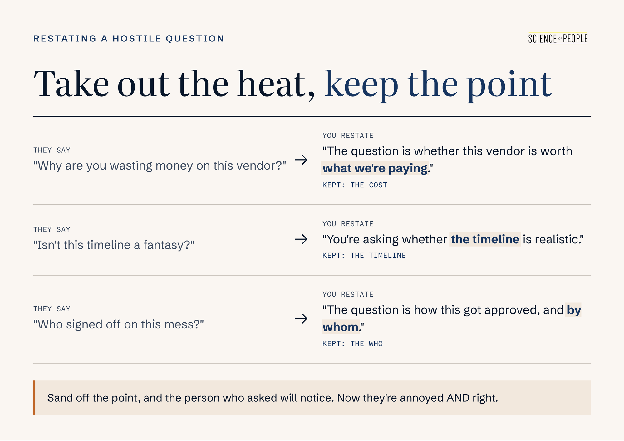
Want to warm it up? Add one honest clause first, then restate: “Maybe you’re worried this repeats last year, and that’s fair. The question is whether this plan is different.” Then answer right away.
Pro Tip On a video call, the hostile question might arrive in the chat. Say it out loud before you answer, so everyone knows what you’re responding to, and soften the wording while you keep the point.
Fix the Premise Before You Answer
Some questions come with a trap built in. “Isn’t this project behind AND over budget?” Or the classic either-or: “So do we cut the team or cut the scope?”
Correct the premise in one clause, then answer the part that’s real:
“It’s over budget, but it’s on schedule. Here’s what’s driving the cost.”
“Those aren’t the only two options. There’s a third: push the launch two weeks.”
Answer First, Pivot Second
Bridging, where you pivot from the question to the message you wanted to deliver, is a classic media-training move. But when the debate speaker from earlier answered something completely unrelated, listeners noticed, and they rated him more harshly.2
So answer first, in one sentence. THEN pivot:
“Yes, it’s 20% over budget. That’s the cost of moving the launch up three months, and here’s why I think that trade is worth it.”
Stay Calm When the Same Hand Goes Up Again
Calm and on-topic sounds like this:
- For the speech with no question in it: “Let me make sure I answer what you’re asking. Is it whether we should delay the rollout?”
- For the third follow-up: “I want to give this the time it deserves, and I don’t want to hold everyone else up. Can we pick it up right after? I’ll stay.”
- For the clock: “We’ve got about five minutes, so I’ll take two more.”
Your body can help, too. You might try dropping your volume a notch and turning to the whole room for your last sentence, so it doesn’t become a two-person argument.
Does “let’s pick this up after” just look like dodging? It can, if “after” never comes. Name a time (“right after this,” “by Friday”), then actually show up. The rest of the room heard you promise it!
When They’re Right, Say It First
Every instinct might tell you to defend against criticism. Explain the method, mention the deadline, point out that the overall trend still looks the same, etc…
But does it work?
In one study, people read about a scientist whose result other labs couldn’t repeat. The scientist who said “it looks like I was wrong” earned more trust than one who refused to accept it or said “no comment.”3 In a Q&A, “no comment” usually comes out as “I’d rather not get into that.” Or a quick change of subject. Neither one helps.
What kind of mistake you’re being accused of matters, though. In research on repairing trust, an apology repaired more trust after a competence mistake, and a denial did better after an accusation about integrity. If later evidence showed the person was guilty, though, a denial did worse than an apology would have.4
Here’s what each one sounds like:
- A competence mistake you made: “You’re right. Slide 14 counts the West region twice. The corrected growth number is 6%. I had 9%.”
- An integrity accusation that’s false: “No. Every cost is on page four of the handout, and I’ll walk through it line by line with anyone who wants to.”
Owning it out loud won’t make the moment painless. The room still watched you be wrong, and the person who caught it may bring it up again next quarter.
Draw a Line Around the Mistake
Once you’ve admitted one thing, a hostile asker may try to stretch it: “So we can’t trust ANY of this?”
Draw the line before they do. Name exactly what was wrong, then name what’s still correct and why:
“The West number was wrong, and I’ve fixed it. The other three regions come straight from the billing system, so those figures are right. I’ll send the corrected deck to everyone this afternoon.”
If the mistake affected someone directly, save a fuller apology for a one-on-one afterward.
Put a Number on “I Don’t Know”
“I don’t know” might backfire, unless you know the three-part recipe to make it good. A good “I don’t know” contains: what you don’t have, your best range, and when they’ll get the real number.
“I don’t have the Q3 churn number with me. My best guess is somewhere between 8% and 10%. I’ll send the exact figure to the group by Thursday.”
What if you can’t even estimate it? Say which way you lean and what it depends on:
“My guess is the delay is more likely the vendor than the staffing gap, but it depends on what their account manager tells me Thursday. I’ll have it by Friday.”
And if it’s outside your lane entirely? Hand it to the person who knows:
“That’s outside what I can speak to, but Marco on the data team owns it. I’ll connect you two today.”
Action Step: Before you leave the room, put the follow-up in your calendar with the asker’s name on it, so you don’t forget the promise.
Open the Floor, Then Close on Your Own Words
Nothing deflates a talk like “Any questions?” followed by crickets. (Suddenly everyone finds their shoes fascinating.)
Try “What questions do you have?” instead, which assumes there are some. And keep one question in your back pocket in case the room stays quiet: “A question I often get is whether this works for smaller teams…”
Then don’t let the last question be the last word, especially if it was the hostile one! Save one minute to close:
“Last question… [your answer]. Before you go, here’s the one thing I’d want you to remember: we can launch in March if we fund the second vendor now.”
Rehearse the Question You’re Dreading
Run this before your next talk. It takes about 20 minutes.
- Write down the one question you’re hoping nobody asks, plus two more you’d hate to hear.
- Hand them to a colleague and ask them to read each one in their least friendly voice. (Most colleagues enjoy this part a little too much!)
- Before you answer, name what you’re feeling: “I feel annoyed.” “I feel embarrassed about that number.”
- Answer with the moves above: restate it, answer in the first sentence, and give a range for anything you don’t know.
- Shuffle the questions and run it again.
Step three feels strange! But in a study of people who were afraid of public speaking, those who picked a word for their feelings (“I feel nervous”) before each practice speech showed a calmer body stress response after speaking a week later than people who did the same practice without labeling.5
(Presenting in your second language? Write your restatements out ahead of time. Our second-language guide has more.)
These moves work anywhere someone puts you on the spot, like a client asking “Why should I trust your price?” or a tough question at the neighborhood association meeting.
Your Q&A Cheat Sheet
Fill this in the night before your talk.
The question I’m dreading: “______”
My one-sentence answer: “______”
My restatement of it: “So the question is whether ______.”
My “I was wrong” line: “You’re right. ______ was wrong. The correct number is ______.”
My range for the number I’m least sure of: “My best guess is somewhere between ______ and ______. I’ll send the exact figure by ______.”
My closing line: “Before you go, here’s the one thing I’d want you to remember: ______.”
Frequently Asked Questions (FAQs) About Presentation Q&A
How do you answer a hostile question in a presentation?
Figure out who’s asking, echo the question in calmer words, and answer it in your first sentence. Keep your voice level and your answer on topic. If they’re right, say so before you explain anything. For “Why are you wasting money on this vendor?”, try “The question is whether this vendor is worth what we’re paying,” then answer that.
Should you pause before answering a question in Q&A?
Skip the pause for simple, factual questions, and narrate it for hard ones. A gap of about two seconds before a short “yes” can make the answer sound less sincere, so answer inside the first second and add detail after. For a hard one, narrate it: “Let me think about that for a second.”
How do you restate a tough question without dodging it?
Take the heat out of the wording, and keep the substance. “Isn’t this timeline a fantasy?” becomes “You’re asking whether the timeline is realistic.” Once you’ve said it out loud, the room checks your answer against it, so answer that exact question in your first sentence. If you sand off the point, the person who asked will notice.
How do you handle a trick or either-or question?
Correct the premise in one clause, then answer the part that’s real. For “Isn’t this project behind AND over budget?”, try “It’s over budget, but it’s on schedule. Here’s what’s driving the cost.” For “So do we cut the team or cut the scope?”, try “Those aren’t the only two options. There’s a third: push the launch two weeks.”
What should you say when you don't know the answer?
Say what you don’t have, give your best range, and name when they’ll get the real number: “I don’t have that with me. My best guess is between 8% and 10%. I’ll send the exact figure by Thursday.” If it’s outside your lane, hand it to the person who knows. Then put the follow-up on your calendar before you leave the room.
What do you do when someone points out a mistake in your presentation?
If they’re right, say so first, then draw a line around the mistake. “You’re right. Slide 14 counts the West region twice. The corrected number is 6%.” Then name what’s still correct and why, and promise the corrected deck by a set time. If the claim is a false accusation about your integrity, a clear, specific “No” works better.
How do you handle someone who keeps asking follow-up questions?
Stay calm, offer a specific time to continue, and then show up. Try: “I want to give this the time it deserves, and I don’t want to hold everyone else up. Can we pick it up right after? I’ll stay.” Drop your volume a notch and turn to the whole room for your last sentence so it doesn’t become a two-person argument.
Should you compliment every question you get?
Once, when you mean it, sure. Said to every question, it can start to sound like stalling. An echo of the question buys you the same few seconds and does more work. It lets the back row hear what was asked, and it gives the room something to check your answer against.
What if nobody asks a question?
Ask “What questions do you have?” instead of “Any questions?”, and keep one in your back pocket: “A question I often get is whether this works for smaller teams…” Answer it yourself, and the room usually warms up. The open-ended version assumes there are questions, which makes it easier for someone to raise a hand.
How do you prepare for a presentation Q&A?
Write down the question you’re dreading plus two more, and have a colleague read them in their least friendly voice. Before each answer, name what you’re feeling, then restate, answer in your first sentence, and give a range for anything you don’t know. Shuffle and run it again. The whole drill takes about 20 minutes.
How do you end a Q&A session?
Announce the last question, answer it, then close with the one thing you want people to remember. That way a tough final question isn’t the last thing the room hears. Try: “Last question… Before you go, here’s the one thing I’d want you to remember: we can launch in March if we fund the second vendor now.”
Presentation Q&A Takeaway
- Write down the three questions you least want to hear, and have a colleague ask them before the talk.
- Decide which quick factual questions you’ll answer in one line, with no pause first.
- Practice restating a hostile question in one neutral sentence, then answering that exact sentence.
- Prepare your “I was wrong” sentence and a range for the number you’re least sure of.
- After the talk, send every follow-up you promised by the day you promised it.
If the nerves start well before the questions do, our guide to stage fright covers the part before you ever take the floor.