Are you still in the group chat?
You know, the one with your old lunch crew, a running joke about the broken printer, and at least one thread roasting the leadership team. (As of Monday… you’re now part of that team.)
First of all, congrats on the promotion! Now for the part most people don’t go over: what happens to the friendships?
The short: Plenty can stay exactly the same. But a few things can’t.
The Thursday Lunch Is About to Change Forever
The slow loss of former peers as friends is real.
Thursday lunch just… stops getting a calendar invite. Conversations shrink to deadlines, and your friend starts saving their real opinion for after the meeting, when you’re not in it.
When researchers collected people’s stories of work friendships that fell apart, promotion was one of the five main causes. And those friendships mostly ended QUIETLY. People stopped bringing up life outside work and went cool in their body language. They also quit hanging out away from the office.1
Part of the strain was there before your new title. Work friends tend to trust each other more, and they tend to do better work because of it. But keeping up both roles at once also wears people out.2 Then a promotion piles on a third role, because now one of you writes the other’s performance review. (No pressure!)
Best Friend, Friendly, or Rival? Sort Your Old Peers
Your former peers weren’t all friends, and each kind of relationship needs a different first move. Let’s say three people on your new team are Dana, Theo, and Simone:
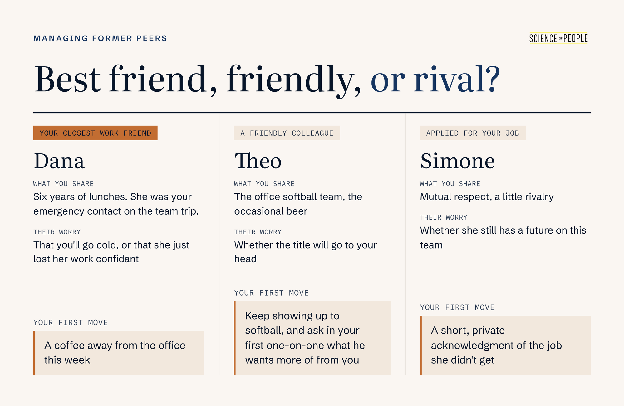
Most of the friendship work goes to your close friends, and that’s usually one or two people. Friendly colleagues mostly need you to be the same person in the hallway that you were last month. The rival is a separate conversation, and we’ve got scripts for the colleague who wanted your role.
(What if your closest friend also applied for the job? Start with the rival conversation. It’s the one most likely to be on their mind.)

A new book by Vanessa Van Edwards
Every conversation is an opportunity.
If conversations have gotten harder, more awkward or less satisfying, you’re not imagining it. We’re simply out of practice. It’s time to find the joy in talking to each other again.
Keep the Life Talk, Lose the Leadership Gripes
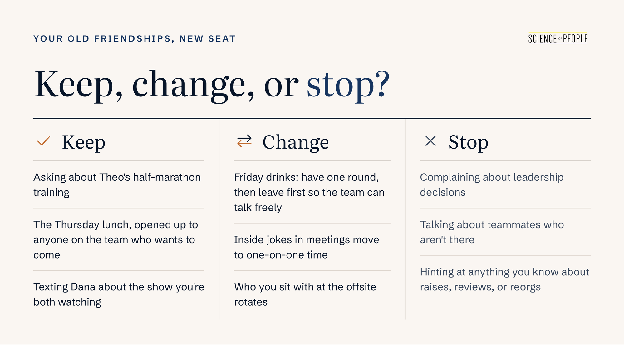
Remember how those faded friendships ended? People stopped talking about life outside work and stopped hanging out after hours. So those are the parts to protect.
What has to go is the stuff that clashes with your new seat. You can’t vent about leadership decisions when you’re IN the room where they get made. Trading opinions about teammates you now review turns into workplace gossip with a power gap attached. And you’ll know things about pay and reorgs that you can’t even hint at.
Here’s what that might look like with Dana and Theo:
Okay… what about the group chat? If it’s mostly memes and weekend plans, stay! If it’s where the team vents about management, leave, and say why with a light touch:
“Bowing out of here now that I’m on the other side of the complaints. Still want the dog photos, though. Send them my way!”
Lurking in a venting chat is actually WORSE than leaving. Every gripe about the new process becomes one the boss saw. (Yikes.)
Have the Friendship Talk Over Coffee
The week-one conversation covers the big shift with your old friend and the rest of the team. This one is smaller. It’s a coffee or a walk with your closest friend, somewhere other than the office, with two specific asks:
“I really don’t want this job to cost us our friendship, so I want to ask you for two things. If I ever do something that looks like special treatment, call it out. It would hurt you with the team way more than it helps. And if I get weird or stiff around you, say so. I’d rather hear it than let it build up.”
Then… let your friend talk. They might have worries you haven’t thought of, like whether they can still disagree with you in a meeting. (They can. Say so.)
I’ve been on the friend side of this coffee. Honestly? Just being asked made the new-boss thing feel a lot less weird.
Pro Tip Book this coffee AFTER the whole team has heard your news. If your closest friend hears it first, someone else on the team will probably find out, and it’ll look like favoritism on day one.
Say “Boss Hat On” Out Loud
A lot of the awkwardness with a friend comes from not knowing which version of you is talking. Is this my friend giving an opinion, or my boss giving a direction? Luckily, you don’t have to become a different person to fix that.
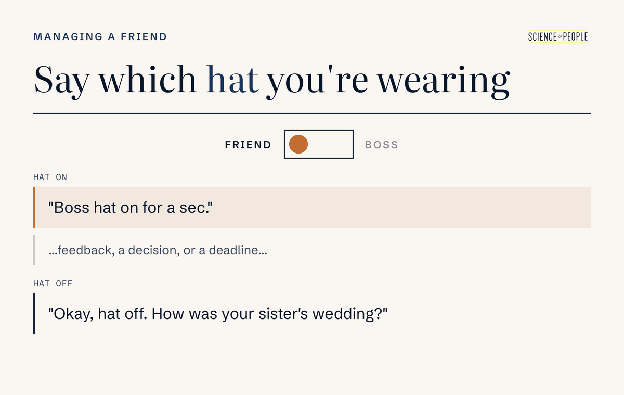
It helps to pick one short phrase that flags the switch and use it every time. “Boss hat on for a sec” works. So does “Putting my manager hat on.” (A literal hat is optional… though we won’t stop you.) Say it right before feedback, a decision, or a deadline. And when you’re done, you can take the hat off out loud: “Okay, hat off. How was your sister’s wedding?”
Pro Tip Use the same phrase with everyone on the team. If only your friend gets the hat line, it turns into a private code, and the rest of the team is likely to notice it.
Not managing anyone? The hat line works anywhere a friendship picks up a second role. Say a buddy asks for a discount on your listing: “Business hat on for a sec. This is the deal I’d offer any client.” Then take the hat off and ask about their weekend. Same idea if a friend becomes your landlord or takes over the book club.
The Two-Minute Friday Favoritism Check
Whether you play favorites often gets decided in conversations you aren’t part of. When a boss treats people differently, coworkers talk about it and often decide together what’s fair.3
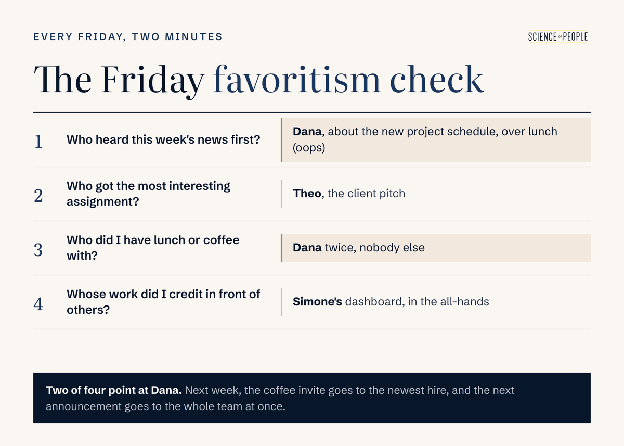
Every Friday afternoon, spend two minutes on four questions:
- Who heard this week’s news first?
- Who got the most interesting assignment?
- Who did I have lunch or coffee with?
- Whose work did I credit in front of others?
Here’s one Friday, filled in:
When Your Friend Drops the Ball, Correct Them First
Here’s a test your team is quietly running. When your work bestie messes up, do they get the same treatment anyone else would?
Let’s say your closest work friend leaves for a week at the beach without writing handoff notes. (They remembered the sunscreen, though.) Someone else spends Monday morning rebuilding the client file from scratch.
Handle it exactly the way you would with anyone on the team:
- Same timing. Bring it up their first day back, not “whenever it feels less awkward.”
- Private and short. One quick conversation, with no team-wide reminder about handoffs.
- Ask before you fix. Maybe they ran out of time on their last day. Maybe nobody ever told them the notes were expected.
Here’s how that might sound:
“Boss hat on for a sec. The handoff notes didn’t happen before your trip, and the team lost a morning piecing the client file back together. What got in the way?”
Then solve it together, and the next trip comes with notes.
Fair warning… a friend can take that first correction harder from you than from a boss they were never close to. They might be a little cool toward you for a few days, or longer. No phrasing fully prevents that, and once in a while the friendship stays smaller for good.
When Your Friend Asks for a Favor
Sometimes the test runs the other way. Your friend asks for Friday off with one day’s notice for a concert, or a quiet extension on a deadline.
Give the answer you’d give anyone, and point to the rule, so the no belongs to the process:
“Boss hat on for a sec. I’d give anyone the same answer here: time off needs a week’s notice so I can cover the schedule. If it’s an emergency, that’s different, so talk to me.”
If they push back with “You’ve changed!”, stay warm and repeat the rule. You can care about them AND say no. Then take the hat off and ask who’s playing the concert.
When an Old Peer Tests Your Authority
Not every test is a missed handoff. Sometimes it’s a joke in a meeting (“Look who’s the boss now!”), an eye-roll, or a “we’ve always done it this way.”
Skip the big speech about who’s in charge. (It rarely goes as well as it does in your head.) Calm and matter-of-fact is the goal:
- The joke: “Ha, it’s still weird for me too. Okay, back to the timeline.”
- The eye-roll in a meeting: Talk privately afterward. “I noticed some pushback on the new process today. What am I missing?”
- “We’ve always done it this way”: “That’s fair, and some of it really works. Can we try the new way for two weeks, then decide together?”
If the pushback keeps coming, it becomes a performance conversation.
The same goes for the colleague who wanted your job. Disappointment is normal, and they’re allowed to feel it for a while. Undermining is different: going around you, stalling shared work, or talking you down to the team. That’s a performance conversation too, and guilt about getting the job isn’t a reason to skip it.
Get to Know Everyone the Way You Know Your Friends
Your history with your friends is a head start! Chances are you already know who has daycare pickup at 3:30, who dreads presenting, and who does their best thinking before 9 a.m.
When people know more about a colleague’s life, they tend to see that colleague as a whole person and respond to them more readily.4
You probably know way more about your friends than about anyone else on the team. So guess who gets your quickest yes? In your next one-on-one meeting with someone you weren’t close to, you might ask one question about life outside work. “Anything coming up outside work I should know about when we plan deadlines?” is easy to answer, and you’ll actually use what you hear.
Think about the person on your team you know least. What’s one thing you could ask them this week?
Lonely at the Top? Find a New Crew to Vent To
Want to guess how much lonelier managers are than everyone else at work?
Not at all, on average! Across three studies, managers were no more and no less lonely than nonmanagers.5
If your old lunch crew was where you griped about a bad meeting or a confusing decision, that’s the part that has to move. It goes to people outside your team now: other new managers, a mentor, or a friend at a different company. (A two-person new-manager coffee I started is now my favorite meeting of the week!)
And add your own boss to the crew. One concrete ask is plenty: “Could we spend ten minutes of our next one-on-one on how I’m handling the team? I’d love your read.”
Action Step: Message two other managers who were promoted in the past year and suggest a standing 30-minute coffee every other week. Bring one real problem to every coffee.
Your First-Month Sticky Note
Fill out one of these for each friend on your team. It fits on a sticky note, and it’s easy to print.
Friend: ______
Keep: ______
Change: ______
Stop: ______
My coffee asks: “I don’t want this job to cost us our friendship. If I ever ______, call it out. And if I get ______ around you, say so.”
My manager-mode phrase: “______”
My Friday check: Who heard news first? Who got the best assignment? Who did I have lunch or coffee with? Whose work did I credit?
Then say your coffee asks out loud once before you book the coffee. (The car is a great place for this… nobody can hear you.) It’s a lot easier to sound like yourself on the second try.
Frequently Asked Questions (FAQs) About Managing Former Peers
Can you stay friends with someone you manage?
Yes, though the friendship will probably change shape. Keep the personal talk, drop the work gripes, and treat your friend the same way you treat everyone else on the team. A keep, change and stop list helps. Keep asking about their weekend. Change how Friday drinks work. Stop complaining about leadership decisions together.
How do I talk to a close friend after I become their manager?
Have a coffee or a walk away from the office, after the whole team has heard your news, and make two asks. Try: “If I ever do something that looks like special treatment, call it out. And if I get weird or stiff around you, say so.” Then let your friend talk, since they may have worries you haven’t thought of.
Should I leave the work group chat after a promotion?
Stay if it’s mostly memes and weekend plans, and leave if it’s where the team vents about management. Lurking in a venting chat is worse than leaving, because every gripe becomes one the boss saw. Keep the exit light: “Bowing out of here now that I’m on the other side of the complaints. Still want the dog photos, though.”
How do you get former peers to respect your authority?
Resist the urge to turn into a stiff, formal version of yourself overnight. (They already know the REAL you.) Hold everyone, friends included, to the same standards, and handle pushback privately and matter-of-factly. For a joke like “Look who’s the boss now!”, try “Ha, it’s still weird for me too. Okay, back to the timeline.”
How do I correct a friend who now reports to me?
Handle it exactly the way you would with anyone else: same timing, private and short, and ask before you fix. “Boss hat on for a sec. The handoff notes didn’t happen before your trip, and the team lost a morning. What got in the way?” Then solve it together. A friend may take it harder from you, and that’s okay.
What do I say when a friend on my team asks for a favor?
Give the answer you’d give anyone, and point to the rule so the no belongs to the process. “Boss hat on for a sec. I’d give anyone the same answer here: time off needs a week’s notice so I can cover the schedule.” If they say “You’ve changed!”, stay warm and repeat the rule, then take the hat off.
How do I avoid favoritism when I manage friends?
Run a two-minute check every Friday afternoon. Ask who heard this week’s news first, who got the most interesting assignment, who you had lunch or coffee with, and whose work you credited in front of others. Same name keeps coming up? Send next week’s coffee invite to someone else, and share news with the whole team at once.
What if a former peer is upset that I got the job?
Acknowledge it privately and briefly, without apologizing for the promotion. Then ask what they want next in their career, and help them get there. Disappointment is normal for a while. Undermining, like going around you or stalling shared work, is a performance conversation. Our guide to executive presence for new managers has scripts for that conversation.
How should I open my first team meeting as the new manager?
Name the elephant in the room in a sentence or two, then get to the agenda. Try: “This is a little weird for all of us, me included. Here’s what isn’t changing, and here’s where I’d love your input.” Then ask each person what they need from you, and pick it back up in your first one-on-ones.
Should I tell my team I'm friends with someone on it?
They probably already know. What matters more is that they see you treating everyone the same, which is exactly what the Friday favoritism check is for. Use the same manager-mode phrase with everyone. That way your friend doesn’t end up with a private code.
Is it lonely being a new manager?
On average, managers report about the same loneliness at work as everyone else, but the venting has to move. Take gripes about meetings and decisions to people outside your team: other new managers, a mentor, or a friend at another company. Ask your own boss for ten minutes of your next one-on-one on how you’re handling the team.
Managing Former Peers Takeaway
- Before the next team lunch, write a keep/change/stop list for each friend on your team.
- Book a coffee away from the office with your closest work friend this week, and ask them to call out anything that looks like special treatment.
- Choose one phrase that flags manager mode, and use it with everyone.
- Put the two-minute favoritism check on your calendar for Friday afternoons.
- Message two managers who were promoted in the past year about a standing coffee.
And the Thursday lunch? Keep it on the calendar. Just send the invite to the whole team this time.
Ready for the rest of your first months in the role? Check out our guide to your first 90 days as a manager.