“The project is… $4,000?”
That’s probably the hardest thing anyone wants to hear in any client call.
A second later, a voice (maybe yours?) adds, “…but we can be flexible.”
But the question is: How can you say the number at full strength, without hesitation, and what should you do in the silence after?
We’ll get to raising rates on current clients, too.
The Three-Second Hush
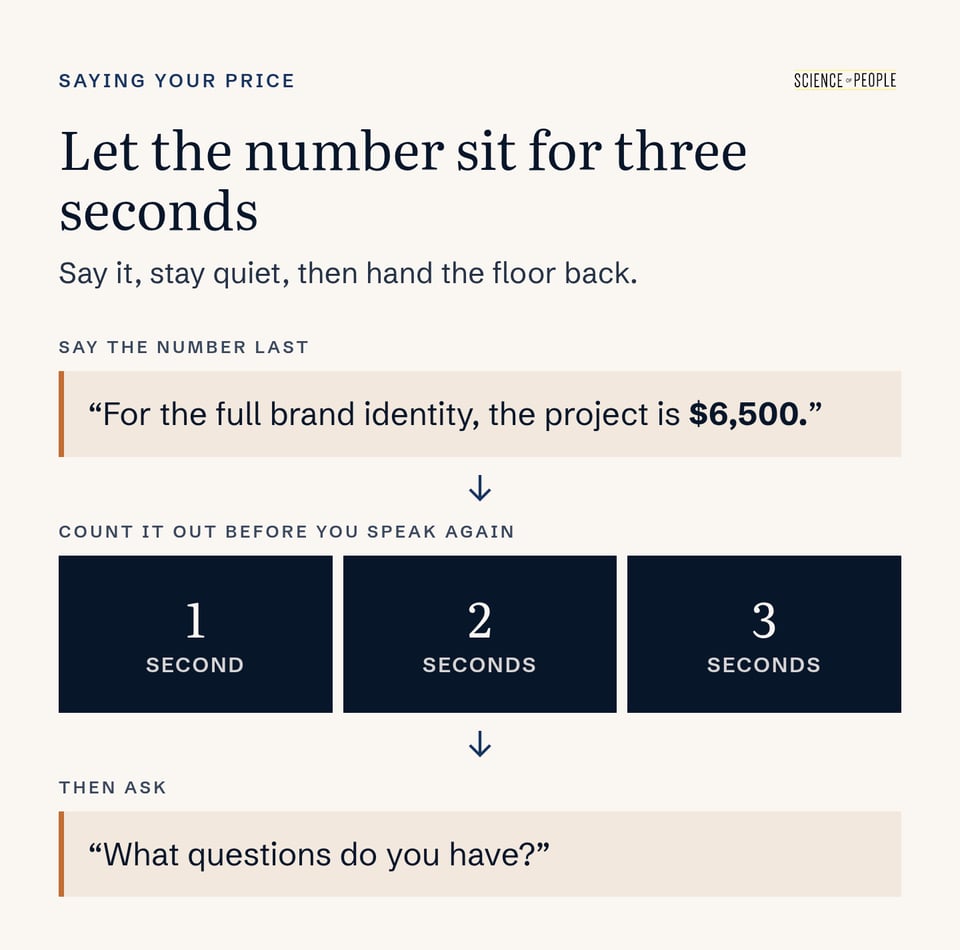
Try this: You say your price in one sentence, then count to three in your head before you say ANOTHER word.
The sentence itself can be short:
“For the full brand identity, with the logo, color system, and a one-page style guide, the project is $6,500.”
Put the scope first and the number last. That way the price is the last thing the client hears. Your nerves get nothing else to grab onto.
Then comes the silence… Three… seconds… feels… endless, when your own price is hanging in the air!
In negotiation research, though, pauses that long or longer went with better outcomes. A 2022 study in the Journal of Applied Psychology found negotiators who paused three seconds or more reached better deals for both sides.1
Wait, is the pause just a pressure move? The same researchers checked. The silent partner didn’t walk away with a bigger slice, and the other person didn’t leave any less satisfied.
So what do you do for those three seconds? Keep your eyes on the client (or the camera) and your mouth closed while they take in the number. They might be doing math, or checking a budget line.
A client on a video call might even scroll right past the $6,500 to reread the launch date. Turns out THAT was the thing they were worried about!
And if the quiet stretches past three seconds? You still don’t need to rescue it.
“What questions do you have?” hands the floor back without touching the price. (I’ve counted “one… two… three…” under my breath on more calls than I’d like to admit.)
Action Step: Write your price sentence with the number as the last word. Say it out loud once, then count to three before you breathe.
Say Your Price Like You Say Your Name
Quick, what’s your name?
Flat and certain, right? Nobody answers “Sam?” unless they’re genuinely unsure who they are. Your price deserves that same pitch and delivery.
Two things tend to go wrong on the number. The first is volume.
Science of People owner Vanessa Van Edwards hears the same slip over and over in her sales trainings. A clear, confident sentence sinks to a mumble on the ONE word:
“I can’t wait to work with you and all we need is a $500 deposit to get started.”
In her guide to conquering phone anxiety, she calls that drop “begging someone to negotiate with you.”
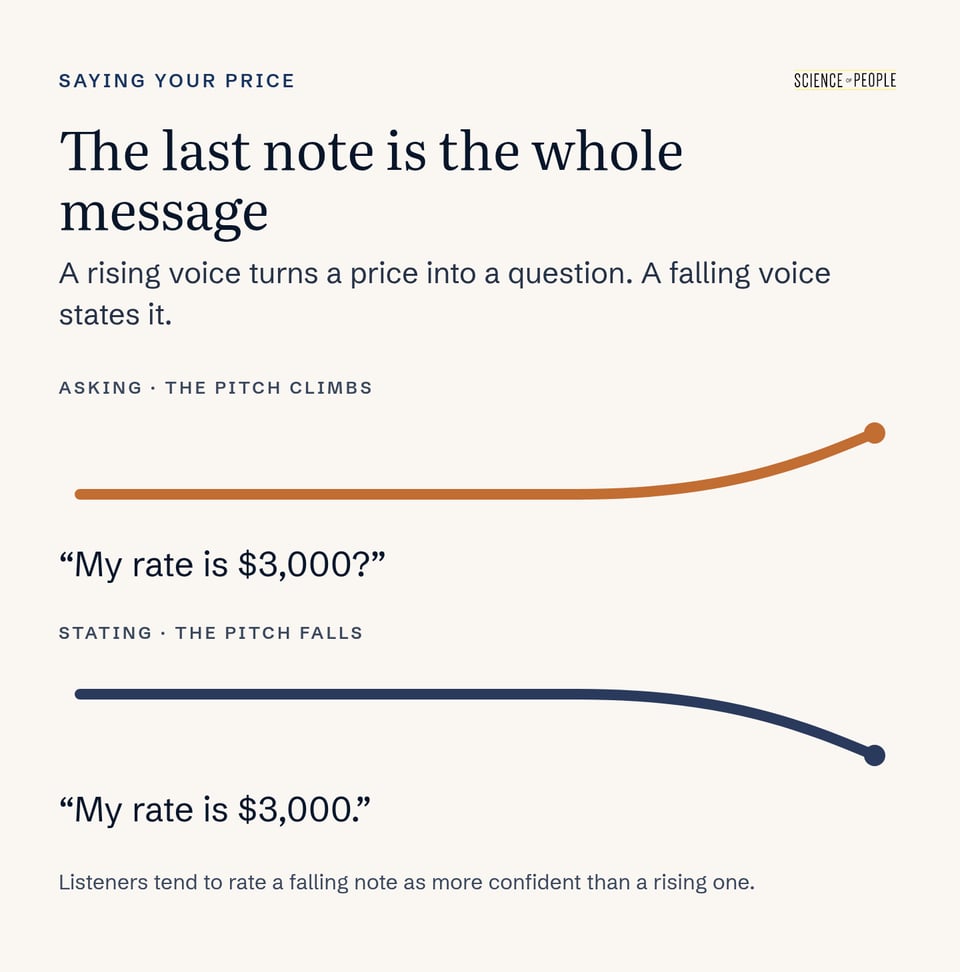
The second is pitch. When your voice lifts at the end, a statement turns into a question. Across several experiments, listeners rated speakers who ended sentences on a falling note as more confident than those whose sentences rose.2
The same research found the falling note only helped persuade people when the argument behind it was strong. One more reason to put your scope before your number!
Here’s how the difference looks written out:
| Asking your price | Stating your price |
|---|---|
| “My rate is two hundred an hour?” | “My rate is two hundred an hour.” |
| “The retainer would be… around $3,000?” | “The retainer is $3,000 a month.” |
| “So that comes to $8,400, if that’s okay?” | “The total is $8,400.” |
Try This: Record yourself saying your price sentence on your phone. Play it back and listen only to the last word. If the pitch climbs, say it again and let the number drop, the way your name does.
A new book by Vanessa Van Edwards
Every conversation is an opportunity.
If conversations have gotten harder, more awkward or less satisfying, you’re not imagining it. We’re simply out of practice. It’s time to find the joy in talking to each other again.
Be the First to Say a Number
Whoever puts a number on the table first tends to get the better deal. In three negotiation experiments, the side that made the first offer came out ahead, buyer or seller. The final price also tended to track the first offer.3
So when a client asks, “What were you thinking, budget-wise?”… that’s your opening! Answer with your number instead of asking for theirs:
“For the scope we just walked through, the project is $6,500.”
Going first works best when you know what the work is worth. Quoting something brand new, with no idea what the market pays? Then letting the client name a figure first can teach you a lot about their expectations.
What if a client beats you to it (“We were thinking around $2,000”)? Their number doesn’t have to become the center of the conversation. In the same research, the first-offer advantage disappeared when the other side focused on their own target instead.
Our advice? Stick a note with your number on your monitor before every pricing call. When the lowball arrives, a glance at your $6,500 gives you something to focus on besides theirs.
Ditch the Panic Discount
“It’s $1,200 a month for the full bookkeeping package… but I could probably do a thousand.”
The client hadn’t said a word. They were still reaching for a pen!
That second sentence is the panic discount: a price cut you hand over before anyone asks for it. It usually slips out in the second or two after the number, when the quiet feels unbearable.
Nerves make it more likely. In a set of negotiation experiments, people made to feel anxious opened lower, responded to offers faster, and walked away with worse deals.4 People who felt confident in their negotiating ability were thrown less by the anxiety.
So rehearse your price sentence out loud until it’s BORING.
(I once knocked a chunk off a quote before the client had even finished reading it. Would they have paid full price? I’ll never know!)
The panic discount also hides inside some very polite phrases. Here’s what each one might tell a client, and what to say instead:
| What slips out | What the client might hear | Try instead |
|---|---|---|
| “I know that’s a lot…” | Even you think it’s too much. | Say nothing. Count to three. |
| “…but I can be flexible.” | The real price is lower, so ask. | “That covers the setup, monthly reconciliation, and quarterly reports.” |
| “Does that work for you?” | This number is up for a vote. | “I can send the agreement over today.” |
| “I usually charge more, but for you…” | The normal price is made up. | “The package is $1,200 a month.” |
If a client does ask for a lower number, you still have room to move. It just comes with a trade attached.
Put a Price Tag on Every Discount
A free discount can teach a client that your prices are soft… so trade it for something instead.
Three trades tend to make sense for both sides, and each one comes with its own line:
- Less scope: “If we drop the second round of revisions, I can do it for $5,800.”
- A longer commitment: “If you book six months up front, I can take 10% off the monthly rate.”
- A faster decision: “If you sign by Friday, I’ll lock this rate in for the full year.”
Action Step: Before your next call, write down which revision round you’d drop, which commitment would earn 10% off, and what date you’d put on a sign-by offer. (For more on trading concessions, check out our guide on how to negotiate.)
Answer “That’s a Lot” With One Question
“Hmm. That’s more than we budgeted.”
Here it is… the exact moment the panic discount has been waiting for! Before you offer anything, ask one question to find out what “a lot” actually means:
“Is it the total that’s the problem, or the timing?”
A price objection often turns out to be about something else. The budget might be capped, the timing might be off, or the client might not be sure what they’re getting. Each one has a different fix, and only ONE of them touches your number.
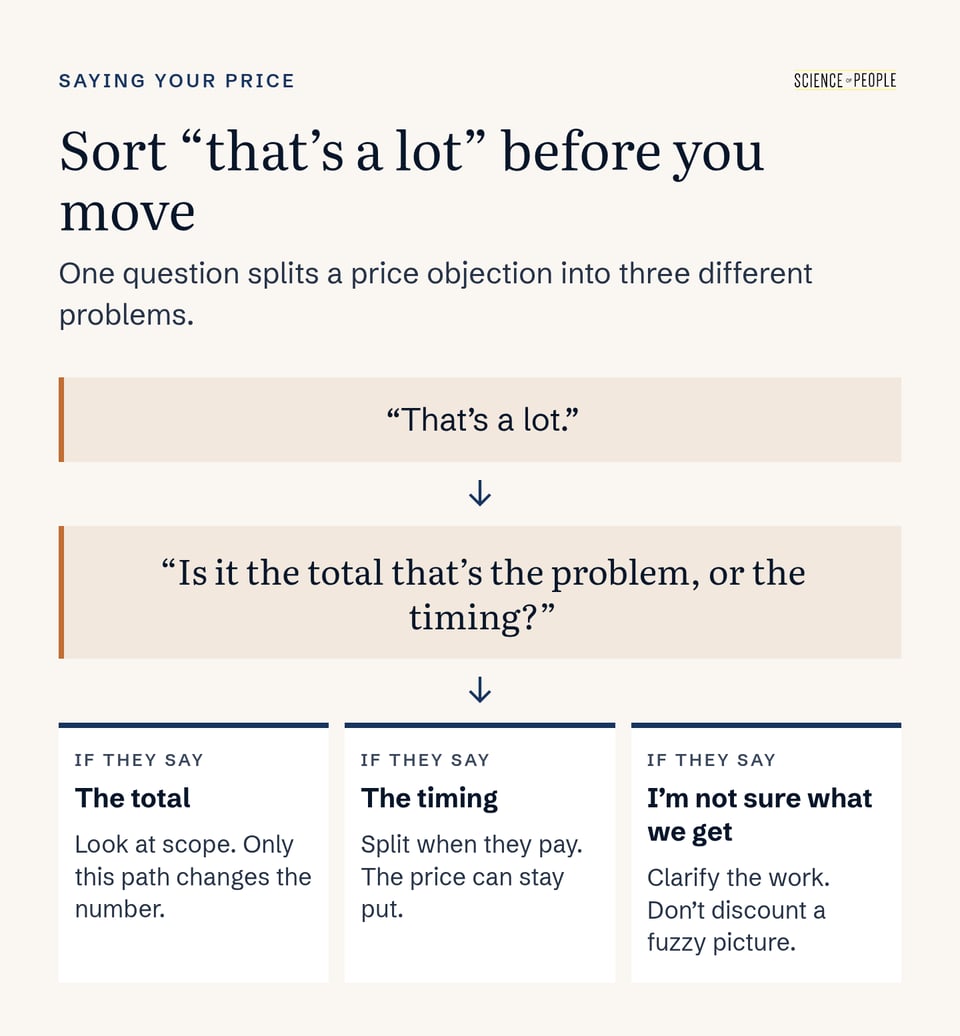
Here’s how that might play out for a photographer quoting headshots for a 40-person team:
Client: “That’s more than we budgeted this quarter.” Photographer: “Is it the total that’s the problem, or the timing?” Client: “Honestly, the timing. Our budget resets in March.” Photographer: “Not a problem. I can bill half now and half on March 1st.”
The price never moved!
If the answer goes a different way, you have a line ready for that too:
| If they say… | You say… |
|---|---|
| “It’s the total.” | “Then let’s look at scope. If we shoot the leadership team this month and everyone else in the spring, it’s $2,900 now.” |
| “When would we pay?” | “I can split it into two invoices, 30 days apart.” |
| “I’m not sure what we get for that.” | “Fair question. Which part feels less clear, the shoot day or the edited files?” |
Raise Your Rates With a Straight Face
A new client has never heard your old price. An existing one has been paying it for years, sends you a holiday card, and maybe knows your dog’s name.
No wonder the rate-increase email can stay in drafts for a month! (Mine once stayed there so long I forgot what I’d written.)
Does the reason for an increase matter? It can change how people judge it.
A classic set of telephone surveys put this to the test. When a grocer’s own lettuce cost rose 30 cents a head, 79% of people said raising the price 30 cents was acceptable. Raise snow shovels from $15 to $20 the morning after a blizzard, and 82% called it unfair.5
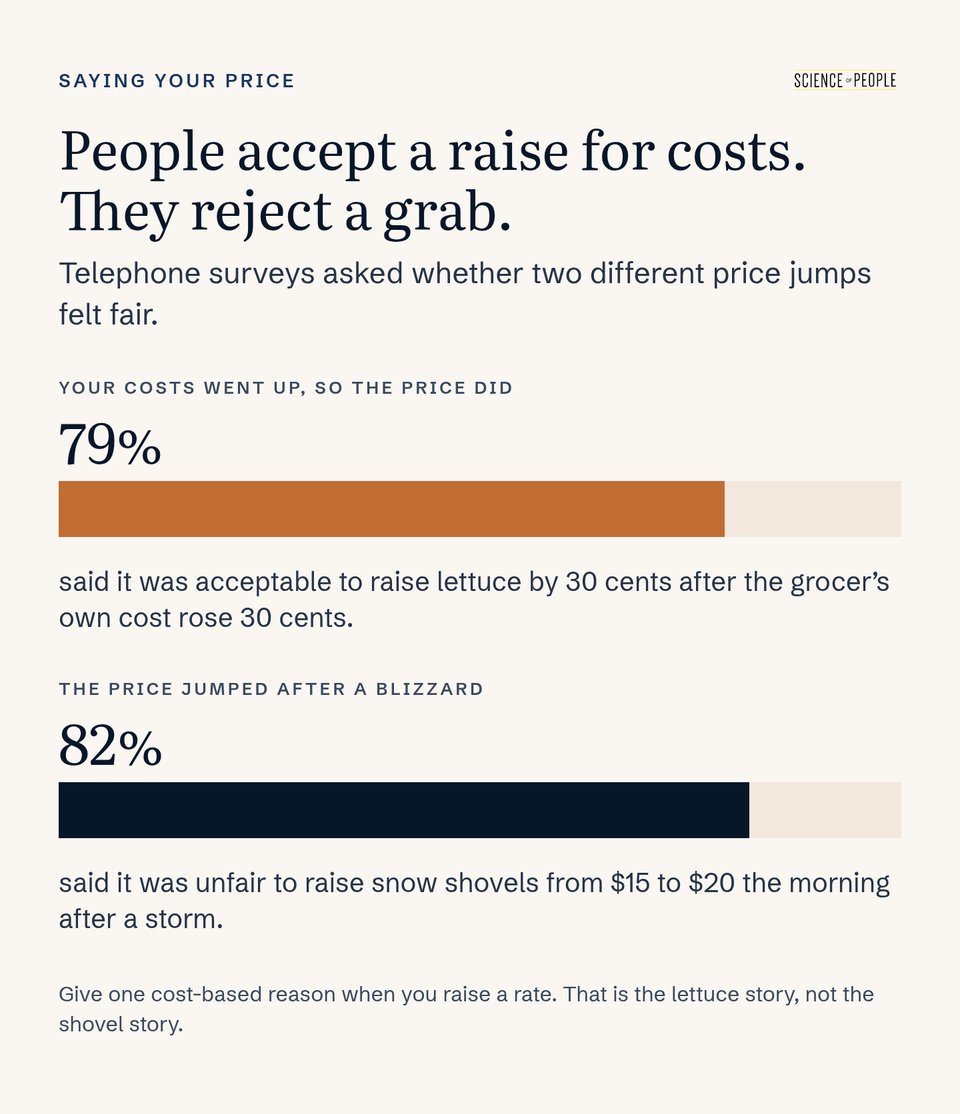
So give one reason, and make it about what the work costs you. Maybe it’s the tools you pay for, the hours each project takes, or the contractor you hire for overflow. One reason sounds OK… but five start to sound like a defense.
Then give real notice. Thirty days is the minimum, and 60 is kinder for a monthly retainer. Here’s what the email can look like:
Subject: Your rate starting March 1
Hi Jordan,
Closing your books every month this year has been one of my favorite parts of the job, and I want to give you a heads-up about a change well ahead of time.
Starting March 1, my monthly rate will be $1,350, up from $1,200. The accounting and payroll software I use for your books has gone up in price, and this covers it.
Everything else stays the same: the monthly close, the quarterly reports, and our Tuesday check-ins.
If you’d like to talk through scope or timing before then, I’m happy to set up a call.
Thanks, Alex
Rather say it on a call first? Keep it just as short:
“One update before we wrap. Starting March 1, my rate goes to $1,350 a month. My software costs went up, and this covers it. I’ll send it over in writing today.”
After that, give it the same three-second hush you’d give a new quote.
And if a client pushes back? You can keep the rate and still offer a choice:
“I hear you. The new rate starts March 1. If the budget’s tight, we could drop the quarterly reports and keep your monthly rate at $1,250.”
Some clients will leave anyway. A rate increase can cost you a client you like, and no wording fully prevents that.
Pick Your Grandfathered Few (and Their End Date)
You might have one or two clients you’d rather not move yet. Maybe it’s the one who took a chance on you in year one, or the retainer that covers your rent (hi, rent!).
Keeping them at the old rate for a while is fine, as long as the exception has an end date. Put that date in writing:
“Because you were one of my very first clients, I’m keeping you at $1,200 through June. Starting July 1, your rate will be $1,350.”
Two habits keep the exception from growing:
- Date it. Put the end date in the same message that grants the extension, like the line above.
- Quote new work at the new rate. If a grandfathered client asks for an extra project in April, that project gets today’s price.
Then put July 1 on your calendar. Add a reminder a month ahead to send a short note that the new rate is coming.
Be Warm About Everything but the Number
The number is the one part of the conversation that stays still. Everything around it can be as friendly as you like!
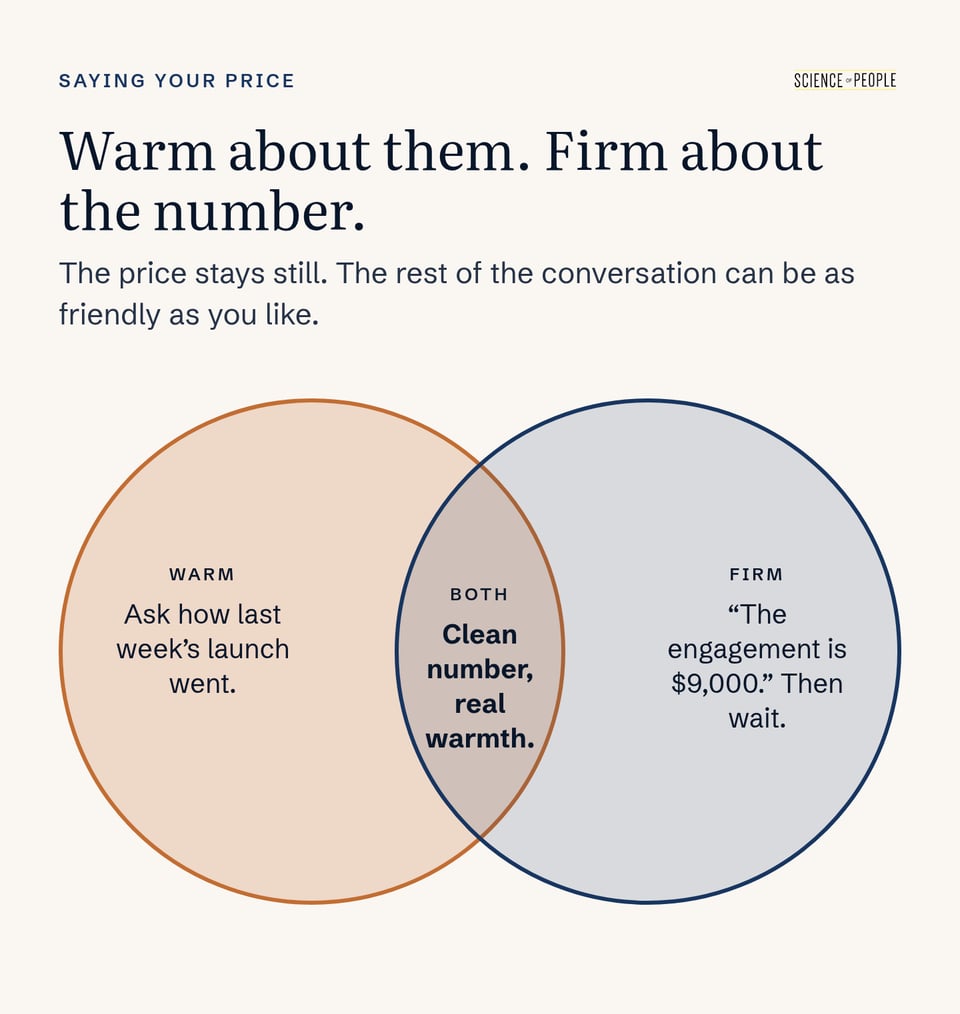
A consultant might say, “The engagement is $9,000,” and count to three. Then they ask how last week’s product launch went, because they actually want to know. The client gets a clear price from someone who seems to care how things turn out.
Who would you rather hire: the person who mumbles the price and apologizes, or the one who says it cleanly and asks about your week?
Easy call.
Saying a price calmly and kindly is a people skill, and the job market pays attention to people skills. Between 1980 and 2012, jobs requiring high levels of social interaction grew by nearly 12 percentage points as a share of the U.S. labor force.6
Frequently Asked Questions (FAQs) About Saying Your Price
How do I tell a client my price without sounding nervous?
Write one sentence that puts the scope first and the number last, then say it the way you’d say your name: flat and certain. “For the full brand identity, with the logo, color system, and a one-page style guide, the project is $6,500.” Rehearse it out loud until the words feel boring, and let the last word drop instead of lifting into a question.
What should I say after I give someone my price?
Nothing, for three full seconds. Keep your eyes on the client (or the camera) and let them take the number in. If the quiet stretches past that, hand the floor back with “What questions do you have?” instead of softening the price.
How long should I pause after saying my price?
Count to three in your head before you say another word. Pauses that long or longer have been linked to better deals for both sides, and the quiet person doesn’t walk away with a bigger slice. If it still feels endless, that is your nerves talking, not a cue to rescue the moment.
Should I name my price first, or wait for the client's budget?
Name yours first when you know what the work is worth. The first number on the table tends to pull the final price toward it. If a client asks, “What were you thinking, budget-wise?”, answer with your number. The exception is work you have never priced before. Then hearing their figure first can teach you what they expect.
What if the client names a low number before I do?
Their number doesn’t have to become the center of the conversation. Glance at a note with your own price so you have something to focus on besides theirs, then come back to your number and the scope it covers. The first-offer pull fades when you keep your own target in view.
How do I handle a client who says my price is too high?
Ask one question before you offer anything: “Is it the total that’s the problem, or the timing?” A price objection is often about timing, payment schedule, or confusion about what they get. Only one of those answers actually touches your number.
What should I do if a client asks for a discount?
Trade for it instead of giving it away. Drop a round of revisions, offer a lower monthly rate for a longer commitment, or lock the current rate if they sign by a date you choose. A free discount teaches them the price was soft. A trade keeps the value of the work intact.
What is a panic discount?
A panic discount is a price cut you hand over before anyone asks for it. It usually slips out in the second or two after you say the number, or inside phrases like “I know that’s a lot” and “but I can be flexible.” Say the number, then count to three instead.
How do I raise my rates with existing clients?
Give them the new rate, the start date, and one reason, in writing, well ahead of time. Make the reason about what the work costs you, like software, hours, or the help you hire for overflow. One reason sounds solid. Five start to sound like a defense.
How much notice should I give before a rate increase?
Thirty days is the minimum, and 60 is kinder for a monthly retainer. You can say it on a call first if you want, then send the same short version in writing the same day. After you say the new number, give it the same three-second hush you would give a new quote.
Should I keep longtime clients at their old rate?
You can, for a while, as long as the exception has an end date in writing. “Because you were one of my very first clients, I’m keeping you at $1,200 through June. Starting July 1, your rate will be $1,350.” Quote any new work at today’s price, and put a reminder on your calendar a month before the change.
What should I write in a rate increase email?
Keep it short: a warm opening, the new rate, the old rate, the start date, one cost-based reason, and a note that the scope stays the same. Invite them to talk through timing or scope if they need to. Then send it. Sitting in drafts doesn’t make the conversation easier.
How to Tell Clients Your Price Takeaway
If you only have a minute before your next pricing call, start here:
- Write your price sentence tonight, with the scope first and the number last. Say it out loud five times and let the last word drop every time.
- Count to three after the number. On your next call, keep quiet for three full seconds before you add anything.
- Pick your trades in advance. Before your next quote, write down one scope cut, one commitment, and one sign-by date you’d accept in exchange for a lower price.
- Draft the rate-increase email this week. Copy the template above, swap in your own rate and reason, and schedule it to send.
- Name your grandfathered clients. Decide who stays at the old rate, and put their end date on your calendar today.
For more on staying firm while keeping things friendly, read our guide on how to be more assertive without being aggressive.