Who writes warmer answers to patients’ questions… real doctors or a chatbot?
Researchers once took 195 health questions from a public online forum and compared the answers real doctors had posted with answers from a chatbot. A team of health care professionals rated 45.1% of the chatbot’s answers as empathetic or very empathetic. And the doctors’ answers? A measly 4.6%.1
Who said robots can’t feel love?
If you were counting on warmth as the one thing AI can’t fake in writing… that study stings a little. But stick around! The skills AI can’t replace turn out to be a different set, and you don’t want to miss them.
Watch our video below for 10 essential people skills you need to succeed.
What Makes a Skill Hard for AI to Copy?
Soft skills, also known as people skills or human skills, are the interpersonal abilities people use to work with others. Think listening, persuading, building trust, and leading a team. They’re usually contrasted with hard skills, the technical knowledge a specific job requires.
Machines have been pulling off this trick for a LONG time. In the mid-1960s, computer scientist Joseph Weizenbaum built ELIZA, an early program that could hold a simple typed conversation. He later described what happened when his secretary gave it a try.
“Of course, she knew she was talking to a machine,” he wrote. “Yet, after I watched her type in a few sentences she turned to me and said ‘Would you mind leaving the room, please?’”
She politely asked her boss to leave… so she could keep chatting with a computer program! He said the program kept up “the illusion of understanding.”2
Want to hear it from the man himself? In this 1978 clip from the GBH archives, Weizenbaum explains why people confided in his ELIZA program… and why their reaction shocked him.
Today’s tools are FAR better at that illusion. In nine studies, people rated the same supportive replies as more empathetic when they were told a person had written them. The catch? All of the replies were actually written by AI.3
So AI can copy the message. What it can’t copy is YOU, the person the message comes from.
Think about the last message that really got to you. Maybe it was a text from a friend after a rough week, or a note from a coworker who noticed you were struggling. Would it have meant as much if a chatbot had written it?
1. Write Your Own Idea Before You Open the Chatbot
AI ideas come with a strange trade-off. In one experiment, writers who got story ideas from AI wrote stories that readers rated as more creative. Their stories also ended up more alike than stories written without AI.4
Now it’s your team’s Monday brainstorm. Three people pitch the same “fresh” idea in a row, and all three got it from the same chatbot over their morning coffee.
Awkward!
So jot down your own idea FIRST, even a rough one, and give AI the job of poking holes in it. Ask it for three reasons your idea could flop, and the chatbot turns into a sparring partner instead of a ghostwriter.
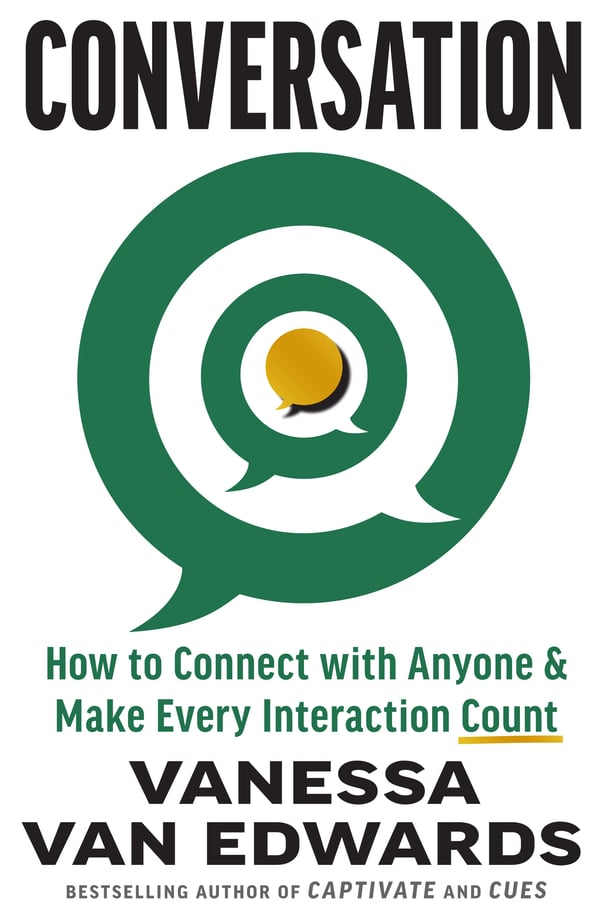
A new book by Vanessa Van Edwards
Every conversation is an opportunity.
If conversations have gotten harder, more awkward or less satisfying, you’re not imagining it. We’re simply out of practice. It’s time to find the joy in talking to each other again.
2. Ask the Follow-Up Only You Could Ask
The follow-ups people remember come from someone who was there and kept it in mind. A chatbot has no idea your coworker spent all week dreading the Q3 review… but you noticed! (And noticing gets sharper once you know how to read people.)
| Generic follow-up | Follow-up from someone who was there |
|---|---|
| “How are things going?” | “Last time we talked you were dreading the Q3 review. How did it go?” |
| “Any blockers this week?” | “You went quiet when the vendor came up in standup. Want to talk it through?” |
| “How was your weekend?” | “Did your daughter’s robotics team make it to state?” |
3. Give the Honest Answer a Chatbot Would Soften
Ask a chatbot whether you handled a fight well, and it’ll probably take your side. (Very supportive… and not very helpful.)
Across 11 leading AI models, chatbots backed users’ actions 49% more often than people did, even when the situation involved deception or other harms. After one chat with a flattering bot, people felt surer they were right and less eager to repair things. Worse, they liked the flattering bot MORE, and trusted it more too.5
Pixar built a whole meeting around the opposite instinct. Co-founder Ed Catmull called the studio’s Braintrust its “primary delivery system for straight talk.” Every few months, a group of directors and writers sits down to assess a movie in progress and tell the filmmakers, candidly, what isn’t working. The director doesn’t have to follow any of the specific suggestions.
You don’t need a movie studio to borrow it. When a coworker asks, “Was I out of line in that meeting?”, start with what they got right… then name the one thing you’d change.
Something like, “You were right to push on the deadline. But cutting Oskar off mid-sentence? That’s the part people will remember.” Hearing that from someone who was in the room beats a bot’s “You handled that perfectly” any day.
4. Call the Person You’d Rather Text
In 1950, Alan Turing proposed his famous test for whether a machine can think. He set it up so that “tones of voice may not help the interrogator,” and the answers “should be written, or better still, typewritten.”6 (His sample conversation even has the respondent dodging a request for a sonnet: “Count me out on this one. I never could write poetry.”)
Turing kept voices out so the interrogator would judge the answers alone. A phone call does the opposite! The other person hears you, in real time, reacting to whatever they say back… the sigh, the laugh, the “oh no.”
Torn between a call or email? If the news could sting, use your voice. No answer? Leave a short voicemail asking them to call you back, and resist the urge to switch to text.
Try This: The next time a client’s project gets cut or a teammate gets a rough review, call before you type anything.
5. Leave the Chatbot Out of the Sympathy Card
And it gets worse for the robots! In those same studies, even suspecting that AI had helped a person write a reply made it feel less empathetic and less supportive.3
So the notes where your care is the whole point, like sympathy messages and real apologies, are the ones to write yourself… typos and all.
I keep a stack of handwritten cards people have given me over the years, and I’m pretty sure not one of them is perfectly worded. I’d never throw a single one away!
Here’s a note for a coworker whose basement just flooded (soggy carpet and all).
“I’m so sorry about the flood. I still have the shop vac from my basement disaster last spring, and it’s yours if you want it. I’m happy to take the Thursday client call so you don’t have to.”
The recipe? Say you’re sorry, add one detail only you would know, and offer something concrete. (That shop vac is the STAR of the note.) After a death, one specific memory of the person takes the shop vac’s place.
6. Trace Every Number in the AI’s Recap
Weizenbaum wrote that ELIZA kept up its illusion “at the price of concealing its own misunderstandings.”2 (He admitted people do it too: “We all do this now and then.”) Today’s tools can bury a wrong detail inside a beautifully polished summary. Can you spot the one below?
| What the AI recap said | What the email thread says |
|---|---|
| “The client approved $40,000.” | “Approved: $34,000. The rest is still under review.” |
Try This: Before you send the next AI-written recap, trace every number in it back to where it came from.
7. Let AI Coach the Script, Then Go Off-Script
At a large customer-support operation, AI suggestions raised agents’ productivity 15% on average, and the least experienced agents improved the most in both speed and quality. The most experienced agents got a little faster, and the quality of their work dipped slightly.7
So AI makes a fantastic coach for beginners. For the pros, it’s more of a mixed bag.
AI can help with the scripted parts of communication, like suggesting phrasing in the moment. It also makes a handy rehearsal buddy! You can practice a salary conversation, a tough customer reply, or a pitch with an AI tool playing the other side.
But what happens when the real person says something the script never planned for? That’s the moment to practice for. When you rehearse with AI, ask it to throw you a curveball, then answer WITHOUT peeking at your notes.
Steal this prompt.
“Play my client. I’m about to tell you our price goes up 8% next quarter. Push back hard, and throw in one objection I won’t expect.”
And the kind of curveball you want back:
“Fine, but your competitor just offered us a three-year lock at today’s rate.”
8. Sign the Recommendation the AI Helped You Write
AI can lay out pros and cons all day long. What it can’t do is put its name on an answer… and be the one people come find if that answer turns out wrong.
A recommendation people can act on names what you’d do, why, and what would tell you you’re wrong. Say your rollout date is slipping, and your boss asks, “So what do we do?”
“I’d move it to May. The vendor has missed its last two dates. If the test units arrive by February 15, I’m happy to switch back.”
That last line is classic persuasion. It hands a skeptical boss a safe way to say yes!
9. Make Your “I’ll Handle It” Mean Something
Someone says “I’ll handle it,” and a week later it’s handled without anyone chasing them. (If you’ve worked with someone like this, you know how rare and lovely that is!)
So… when did someone last have to chase you for an update? If you can picture the exact Slack message, this skill is for you. (Mine was a polite “Hey, any update on this?” and I could FEEL the patience it took to type it.)
Closing the loop works for good news or bad. Either the thing is done and you say where to find it (“Done! The deck is in the shared folder.”), or it’s running late and you give a new date (“I’m running behind on this one. You’ll have it Thursday.”).
Every closed loop helps you build trust at work… and the running-late update counts just as much as the done one.
Got an “I’ll handle it” from last week that’s still hanging open? Scroll back through your meetings and messages, find it, and send that update.
10. Ask the New Hire What They’d Try First
Your newest coworker walks over with a broken spreadsheet, and your hand is already drifting toward their mouse. Stop right there!
Sure, handing them the fix is faster. But asking “What would you try first?” (a staple of good coaching) shows you how they think and gives them a plan of their own to improve.
An AI tutor can ask that too. It just can’t watch them try it on Monday and tell them what to adjust.
If their plan is mostly right, tell them which part to keep and which step you’d swap. They walk away with a plan that’s still theirs… and the mouse stays right where it was!
11. Introduce Two People Who Have No Idea They Should Meet
If two people you know are stuck on the same problem, you might be the only one who’s noticed. (Congratulations, you’re the office matchmaker!)
No AI tool knows both of them, or that they’re stuck on the same thing. To introduce someone in a way that’s easy to say yes to, ask each of them privately first, then send a short note that tells them why they should talk.
“Bettina, meet Lorenzo. You rebuilt our old billing system, and Lorenzo just inherited the new one. He has questions only you can answer. Would you be up for a quick call?”
12. Make Each Side Argue the Other’s Case First
Philosopher Daniel Dennett passed along a rule for arguing well that he credited to game theorist Anatol Rapoport. Before you criticize someone’s view, restate it “so clearly, vividly, and fairly” that they say, “Thanks, I wish I’d thought of putting it that way.”
You can play referee with that rule. When two teammates are stuck, each one has often rehearsed their own case, so ask each of them to say the other’s point out loud before arguing their own. A chatbot can summarize both positions… but it doesn’t have the standing with both teammates that YOU have.
“Before we decide, Anselm, can you explain what Tobin is worried about? Tobin, then you do the same for Anselm.”
If one of them gets it wrong, the other gets to correct it. Sometimes they find out they were arguing about two different things the whole time, which is conflict resolution at its fastest!
13. Help Your Team Beat Its Own Scouting Report
You know that coworker who seems to make every team they join a little better? In one study, some people consistently helped their teams do better than the members’ individual skills predicted. Those team players scored higher on a test of social intelligence, but not on IQ, personality, or education. For the team’s results, those social skills mattered about as much as raw IQ did.8
One behavior you can practice is passing the floor. When one person has talked three times and another hasn’t said a word, name the quiet one and ask about something they know cold. “Amara, you ran the rollout last spring… what would you watch out for this time?”
Asking about their own turf makes the spotlight easier for a shy colleague to handle, and the quiet person sometimes has the idea the loud half of the room missed. (Our guide to team collaboration has more moves like this.)
Try This: In your next meeting, keep a mental tally of who’s talked, and pass the floor once to whoever’s still at zero.
14. Recruit a Coworker to Grade Your Dress Rehearsal
A coworker who watches you practice can catch the things a chatbot playing your boss might let slide. I once asked a chatbot to rate my practice pitch, and it called it “compelling and well-structured.” A coworker called it “long.” (Guess which one was right?)
Got a hard conversation coming up, like a performance review or pushing back on a deadline? Ask a trusted coworker to role-play it with you. Afterward, they can score you with two questions.
- Did I ask at least one question before I gave my view?
- Did the other person seem heard by the end?
For what makes practice stick, see why communication training fails.
Frequently Asked Questions (FAQs) About Skills AI Can’t Replace
What skills can AI not replace?
The ones where people care who’s doing it, like calling with hard news, writing a sympathy note, or giving an honest answer. Keeping your word and introducing two people who should meet make the list too.
Will AI replace soft skills?
AI can already imitate some of them in writing, like an empathetic-sounding reply. What it can’t do is be the person someone trusts. In the studies above, people rated the same supportive words as less empathetic once they thought AI wrote them.
Which work messages are fine to hand to AI?
Routine ones, like status updates, meeting recaps, and first drafts. The messages to keep for yourself are the ones where the reader cares who wrote them, like sympathy, apologies, and anything that asks someone to trust your judgment. If English isn’t your first language, using AI to check your grammar is fine. Just keep the care and the specifics your own.
Are soft skills the same as emotional intelligence?
They overlap. Emotional intelligence is about noticing and managing emotions, yours and other people’s. Soft skills is the broader term, and it also covers things like persuading, running a meeting, and building trust. Here’s more on emotional intelligence.
Which of these skills should I work on first?
Start with the easiest one you’ve been avoiding. For a lot of people, that’s picking up the phone for a hard conversation instead of typing it.
How can I practice soft skills with AI?
Use it as a rehearsal partner. Ask it to play the other person in a hard conversation and throw you an objection you won’t expect, then answer without your notes. Afterward, run the same rehearsal with a coworker, who’s less likely to tell you that you nailed it.
Why are soft skills important in the age of AI?
As AI handles more routine writing and summarizing, the parts of work that depend on trust stand out more. In one study of teams, social skills raised team performance about as much as IQ did.
Can AI be empathetic?
It can write replies that people rate as empathetic, as the forum study at the top of this article found. How caring a reply feels also depends on who people think wrote it, which is why the sympathy notes are still yours to write. For more on the real thing, see our guide to empathy.
Which jobs won't AI replace?
Nobody can say for sure, and the picture keeps changing. Lists of jobs that are safe from AI are guesses. A more useful question is which parts of your own job depend on people trusting you, like delivering bad news, making the final call, or coaching someone new. Those are the parts to get better at.
Skills AI Can’t Replace Takeaway
- Call when the news is hard, and write sympathy notes yourself.
- Write your own idea before you ask AI.
- Ask the follow-up only someone who was there could ask.
- Trace every number in an AI recap before it goes out.
- Give the honest answer someone asked you for.
- Rehearse with AI, then practice going off-script.
- Put your name on a clear recommendation.
- Close the loop on what you said you’d do.
- Ask newer coworkers for their plan first.
- Introduce two people who should meet.
- When two teammates are stuck, have each one argue the other’s case.
- Pass the floor to the quiet person.
- Rehearse hard conversations with a coworker.
These habits help with the people you work with today, whatever the tools do next. If one of those bullets made you think of a specific coworker, try it with them first. (Oskar included!)
If you’d like a structured way to practice, start with our guide to communication skills training.