Advice about social anxiety usually works on you: your thoughts, your confidence, your willingness to push through the discomfort. That’s a real lever, and it’s the one nearly every article reaches for.
There’s a second lever, and it costs a good deal less nerve. How hard a social situation feels depends heavily on how that situation is built—how long it runs, whether you have anything to do, and whether you’ll be in the same room again next week. All of that is adjustable before you arrive.
Think about the last invitation you turned down. Was it the people? Or was it the shape of the thing: three hours long, no obvious exit, nobody to talk to but strangers. (If it was the shape, this list is for you.)
What Social Anxiety Feels Like
Social anxiety is persistent worry about being judged, embarrassed, or found wanting in social situations, together with a pull toward avoiding those situations. It’s also known as social phobia. It tends to show up as dread beforehand, self-monitoring during, and a long mental rerun afterward.
It sits on a spectrum. Plenty of people get a version of it before one specific kind of event, like a work presentation or a party where they’ll know two people, and feel fine everywhere else. For others it runs across most of their social life.
Where you fall on that spectrum is worth knowing, and it isn’t something an article can tell you.
We are so honored to help you find authentic connections! If you are struggling to find the help you need, please note that all content found on this website is not to be considered professional medical advice. It is always best to consult a doctor or licensed therapist with any questions or concerns in regards to your physical or mental health. For a good resource for therapists, you can check out Mental Health America’s helpful list.
Why the Room Matters More Than Your Nerve
Ask someone with social anxiety what makes it hard and they’ll usually describe themselves: too awkward, too quiet, bad at this. Ask what would fix it and they’ll describe a different personality.
Two things sit against that. The first is that the comparison driving it is skewed. Eleven studies covering 3,293 people1 found that people consistently believe others go to more parties and sit closer to the inner circle of their social world than they do. It held among college students, online panels, and shoppers at a mall, and it tracked with well-being. The reason traced back to who springs to mind: the most sociable people you know are the easiest ones to picture, so they quietly become the yardstick. When the studies made those people harder to call to mind, the bias went away.
The second is that difficulty is spread very unevenly across situations. The same person can find a two-hour mixer unbearable and a two-hour hike with the same people completely fine. That gap is structural. It comes down to duration, format, whether there’s a task, and whether there’s an exit, and all four are things you get to pick.
The changes below work on structure. Not one of them requires feeling differently first.
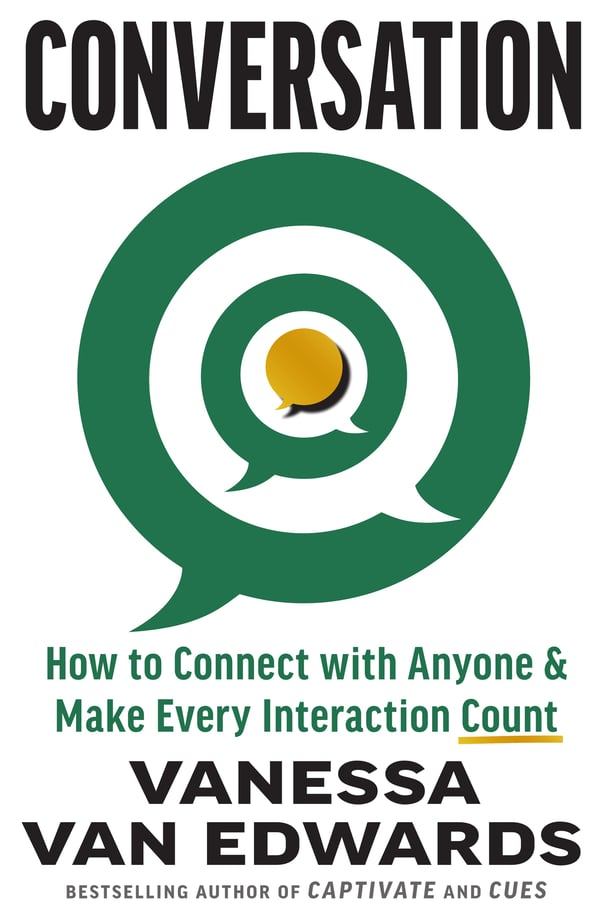
A new book by Vanessa Van Edwards
Every conversation is an opportunity.
If conversations have gotten harder, more awkward or less satisfying, you’re not imagining it. We’re simply out of practice. It’s time to find the joy in talking to each other again.
How to Lower the Cost of Showing Up
Use the following tips like a buffet—take the ideas that take your fancy, and leave the ones that don’t fit.
1. Give Yourself a Job
The fastest way to make a room easier is to walk in holding a task.
At work, that means volunteering for the thing nobody else wants: running the agenda, taking notes, staffing the sign-in table, setting up chairs. At a party, it’s helping in the kitchen or taking coats. A job does three things at once. It gives you a reason to move around, so you’re never parked in one spot deciding who to approach. It gives you an opening line that has nothing to do with you: “Do you know where the extra chairs went?” And it gives you an exit from any conversation that stalls, because you have somewhere to be.
Consider a new hire who dreaded the quarterly all-hands and spent two of them against the back wall. At the third, they offered to run the check-in table. They spoke to nearly everyone in the company that morning, one name at a time, with a clipboard doing most of the work.
Action Step: For the next work event on your calendar, reply to whoever organized it and ask what needs doing.
2. Get There Before the Room Fills
Walking into a space where everyone is already seated and talking is one of the hardest single acts in social life. It’s also avoidable.
Arrive first, or close to it. An empty room asks nothing of you. You pick your seat, get your bearings, and then meet people one at a time as they trickle in, which is a completely different task from breaking into a group that has already formed. The people arriving after you are the ones scanning for a way in. You’re already in.
Oh, and this runs against the usual instinct, which is to turn up late enough to slip in unnoticed. Late arrival tends to cost more: every group in the room has already closed, and each one has to open again to let you in.
3. Pick Shoulder-to-Shoulder Over Face-to-Face
Sitting across a table from someone means sustained eye contact, nothing to look at but them, and no natural pauses. A walk means none of that.
Side-by-side activities take the pressure off. Eye contact becomes occasional and optional. Silence feels less like failure when you’re both looking at something else. And you get a third thing in the conversation, whether that’s the route, the road, the game, or the dough you’re both kneading, which means you’re rarely out of material.
This is why a drive with a friend often goes deeper than a dinner with them, and why “let’s get coffee” is a heavier ask than “walk me to the station.” (If you’ve ever driven a few hours with someone and ended up somewhere you’d never have reached across a table, you know the effect.)
Try This: Take your next one-on-one catch-up outside. Suggest a walk, and notice how much less work the pauses feel like.
4. Choose the Repeat Over the One-Off
If you change one thing on this list, change this one.
In a 1992 field study2, four women posed as students in a large lecture course. One attended 15 sessions, one attended 10, one attended five, and one never went at all. Each of them arrived a few minutes early, walked toward the front, sat where she could be seen, and took notes through the lecture. None of them spoke to a single student all term.
At the end, the class rated the four women from photographs. The one who had attended 15 times scored highest on how familiar she seemed, how similar to themselves she seemed, and how attractive they found her. The one who never came scored lowest.
Fifteen silent appearances beat zero. And those are photo ratings, from a room where nobody spoke to anybody and nobody made a friend. But the finding points at something useful: familiarity accumulates quietly, and it doesn’t ask you to perform. A weekly class where you say very little for a month may be building more familiarity than four different parties where you work the room.
So favor things that recur, and bolt them onto something you already do. The run club that meets where you already run. The Thursday evening class on your way home from work. Recurrence is far easier to sustain when it costs you no extra decision.
5. Trade the Mixer for the Structured Thing
An open networking event hands you nothing: no turn-taking, no topics, no reason to be standing where you’re standing. A pottery class hands you all three. (Ever noticed how much easier it is to talk to somebody while you’re both quietly failing at the same thing?)
Structure does social work you’d otherwise have to generate yourself. In a class, a league, a choir, a book club, or a volunteer shift, a schedule decides when people talk, a subject decides what they talk about, and everyone has a shared reason for being in the room.
Structured prompts also tend to beat open-ended chat for building closeness. A 1997 procedure3 paired strangers for about 45 minutes and gave some of them a set of escalating personal questions and others comparable small-talk tasks. The question pairs reported greater closeness afterward.
Action Step: Find one recurring, structured activity near you this week. The requirement is that it meets on a schedule and has an activity in it other than talking.
6. Bring a Body Double
“Body doubling” comes out of ADHD communities, where it describes having a second person present while you do something you’d otherwise put off. It transfers to social situations well.
Pick someone you trust who finds this easier than you do, whether that’s a friend, a sibling, or a colleague. Tell them plainly what you’re asking for. Then have them come with you.
Tasks worth a body double:
- A doctor’s appointment
- A house party where you’ll know almost nobody
- Your first day at a new job
- Sitting with you while you make a phone call you’ve been putting off
- Exploring the supermarkets in a new area after moving house
A body double is scaffolding for the first few attempts, and scaffolding is meant to come down. If you’re still bringing someone to the same event a year from now, the scaffolding has quietly become the building. Use it for the first three times, then try the fourth on your own.
7. Set a Hard Stop Before You Go
Decide when you’re leaving before you arrive, and tell one person.
An open-ended event is infinitely long in advance. A 40-minute event is 40 minutes. A lot of the dread on the way to something is dread about a duration nobody has defined, and defining it takes about four seconds.
Twenty minutes counts. Showing up and leaving early is a completed attempt, and completed attempts are the ones you repeat. An hour you white-knuckled and then swore off is worth less than three short visits.
Ask yourself: what’s the shortest version of this event that would still count as having gone? (Whatever number came to mind, that’s your hard stop.)
Action Step: Before your next event, pick a leaving time and text it to someone who’ll be there. Saying it to another person is what makes it stick.
8. Reset Before You Walk In
Two minutes in the car or the corridor, before you go in.
Don’t underestimate the power of a deep breath. A 2018 review of slow-breathing research4 looked at techniques that bring you under 10 breaths a minute, with most of the studies working in the four-to-six range. Across that literature, slower breathing was associated with a shift toward parasympathetic activity (the rest-and-digest side of the nervous system, and the counterpart to fight-or-flight) and with reports of more comfort and less anxiety. These are correlations, and the heart-rate measurements were taken during the breathing itself.
If your head is somewhere else entirely, the 5-4-3-2-1 method can help pull it back. Name five things you can see, four you can touch, three you can hear, two you can smell, and one you can taste. For 60 seconds your attention is on the room, and the rerun in your head has nobody to play to.
9. Say the Nervous Part Out Loud
One sentence, early. “I always find these a bit much.” “I don’t know a soul here, so I’m attaching myself to you for ten minutes.”
Hiding nervousness is expensive. It runs in the background all evening and takes attention away from the conversation you’re actually in. Saying it costs one sentence (hint: the second one tends to get you a laugh and a drink handed to you).
It works better than people expect because your audience is grading on a different curve than you are. Across studies of situations that require exposing yourself (confessing romantic feelings, revealing physical imperfections, asking for help), people described their own vulnerability in terms like weakness and exposure, while describing the identical act in someone else as courage and authenticity5. Admitting nerves wasn’t one of the situations tested, so treat this as a reasonable extension rather than a measured result. The direction is consistent, though, and the downside of one honest sentence is small.
Check out what nervous laughter is actually doing when it turns up uninvited:
10. Walk In With One Question
One question, picked for this specific room, ready before you go in.
“How do you know the host?” works at a party, “What are you working on at the moment?” at anything work-adjacent, and “Have you done one of these before?” at a class.
The question matters far less than having it ready. You never have to stand there generating one from nothing, which is the part people tend to describe as the worst. If you want a wider pool to draw from, there’s a longer list of conversation starters here.
11. Build the Skill That’s Actually Missing
Some of the dread is a prediction about how the interaction will go, and sometimes that prediction is accurate, because the underlying skill genuinely isn’t there yet.
Okay, you might be wondering whether that’s a discouraging thing to admit. It’s the opposite. Starting a conversation, introducing yourself, remembering names, reading a room, and ending a chat gracefully all improve with practice. Social skill also shows up in results that have nothing to do with charm. In a 2021 study6 that randomly assigned people to multiple teams for a set of problem-solving tasks, teams whose members scored higher on a test of reading emotion from faces performed better, which is worth knowing if the rooms you dread are mostly work rooms.
Pick one and work on it this week:
- How to be funny
- The nice person’s guide to being assertive
- Interpersonal intelligence skills
- Be more likable using science-backed strategies
- How to remember names
- How to be more confident
If you want coaching and more advanced strategies, consider joining our science-based online communication course, People School.
12. Check What You’re Comparing Yourself To
The belief underneath a lot of this is that everyone else finds it easy, and you’ve already met the evidence against it. People tend to assume others go to more parties and sit closer to the social center than they do, largely because the most sociable people they know are the easiest to bring to mind. Widen the range of people you picture and the gap closes on its own.
Think of three people whose social lives look easier than yours. Write them down: ________ Now add the three quietest people you know. That second list tends to be harder to write, which is the whole bias in one exercise.
Which matters, because that comparison is what makes avoidance so tempting.
I get it. I understand—sticking your head in the sand is the easiest way to avoid your social anxiety.
Big deadline coming up? Let’s go tidy the bathroom instead. Worried about how you are going to tackle that next presentation at work? Let’s start Googling something entirely unrelated.
Avoidance works, briefly, and that’s exactly what makes it hard to give up. The relief arrives immediately and the cost arrives later, which is the worst possible arrangement for learning anything.
None of this turns a hard room into an easy one. Some rooms stay hard. What changes is how often the nerves get to decide what you do. If you want the cognitive side of this, including the specific biases that inflate how badly you think an interaction went, we cover those in depth separately.
Social Anxiety FAQ
Do I have social anxiety, or am I just shy?
They overlap, and the difference is mostly degree and reach. Shyness tends to be a warm-up problem: you need a few minutes to settle with new people, or you feel most like yourself around old friends. Social anxiety is more persistent and usually comes with avoidance, so it shapes which invitations you accept and which rooms you walk into. If it’s affecting your work or your relationships, a doctor or licensed therapist is the right person to ask.
How does social anxiety affect work?
Usually through small things. Staying quiet in meetings, skipping the optional events where informal networks form, avoiding a call that would be faster than a thread. Those add up to fewer opportunities over time, which is why claiming a role, arriving early, and favoring recurring commitments apply so directly at work.
Which of these should I try first?
Pick something recurring and give yourself a job inside it. Those two combine well: the recurrence means familiarity builds without you having to do anything clever, and the role means each individual visit has a shape. A weekly volunteer shift covers both at once.
What if I still feel nervous after all this?
Then it’s working as intended. None of these remove the feeling, and an approach that promised to would be worth distrusting. What they change is how much nerve a given event demands, which is the difference between an invitation you decline and one you accept and survive. If the nerves are severe enough to be shrinking your life, that’s a conversation for a professional.
Social Anxiety Takeaway
- Pick one recurring weekly thing and commit to four appearances before you judge whether it’s working.
- Before your next work event, claim a job. Offer to run the agenda, take the notes, or handle the sign-in table.
- Decide your leaving time before you go, and tell one person what it is.
- Swap one face-to-face plan this month for a side-by-side one: a walk, a drive, a game, or a shared task.
- Text one person and ask them to come with you to the next thing you’re dreading.
- Choose the single social skill you most want to improve, and work one article’s worth of it into this week.
Start with the recurring thing. If you want somewhere to point the confidence you build there, try Self Worth: 20 Ideas to Build Self Esteem.
- Deri, Davidai & Gilovich, Home alone: Why people believe others' social lives are richer than their own (Journal of Personality and Social Psychology, 2017)
- Moreland & Beach, Exposure effects in the classroom: The development of affinity among students (Journal of Experimental Social Psychology, 1992)
- Aron, Melinat, Aron, Vallone & Bator, The Experimental Generation of Interpersonal Closeness: A Procedure and Some Preliminary Findings (Personality and Social Psychology Bulletin, 1997)
- Zaccaro et al., How Breath-Control Can Change Your Life: A Systematic Review on Psycho-Physiological Correlates of Slow Breathing (Frontiers in Human Neuroscience, 2018)
- Bruk, Scholl & Bless, Beautiful mess effect: Self-other differences in evaluation of showing vulnerability (Journal of Personality and Social Psychology, 2018)
- Weidmann & Deming, Team Players: How Social Skills Improve Team Performance (Econometrica, 2021)