In January 2003, a chunk of foam hit the wing of the Space Shuttle Columbia during launch. While the astronauts were in orbit, engineers briefed NASA managers on whether it was a problem.
The report looked like good news, at first. But the most important fact was buried in the very last line… the foam was hundreds of times bigger than anything in their test data.
Columbia broke apart on its way home, and all seven astronauts unfortunately didn’t make it. Investigators later said it was easy to see how a manager could read that report and never realize it described a life-threatening situation.1
Most of us will never brief anyone about a spaceship. But we bury the bottom line all the time… in status updates, in emails, and in six minutes of background before we finally say what we need.
The military calls the fix bottom line up front, or BLUF. You say the answer first and the reasons second.
What Is Bottom Line Up Front (BLUF) and When Should We Use It?
Bottom line up front, also known as BLUF, is a writing and speaking practice in which the main point, decision, or request comes in the opening sentence, followed by the supporting details.
Using BLUF is so important that the US Army correspondence rules list it as one of two essential requirements of Army writing.2
The Army’s bar is high. Good writing, the rules say, is understood “in a single rapid reading.”
Use BLUF any time someone has to decide, approve, or act on what you’re saying. At work, that covers status updates, project check-ins, budget requests, and pretty much anything you send to a manager with a packed calendar.
If your boss is reading between meetings, your first line might be the only one they get to before they reply.
The same goes for Slack and Teams messages, comments in your project tool, meeting invites, and the first 30 seconds of a video call. On a call, some of the faces on screen are probably glancing at their inbox (we’ve all done it!). So say the point before they drift.
Why the Smartest Person Overexplains
In one study, people with more expertise in a task were worse at predicting how long it would take a beginner to finish it. They kept underestimating beginners, even after they were given techniques meant to correct that bias.3
Experts also tend to just explain things differently. When experts taught beginners a circuit-wiring task, they used more abstract, technical statements AND fewer concrete ones than less-experienced instructors did!
The novices they taught did worse on that exact task than novices taught by the less-experienced instructors.4
So if you’re the expert in the room, you might be overexplaining… the exact thing you want to avoid if you want to be a clear, concise communicator to a general audience.
So how do we actually do BLUF without overexplaining or being technical? Here’s where to start:
A new book by Vanessa Van Edwards
Every conversation is an opportunity.
If conversations have gotten harder, more awkward or less satisfying, you’re not imagining it. We’re simply out of practice. It’s time to find the joy in talking to each other again.
Give People the Topic Before the Details
Let’s say you have NO idea what a talk is about, and you hear this:
“Of course, one pile may be enough depending on the capacity of your equipment. Maybe two, max.”
Hard to say, right? Now read it again knowing they’re about doing laundry. Suddenly the piles make sense!
A 1972 study in the Journal of Verbal Learning and Verbal Behavior had people listen to passages like that one. People who heard the topic before the passage understood it better and remembered much more of it. People who got the topic right after the passage did about as poorly as people who never got it at all.5
That’s likely what happens in a meeting where the point comes last. Your listeners hear the details first, with nothing to hang them on. By the time you reveal what the details were for, it’s too late to even help them remember.
Your first sentence tells people what this is about and what you need from them.
Write Your Bottom Line in One Sentence First
Before the meeting or the email, write one sentence with three parts:
- The answer. What you found, decided, or recommend.
- The ask. What you need from the other person.
- The deadline. When you need it.
Here’s what that looks like for three everyday situations:
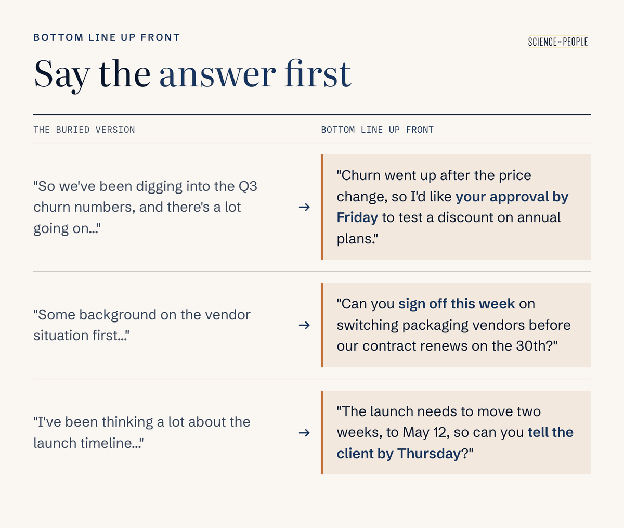
Not every bottom line has an ask. A status update might be “We’re on track for the 14th, and nothing needs your attention.” That counts too! (It’s also the update everyone secretly hopes to hear.)
Could someone who reads only this sentence act on it? If they’d still have to ask “So what do you want from me?”, it needs another pass.
Think about the next update you have to give. What’s your one sentence?
Write it down: ________
Open the Meeting With the Answer
Talking is harder than writing most of the time (you can’t exactly delete what you say!). So the bottom line goes in your first breath, your top two or three reasons come next, and the ask gets repeated at the end again.
Here’s a 30-second version:
“Bottom line, I think we should move the launch two weeks, to May 12. There are two main reasons. QA found a payment bug we can’t fix by the 28th, and the client’s team won’t be trained in time. I need a yes from you today so I can tell the client tomorrow. I’m happy to walk through any of the details!”
This works for questions too. When your boss asks “Can we ship Thursday?”, they want a yes or a no in your first breath.
“Yes, we can ship Thursday. The one risk is the security review, and here’s my plan” gets you there. “So, there are a few moving parts here…” is the spoken version of a loading screen.
Worried that sounds abrupt? One warm line up front fixes that, like “Thanks for making time! Bottom line, we should move the launch.”
And all that backstory? Keep it in your back pocket. When someone asks “How did you get there?”, that’s your invitation to tell the whole thing.
Explaining your work so other people can act on it is a people skill.
Put the Ask in the First Two Lines of Your Email
Researchers emailed 7,002 school board members asking them to take a short survey. Some got a 127-word email. Others got a 49-word version.
The 49-word email got a 4.8% response rate, compared with only 2.7% for the 127-word one.6 Both emails asked for the exact same five-minute survey!
So the setup paragraph might be costing you replies. And in a busy inbox, the subject line and the preview text might be all someone sees before they decide whether to open it.
That’s where your bottom line goes.
Here’s a typical first draft:
Subject: Vendor update
Hi Jay,
As you know, we’ve been with our current packaging vendor for about three years. Over the past quarter there have been a few issues with late deliveries, so I pulled the numbers to see how bad it really was. It turns out about one in five orders arrived late. I also got quotes from two other vendors to compare…
Jay is four sentences in and still doesn’t know what you want! Here’s the same email, bottom line up front:
Subject: Approval needed by Thursday: switching packaging vendors
Hi Jay,
I recommend we switch packaging vendors before our contract renews on the 30th. Can you approve by Thursday so I can give notice in time?
The reasons:
- About one in five orders from our current vendor arrived late last quarter.
- The new vendor quoted 6% less for the same volume.
- They can start on the 1st, so there’s no gap in deliveries.
The full comparison is attached if you want the details.
Thanks! Rob
The subject line tells Jay there’s a decision and a deadline. The first two lines give her the answer and the ask. Everything below that is backup for whenever she wants it.
Slack works the same way, only shorter. “Can you approve the vendor switch by Thursday? Details in the doc” usually gets a faster reply than “Hey! Got a sec?” followed by silence. For the line people see first, here’s how to write a better email subject line.
A Copy-and-Paste BLUF Email Template
Here’s a template for your next email. Just swap in your own details for the parts in brackets.
Subject: [What you need] by [deadline]: [topic]
Hi [name],
[Your answer or recommendation, in one sentence.] Can you [the ask] by [deadline]?
The reasons:
- [Reason 1]
- [Reason 2]
- [Reason 3, if you have one]
The details are [attached / in this doc] if you want them.
Thanks! [Your name]
On Slack or Teams, shrink it to one line, like “Can you [the ask] by [deadline]? [One-sentence reason]. Details here: [link]”
When Your Bottom Line Is Bad News
Bad news is where the setup gets LONGEST. It’s tempting to put off the hard part, so the background keeps growing…
But here’s a little tip. When news is mixed, the people delivering it and the people receiving it tend to want it in a different order. The people receiving it usually want the bad news first, and hearing it first eases their worry.7
So the wind-up that makes the room brace (“So, um, I wanted to touch base about something…”) can go. The news comes first, then the plan:
“I have some bad news about the launch. We’re going to miss April 28. The new date is May 12, and here’s what we’re doing to hit it.”
For the harder conversations, here’s more on how to deliver bad news with care.
How to Use BLUF on a Global or Remote Team
BLUF comes from American military writing, and it fits how a lot of Americans like to get information. On a team that spans countries, the same opening line can land a little differently.
An INSEAD professor who studies cross-cultural management describes two styles of persuasion. In “applications-first” cultures like the US, people want the conclusion and the practical next steps. In “principles-first” cultures like Germany, France, and Russia, people want to understand the “why” behind a proposal before they act on it.
For Londoners or New Yorkers, her advice is to “get to the point and stick to it.” For Belgians, Spaniards, or Germans, she suggests you “spend more time setting the parameters and explaining the background before jumping to your conclusion.”8
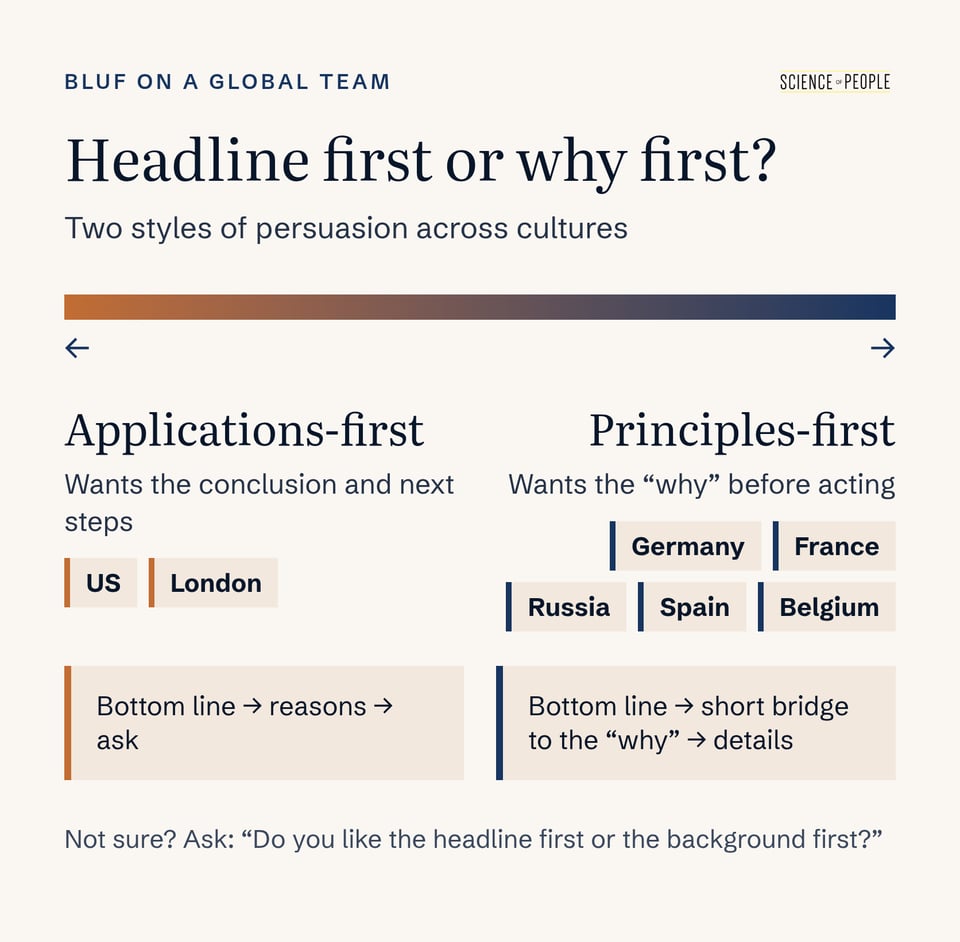
So keep your bottom line up front, and give principles-first colleagues a short bridge to the “why” before the details. For example:
“I recommend we switch packaging vendors before our contract renews on the 30th. Here’s how I got there, so you can check my reasoning. I compared last quarter’s deliveries with quotes from two other vendors…”
Not sure which style a colleague prefers? Ask! “Do you like the headline first or the background first?” takes five seconds and saves you from guessing.
When to Hold the Answer Back
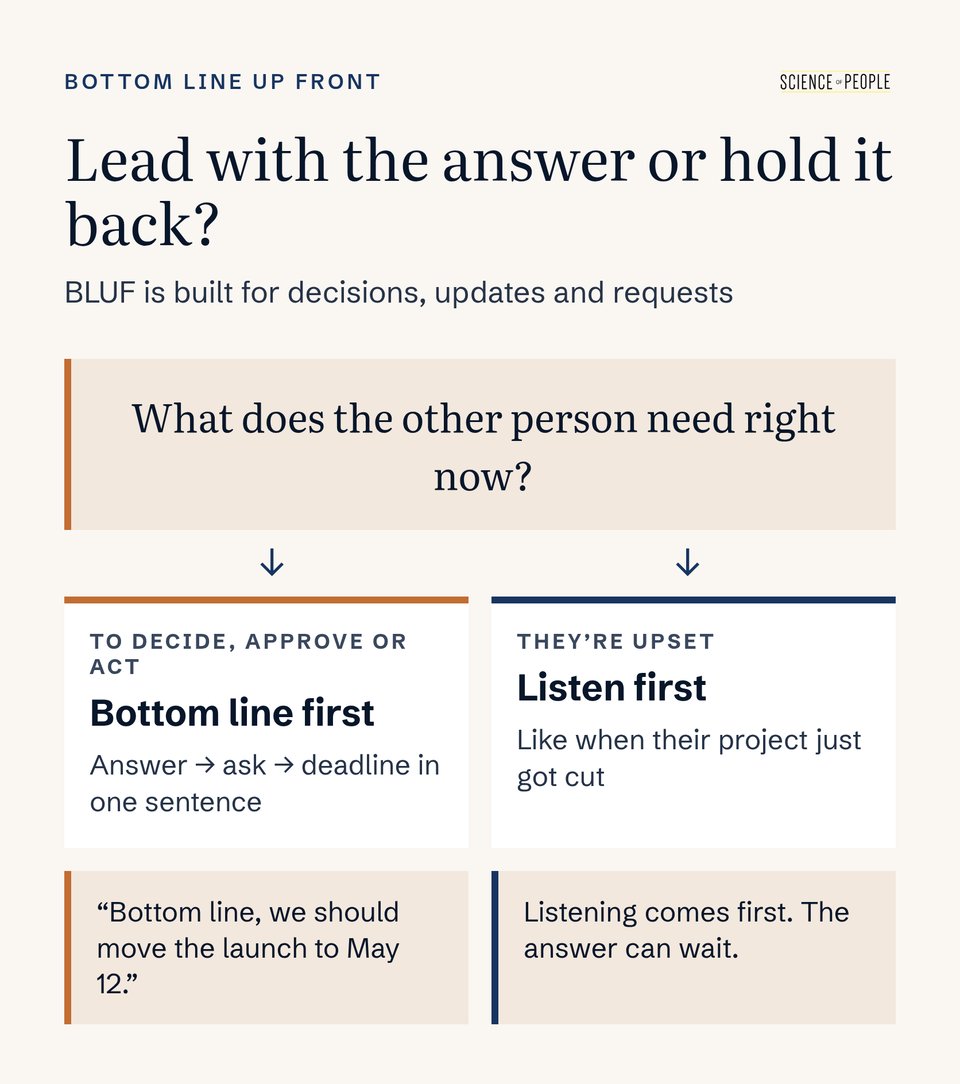
BLUF is built for decisions, updates, and requests. It’s probably the wrong tool when someone is upset.
If a teammate is telling you their project just got cut, “Bottom line, here’s what you should do next” will probably feel cold, however right it is. Listening comes first. The answer can wait until they ask for it, and our guide on how to comfort someone can help with what to say in the meantime.
Frequently Asked Questions (FAQs) About Bottom Line Up Front
What does BLUF stand for?
BLUF stands for bottom line up front. It’s a military writing rule for putting your main point, decision, or request in your first sentence, with the supporting details after it. The US Army lists it as one of two essential requirements of Army writing. At work, it means your reader knows what you found and what you need before they reach the background.
Is bottom line up front rude?
It can feel abrupt if the answer shows up with zero warmth. One friendly line first fixes that, like “Thanks for making time! Bottom line, we should move the launch.” Your listener gets the point fast, and they still get the kindness. Keep the warm-up to that one line, then give your top reasons and repeat the ask at the end.
What's the difference between BLUF and an executive summary?
An executive summary is a section at the top of a long report that sums up the whole thing. BLUF is a habit for every message, from a two-line Slack to a 30-page report. They work well together… just make sure your executive summary opens with the bottom line too, instead of the background. The first sentence should still give the answer, the ask and the deadline.
How long should my bottom line be?
One sentence. It should give the answer, the ask, and the deadline. If someone could act on that sentence alone, it’s ready. For example: “Can you sign off this week on switching packaging vendors before our contract renews on the 30th?” If they’d still have to ask “So what do you want from me?”, give it another pass.
Can I use BLUF in a presentation?
Yes! Say your recommendation in the first minute, then give your top reasons. It also helps to make each slide’s title the takeaway itself, like “Churn went up after the price change,” instead of a label like “Q3 churn review.” Keep the backstory ready for questions. When someone asks “How did you get there?”, that’s your invitation to walk through it.
How do I write a BLUF subject line?
Put the ask and the deadline right in the subject line, like “Approval needed by Thursday: switching packaging vendors.” Your reader knows what you need before they even open the email. Then use the first two lines of the body for your recommendation and the ask, and put the reasons in short bullets underneath for whenever they want the details.
Should bad news go first too?
Usually, yes. When news is mixed, the people receiving it tend to want the bad part first, and hearing it first eases their worry. Give the news, then the plan, and skip the long wind-up. Try: “I have some bad news about the launch. We’re going to miss April 28. The new date is May 12, and here’s what we’re doing to hit it.”
Why do experts bury the point?
Experts tend to underestimate how hard their topic is for a beginner, so they explain more background and use more abstract language than a newcomer needs. That makes the point easy to lose. If you’re the expert in the room, write your one-sentence bottom line before the meeting or email, and check that someone outside your field could act on it.
How do I use BLUF with colleagues from other cultures?
Keep the bottom line first, then add a short bridge to the “why” for colleagues who prefer principles before conclusions. For example: “I recommend we switch packaging vendors before our contract renews on the 30th. Here’s how I got there, so you can check my reasoning.” Not sure what someone prefers? Ask: “Do you like the headline first or the background first?”
Bottom Line Up Front Takeaway
- Before your next update, write your bottom line as one sentence with the answer, the ask, and the deadline.
- Read that sentence on its own and ask whether someone could act on it with nothing else. If not, rewrite it.
- In your next meeting, say that sentence in your first breath and keep any warm-up to one line.
- Move the answer and the ask into the subject line and first two lines of your next email, with the reasons in bullets below.
- If you have bad news to share this week, give the news and the new plan in your first two or three sentences, with no wind-up.
Got a big decision coming up? Get the key people on board before you walk in, with these tips for the meeting before the meeting.