Have you noticed that two interviews can go by the same name and work completely differently? By the final round you’re usually in a place where the questions are looser, the room is filled with more seniors, and the impression you leave does more of the deciding.
So let’s get you the sentences for the moments that make it hard.
Find the Scorecard First
By the last round, nobody is still checking whether you can do the job. Almost everyone left can. So before you walk in, we need to answer one question: is there a scorecard?
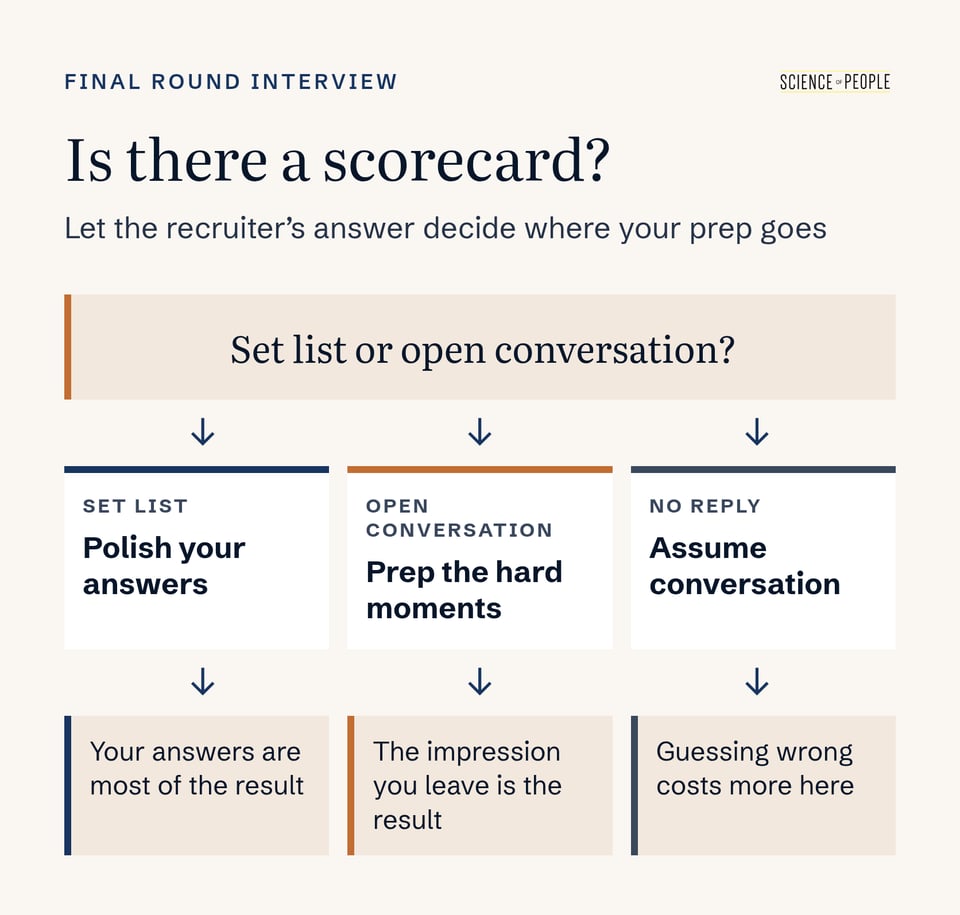
Some final interviews are built like a test. Every candidate gets the same questions in the same order. Others are like a loose conversation. A VP you’ve never met talks with you for 45 minutes, then tells the hiring manager how it went. If several of them are in the room at once, you’re in a group interview, which has rules of its own.
Research across many workplaces found the standardized interview was a better guide to who would actually be good at the job than the loose conversation interview.1
In the scored version, your answers to the listed questions are most of your result. In the open one, the impression you leave is the result. We can’t tell you from out here which one you’ll walk into… but you can find out before Thursday.
The Email That Tells You Everything
Recruiters answer this one. They want you to do well; a candidate who falls apart in the last round costs them a month too.
Try This: Send it about three days out.
“Hi [Name], looking forward to Thursday. Two quick things so I can prep properly: who’ll be in the room, and is it a set list of questions or more of an open conversation? Thanks!”
If the answer is a set list… good, put your prep into answers. If it’s a conversation with the team, put it into everything below. (And if they don’t answer? Assume conversation. That’s the one that punishes you for guessing wrong.)
Calm Is King
How rattled you look is part of what’s being measured.
In an analysis of recorded job interviews, the people who seemed more stressed tended to get lower hireability scores.2 It’s also the part of the interview you’re least likely to be rehearsing. When did you last practice losing your train of thought?
Maybe you’ve blanked on a question you’d practiced. Maybe you’ve heard your own voice climb. Or, maybe you’ve just watched a good answer fade away and kept talking anyway.
We can all picture it from the other side of the table. A candidate gets a question they half-expected, starts strong, then realizes two sentences in that they’ve picked the wrong example. But… they keep going anyway. Yikes.
Some interviewers make the pressure deliberate. Interviewers who push hard on purpose tend to get a sharper read on how well candidates manage their own emotions. Those candidates also tend to come away liking the company less.3 The hard question is sometimes a very good measurement, and the company is choosing to pay for it.
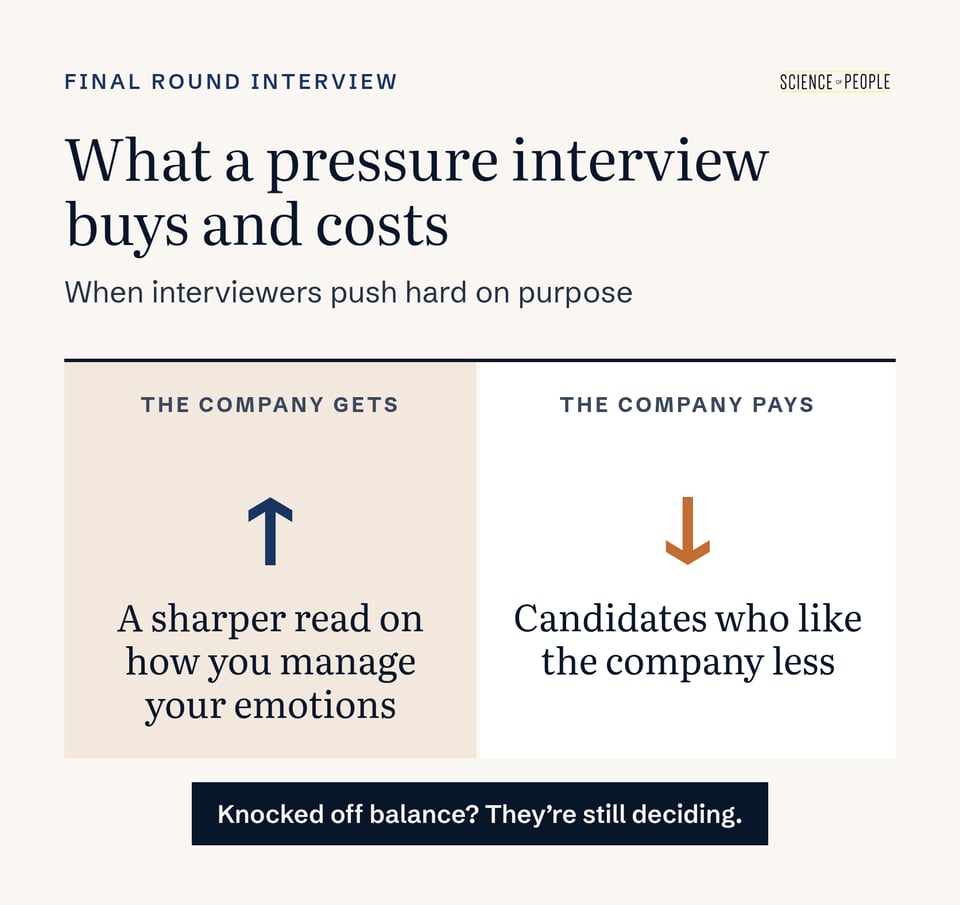
A question built to knock you off balance usually means they’re still deciding, and they want to see one more thing before they do.
So the thing we should rehearse is the four seconds after you lose your footing.
Try This: When you lose your thread mid-answer, stop and restart out loud.
“Let me back up and start that again.”
Our instinct is to finish a sentence we’ve already lost, and the reaching is the part that shows. Say the line, take a breath, and start the answer from the top.
Mini Course
Interview to Hired: The Science of Hidden Signals That Get You the Ideal Offer
Walk into any interview as the obvious hire. All sales are final. No refunds.
Answer the Question Under the Question
“This might be a step down for someone at your level. Won’t you get bored?”
And somewhere behind your eyes:
Did they seriously just ask that?
Nobody is going to rescue you. The hiring manager looks at their laptop. None of us gets to pick which question lands.
They get worse than that one. Somewhere in the last round you may get a question that’s too personal, or one built on something about you that isn’t true. You’ll have about two seconds to decide who you’re going to be.
The pause is the WHOLE move. Two seconds of silence feels like a minute from the inside. From the outside, it just looks like you’re thinking, and the water glass is there if you need somewhere to put your hands.
There’s a version of you that answers honestly, a version that gets angry, and a version that says something so agreeable you’re still thinking about it on the drive home. (We’ve all been that third one.) There’s a fourth one, too.
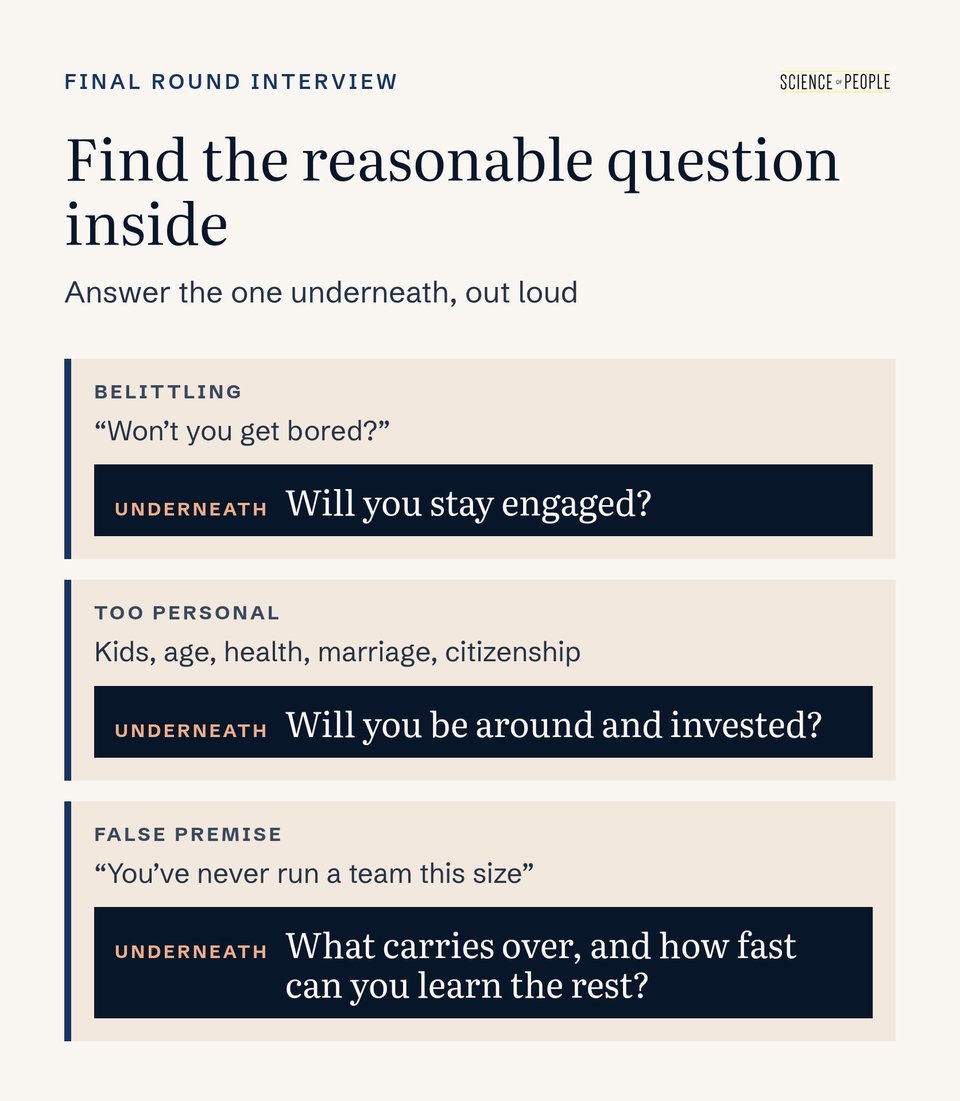
Here’s what we’re going to do with it. Almost every bad question has a reasonable question inside it. Answer that one, out loud, as though it’s what they meant.
What does that actually sound like?
The belittling question, the one at the top of this section:
“Fair thing to check. The part of this job I actually want is the [specific thing], and it’s the part I don’t get to do now. If I’m bored in a year, it’ll be because that turned out to be smaller than you’re describing. So I’d like to pressure-test that today.”
The too-personal question. Anything about kids, age, health, marriage, or citizenship. The reasonable question underneath is almost always about commitment.
“I think what you’re getting at is whether I’ll be around and invested. I will. I relocated twice for work, and I stayed five years with the last team I joined.”
The question built on a false premise. “You’ve never run a team this size, so how would you even start?”
“The biggest team I’ve run was nine. What carried over was [X]. What I’d have to learn quickly is [Y], and I’d want the first month to be about exactly that.”
None of these is the same as the worst things to say in an interview. None of the three corrects the interviewer.
The Expensive Way to Be Right
Sooner or later a senior person says something about your own field that you know is wrong.
This is the moment candidates handle worse. We tend to agree and move on or stay silent. But what should you do? Be assertive… the right way.
Assertiveness works more like a dial than a switch. Say too little and you don’t get heard; push too hard and people stop wanting to work with you.4 Most of the work is finding where the middle falls in this particular room, which is the same skill as being assertive without being aggressive anywhere else.
| Where you are | What they take from it |
|---|---|
| Too far back | You agreed with everything, and they learned nothing about how you think |
| The workable middle | You held one position and gave ground on the rest |
| Too far forward | You won the exchange, and they stopped picturing you on the team |
Try This:
“You’re right that [true part]. The thing I keep running into is [the part they’re missing].”
And when you have something concrete to put behind it:
“That matches what I saw at [company] until about [year]. What changed it for us was [specific thing]. Happy to be wrong about how it works here.”
The same disagreement, said two ways:
| The costly one | The one that works |
|---|---|
| “That’s not how it works anymore.” | “You’re right that it worked that way for a long time. What changed for us was the move to [X].” |
| “I disagree.” | “I’d push back on one piece of that.” |
| “Actually, the numbers say the opposite.” | “The number I’ve seen points the other way, and I’d want to know why they differ.” |
The Words That Shrink You
It’s common to walk into the last round planning to sound humble. And why wouldn’t we? Softening feels safe. It takes the edge off a strong claim, it leaves room for the other person, and it seems like the opposite of arrogant.
That’s not how it sounds from across the table. In recorded mock interviews, a direct speech style drew better judgments of competence and employability than a hedging, hesitant one.5
But there’s a difference between conceding on purpose and hedging by reflex, and it’s one we blur constantly. “Happy to be wrong about how it works here” is a decision you make after you’ve said your piece. “I mean, I could be wrong, but maybe it’s sort of like…” opens the door before you’ve walked through it.
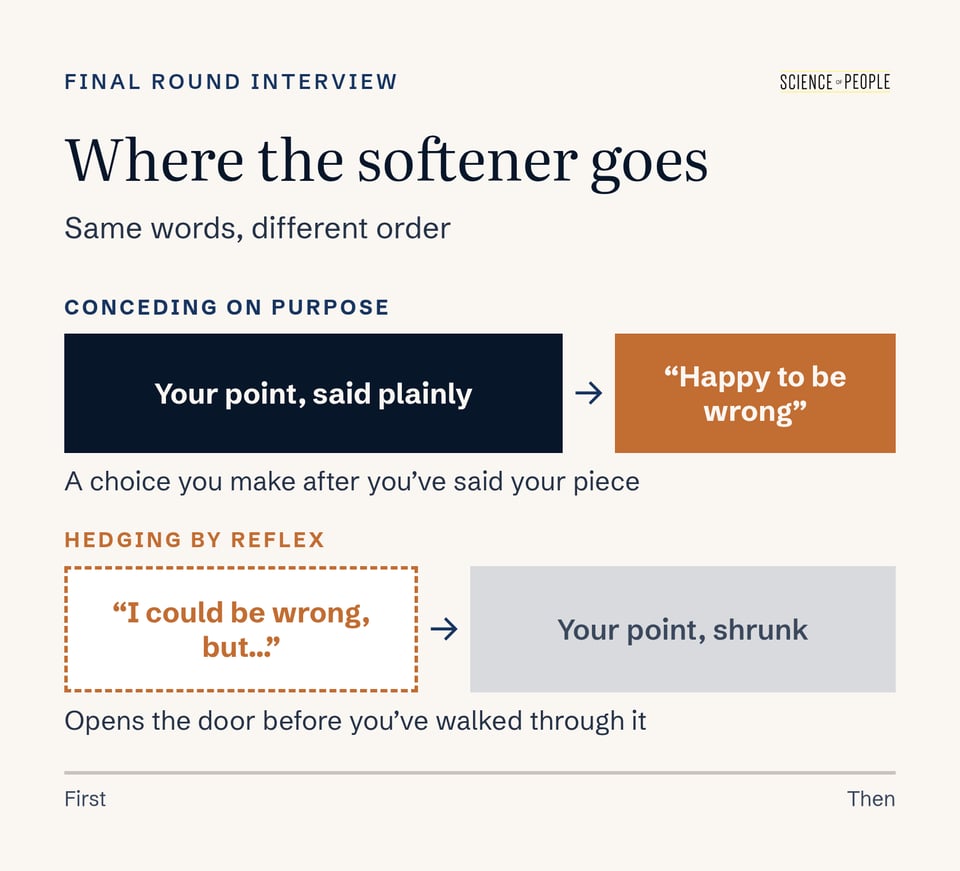
Here’s the same content, twice:
| The hedge | The plain version |
|---|---|
| “I think I probably could have handled that better.” | “I’d handle that differently now. Here’s how.” |
| “This might be kind of a small thing, but…” | “One thing I’d change in the first month:” |
| “I’m no expert, but my sense is…” | “My read is…” |
| “Does that make sense?” | (say nothing, and let the answer sit) |
| “I just wanted to ask about the roadmap.” | “I wanted to ask about the roadmap.” |
| “We sort of managed to grow it a bit.” | “We grew it 40%.” |
Want the fastest way to hear your own? Record yourself answering one question you expect, then listen back and count them. The cheapest fix is deleting “just,” “sort of,” and “I think” without putting anything in their place.
Ask Like You Already Work There
Nearly every final round ends with the same invitation. “What questions do you have for us?”
Most candidates answer it with questions about the job as a thing they might be given. What does the role involve? What does success look like in year one? Is there room to grow? All reasonable, and they all sound like the same person: someone waiting to hear whether they’re allowed in.
A colleague asks differently, because a colleague is already picturing the work. So how do we get you there?
Try This: Ask how the work actually goes.
“When [the thing their team owns] slips, who feels it first?”
And ask what goes wrong:
“What’s the part of this job that people underestimate before they start?”
Both get you a real answer. Both also tell the room you’ve spent your prep time on the work. If you want a longer list to pick from, there are plenty of good questions to ask a hiring manager.
You can watch it change the conversation. A candidate stops asking whether they’d own the migration and asks instead who gets paged when it slips. The interviewer talks for four minutes, gets specific about a bad quarter, and forgets to ask the next question on their list.
And remember, the people across the table are about to be the people you talk to more than almost anyone else in your life. Why not find out what they’re like while you still have a reason to ask?
Who the Beer Test Really Helps
A study of hiring at elite professional service firms found evaluators leaning hard on similarity: shared leisure pursuits, shared experiences, and a familiar way of presenting yourself. Concerns about shared culture often outweighed concerns about who would actually produce more.6
Call it the beer test.
A candidate who already looks and sounds like the people deciding gets more out of these scripts than a candidate who doesn’t.
The thing you do control is which common ground you reach for. Shared work travels further than shared background: the thing their team shipped last quarter, the problem you’ve both had with the same vendor, the article you both read last month. That kind of common ground is available to you whether or not you grew up anywhere near these people.
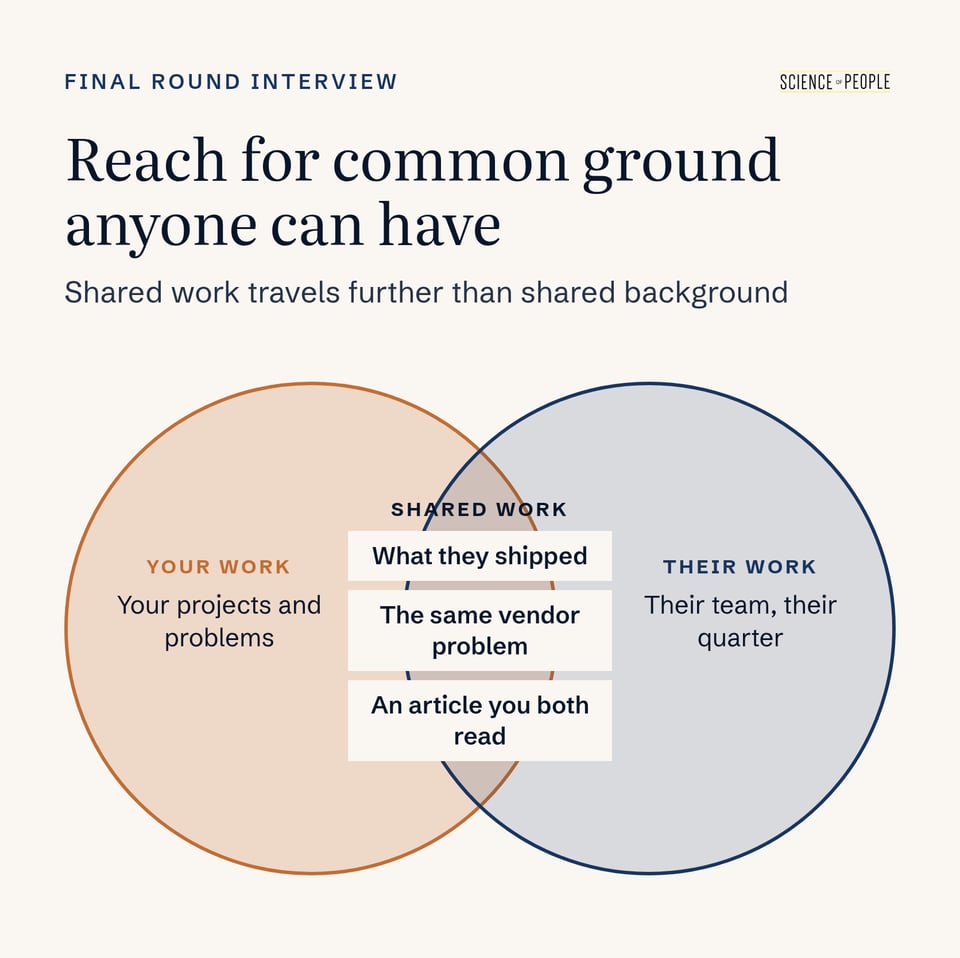
Before the last round, find one thing about their actual work you have a real opinion on.
Frequently Asked Questions (FAQs) About Final Round Interviews
What is a final round interview?
A final round interview is the last stage of hiring, where the company compares a short list of candidates who can all do the job. The questions tend to get looser, the room gets more senior, and the impression you leave counts for more. It might be a structured panel with a set list of questions, a one-on-one with a VP, or a group interview. Ask the recruiter which one it is so you know where to put your prep.
Is the final round interview just a formality?
The final round is rarely a formality, because the people left in it can usually all do the job and the company still has to choose one. So it comes down to how you handle pressure, how you disagree, and what you’re like to work with. Prepare for it as a real round. Write the first sentence of your answers to the three questions you’re dreading, and have one question ready about the work itself.
How do I prepare for a final round interview?
Start by finding out the format, then rehearse the hard moments instead of the easy answers. About three days out, ask the recruiter who’ll be in the room and whether it’s a set list of questions or an open conversation. If it’s a set list, polish your answers. If it’s a conversation, practice the pause before a tough question, the plain version of your favorite hedge, and one question about how the work actually goes. The Interview to Hired mini-course covers the day itself.
What questions should I ask the recruiter before a final interview?
Ask who’ll be in the room and whether it’s a set list of questions or more of an open conversation. Recruiters tend to answer, because a candidate who falls apart in the last round costs them time too. Try: “Hi [Name], looking forward to Thursday. Two quick things so I can prep properly: who’ll be in the room, and is it a set list of questions or more of an open conversation?” If you don’t hear back, prepare for a conversation.
How do I answer an inappropriate interview question?
Pause for two seconds, then answer the reasonable question hiding inside the bad one. A question about kids, age, health, marriage, or citizenship is usually a clumsy way of asking about commitment. You can say, “I think what you’re getting at is whether I’ll be around and invested. I will.” Then give one concrete proof, like how long you stayed with your last team. You keep your dignity without correcting the interviewer in front of the panel.
What should I do if I blank or lose my train of thought in an interview?
Stop, say so out loud, and restart the answer from the top. Try: “Let me back up and start that again.” Then take a breath and begin with your first sentence. Pushing through a sentence you’ve already lost is the part that shows. How rattled you look is part of what a final round measures. Practice this line at home so it’s ready when your mind goes blank, and keep a glass of water nearby for the pause.
Is it okay to disagree with an interviewer?
Yes, disagreeing with an interviewer can help you, as long as you agree with the true part first and push back on one piece. Staying silent tells them nothing about how you think. Winning the argument makes it hard to picture you on the team. Try: “You’re right that it worked that way for a long time. What changed for us was the move to [X].” For more on finding that middle, see how to be assertive without being aggressive.
How do I sound more confident in a final round interview?
Cut the hedges and say your answer plainly. A direct speech style tends to sound more competent and more employable than a hesitant one. Swap “I’m no expert, but my sense is…” for “My read is…” and “We sort of managed to grow it a bit” for “We grew it 40%.” Record yourself answering one likely question, count the “just,” “sort of,” and “I think,” then delete them. Our guide to filler words has more swaps.
What questions should I ask at the end of a final round interview?
Ask about how the work actually goes, the way someone who already has the job would. Two that work in almost any role: “When [the thing their team owns] slips, who feels it first?” and “What’s the part of this job that people underestimate before they start?” Both get you a real answer and show you spent your prep on the work. For a longer list, see these questions to ask a hiring manager.
What does culture fit mean in a final round interview?
Culture fit often comes down to similarity, which quietly favors candidates who already resemble the people on the panel. You can’t change your background, but you can choose which common ground you reach for. Shared work travels further than shared history: the thing their team shipped last quarter, a problem you’ve both had with the same vendor, or an article you both read. Before the interview, find one thing about their actual work you have a real opinion on.
How do I know if my final round interview went well?
A final round usually went well when it turned into a real conversation about the work, with interviewers getting specific about their problems and talking about what happens next. A good sign is an interviewer who gets specific about a bad quarter and forgets their next question. Send a short thank-you note, then give it the time they told you. These signs you got the job can help you read the rest.
Final Round Interview Takeaway
Between 1980 and 2012, jobs calling for a lot of social interaction grew by nearly 12 percentage points of the U.S. workforce.7 Twelve points. That’s why a company that already trusts your skills still spends a last hour with you. They want to know what you’re like in a room.
So what do we actually do with the week before yours?
- Email the recruiter. Ask who’ll be in the room, and whether it’s a set list of questions or an open conversation. The answer decides where the rest of your prep goes.
- Write down the three questions you hope they don’t ask. Draft the first sentence of each answer, and only the first sentence. The rest you can improvise; the opening is what you lose under pressure.
- Find the reasonable question inside the worst one. Say that answer out loud until the pause before it feels normal.
- Pick the hedge you reach for most. Practice the plain version of the same sentence until it stops sounding rude to you.
- Decide where you’d disagree. Write the half of the sentence that says what they got right, because that’s the half you’ll skip when your pulse is up.
- Prepare one question about the work itself, phrased the way someone who already has the job would ask it.
Remember, the people in that room have already decided you can do the job. What’s left is a conversation, and a conversation is something we can practice. You’ve got a week!
So start with the question you’re dreading. Say the first sentence of your answer out loud, right now, and notice how much shorter it is than the one in your head. Want a full plan for the day itself? The Interview to Hired mini-course walks you through the first five seconds, your STAR stories, and a day-of ritual.
Then, while you wait to hear back, there are signs you got the job worth knowing how to read.