In This Article
The best interview questions to ask candidates, what a strong answer sounds like, how to score it, and which questions you can't legally ask.
You have an opportunity. Great interview questions help you…
- Reveal someone’s true personality
- Speed read a candidate quickly
- Build rapport that lasts
Your questions might be even more important than a candidate’s answers.
The trouble is that most interviews run on the same handful of questions. The candidate has answered them a million times before. The interviewer has heard the same answers a million times before. It’s a waste of everyone’s time!
I think there is a better way. It’s called behavioral interviewing. When researchers went back and re-ranked every common hiring method against how people actually turned out on the job, the structured interview came out first, ahead of the aptitude tests and personality inventories that were supposed to beat it.1
The questions below come from real hiring managers, CEOs, and experts at companies like ZipRecruiter, Evernote, and Curology, plus the ones we built from our own research at the Science of People. You’ll also get the two things that turn a question list into a process: how to score the answers, and which questions you’re not allowed to ask.

What Are Behavioral Interview Questions?
Behavioral interview questions are prompts that ask a candidate to describe something specific that already happened at work, rather than what they would do or what they think they’re like. They usually open with “Tell me about a time when…” or “Describe a situation where…” and they’re judged on the detail of the answer.
They’re also called past-behavioral questions, and they sit opposite the two other formats you’ll meet below: situational questions, which hand the candidate a hypothetical, and creative questions, which go somewhere unrelated to work on purpose.
The reason experienced interviewers lean on them is plain enough. Anyone can tell you they’re resourceful. Someone describing the week their vendor pulled out four days before launch has to produce specifics, and specifics can be checked.
Why Structure Beats Clever Questions
Quick gut check before we get to the list. Which one of these tells you the most about how somebody will actually do the job?
- a. A cognitive ability test
- b. A structured interview
- c. A personality questionnaire
- d. Years of experience in the same role
If you answered b, you’d be correct. When researchers compared the standard hiring methods in 2022, the structured interview came out on top of the list.1
The gain has almost nothing to do with the questions being clever. It comes from the boring half, the part nobody puts in a blog post.
An interview counts as structured when you do things like this:
- Write the questions from the actual job, working off the job description in front of you.
- Ask every candidate the same questions in the same order.
- Score each answer on its own, right after you hear it, instead of forming one overall impression at the end.
- Score against anchors you wrote in advance — a description of what a 1, a 3, and a 5 actually sound like.
- Take notes on what the person did, in their own words where you can.
- Keep the panel from talking until everyone has scored independently.
- Hold the candidate’s questions until the end, so their curiosity doesn’t reshape your remaining questions.
That list comes from a review that pulled apart what “structured” actually means and found fifteen separate components, split between how you build the questions and how you evaluate the answers.2 You don’t need all fifteen. The evaluation half is where most interviewers are leaking accuracy, and it’s the half nobody talks about.
Google worked this out the expensive way. The executive then running its people operations told the New York Times the company had gone back through tens of thousands of interviews, comparing what each interviewer scored a candidate against how that person actually did once hired. The brainteasers Google had become famous for showed “zero relationship” to performance. His verdict on them: “a complete waste of time.” What replaced them?
“What works well are structured behavioral interviews, where you have a consistent rubric for how you assess people, rather than having each interviewer just make stuff up.”
How to Use the STAR Method (For Answering or Evaluating Answers)
Before the questions themselves, every interviewer and candidate needs to know the STAR Method. Development Dimensions International built it into its Targeted Selection system in 1974, and it’s still the standard way to shape a behavioral interview answer.3
STAR stands for:
- Situation: Set the scene briefly. What was happening?
- Task: What was your specific responsibility?
- Action: What did you personally do? (This is the most important part.)
- Result: What happened? Use numbers when possible.
The most common mistake? Spending so long setting up the Situation that the Action never arrives. MIT’s career office splits a two-minute answer roughly 20/10/60/10 — which puts about 60% of it on the Action step.4 Most of your answer should be the part where you’re the one doing something.
Since that’s easier to agree with than to do, here’s the same story told badly and then well. The question: tell me about a time you had to fix something under time pressure.
The script that loses the room:
“So our whole Q3 campaign was already behind because the design team had two people out, and then marketing changed the brief in week two, which honestly happens a lot there, and the agency we were using wasn’t great at turnarounds either. It was a pretty stressful few weeks for everybody. Anyway, we got it out and it did fine.”
Ninety seconds of Situation, no Action, and a Result you can’t check.
The script that scores:
“Our Q3 campaign was six days from launch with no approved creative. (Situation.) I owned the launch date. (Task.) I cut the campaign from five assets to two, got the CMO to approve the reduced scope in a fifteen-minute call that afternoon, and moved the remaining design work to a freelancer I’d used before so our in-house team could finish the landing page. I ran a standup at 9 and 4 each day until launch. (Action.) We shipped on the original date with two assets instead of five, and that campaign brought in about 12% more signups than Q2. (Result.)”
The second one tells you what the person actually did, and every claim in it is something you could ask a follow-up about.
If you’re the interviewer: Listen for specifics in the Action step. Vague answers like “We worked together to fix it” are a red flag. You want to hear what this person specifically did.
If you’re the candidate: Prepare 6–8 versatile stories from your last two to three years of work. Each story should be adaptable to different question types. A story about a delayed project might demonstrate leadership, problem-solving, and handling pressure.
Pro Tip: Harvard Business Review suggests adding a fifth beat, a Takeaway, where you connect the story to the job in front of you: “The takeaway for this role is that I can apply that same rapid problem-solving approach to your upcoming product launch.”
Of every standard hiring method researchers have put side by side, the structured interview now ranks first.
Behavioral Questions That Show How Someone Works
These ask about things that actually happened. They’re the format this article is built around, because a real past event gives you something specific enough to check.
#1. “What’s something you used to believe but no longer believe?”
This is one of my favorite behavioral interview questions, because it explores someone’s ability to change and stay open-minded. One of the hardest parts about starting a new job is the learning curve: new processes, new culture, new relationships. Sometimes those new ways challenge someone’s deeply held assumptions.
This question gets at a few key behaviors:
- Can they easily recall a time they changed their mind? If not, you might have someone who is very stuck in their ways.
- What was the magnitude of the change? If someone says, “I used to believe in the Easter Bunny and no longer do,” that signals a lack of seriousness. But if someone answers, “I used to believe charisma and leadership were genetic, but now I believe they can be learned, and leadership is a skill I’ve been working on.” Wow! Winner!
- How do they describe the process of changing? Did they change because of evidence, a mentor, or a personal experience? The how reveals intellectual humility.
Action Step: If you’re a candidate, prepare a genuine answer that shows growth. Pick something professionally meaningful. A trivial answer wastes the question.
#2. “Who were the competitors at your last company, and how did your company differentiate itself?”
This one comes from Ian Siegel, co-founder and CEO of ZipRecruiter. If anyone is an expert at hiring and interviewing, it’s Ian and his team. He uses this question because:
“I want to determine if the candidate had a strategic understanding of the business. Surprisingly, few candidates can answer this question. I am especially impressed by candidates who have a grasp of existing competitors, potential competitors, and what a disruptive, new market entrant could do.”
I love this as a behavioral interview question because it taps into a way of thinking. Every great employee should know three basic things about their company:
- The company’s mission
- The company’s goals
- The company’s competitors
When an employee is aware of all three (even if it doesn’t directly tie into their job), it shows they think whole-mindedly about why they do what they do.
Pro Tip: Candidates, before any interview, spend 20 minutes researching the company you’re applying to using this same framework. Know their mission, their top three competitors, and one thing that differentiates them. You’ll be ahead of 90% of applicants.
#3. “Tell me about your best and worst days at work.”
This question gauges someone’s outlook and perspective. It comes from Chris O’Neill, former CEO of Evernote. Here’s his insider interview tip:
“The answers are very revealing. ‘Best day’ answers demonstrate what makes that person tick, what motivates them. ‘Worst day’ answers tell whether a person is a team player. If their response focuses on what went wrong without taking any ownership, there is a good chance they won’t thrive in a collaborative environment.”
I’d recommend taking this a step further and thinking about what your ideal answer to this question would be as an interviewer. If you were to ask your top performers this question, how would they answer? What examples would they give?
If you find a candidate who has similar answers to your top performers, they are a winner!
Action Step: Interviewers, write down what you consider the ideal “best day” and “worst day” answers before the interview. Having a benchmark makes it much easier to evaluate candidates consistently.
#4. “If I called your current boss, what would they say about you?”
Fair warning: this question will get your candidate’s blood pumping. Anytime you ask about a previous boss, it creates pressure. That doesn’t mean it’s not useful. Here’s why:
- How does someone perform under pressure? This is a tough question even if their boss loved them. It’s hard to talk about yourself positively or negatively on the spot.
- How does someone frame themselves? Are they a boaster, a downer, humble, or a smooth-talker?
- How does someone talk about a past boss? Do they hold grudges? Show resentment? Offer genuine praise?
Chris M. Williams, CEO of pocket.watch, asks this question for one big reason:
“Interviewees tend to be very honest in their response because they anticipate that there’s an actual possibility I’ll make that call.”
You can ask this question only if you’re actually willing to call their previous boss, especially if you hear something that piques your interest and you want to confirm it.
#5. “Describe the last significant conflict you had at work and how you handled it.”
No one likes conflict. But it happens. How will your candidate deal with it? History is your greatest help. This question reveals how they view conflict and how they might handle it in your organization. Watch for honest, specific answers, and for red flags like obvious deflection or blame-shifting.
This question comes from Kent Porter, founder and CEO of Porter Leadership Development:
“Savvy hiring authorities respond well when I say, ‘We hire them for what they know, we fire them for who they are.’ The question now is how do we determine who they are? Questions like this help to discern who a candidate is.”
Be prepared to ask follow-up questions. Get details, use specifics. The more you know about how they handled the past, the more you’ll know about how they might handle the future.
Action Step: Use the STAR Method to evaluate their answer. Did they describe a specific Situation? Did they own their Actions? Did they share a concrete Result? If any of those are missing, probe deeper.

#6. “Tell me about a time you had to quickly learn something new to complete a project.”
With AI tools, new software, and shifting business priorities reshaping most industries, how fast somebody gets up to speed has turned into one of the things hiring managers ask about first.
What to listen for:
- Speed of learning: How quickly did they get up to speed?
- Learning strategy: Did they watch tutorials, ask colleagues, read documentation, or experiment? Their approach reveals how they’ll onboard at your company.
- Self-awareness about gaps: The best candidates admit what they didn’t know and explain how they closed the gap.
What you’re really testing is whether somebody can take a lesson out of one situation and use it in a very different one. That knack travels with a person across roles in a way that any particular skill on their resume doesn’t.
Pro Tip: Candidates, pick a story where the stakes were real and the timeline was tight. “I had to learn Salesforce in a weekend for a Monday client demo” is far more compelling than “I took an online course over six months.”
#7. “Tell me about a time you received feedback that was difficult to hear. How did you respond?”
Coachability is hard to test and easy to claim, which is what makes this question worth its two minutes. The best candidates don’t just say they’re “open to feedback.” They can point to a specific moment when feedback stung, and they used it to get better.
Red flags to watch for:
- Dismissing the feedback (“They were wrong about that”)
- Vague answers with no specific example
- Focusing entirely on the emotional reaction without describing any change in behavior
Green flags:
- Naming a specific piece of feedback
- Describing the initial emotional reaction honestly (“My first instinct was to get defensive”)
- Explaining what they changed as a result
The best candidates don’t just say they’re open to feedback. They can point to a specific moment when feedback stung and they used it to get better.
#8. “Tell me about a time you had to lead or influence others without having formal authority.”
In flat organizations, cross-functional teams, and remote environments, most of the people you’ll hire have to move work forward without anyone reporting to them.
Listen for:
- How they built buy-in: Did they use data, storytelling, relationship-building, or some combination?
- How they handled resistance: What happened when someone pushed back?
- The outcome: Did their influence produce a measurable result?
Action Step: Candidates, even if you’ve never had a management title, you’ve influenced people. Think about a time you convinced a team to adopt a new process, rallied colleagues around an idea, or mentored someone informally.
Situational Questions That Test Judgment
These hand the candidate a hypothetical and ask what they would do. Hypotheticals have a bad reputation, and half of it is deserved. The half that isn’t matters more.
The thing that failed was the brainteaser. Google built a reputation on questions like how many golf balls fit in a school bus, then went back through tens of thousands of its own interviews and compared what interviewers scored against how those hires actually did. It found “zero relationship.” Its head of people operations called brainteasers “a complete waste of time” and said they “serve primarily to make the interviewer feel smart.”5
A situational question about the actual job is a different animal. “Your team missed a deadline, what now?” is scoreable against the job. “How many gas stations are in Manhattan?” is trivia with a stopwatch. Ask the first kind, and score it the same way you score everything else.
#9. “You have two teleportation devices. Where do you place them and why?”
This gem comes from David Lortscher, founder and CEO of Curology:
“Questions that are open-ended test for critical thinking instead of pure knowledge. One candidate told us they’d place one device in their home and one on the moon, because they want to explore space and make new discoveries. That may translate into someone who displays expansive thinking, is curious, and is hungry to learn.”
This question might feel irrelevant or silly, and it is a little unconventional. But that’s the point. How does your candidate think on the spot? How creative can they be? What does their answer reveal about their priorities?
This is also a great opportunity to lighten the mood. If you want to build rapport, share your own answer and have a laugh together.
Special Note: Be honest with yourself about what this one is. It belongs nearer the brainteaser end than the job-relevant end, which means it’s a rapport tool and a conversation-starter rather than something you should score. Use it to warm the room up. Don’t let it move anybody’s rating.
#10. “If you didn’t have to work, why would you come into the office?”
This question comes from Gautam Gupta, co-founder of NatureBox. It looks directly at motivations and interest. You can gauge someone’s why very quickly: do they work for the money, the status, the learning, the relationships?
In Vanessa’s book Captivate, she presents the concept of a Primary Value, the underlying motivation that drives a person’s decisions, actions, and desires. Understanding which values matter most to a candidate reveals whether they’ll truly thrive in a role.
Here’s what Gupta has to say:
“I try to understand the person’s motivations and interest. I also try to understand where they want to take their career and how NatureBox fits within that path. Lastly, I’m looking to gauge their intellectual curiosity.”
Think of your ideal answer to this question. What do you hope will drive your potential employees?
#11. “How would you handle a situation where your team missed an important deadline?”
This is what a good situational question looks like: it’s about the job, and you can score it. It tests accountability and problem-solving without requiring the candidate to have lived through this exact scenario. You’re listening for their process. A perfect answer is beside the point.
Strong responses typically include:
- Immediate triage: Assessing the damage and communicating with everyone affected
- Root cause analysis: Understanding why the deadline was missed before jumping to a reaction
- Ownership language: “I would take responsibility for…” rather than “I’d figure out who dropped the ball”
- Prevention thinking: What systems or processes they’d put in place to prevent it from happening again
The single most useful thing to watch is which way the ownership points. Candidates who narrate the problem as something that happened to them tend to keep doing that after you hire them.
Creative Questions That Break the Script
These questions step outside the standard pattern and show you personality, social skills, and presence under pressure. Treat them the way you’d treat #9: good for reading the room, weak for scoring.
#12. “Are you working on anything exciting outside of work?”
Getting a sense of someone’s life outside of work helps you understand cultural fit and how they’ll connect with colleagues. Their answers can be surprisingly revealing:
- If they can’t think of anything: It could indicate poor work-life balance. If someone is consumed by work, they might not have time or energy for anything else. Does that work for your culture?
- If they say something generic: This could signal nerves rather than a lack of creativity. How important is easy small talk to your team’s dynamic?
- If they have a fascinating or surprising answer: You get a sneak peek into who they really are. How does that fit with your company?
Their comfort level with this question also reveals how this candidate might socialize with colleagues, which matters for work environment chemistry.
Special Note: This is the question where interviewers most often hire their own reflection. Shared hobbies feel like chemistry. If you catch yourself warming to somebody because you both rock climb, say it out loud to whoever else is interviewing, before it turns into a number.
#13. “Wait… do you remember all of our names?”
This idea comes from Gil Addo of RubiconMD, and it’s a genuinely interesting test of behavior:
“We like to have a little fun with our sales candidates, while testing their ability to connect with people. They act like the interview is done then call them back in and have them go over everyone they met, including their names, and what they talked about. We end by asking directly, ‘Did you get the job?’ It’s a great way to gauge their self-confidence and see if they can hold their own from start to finish in an unpredictable situation.”
This is intense, but the skills of remembering names, projecting self-confidence, and quickly memorizing people’s details are essential for sales roles. Why not test those abilities right in the interview room?
Special Note: Use this one selectively. It works well for client-facing and sales roles where relationship memory matters. For technical or introverted roles, it could feel unfair.
#14. “What question did you expect me to ask that I haven’t?”
This is a sharper version of the classic “Is there anything else you’d like to share?” It catches candidates off-guard in a productive way, because it forces them to reveal what they’ve been preparing for, which tells you what they think this role is really about.
If a candidate expected a technical question you never asked, that might signal they see the role differently than you do. If they expected a question about leadership and you focused on technical skills, that gap is worth exploring.
This question also gives ambitious candidates a chance to show off their preparation and self-awareness. The best candidates will pivot this into a brief pitch for their strongest qualification.
#15. “Is there something I didn’t ask that I should have asked you?”
I like to give candidates a chance to show off a special talent, need, or request. If your interview is too carefully choreographed, you won’t give a candidate sufficient space to share something important. This is their chance to shine, and they should take it.
Watch for these signals:
- If they say everything was covered, you might wonder how prepared they were, or if they want to go above and beyond.
- If they use this moment to address a concern or highlight a unique qualification, that shows strategic thinking.
- If they overshare, that tells you something about their judgment and boundaries.

Nine More Questions, Sorted by What They Actually Measure
Here are more questions to choose from, each with the skill it tests. You won’t need all of them. Pick the two or three that fit what worries you most about the role you’re filling.
#16. “Walk me through a decision you made that you’d make differently now.”
This question tests ownership. It’s gentler than “tell me about a failure,” because nothing has to have gone visibly wrong. Strong candidates can think of one right away and explain what they’d do differently. Watch out for anyone who describes a decision somebody else got wrong.
#17. “Tell me about a week when everything on your list was urgent. What actually got done?”
This one tests prioritization. Listen for whether they name a principle they used or just describe working longer. The good answers usually include something they deliberately let fail.
#18. “Describe a project where nobody could tell you what success looked like.”
This one tests how someone handles ambiguity. It’s especially useful for startups, or for any role that reports to a brand-new manager. You want to hear them go find the answer themselves by talking to customers, writing a rough plan, or pushing for a decision. If they just waited for someone to tell them, that’s worth a follow-up.
#19. “Tell me about a time another team blocked something you needed.”
This one tests how someone works with other teams. Almost everyone has a story like this, so pay attention to how they describe the other team. Do they talk about them as people with their own priorities, or just as an obstacle? If a candidate can explain why the other side said no, they’ll probably get things unstuck at your company too.
#20. “What’s something you learned about your customers that surprised you?”
This one tests customer empathy, and it works for more roles than you’d expect, including engineering and finance. (Just swap “customers” for whoever their work affects.) If the whole answer is secondhand, like “our research team found…,” ask when they last talked to a customer themselves.
#21. “Tell me about a piece of your own work you weren’t happy with, that nobody else noticed.”
This one tests someone’s personal standards. It’s a tough question, in a good way! You’re finding out whether they hold themselves to their own bar or only meet other people’s. It’s hard to prepare for, so listen for how specific the answer is.
#22. “What did your first thirty days in your last role look like?”
This one tests how fast someone gets up to speed. You’re about to pay for their first thirty days, so it helps to know what they did with the last ones. Listen for whether they got to know people on purpose, what they read to learn the job, and whether they finished something small early on.
#23. “Tell me about a time you disagreed with your manager and went ahead with your own approach.”
This one tests whether someone will speak up. If a candidate can’t remember ever disagreeing with a boss, that’s worth noting. The best answers cover how they raised it, what their manager said, and what happened next, even if they turned out to be wrong.
#24. “What’s something you started that’s still running now that you’ve left?”
This one tests follow-through. Plenty of people can start a project. This question asks whether they built something that kept going after they left, and whether they handed it off well. If nothing they started is still going, ask them why.
Action Step: Before your next interview, name the one thing that worries you most about this hire. Maybe it’s a new manager, lots of work across teams, or a job nobody has fully defined yet. Then pick the two questions above that test for it and add them to your list.
How to Score an Answer Without Guessing
This is where a lot of interviews go wrong. You ask a good question, get a good answer, and jot down “strong communicator?” in your notebook. Three candidates later, you’re comparing gut feelings.
The fix is simple, if a little boring. Before you meet anyone, write down what a bad, an average, and an excellent answer to each question would sound like. Then score each candidate against what you wrote, instead of against the last person you interviewed.
Here’s an example for question #5, the conflict question:
| Score | What the answer sounds like |
|---|---|
| 1 | Blames the other person start to finish. Can’t say clearly what the disagreement was about. No detail about their own behavior, or the conflict is described as something that happened to them. |
| 3 | Describes the disagreement accurately and admits some part in it. The resolution came from a manager stepping in, or from the problem going away on its own, rather than from anything they did. |
| 5 | Names what the disagreement was actually about, what they did to open the conversation, what they gave up, and what the working relationship looked like three months later. Mentions something they got wrong. |
You don’t need to write out a 2 or a 4. Once you’ve defined 1, 3, and 5, the in-between scores are easy to place.
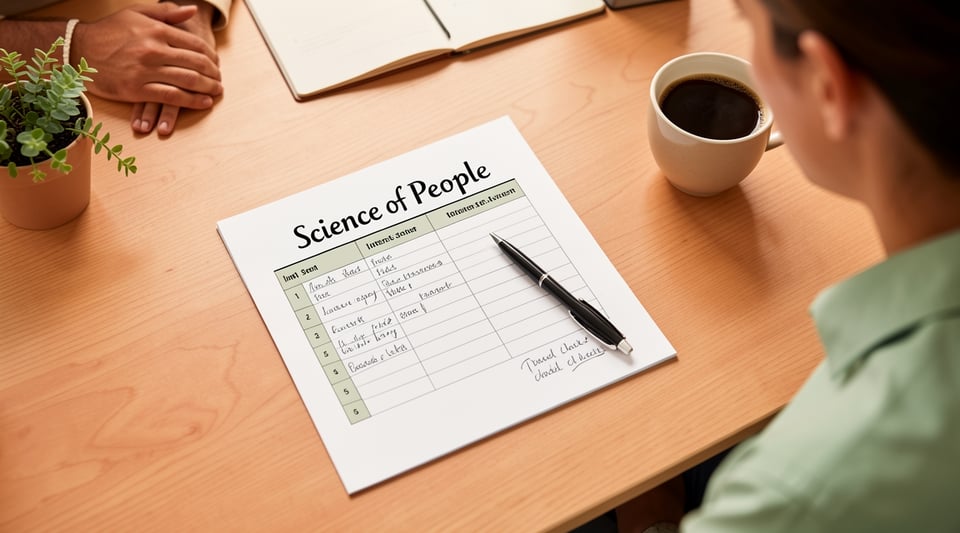
It takes about ten minutes per question, and it’s one of the most useful changes you can make to how you hire.
A few tips that make scoring easier:
- Score during the interview. Write the number down right after each answer, while it’s still fresh. Rating each answer separately works better than forming one overall impression at the end.
- Take notes on what they did. Write down the specific actions the candidate described and how things turned out, instead of how the conversation felt. Detailed note-taking is one of the building blocks of a structured interview.2
- On a panel, everyone scores before anyone talks. Once one person says “I loved her,” everyone else’s scores start to drift. Collect the numbers first, then talk about where you disagree. Those disagreements are often the most useful part of the conversation.
- Add up the scores. It’s tempting to talk your way to whoever “felt right,” but the whole point of scoring is to keep that feeling from making the decision.
Pro Tip: Candidates, you can use this too. Interviewers are listening for what you personally did, what you gave up, and what happened afterward. Build those three pieces into every story you prepare, because there’s a good chance you’re being scored on them.
Questions You’re Not Allowed to Ask
Most bad interview questions are just unhelpful. A few can get you sued.
The tricky part is that risky questions don’t usually feel risky. They tend to come up during small talk, when you’re just trying to be friendly: Any kids? Where’s the accent from? What year did you graduate?
In the US, four federal laws draw the lines. Title VII covers race, color, religion, sex, and national origin. The Age Discrimination in Employment Act covers workers 40 and over. The Americans with Disabilities Act covers disability. And the Genetic Information Nondiscrimination Act covers family medical history, which is why “does heart disease run in your family?” is a problem even when it’s small talk.
Disability is the clearest line. Employers “are explicitly prohibited from making pre-offer inquiries about disability.”6 The rest is a bit more subtle. The EEOC treats information about race, sex, national origin, age, and religion as irrelevant to whether someone can do the job, and says asking about it “may be used as evidence of an employer’s intent to discriminate unless the questions asked can be justified by some business purpose.”
In other words, a question can cause trouble even if it never affected your decision. It just has to be on the record.
The good news is that most risky questions have a legal version that gets you better information anyway. Ask about the job’s requirements instead of the person’s life:
| Don’t ask | Ask instead |
|---|---|
| “Do you have kids? Are you planning to?” | “This role has two or three trips a quarter. Does that work for you?” |
| “Where are you from originally?” | “Are you authorized to work in the US?” |
| “What year did you graduate?” | “Tell me about the experience you’d bring to this role.” |
| “Do you have any health conditions we should know about?” | “Can you perform the essential functions of this job, with or without reasonable accommodation?” |
| “What church do you go to?” | “This role occasionally requires weekend coverage. Is that something you can do?” |
| “Have you ever filed a workers’ comp claim?” | Nothing. Wait until after a conditional offer. |
Also, don’t ask for a photo or go looking for one. According to the EEOC, if you need a photograph for some reason, get it after the candidate has accepted an offer.

Salary history has its own rules. There’s no federal ban, but a growing number of states and cities don’t let employers ask candidates what they currently earn. That list changes often, so check the rules where you’re hiring. Asking about salary expectations is generally fine. Asking what someone makes now is the part that’s restricted in many places.
Special Note: This is a broad overview of US federal law, and your state or city probably has more rules. If you hire regularly, it’s worth a short conversation with an employment lawyer.
5 Questions Every Candidate Should Ask the Interviewer
Saying “No, I don’t have any questions” usually comes across as a lack of interest. The end of the interview is also your best chance to figure out whether the company is right for you. A lot of bad fits are easy to spot in the interview, if you ask.
Here are five questions that impress interviewers and give you genuinely useful information:
-
“What are the most immediate priorities for this role in the first 90 days?” This shows you’re already thinking past the offer to delivering results.
-
“How do you measure success for this position?” If the interviewer can’t answer this clearly, that’s a red flag about role clarity.
-
“What’s your favorite thing about working here, and what’s one thing you’d change?” The second half of this question is the key. It invites honesty and signals that you’re evaluating them too.
-
“Where do you see the team or company heading in the next three years?” This demonstrates long-term thinking and helps you assess growth potential.
-
“Do you have any hesitations about my fit for this role that I can address right now?” This is bold but powerful. It surfaces hidden objections and gives you a final chance to make your case before you walk out the door.
Quality matters more than quantity here. Two or three thoughtful questions will do more for you than eight polite ones. And skip anything you could have answered by reading the company’s website.
Action Step: Pick two or three of these and customize them for each interview. Write them on a notepad and bring them with you. It shows preparation.
The 5 Hardest Interview Questions (and Why They Trip People Up)
These are the questions candidates dread most. They all test self-awareness and honesty under pressure.
-
“Tell me about a time you failed.” Hard because it requires genuine vulnerability. The best answers own the failure completely, describe what was learned, and explain what changed.
-
“What is your greatest weakness?” Hard because the obvious answers (“I’m a perfectionist”) are transparent, and the honest ones feel risky. The winning approach: name a real but non-critical weakness, briefly explain its downside, then detail the specific steps you’ve taken to improve.
-
“Why should we hire you over other candidates?” Hard because you don’t know who you’re competing against. Focus on what makes your specific combination of skills and experience uniquely valuable for this role.
-
“Where do you see yourself in five years?” Hard because it requires balancing ambition with realism. Spend about 70% of your answer on how you’ll grow within the company and 30% on how that growth benefits the organization.
-
“Tell me about a gap in your resume.” Hard because it feels defensive. The best approach: explain honestly, then immediately pivot to what you learned or accomplished during that time.
With all five of these, it’s tempting to give the answer you think they want to hear. The problem is practical. A made-up answer has no real details behind it, and every one of these questions invites a follow-up. A true story about something you handled imperfectly gives you something to say when they ask for more. An invented one usually falls apart.
How to Talk About Strengths and Weaknesses
These questions appear in nearly every interview, and most people handle them poorly.
Strengths
Pick two or three strengths that directly match the job description, then back each one with a specific example. Skip the adjectives and frame the strength as a story instead. Don’t just say “I’m detail-oriented.” Say: “My attention to detail caught a reporting error that saved our team from a $15,000 revision.”
Weaknesses
Name a real (but non-critical) weakness, briefly explain its downside, then detail the specific steps you’ve taken to improve. Avoid cliches like “I’m a perfectionist” or “I work too hard.” Hiring managers see through these instantly.
Five examples of safe weaknesses to mention:
- Public speaking: common, clearly improvable, and shows self-awareness
- Difficulty delegating: signals high standards while acknowledging a growth area
- Being overly self-critical: indicates drive for quality
- Discomfort asking for help: highlights independence while showing you know it’s a limitation
- Struggling with saying no: shows willingness to help while acknowledging boundary-setting as a skill to develop
Every answer is a behavioral clue. Listen to what candidates say, but watch how they say it.
The Science of First Impressions in Interviews
The impression an interviewer forms during the opening small talk (the walk from reception, the chat about the weather, the “did you find us okay?”) tends to line up with the rating they give at the end.7 So a first impression can color the whole interview.
Watch what an early impression does to your questions. If you liked someone in the first two minutes, notice whether your follow-ups get easier, and whether the candidate you didn’t click with is getting tougher ones. It’s easy to run two very different interviews without noticing.
If you’re the interviewer, this is one more reason to use the scoring system above. A set list of questions and written anchors keep an early feeling from shaping the next forty minutes. You can’t stop yourself from forming a first impression, but you can stop it from choosing your follow-up questions.
If you’re the candidate, the first ninety seconds are worth practicing, because they can shape the rest of the interview. Walk in with your shoulders back, make eye contact with each person, and offer a firm handshake. These are learnable body language cues, and interviewers often read them as confidence. (If you’re neurodivergent, or you’re interviewing someone who is, go easy on all of this. Eye contact and stillness vary a lot from person to person and say less than many interviewers assume.)
Action Step: Before your next interview, practice your entrance. Say your first two sentences out loud: your name, and one line about why you’re glad to be there. It’s the only part of the interview you can fully script.

How AI Is Changing Interviews on Both Sides
A few years ago, the big AI question in hiring was whether candidates should practice with a chatbot. Now AI is screening candidates, some candidates are using AI during the interview, and new laws are starting to regulate all of it.
If You’re the Candidate
AI practice tools are most useful for polishing your delivery. You can record yourself, then watch it back for pace, filler words, and whether you actually get to the Action part of your story. You can also paste in the job description and ask for the ten questions most likely to come up. Then run a mock interview out loud, so the real interview isn’t the first time you’ve told your failure story.
What AI can’t do is tell you how your story comes across to a real person. It can’t tell you whether the interviewer leaned in, or whether the thing you’re proud of is something this team cares about. Use it to practice, then put your real energy into connecting with the person across the table.

Special Note: Some candidates now use AI during remote interviews, and there’s software designed to catch it. Even setting aside whether it’s cheating, it tends to backfire. Reading answers off a second screen adds a pause and a glance away before every reply. And if you get the job, you’ll have to do it without the second screen.
If You’re the Interviewer
Two things have changed for interviewers.
First, some of the answers you hear in early rounds may not be the candidate’s own. Your best defense is the same structure this article recommends. Ask for details only that person would know, and follow up twice on the same story. An AI-generated answer usually sounds smooth at first and gets thinner as you dig. A question like “What did the other person say when you told them?” is much harder to fake.
Second, if you use AI to screen candidates, you may have new legal duties:
- Illinois requires you to tell applicants that AI will be used to analyze their video interview, explain in general terms how it works and what it’s evaluating, and get their consent before the interview.8
- New York City requires an independent bias audit of automated hiring tools within the previous year, a public summary of that audit, and advance notice to candidates.
- The EEOC treats AI screening tools as selection procedures under Title VII. If the tool produces a discriminatory pattern, the duty to justify it is yours, even when a vendor built the whole thing.
Special Note: Buying an AI tool from a vendor doesn’t make the vendor responsible for it. If you can’t explain what your screening software is measuring, ask the vendor before you use it.
How to Spend the 45 Minutes
A lot of interviews go sideways simply because time runs out. Introductions take twelve minutes, the candidate tells one long story, someone mentions a shared hometown, and suddenly there are four minutes left for the questions that mattered most.
So plan your time in advance. Here’s a 45-minute interview that works for most non-technical roles:
| Minutes | What’s happening |
|---|---|
| 0–4 | Welcome, how the next 45 minutes will go, and that you’ll be taking notes and saving their questions for the end. It takes 20 seconds and helps keep things on track. |
| 4–8 | One warm-up question about their current role. Not scored. This is where you let them settle. |
| 8–33 | Your four or five scored questions. Roughly five minutes each, including one follow-up. This is the part to keep on schedule. |
| 33–40 | Their questions for you. |
| 40–45 | What happens next and when, said specifically. “You’ll hear from me by Thursday” beats “we’ll be in touch.” |
Time usually slips away in two places: the opening, and the first scored question. If you’re nervous, or you feel rude interrupting, it’s easy to let the first answer run nine minutes and then rush the rest. It’s okay to say, “That’s really helpful. Let me move us on.” Most candidates won’t mind.

Pro Tip: Save the candidate’s questions for the end. If they ask about the team’s priorities in minute six and you answer, they’ll likely shape the rest of their answers around what you just told them. Instead, jot the question down, tell them you’ll give it a proper answer at the end, and keep going.
Action Step: Write your time plan at the top of the same page as your questions and anchors. Keep it to one page per role, and use it for every candidate.

Frequently Asked Questions
What are the 5 STAR interview questions?
The five most common STAR-format behavioral interview questions are: “Tell me about a time you faced a conflict with a coworker,” “Describe a situation where you had to meet a tight deadline,” “Give me an example of a goal you set and achieved,” “Tell me about a time you demonstrated leadership,” and “Share a time you made a mistake and how you handled it.” Each of these asks about a real past experience and can be answered using the Situation, Task, Action, Result framework.
What are the 10 most common interview questions?
The ten most frequently asked interview questions are: “Tell me about yourself,” “What are your strengths and weaknesses?” “Why do you want this job?” “Where do you see yourself in five years?” “Why are you leaving your current job?” “Tell me about a challenge you’ve faced at work,” “What is your greatest professional achievement?” “How do you handle stress and pressure?” “Why should we hire you?” and “Do you have any questions for us?” Preparing STAR-method stories for the behavioral questions on this list gives you a significant advantage.
What are the 5 hardest interview questions?
The five hardest interview questions are: “Tell me about a time you failed,” “What is your greatest weakness?” “Why should we hire you over other candidates?” “Where do you see yourself in five years?” and “Tell me about a gap in your resume.” These are difficult because they all require genuine self-awareness and honesty under pressure, and most rehearsed answers sound transparent to experienced interviewers.
What questions should I ask at the end of an interview?
The best questions to ask an interviewer focus on role clarity, success metrics, and culture. Try: “What are the most immediate priorities for this role in the first 90 days?” “How do you measure success for this position?” and “Do you have any hesitations about my fit for this role that I can address?” That last question is bold but powerful because it surfaces hidden objections and gives you a chance to address concerns before you leave. Two or three specific questions do more than eight generic ones, and it’s best to skip anything the company’s website already answers.
What is the difference between behavioral and situational interview questions?
Behavioral questions ask about real past experiences (“Tell me about a time when…”) and are the most predictive type of interview question. Situational questions present hypothetical scenarios (“What would you do if…”) and test judgment and reasoning. Both work well when they’re about the actual job and scored the same way for every candidate. Brainteasers, like puzzle questions unrelated to the work, are the format to avoid. Google dropped them after finding no link between brainteaser scores and job performance.
What are red flags in behavioral interview answers?
The biggest red flags are: blaming others without taking any ownership, using only “we” language without clarifying personal contributions, giving vague answers with no specific details, choosing irrelevant or overly dramatic examples, and sounding so rehearsed that the answer feels robotic. One of the clearest signs is what happens when you ask a second follow-up question. A real story has more detail behind it, while a made-up one gets thinner the more you ask.
How should I score interview answers?
Write down what a poor, an average, and an excellent answer sound like for each question before you interview anyone, then score each answer against those written descriptions immediately after you hear it. Rating answers one at a time works better than forming one overall impression at the end, and scoring against a written standard is fairer than comparing candidates to each other. If several people are interviewing, everyone should record their scores independently before any discussion happens.
What interview questions are illegal to ask in the US?
Federal law makes questions about disability off-limits before a conditional job offer, and questions touching race, color, religion, sex, national origin, age (40 and over), or family medical history can be used as evidence of discriminatory intent. In practice that rules out asking about children or pregnancy plans, national origin, religious practice, age or graduation year, health conditions, and workers’ compensation history. Many states and cities also prohibit asking what a candidate currently earns, though salary expectations are generally fine. Ask about the job requirement instead of the personal circumstance.
Best Interview Questions Takeaway
Every answer is a behavioral clue. Listen closely to what candidates say and watch how they say it. Here’s how to put it into practice:
- Build your interview page before you meet anyone. Put your questions, anchors, and time plan on one sheet for this role.
- Pick five or six questions. Choose them by the risk that actually worries you about this role, and take them from the lists above rather than from whatever comes to mind in the room.
- Write anchors for 1, 3, and 5. Describe what a bad, an average, and an excellent answer would sound like for this role.
- Write each score down right away, before you ask the next question.
- Follow up twice on every story that matters. “What did you personally do?” then “what did they say when you told them?” Rehearsed answers usually run out of detail by the second follow-up.
- Read your question list once with the legal section open. It takes about three minutes and can save you a lot of trouble.
- If you’re the candidate, build 6–8 stories and time them. Aim for about two minutes each, with most of that time on what you did. Practice them out loud until the details come easily.
If you want to go deeper on the read-the-room half of this, our guide to how to read people picks up where the question list leaves off.