“I think that’s a mark of immaturity.”
A Wall Street analyst said that on Bloomberg TV in May 2012. And the immature thing he was talking about? A HOODIE.
Mark Zuckerberg wore his usual one to kick off Facebook’s IPO roadshow with investors in New York, less than two weeks before the company went public. He was 27.12
If a 27-year-old about to take his company public gets called immature over a sweatshirt, what chance does a first-year analyst have in the Monday stand-up?
Researchers even have a word for it, “youngism.” In one set of studies, young adults got judged more harshly than both older age groups.3
So what do you do about it? Hand people something better to judge than your birthday! Each move below gives them a fact about your work to go on.
They also help if you’re new to the team at 40, the only woman in the room, or working in your second language.
Watch our video below to learn how to be indispensable, appreciated, and respected (at work and everywhere else).
Make Your First Sentence a Receipt
It’s the kickoff with a brand-new client team. Laptops are open, the coffee is going cold, and it’s your turn to introduce yourself. Which of these three Mias would you hand the tough questions to?
- “Hi, I’m Mia. I’m new on the team.” (They know your name and nothing about your work.)
- “Hi, I’m Mia. I’m excited to learn from everyone.” (It’s friendly, and it puts you in the learner’s seat.)
- “Hi, I’m Mia. I rebuilt the website last week, so I’ll take any new feedback today.”
Third Mia, right?! We call her line a receipt. A receipt names ONE thing you’ve done that people can check, and it ties straight to today’s agenda. If you already keep a running log of wins for confidence at work, that’s where you’ll find yours.
Mindy Kaling knows this move well. She joined the writing staff of The Office in 2004, when she was 24 and the only woman on the staff, and she had never written for TV before. (No pressure!)
Years later, on The Kelly Clarkson Show, she talked about showing up an hour early and leaving an hour late. Then she dropped the count.
How many episodes do you think she wrote? A. 6 B. 12 C. 24
If you guessed C, you’re right! “I wrote the most episodes in The Office of any writer there. I wrote 24 episodes.”
Now THAT is a receipt… and anyone can look it up.
Not a TV writer? Here’s how a receipt might sound in your world.
| Your role | Your receipt |
|---|---|
| Engineer | “I wrote the retry logic that brought failed payments under 1%.” |
| Marketer | “I ran the spring email test that doubled our webinar signups.” |
| Sales | “I closed the renewal, so I know their procurement team.” |
| Recruiter | “I’ve filled 14 engineering roles this year, so I can speak to the hiring timeline.” |
Why does one line help so much? In newer teams, especially top-down ones, who gets seen as the expert tends to line up with broad social cues… the stuff people can tell about you before they’ve seen your work. In teams that have worked together longer, what each person has actually done counts for more.4
If your age is one of those early cues, a receipt gives people something better to go on while they’re still sizing you up.
Action Step: Before your next meeting with people who don’t know you yet, write your receipt as one line with your name, the thing you did, and the part of today’s agenda it covers.
Drop the “I Know I’m Young, But…”
How often do you start a perfectly good point with an apology? (I once caught myself typing “sorry to bother you” to someone who sits ten feet away from me.)
“This might be a dumb question, but…” And just like that, the room is braced for a dumb question, even when it’s the smartest one on the table! Try these swaps instead.
| With the disclaimer | Without it |
|---|---|
| “I know I’m young, but I think we should push the launch.” | “I think we should push the launch. QA found two blockers yesterday.” |
| “This might be a dumb question, but who owns the vendor contract?” | “Who owns the vendor contract?” |
| “I’m probably wrong, but the March numbers look off.” | “The March numbers look off. Can we check the source data?” |
See what happened in that first row? The apology got swapped for a reason. Two QA blockers are a lot harder to argue with than “I know I’m young”!
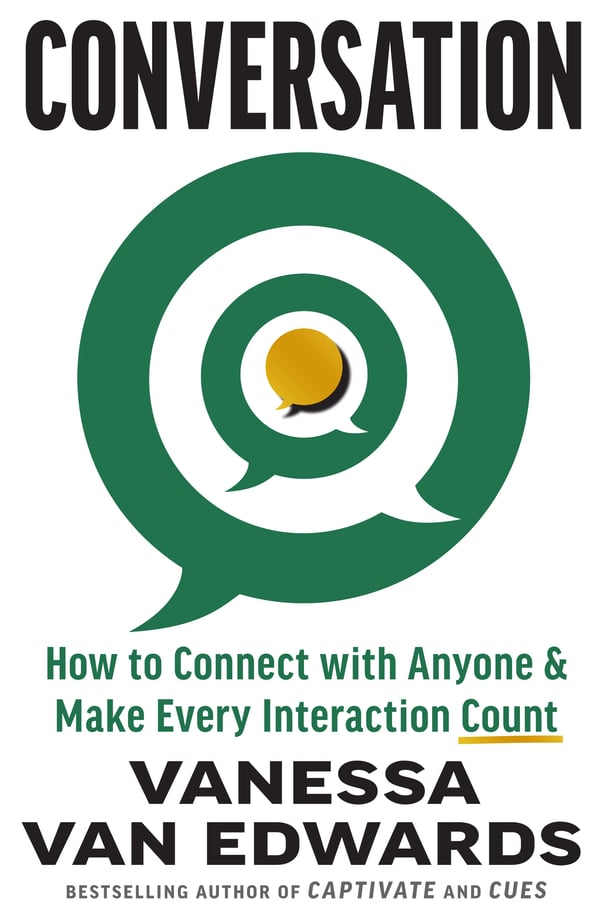
A new book by Vanessa Van Edwards
Every conversation is an opportunity.
If conversations have gotten harder, more awkward or less satisfying, you’re not imagining it. We’re simply out of practice. It’s time to find the joy in talking to each other again.
Put the Answer in Sentence One
When you’re the youngest person in the room, it’s tempting to walk everyone through all your homework first. (We get it… you worked hard on that spreadsheet!) Try the conclusion first, then the backstory.
Barbara Minto’s book The Pyramid Principle is built on exactly this. You open with your recommendation, then give the reasons behind it.
| Work first | Answer first |
|---|---|
| “So I pulled six months of churn data, and then I split it by plan, and I noticed the annual customers…” | “We should send the renewal email two weeks earlier. Annual customers who hear from us sooner renew more often, and here’s the chart.” |
Which one would you rather sit through on a Friday afternoon? Exactly.
And your six months of detail doesn’t go to waste. If someone wants it, they’ll ask… and now you’re walking through it as the answer to THEIR question.
Get Your Name Printed on the Agenda
In small groups working together, the people who talk more tend to be the ones others name as the leader, even after accounting for intelligence and personality.5 Not great news if you’re the youngest one there, politely waiting for someone to invite you in!
So skip the waiting. A day or two ahead, ask the meeting’s organizer for a named slot on your piece of the work:
“Could I take two minutes on Wednesday’s agenda to walk through the A/B test results? I ran them, so I can answer questions on the spot.”
If they say yes, the agenda everyone opens on Wednesday will have a line like this on it:
10:15 A/B test results (Mia)
Check out our guide on how to speak up in meetings for what to do once you’re in the room.
One catch… once your name is on the agenda, people will remember those two minutes, good or bad. Practice your update out loud first, so it doesn’t come out as “so, um, basically.”
Save the Smiley for People Who Know You
A smiley can feel like the friendliest way to end a first email to a new client. I once signed off a first email with “Can’t wait!! :)” and it felt so warm when I hit send. On the reread? It looked like a postcard from summer camp.
In experiments on first impressions over work email, a smiley didn’t make the sender seem any warmer, and it made them seem less competent.6
No warmer AND less competent? Double ouch. So in a first email to someone new, leave the smiley out.
| First email | Sounds like |
|---|---|
| “Great to meet everyone!! Excited to dig in :)” | Friendly, and easy to picture as the intern |
| “Great to meet everyone. I’ve attached the churn model so you can see the inputs before Thursday.” | Friendly, and someone who already did the work |
When you’re the youngest on the thread, competence is the part people are still deciding about. Once a client sends you a smiley, feel free to send one right back! For the rest of the email itself, our professional email tips cover subject lines, sign-offs, and length.
Treat Age Jokes Like Weather Talk
“So… how old ARE you?” Treat it like small talk about the weather. Answer or deflect in one line, then get back to the work.
| They say | You might say |
|---|---|
| “How old are you, anyway?” | “Twenty-six. Anyway, on the Q3 numbers…” |
| “Wait, are you the intern?” | “I’m the analyst on this account. I built the model we’re looking at.” |
| “You remind me of my kid.” | “Ha, I hope they’re good with spreadsheets. Speaking of which…” |
| “When I started here, you weren’t even born.” | “Then you’ve seen a lot of these launches. What would you watch for on this one?” |
Some of those comments are flat-out rude. If they keep coming, or they come from your own manager, you might raise it with them privately instead: “I’ve noticed my age comes up a lot in client meetings. Can we keep the focus on the work?”
Bring a Draft Answer to Every Question
How many of your questions this week were secretly permission slips? When you’re the youngest on the team, it’s an easy habit to fall into. Here’s how each one sounds as a plan.
| Sounds junior | Sounds like a peer |
|---|---|
| “Is it okay if I reach out to the vendor?” | “I’m planning to call the vendor Tuesday about the delay. Anything you want me to raise?” |
| “What should I do about the bug?” | “I can patch it today or fix it properly by Friday. Which matters more for this release?” |
| “Am I doing this right?” | “Here’s my approach on the migration. Where would you poke holes?” |
Does that mean you should stop asking for help? Not at all.
Asking can feel like a big imposition. But in a series of studies, people underestimated how likely others were to agree to a direct request for help… by as much as 50%.7
Half! So the senior engineer you’ve been tiptoeing around is likelier to say yes than you think.
Steve Jobs had a great story about this, from a 1994 interview. At 12, he found Bill Hewlett, the co-founder of Hewlett-Packard, in the phone book… and called him. He asked for spare parts to build a frequency counter. Hewlett gave him the parts, and then a summer job on the company’s assembly line!
“I’ve never found anybody that didn’t want to help me if I asked them for help,” Jobs said.
If a 12-year-old can cold-call a company’s co-founder, you can probably ask the senior engineer down the hall! Bring your plan along and ask for their judgment on it.
“You’ve run three of these migrations. Here’s my plan for ours. What would you watch for?”
Become Your Boss’s Tutor
Being the youngest comes with perks, too! There’s a good chance you know something better than the people above you. Maybe it’s the tool your team just adopted, or how customers your age actually find your product.
Some companies build this into reverse mentoring programs, where a junior employee teaches a senior leader and the leader mentors them back. You don’t need a program to offer it, though:
“I noticed the new dashboard has been slowing everyone down. Want me to show you the three filters I use every day?”
After one walkthrough, you’re the person the VP messages when the dashboard acts up. (Congrats on your new unofficial title… Dashboard Whisperer.)
Own the Recap
We’re BIG fans of the recap email around here. Whoever writes down what a meeting decided tends to become the person everyone checks with afterward. So why not volunteer for the job?
Recap: Q3 forecast review
Decided: we hold the price through September.
Next: I’ll send the revised model to Kenji by Friday. Raj is checking the vendor quote.
Still open: whether the Midwest numbers include the pilot stores.
Send it to everyone who was in the room. People will search for that email later, and your name is the one on it.
Name Your Project
Work without a name gets described as “that thing Mia’s doing.” (Or worse, “that thing someone’s doing.”) A short, plain name, like “the churn rebuild” or “Project Tidewater,” gives people something to repeat.
When your manager mentions “the churn rebuild” in a leadership meeting you’re not in, someone might ask who’s running it. And the answer is YOU.
Hand Back the Pen
Who ends up with the meeting notes, the birthday card, and somehow… the lunch order? Very often, the youngest person in the room.
Women get more of them, too. In one set of experiments, women were asked more often than men to volunteer for tasks nobody wanted, like writing a report, and they said yes more often. Those jobs rarely come up when promotions get decided.
Wait, didn’t we just tell you to write the recap? We did… and there’s a difference. A recap puts your name next to the decisions and who’s doing what. Typing up everything everyone said, every week, mostly gets you asked to do it again next week.
If you’ve taken the notes three weeks running, you might suggest a rotation:
“Happy to take notes today. Can we rotate it starting next week?”
The “Hoodie Exception”
Remember Zuckerberg’s hoodie? He had a company worth billions behind it. (Most of us… do not.) Without that, what you wear is one of the few early cues you control.
In one study, men who wore a business suit to a negotiation came away with more profit and gave up fewer concessions than men who wore sweatpants.8
Sweatpants never stood a chance! You don’t need a suit for every meeting, though. Let your own office set the bar.
For your first few meetings with a new client or team, you might match what the most senior person in the room usually wears. Once people know your receipts, you can dress like everyone else. Our office dress code guide breaks down what each level of formality looks like.
Frequently Asked Questions (FAQs) About Being Taken Seriously at Work
How do you get taken seriously at work when you're young?
Give people facts about your work to judge you on, so they lean less on how old you look. Open with a receipt, one line naming something you’ve done that ties to today’s agenda. Drop disclaimers like “I know I’m young, but,” put your answer in the first sentence, and ask for a named slot on the meeting agenda. Each move hands people something better to go on than your age.
How should I respond when someone comments on my age?
Answer lightly, then steer back to the work, the way you’d handle small talk about the weather. If someone asks “Wait, are you the intern?” you might say “I’m the analyst on this account. I built the model we’re looking at.” If an older colleague says “When I started here, you weren’t even born,” try “Then you’ve seen a lot of these launches. What would you watch for on this one?”
How do I speak up in meetings when I'm the youngest person there?
Ask the organizer for a named slot on the agenda a day or two ahead, instead of waiting for an opening. In small groups, the people who talk more tend to be the ones others name as the leader. Waiting politely works against you. Try “Could I take two minutes on Wednesday’s agenda to walk through the A/B test results?” Then practice the update out loud so it doesn’t come out as “so, um, basically.”
Is it unprofessional to use emojis in a work email?
In a first email to someone new, it’s safer to leave the emoji out. In experiments on first impressions over email, a smiley didn’t make the sender seem any warmer, and it made them seem less competent. Show warmth with your words and attach the work: “Great to meet everyone. I’ve attached the churn model so you can see the inputs before Thursday.” Once a client sends you a smiley, feel free to send one right back.
What should I wear to be taken seriously at a young age?
For your first few meetings with a new client or team, match what the most senior person in the room usually wears. Clothes are one of the few early cues you control. In one negotiation study, men who wore business suits came away with more profit and gave up fewer concessions than men in sweatpants. Once people know your receipts, you can dress like everyone else on the team.
How do I ask senior coworkers for help without looking inexperienced?
Bring your plan along with the request, so you’re asking for their judgment instead of a rescue. Try “You’ve run three of these migrations. Here’s my plan for ours. What would you watch for?” People also tend to underestimate how likely others are to say yes to a direct request for help, so the ask is usually safer than it feels. Steve Jobs cold-called HP’s co-founder at 12 and came away with a summer job.
Should I hide my age?
No, you don’t need to hide your age or announce it. When it comes up, give a light answer and turn back to the work: “Twenty-six. Anyway, on the Q3 numbers…” The more people hear about what you’ve built, the less they fall back on your age. Let your receipts carry the conversation, and your birthday can stay a fun fact.
Is it okay to joke about my age first?
Joking about your age first can work against you, because it makes your age the first thing people hear about you. It can feel like a way to get ahead of the comment. But a line like “Don’t worry, I’m older than I look” puts the spotlight right where you didn’t want it. Lead with a receipt instead, like “I rebuilt the website last week, so I’ll take any new feedback today,” and save the age jokes for people who already know your work.
What if talking to my manager doesn't change anything?
If a private conversation with your manager doesn’t help, bring in someone else. That might be your manager’s manager in a skip-level meeting, HR, or a mentor who knows your company. Before that conversation, write down each comment, the date, and who was in the room. A short record like that keeps the discussion on what was actually said, instead of on how you felt about it.
Being The Youngest in The Room Takeaway
Want the short version? Start with these.
- Write your receipt. Put your name, one thing you’ve built, and the part of the agenda it covers into a single line. Say it out loud before your next meeting with new faces.
- Cut one disclaimer. Search your sent email for “this might be a dumb question” and “I know I’m new,” and leave them out of the next message you write.
- Ask for a slot on the agenda. Message the organizer of your next recurring meeting and name the piece of work you’ll walk through.
- Bring a senior colleague your plan. Pick a hard problem, show a senior colleague how you’d handle it, and ask what they’d watch for.
- Send the recap. After your next meeting, email the decisions, owners, and open questions to everyone who was there.
- Suggest a note-taking rotation. If you’ve taken the notes three weeks running, ask the organizer to rotate them.
- Match the most senior person in the room. For your next meeting with a new client or team, dress the way they usually do.
You don’t have to look older or act like someone else for any of this. Each step gives people a fact about your work, so they lean less on how old you look. Say your receipt and your agenda-slot ask out loud a few times, ideally to a friend who’ll tell you which line sounded unsure.
To keep your receipts in front of people every week, our guide on how to give a status update shows you what to say.