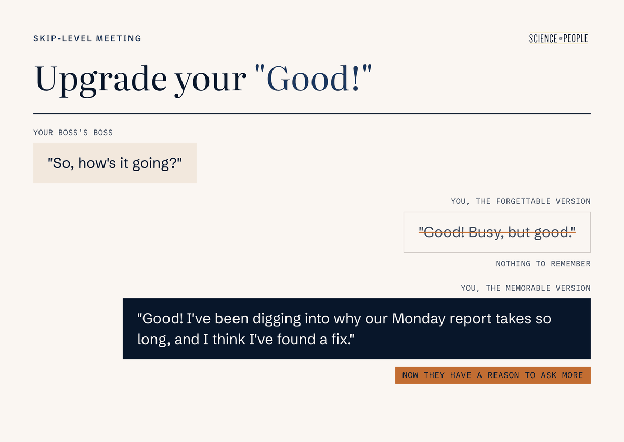
“Good! Busy, but good.”
A friend called me right after her first skip-level meeting to confess that this was her ENTIRE contribution. “My boss’s boss asked how things were going, and out it came,” she said.
She continued: “Then I was asked whether anything was slowing the team down, and my mind went completely blank. I thought of three things on the walk back to my desk. Of course!”
Nothing went wrong, exactly. But your boss’s boss often has a say in who gets promoted. They just spent 30 minutes with my friend and walked away with nothing to remember. “Good” might be the most expensive word you can say in that room!
The good news? A skip-level is one of the easiest meetings to prep for. Plus, the whole plan can fit on a sticky note. Let’s fill it in!
What Is a Skip-Level Meeting (and Should You Be Nervous)?
A skip-level meeting is a one-on-one conversation between an employee and their manager’s manager, held without the direct manager in the room. It’s also known as a skip-level one-on-one, or just a skip-level. The senior leader usually sets it up to hear how work looks from further down the organization.
So… are you in trouble? Probably not! If the invite went to everyone on your team, your boss’s boss is most likely working through the whole group.
Let’s say a director books 30-minute slots with eight people in her team. She keeps notes in one running doc, and by Friday it reads like this:
“All good” / “All good” / “Good! Busy, but good” / “All goood” / “All good” / “All good”
Then come the two entries she starred: “Monday report eats four hours a week. Already has a fix!” and “Asked how we decide which projects get funded. GREAT one.” Guess which two names she remembers?
Why do so many people play it safe? A 2010 study in Organization Science interviewed employees at a large tech company about speaking up. When they explained why it felt risky or pointless, they brought up leaders several levels above them almost as often as their own boss.1
That’s often why your boss’s boss holds these meetings in the first place. They want to hear what rarely makes it up the chain on its own.
Turn “How’s It Going?” Into Your Best Opening Line
Plenty of people follow unwritten rules about when it’s risky to speak up, even when what they’d say would help the company.2
But a pleasant half hour teaches the skip-level exactly one thing about you… that you’re nice. They probably assumed that already!
Ideas can help, though. Employees who spoke up with ideas for improving how things worked were rated as more promotable by their supervisors.3 So keep the “Good!” and add one sentence with something real in it:
- Instead of “Good! Busy, but good,” try: “Good! I’ve been digging into why our Monday report takes so long, and I think I’ve found a fix.”
- Instead of “Nothing, really,” when they ask what’s slowing you down, try: “Honestly? Waiting on data from another team. I’d love your take on that, actually.”

A new book by Vanessa Van Edwards
Every conversation is an opportunity.
If conversations have gotten harder, more awkward or less satisfying, you’re not imagining it. We’re simply out of practice. It’s time to find the joy in talking to each other again.
Bring One Win (Hard Part Included)
Your boss’s boss may never have seen your best work up close. So bring one recent win, told in three beats: what you did, why it mattered, and why it was hard.
“Last month we cut the onboarding backlog from three weeks to four days. New clients were stalling, so it mattered. The hard part was getting legal to sign off on a shorter contract.”
Why the hard part? It’s the beat that shows how you think, and it’s usually the piece nobody above your manager knows about.
Pick ONE. A list of five starts to sound like a self-review!
Give Your Manager a Heads-Up the Day Before
Few managers enjoy hearing news about their own team from their boss first. (If you’ve ever been stopped in a hallway with “So what’s this about the Monday report?”, you know the feeling.)
Try sending your manager something like this the day before:
“Hey! I’ve got my skip-level with Nadia tomorrow. I’m planning to mention how long the Monday report takes us and an idea for automating most of it. Wanted you to hear it from me first… is there anything you’d rather I leave out, or want to raise yourself?”
Why bother? In a study in China and Japan, people who pictured themselves as the manager rated an employee lower when that employee spoke up to the manager’s boss instead of to them. Part of the reason was that they liked that employee less, or felt threatened.4
Ouch.
What if your manager replies, “Actually, let me raise that one”? That’s a fine outcome! Ask them to mention it came from you, then pick a different topic for your half hour.
Action Step: Open a message to your manager now and fill in the blank: “Tomorrow I’m planning to bring up ______.” Send it the day before so they have time to reply.
Bring One Idea With the Fix Stapled On
Bring the problem, your fix, and a small ask, in that order.
Here’s the version that sounds like venting next to the version that sounds like someone worth promoting:
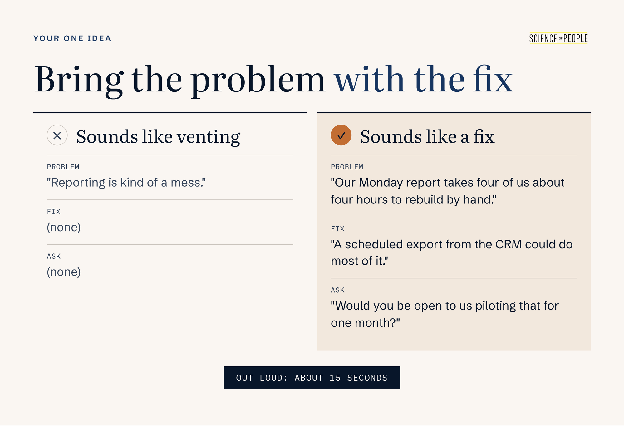
Pro Tip The ask is small on purpose. A one-month pilot is easy to say yes to… and easy to simply end if it flops. Got more ideas? Save them for the follow-up or for your next one-on-one with your own manager.
Borrow Their Brain for One Hard Problem
Asking a senior leader for help can feel like admitting you’re in over your head. Or like asking for a favor you’ll NEVER be able to repay.
People say yes to a request for help more often than we expect. Help-seekers underestimated, by as much as half, how likely others were to agree.5
What’s the hardest problem on your plate right now? Write it down: ________________
Then turn it into a question for someone two levels up. A few that work:
- “Our team needs data from the platform team every sprint, and it keeps arriving late. How have you gotten a team that doesn’t report to you to move something up their list?”
- “I’m about to run a project with people more senior than me for the first time. What do you wish you’d known the first time you did that?”
- “When you were at my level, how did you decide which projects to say yes to?”
If you try their suggestion, you’ve got the PERFECT line for your follow-up (more on that below)!
Skip-Level Meeting Questions That Get You Behind the Curtain
Your boss’s boss usually knows why your team got its current project, and what got cut to make room for it. They may also be worried about something that hasn’t reached you yet. (Wouldn’t you love to know what that is?)
Over two years, employees who understood how decisions and politics really worked in their organization saw faster salary growth and more promotions.6 A skip-level meeting is one of the few places you can just… ask.
Here are questions grouped by what they teach you. Try picking two.
About Priorities
- “If our team could only get one thing right this quarter, what would you want it to be?”
- “What’s something you’re thinking about that people at my level probably don’t see?”
- “What are you hearing from your own leadership that would be useful for us to know?”
About How Decisions Get Made
- “When two teams want the same budget, how does that usually get decided?”
- “What made the last big project here get approved?”
- “What’s a decision from the past year that looked obvious from the outside but wasn’t?”
About What the Next Level Looks Like
- “What do the people who move up from my level tend to do differently?”
- “What would you want to see from someone on our team who’s ready to take on more?”
- “Is there a problem somewhere in the wider org where someone with my skills could help?”
For the weekly version of this with your direct manager, check out these questions to ask your boss.
Have Answers Ready for Their Questions
Your skip-level has their own list, and the questions come fast. (Hello again, blank mind.) A one-line answer for each of the usual suspects keeps you out of “Good! Busy, but good” territory:
- “What’s one thing we could change?” This is your cue for your one idea: problem, fix, small ask.
- “Do you have what you need?” Name one real blocker and what would fix it: “Mostly! Data from the platform team arrives late, and a shared deadline would solve most of it.”
- “What’s the best part of your job right now?” Be specific, and have a little fun with it: “Honestly? Watching our new dashboard catch a bug before a client did.”
- “If you were the manager, what would you do differently?” Treat it like the next question on the list, and keep it to one specific, fixable thing.
How to Answer “How’s Your Manager?” Gracefully
If things are good, give one specific strength with a real example: “She’s great at clearing blockers. The contract was stuck for two weeks last month, and she got it signed in two days.”
(Vague praise is the spoken version of a reference letter that says “Sam was always punctual.” Perfectly polite… and totally forgettable.)
Specific praise sounds believable, and it makes your manager look good to their own boss.
If there’s a problem, keep it short and steer it back to your manager: “There’s one thing I’m still working through with them directly. If it’s not sorted in a couple of months, could I come back to you on it?”
Something serious, like harassment or an ethics problem, goes straight to HR, separately from this meeting. And if your manager really is the issue, how to deal with a bad boss covers that conversation in more depth.
Send a Four-Sentence Follow-Up Before They Forget Your Name
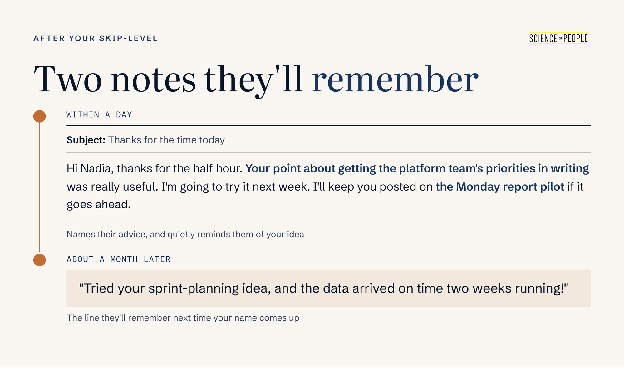
Send a short note within a day. It gives the skip-level a written record of the one thing you want them to remember, and it proves you were listening!
Subject: Thanks for the time today
Hi Nadia,
Thanks for the half hour. Your point about getting the platform team’s priorities in writing before sprint planning was really useful. I’m going to try it next week.
I’ll keep you posted on the Monday report pilot if it goes ahead.
Thanks again, Tomás
Then comes my favorite part. A month or so later, send one more line on how the advice went:
“Tried your sprint-planning idea, and the data arrived on time two weeks running!”
How often does anyone go back to tell a VP their advice WORKED? We’d guess… not often! That line is what the skip-level will probably remember the next time your name comes up.
For more on timing and wording, see how to follow up without being annoying.
Not in a corporate job? The same two moves work with clients and new circles, too. Ask a longtime client, a mentor, or the most connected person in your book club for advice on one real problem. A month later, go back with the update: “I tried your idea about Sunday open houses, and it worked!”
Your Skip-Level Sticky Note
Here’s the whole plan on one sticky note. Copy it, fill in the blanks, and keep it in your pocket (or just off-camera).
My heads-up to my manager: “Tomorrow I’m planning to bring up ______.”
My one win: “Last ______, we ______. It mattered because ______. The hard part was ______.”
My idea: “Our ______ takes ______. I think ______ could fix most of it. Would you be open to us trying that for a month?”
My advice question: “I’m stuck on ______. How have you handled ______?”
My two questions: (1) ______ (2) ______
My follow-up line, one month later: “Tried your ______ idea, and ______!”
Then say the whole thing out loud once before you walk in, to a friend, a mirror, or a very patient dog. The first time you say your pitch shouldn’t be in front of your boss’s boss! (Working in a second language? Here’s how to sound charismatic in your second language, practice tips included.)
Frequently Asked Questions (FAQs) About Skip-Level Meetings
Is a skip-level meeting a bad sign?
Usually not. Many companies run them on a regular cycle, and if your whole team got invites, it’s most likely a listening tour. Your boss’s boss wants to hear what rarely makes it up the chain on its own. If it’s just you and it came out of nowhere, it’s fine to ask your manager, “Anything I should know going in?”
How often do skip-level meetings happen?
It depends on the company. Some leaders hold them every quarter or so, and others hold one when they’re new to the role or when something big is changing. If you’re not sure whether yours is routine, your manager can usually tell you. Either way, the prep is the same and fits on one sticky note.
How do you prepare for a skip-level meeting?
Write down four things: one idea with a fix and a small ask, one problem you’d like advice on, and two questions. Then send your manager a heads-up the day before. That’s the whole prep, and yes, it fits on a sticky note. Say it out loud once before you walk in so the first time isn’t in front of your boss’s boss.
What should I say when my skip-level asks how it's going?
Keep the “Good!” and add one sentence with something real in it. Try: “Good! I’ve been digging into why our Monday report takes so long, and I think I’ve found a fix.” That gives them a reason to ask more. If they ask what’s slowing you down, name one real blocker instead of “Nothing, really.”
What questions should I ask in a skip-level meeting?
Pick two questions about priorities, how decisions get made, or what the next level looks like. One good option is “If our team could only get one thing right this quarter, what would you want it to be?” Another is “When two teams want the same budget, how does that usually get decided?” Leave the rest at home.
Should I tell my manager what I plan to say in a skip-level?
Yes, send a short heads-up the day before. Managers rarely enjoy hearing news about their own team from their boss first. Try: “I’ve got my skip-level with Nadia tomorrow. I’m planning to mention the Monday report and an idea for automating it. Anything you’d rather I leave out?” If they want to raise it themselves, ask them to mention it came from you.
How do I answer "How's your manager?" in a skip-level?
Give one specific strength with a real example. “She’s great at clearing blockers. The contract was stuck for two weeks, and she got it signed in two days.” If there’s a problem, keep it short: “There’s one thing I’m still working through with them directly.” Serious issues like harassment or ethics go straight to HR.
What should you not say in a skip-level meeting?
Skip the complaint list, gossip about coworkers, and anything about your manager you haven’t said to your manager first. Skip asking for a promotion outright, too. The “next level” questions get you that conversation without putting anyone on the spot. Try “What do the people who move up from my level tend to do differently?”
Can I bring up my career goals in a skip-level?
You bet. Ask what people who move up from your level do differently, or what they’d want to see from someone who’s ready for more. Then listen hard and take notes. Their answer gives you a short list to work on and a natural reason to send an update later about what you tried.
How do I follow up after a skip-level meeting?
Send a short thank-you within a day that names the one piece of advice you’ll act on. A month or so later, send one more line on how it went: “Tried your sprint-planning idea, and the data arrived on time two weeks running!” Few people go back to tell a senior leader their advice worked, so that line tends to stick.
What if it's a group skip-level meeting?
The same prep works, just smaller. Bring one question and ask it early, before the conversation drifts. In a group, one good question is often what people remember you by. A question about how decisions get made, like “What made the last big project here get approved?”, works well in a room.
Skip-Level Meeting Takeaway
- Send your manager a short note about your one idea the day before the meeting, and offer to drop it if they’d rather raise it.
- Write your idea as problem, fix, and a small ask, then say it out loud once so it fits in about 15 seconds.
- Pick one hard problem you’d like the skip-level’s advice on, and phrase it as a question about a real situation.
- Choose two questions from the lists above and leave the rest at home.
- Within a day, send a thank-you that names the one piece of advice you’ll act on, then send a one-line update once you’ve tried it.
Your own manager probably gets a half hour with you most weeks, and that one deserves the same prep (and a better answer than “good”). For that conversation, start with how to make one-on-one meetings impactful.