In 1955, Ella Fitzgerald was already a star. But there was a problem… she still wasn’t getting booked at the Mocambo, one of Hollywood’s most exclusive nightclubs.
Then Marilyn Monroe, a devoted fan, got involved. She helped persuade the club’s owner to book Ella.1
Ella had the talent the whole time, but what she needed was someone with clout to say “Book her!” in a room she wasn’t in.
Work can go the same way. Three straight years of “yep, exceeds expectations” can still end with no promotion… because nobody argued for you.
So who can help? That somebody is a sponsor.
What Is an Executive Sponsor?
An executive sponsor is a senior leader who uses their own influence to advance a more junior person’s career. Sponsors recommend their protégés for roles, stretch assignments, and promotions, and vouch for them when those decisions are made. They’re also called career sponsors or champions. A sponsor usually works in the same organization as the person they back.
Quick note on the name: in project management, “executive sponsor” also means the senior leader who owns a project and its budget (there’s more on that role in the FAQ below). This article is about the career kind… the person who backs YOU.
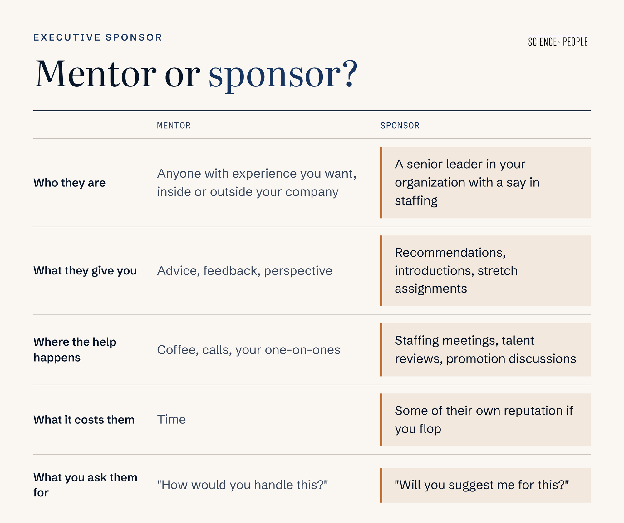
Are they a mentor? Not really… Here’s how the two roles compare:
If the advice side is what you’re missing, we have a full guide to finding a mentor.
Great Reviews, No Promotion? Meet the Second Judgment
Say Ines gets a third straight “exceeds expectations.” Her manager writes “consistently excellent” in the comments, and means it! Two weeks later, the promotion goes to someone else. Bummer.
Wait… what did I miss?
So what happened? Often, a SECOND judgment happened, and it never appeared on Ines’s review form.
At one large retail chain, women got higher performance ratings than men and lower ratings for “potential.” That potential gap explained about half of the gender difference in promotions, even though the women later outperformed their male colleagues.2
Potential is basically a guess about how you’ll do in a job you don’t have yet. And somebody in a calibration meeting is making that guess about you (yikes). It helps a LOT when one of the people in that meeting has seen you handle something bigger than your current role.
Great work keeps you in the running. Often what moves your name to the offer letter is a senior person saying, “I watched them run the vendor negotiation. They’re ready.”
Who in your company would make that call about you right now? If no name pops into your head, that’s what to work on first.

A new book by Vanessa Van Edwards
Every conversation is an opportunity.
If conversations have gotten harder, more awkward or less satisfying, you’re not imagining it. We’re simply out of practice. It’s time to find the joy in talking to each other again.
Is Your Mentor Secretly a Sponsor? The Three-Question Test
Your mentor might be wonderful! Maybe they send great book recommendations, or once fixed your slide deck at 11 p.m. the night before a client pitch (true hero behavior).
I had a mentor like that for years. Lovely person… who never once said my name in a meeting I wasn’t in.
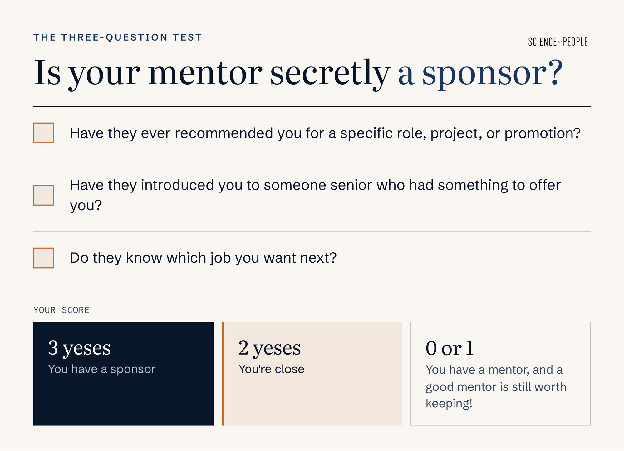
So are they sponsoring you too? Three questions will tell you:
- Have they ever recommended you for a specific role, project, or promotion?
- Have they introduced you to someone senior who had something to offer you?
- Do they know which job you want next?
Three yeses means you have a sponsor, and two means you’re close. One or zero might mean you have a mentor, and a good mentor is still worth keeping!
Find the Three Seats That Decide Your Promotion
Research shows that people whose contacts passed them information, resources, and sponsorship tended to have more successful careers.3
So before you pick a sponsor, figure out who’s actually close to the decision. For most promotions, three seats matter most:
- The talent review regular. Who sits in the meeting where people at your level get discussed?
- The headcount owner. Who controls the budget for the role you want?
- Your boss’s sounding board. Whose opinion does your manager check before putting anyone up?
(That first meeting goes by a lot of names: calibration, talent review, people review, succession planning. If none of those words has ever come up at your company, ask what happens to your review after you sign it. Somebody is probably comparing it to other people’s.)
Here’s a filled-in map for example:
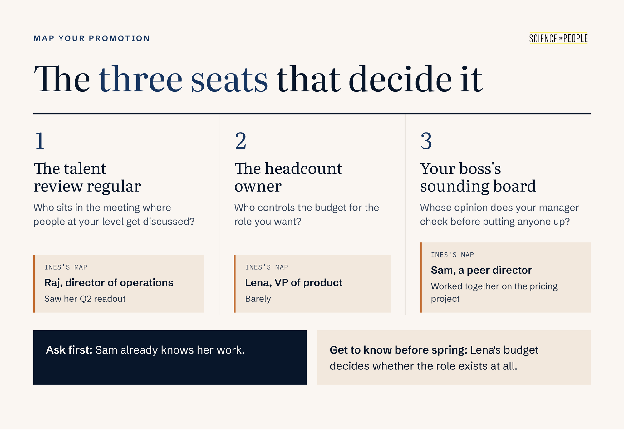
In this map, Sam is the obvious first ask. Lena? She’s the one worth getting to know before next spring, since her budget decides whether the role exists at all!
If you’ve ever mapped who to talk to before pitching an idea, this is the same exercise, aimed at your career. Our guide to the meeting before the meeting walks through that version.
Action Step: Fill in the three seats with real names tonight. If a seat stays blank, ask your manager in your next one-on-one, “Who weighs in on promotions at my level?”
Look Like a Safe Bet (Before You Even Ask)
Most of what a senior person knows about you probably came secondhand (a hallway comment here, a slide there). A short update fixes that. Here’s one Ines might send to Lena, the headcount owner from the map:
Subject: Quick update on the returns project
Hi Lena,
At the August town hall you mentioned cutting returns processing time as a top goal for the year. Our team got it from nine days to four this quarter. I led the vendor side.
I’m working toward a product lead role, and I’d love 20 minutes this month to hear what you look for in people at that level.
Thanks, Ines
The email ties Ines’s result to Lena’s own goal and says where Ines is headed. The only thing it asks for is 20 minutes, which is easy to say yes to!
Ask for One Job, in One Meeting
After a few conversations like that, a sponsor ask can sound like this…
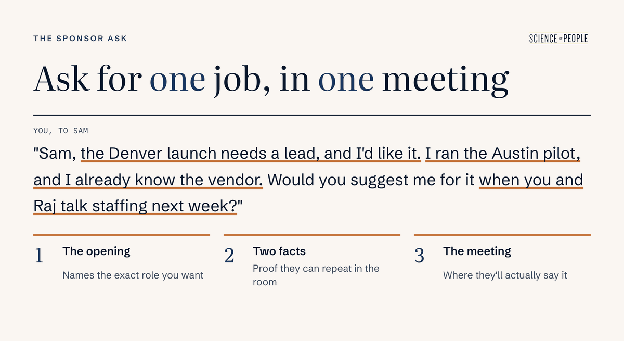
Compare that to “Do you have any advice for getting promoted?” Totally fine mentor question. But a sponsor can answer it warmly… and then do nothing at all.
I once asked a senior leader for “any advice” about a role I wanted. I got a great book recommendation. I did not get the role!
When They Say “I’m Not Sure You’re Ready”
Sometimes the answer is “I’m not sure you’re ready yet.” Oof. It stings, but it’s useful, as long as you get the details.
“That’s fair. What would you need to see from me to feel good recommending me next time?”
Whatever they list becomes your plan for the next six months. Checking back in as you finish each item gives them a reason to say yes the next time a role opens.
What would your target sponsor say you still need to show? Write your best guess down: ________
Make Your Sponsor Look Smart for Backing You
Sponsorship can feel like a favor you’ll NEVER be able to repay. So what’s in it for them?
Employees at a health care organization who had mentored others reported higher pay, more promotions, and a stronger sense of career success than those who hadn’t.4 A backer also earns a reputation for spotting talent early!
You can make that payoff easier to see. After every opportunity they hand you, send a quick report back:
“Sam, quick update. The Denver launch hit its date, and the client renewed for two years. Thanks for recommending me. I mentioned your vendor scorecard idea in the readout to the leadership team.”
Get Seen When You Work Remotely
Working remotely makes this hard. Sponsors back people they’ve seen in action, and on a remote team, a lot of your best work happens where no senior person can see it.
So make your work easier to see:
- Present your team’s results on the big calls, even for five minutes.
- Send short updates like the one to Lena above, instead of waiting for someone to ask.
- Use your in-office days well. If you’re in once a quarter, book a coffee with someone in one of your three seats.
- Make the big ask on a video call, so they can see that you mean it.
None of this needs to be loud. It just needs to happen where the people in your three seats can see it.
Get a Backup Sponsor Before You Need One
A sponsor’s influence is borrowed. What if they take a job at a competitor in March, a month before review season? Your advocate leaves with them. And if they fall out of favor, you can get filed as “their person.”
Yikes!
There’s no tidy fix for that. But a second sponsor in a different part of the company might be a good idea.
Frequently Asked Questions (FAQs) About Executive Sponsors
What's the difference between a mentor and a sponsor?
A mentor gives you advice and support, and a sponsor uses their own influence to get you considered for roles, projects, and promotions. A sponsor also vouches for you when those decisions get made, often in meetings you’re not in. One person can be both. The quick tell is what you’d ask them for: a mentor gets “How would you handle this?” and a sponsor gets “Will you suggest me for this?”
How do I know if my mentor is already my sponsor?
Ask yourself three questions about them. Have they recommended you for a specific role, project, or promotion? Have they introduced you to someone senior who had something to offer you? Do they know which job you want next? Three yeses means you have a sponsor, two means you’re close, and one or zero means you have a mentor worth keeping.
How do I find an executive sponsor?
Start by mapping who’s close to your next promotion, then pick from those names. Fill in three seats. Who sits in talent review for your level? Who owns the budget for the role you want? Whose opinion does your manager check before putting anyone up? Start with the one who already knows your work. If a seat is blank, ask your manager, “Who weighs in on promotions at my level?”
How do I ask someone to be my sponsor?
Skip the big “Will you be my sponsor?” question. Have two or three real conversations first, then ask for one specific thing, like being suggested for a named role in a named meeting. “Sam, the Denver launch needs a lead, and I’d like it. I ran the Austin pilot. Would you suggest me for it when you and Raj talk staffing next week?”
What should I do if a potential sponsor says I'm not ready?
Ask for the details, then turn them into your plan. Try: “That’s fair. What would you need to see from me to feel good recommending me next time?” Whatever they list becomes your work for the next six months. Check back in as you finish each item, so they have a reason to say yes the next time a role opens.
Can my boss be my sponsor?
Yes! A manager who pushes for you in calibration is already doing part of the job. It helps to have one more sponsor outside your reporting line too, since your manager’s voice is one vote in that meeting. A good first step is asking your manager whose opinion they check before putting someone up for promotion.
What does a sponsor get out of backing me?
A sponsor can earn a reputation for spotting talent early, and people who have mentored others have reported higher pay and more promotions. Make that payoff easy to see. After every opportunity they hand you, send a short report back with the result, a thank-you, and credit for their idea where their peers can see it.
How do I get a sponsor when I work remotely?
Put your work where senior people can see it, since sponsors back people they’ve seen in action. Present your team’s results on the big calls, even for five minutes. Send short updates that tie a result to a goal the leader cares about. If you’re in the office once a quarter, book a coffee with someone in one of your three seats.
Can you have more than one sponsor?
Yes, and it’s smart to. A sponsor’s influence is borrowed, so a second sponsor in another part of the company keeps you covered if your first one leaves or falls out of favor. Start building that second relationship before review season. Use the same short updates and one specific ask.
What does an executive sponsor do on a project?
In project management, an executive sponsor is the senior leader who owns a project at the business level. They secure funding and resources, clear roadblocks, and connect the project team to top leadership, while the project manager runs the day-to-day work. It’s a different role from a career sponsor, though one person can play both.
Executive Sponsor Takeaway
- Run the three sponsor questions on your current mentors this week, and see who already scores two out of three.
- Fill in the three seats on your decision map with real names, then start with the one who already knows your work.
- Send the seat-holder who knows your work least one short update that ties a result to a goal they care about.
- Before the next review cycle, ask for one named opportunity, in one named meeting.
- Report back after every opportunity and give them credit where their peers can see it.
- Start building a second sponsor relationship in another part of the company before you need one.
When you’re ready for the conversation about the title itself, our guide on what to do when you’re smart but can’t get promoted covers it.