“Why didn’t anyone say something?”
That question tends to get asked many weeks after a launch goes bad, usually in a room where at least one person DID see it coming. They spotted the problem early and kept it to themselves.
Been that person? You’re not alone! In one set of interviews, 34 of 40 employees said they’d stayed quiet at least once about something important with their boss.1 Their most common reason? Fear of being labeled something like a troublemaker or a complainer.
I’ve sat on a “this won’t work” for an entire project myself. (Not my proudest moment.)
And honestly, that fear has a point. Disagreeing with your boss CAN cost you… depending on how you say it.
Is This the Hill? Three Quick Checks
Not every disagreement needs to be said out loud! Before you raise one, run three quick checks.
- How big is it? A deadline that will slip or a real risk to customers? Worth raising. A slide you’d have designed differently? Probably not.
- Whose call is it? If it’s your boss’s decision and the downside is small, let it go and save your energy for the one that matters.
- What might they know that you don’t? Your boss may be working with information you haven’t seen yet, like a promise to a client or a budget change that isn’t public.
Not sure about that last one? Ask before you disagree. “What am I missing about the April date?” either gets you the missing piece… or opens the door for your concern.
Pushed back on the last few decisions in a row? Get pickier. When every decision gets a concern, the important ones get harder to hear.
Swap “This Won’t Work” for “What If We…”
This one surprised us. Researchers looked across many workplaces and split speaking up into two kinds. Suggesting a way to make something better tended to go with stronger job performance. Pointing out what’s going wrong? That went the other way.2
Wait… what?!
Being RIGHT about the problem doesn’t earn you credit on its own. Bring it up as a proposal, though, and suddenly you look like the person who solved it.
Sometimes the honest answer really is “this won’t work.” Fair enough! You can still say it as a next step. A good proposal names the thing you’re both protecting, offers what you’d do about it, and ends with a question.
Here are three concerns, said both ways:
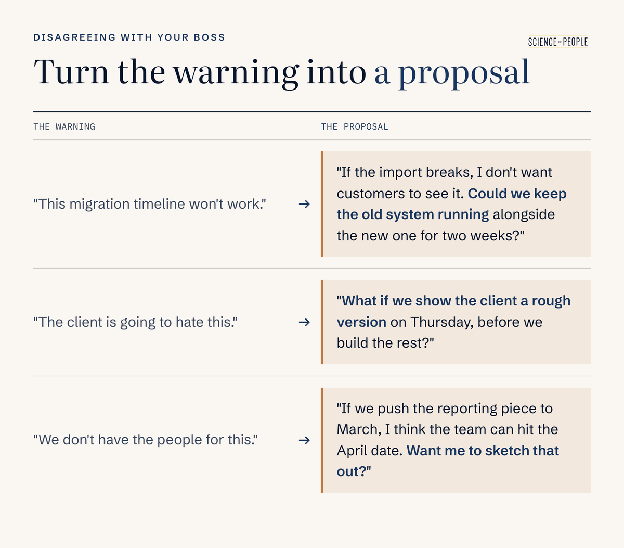
Try This: Think of a concern you’ve kept to yourself this week. Write it down the way it sounds in your head first (yes, even the grumpy version). Then rewrite it as one sentence that starts with “What if we…” or “Could we…”
A new book by Vanessa Van Edwards
Every conversation is an opportunity.
If conversations have gotten harder, more awkward or less satisfying, you’re not imagining it. We’re simply out of practice. It’s time to find the joy in talking to each other again.
Speak Up While It’s Still One Edit
Say your boss shares a draft plan, and you notice the launch falls in audit week, when the support team is down two people.
Right now, changing the date takes ONE edit. Once it’s on a slide in front of the whole company, it takes an announcement, an apology, and a little embarrassment. So speak up while it’s still a draft, with something like this:
“Before this goes out, can I point out one date? Launch lands in audit week, when support is short two people. Could we move it to the 14th?”
That’s it! Already announced? It’s still worth raising, and the tricky-moment lines near the end show you how.
Talk to Your Boss One-on-One First
Managers tend to get more defensive about a concern raised in front of an audience than about the same concern raised one-on-one, and they back it less.3
Why? In front of other people, a concern can feel like a public test of whether your boss knows what they’re doing. (It matters most when you and your boss aren’t especially close.)
So bring it up one-on-one first, and with the group second (if the group needs to hear it at all!).
To ask for the time, try: “Have you got 10 minutes before Thursday? I’ve got one concern about the rollout, and I’d rather bring it up with you first.”
Pro Tip “I’d rather bring it up with you first” tells your boss you’re protecting them from a surprise. It’s the opposite of going around them, and it tends to get you a warmer 10 minutes.
If the decision is headed for a bigger meeting, this is your chance to shape it before the room does. The meeting before the meeting covers how to run those quieter conversations in the right order!
When the Decision Is Happening Right Now
Sometimes the decision is happening right now, in the room. Wait, and it’s settled. So ask ONE question, then step back.
- “Can I ask one thing about the timeline? How are we handling audit week?”
- “Before we lock this in, what’s the plan if the import breaks?”
- “Quick one: is ‘hope’ our support plan for audit week?”
Answer doesn’t settle it? Park the rest: “That’s helpful. Can I grab you after?”
One question shows you’re paying attention. Five in a row is a cross-examination… but with an audience!
Flag It in Writing, Fix It on a Call
Putting it in writing? Keep it short, send it just to your boss, and point it at the plan.
Like this:
Subject: Quick thought on the April 2 launch
Hi Scott,
Before we lock the launch date, can I raise one thing? April 2 lands in audit week, when support is down two people. Could we look at the 14th instead?
Happy to talk it through on a quick call if that’s easier.
Thanks,
Rob
Pro Tip Don’t hit reply-all with a concern that’s meant for your boss, since that turns a private issue into a public one. And skip the five reasons. One clear reason gets read.
Tie It to the Number (The Right Way)
Want your concern to actually get heard? Hang it on something your boss already cares about. Researchers interviewed middle managers at a hospital about times they’d tried to get senior leaders to take an issue seriously. Linking an issue to a goal that leadership already cared about, like profitability, came up in 18 of the success stories… and just two of the failures.4
Here’s what that looks like. Say your team wants to cut the QA pass to ship faster, and you think that’s a mistake.
“If we cut the QA pass, I’m worried we’ll see more bug reports. Could we keep a lighter version instead?”
So how do you find their number? Listen for what they repeat in team meetings, or notice what their own boss keeps asking them for. Or simply ask in your next one-on-one: “What’s the number you’re getting the most questions about this quarter?”
We LOVE that question! The answer tells you which concerns your boss is ready to hear… and which ones will sound like noise.
Drop the Devil’s Advocate Act
“I’m just playing devil’s advocate here, but…”
It’s a tempting cover, right? If your boss hates the point, it was never really yours!
In group experiments, a person who genuinely disagreed got groups to come up with more and better solutions than any version of an assigned devil’s advocate.5
So own the objection. Try: “I’m on board with the goal. I see the timeline differently, and here’s why.”
It’s barely longer than the cover, and nobody has to guess whether you mean it.
Just don’t become the team’s dream killer. Owning an objection works because you don’t have one for everything, so save it for the decisions that matter, and cheer the rest on. Here’s how to tell dream killers from dream builders.
When They Push Back, Do What Lincoln Did
July 1863. Gettysburg is over, and Abraham Lincoln is deeply frustrated. General George Meade has let Robert E. Lee’s army slip away, so Lincoln sits down and writes him a sharp letter.
“Your golden opportunity is gone, and I am distressed immeasurably because of it,” he wrote.
Then he put it in an envelope, wrote “To Gen. Meade, never sent, or signed” on the outside, and filed it away. Writing letters like that and storing them was one of his favorite ways to cope.6
I keep a “never send” folder in my drafts for exactly this reason. It’s… very full.
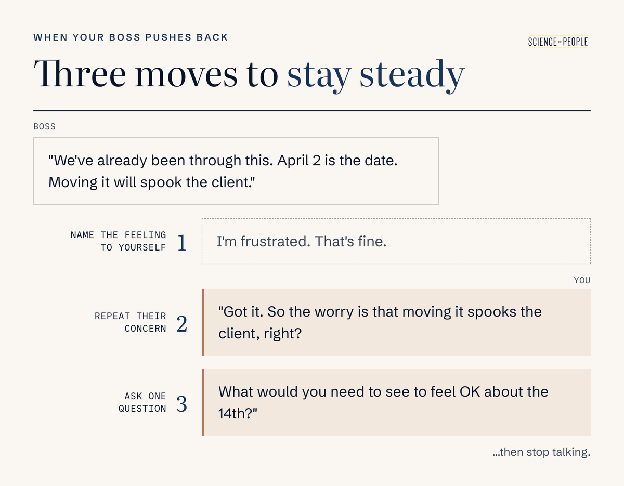
Mid-meeting, you don’t have time for a whole letter. But you can do the few-second version… notice the feeling first, then choose your next sentence.
- Name the feeling to yourself. I’m frustrated. That’s fine. Naming it takes a few seconds, and it buys you a beat before your next sentence.
- Repeat their concern before you repeat yours. “So the worry is that moving the date spooks the client. Is that right?”
- Ask one question, then stop talking. “What would you need to see to feel OK about the 14th?”
Here’s how that sounds strung together:
If staying calm in the moment is the hard part for you, how to be calm has more ways to practice.
Give a Shaky Boss a Win First
Some bosses hear “I disagree” and say “Great, tell me more!” Others take it personally. That second reaction often has more to do with how capable they’re feeling right now than with you.
Maybe they’re three weeks into the job. Maybe they just got grilled by their own boss. In a series of studies, people with power got more aggressive when they felt incompetent in their role. But when their sense of self-worth got a boost first, the aggression disappeared.7
You can’t run a study on your boss (sadly). You can do the everyday version, though… start with something they genuinely got right, then ask for their read instead of handing them your verdict.
“The way you calmed the client down last week was exactly right. That’s why I wanted your read on something. How would you handle support during audit week?”
Keep the compliment true and specific. A made-up one is easy to spot. And the question lets them be the expert while they look at the problem.
If you can, hand them the credit too: “If it’s useful, I can write up a backup plan, and you can take it to your boss.” (Will that sting a little? Maybe. A fixed problem is still worth more to you than the credit.)
And sometimes none of it works. A boss who feels threatened can hold a disagreement against you even when you raised it privately, as a proposal, in your calmest voice.
Lost the Debate? Commit and Leave Breadcrumbs
So your boss hears you out and decides the other way. Now what?
First, commit out loud: “Okay, I’m in. I’ll make April 2 work.”
Then leave a trail, with a short note that same day:
“Thanks for talking it through today. We’re going with April 2, and I’m on it. If support gets swamped that week, I have a backup plan ready to go.”
Use These Lines for Six Tricky Moments
Some moments come up again and again. Here’s what tends to slip out, and what to say instead:
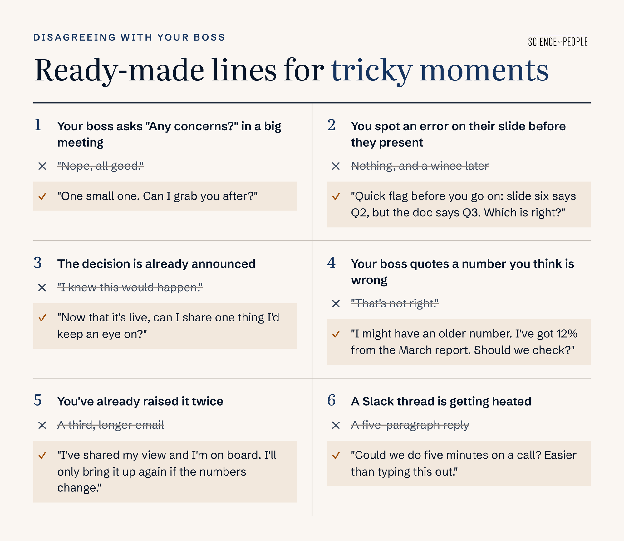
Our favorite is the last one. Some disagreements are just easier with a voice attached!
Frequently Asked Questions (FAQs) About Disagreeing With Your Boss
Is it okay to disagree with your boss?
Yes! How you say it matters more than whether you say it. A concern raised early, one-on-one, and as a proposal tends to go over much better than the same concern dropped into a big meeting. Before you raise it, ask three things. How big is it? Whose call is it? What might your boss know that you don’t?
Can you get fired for disagreeing with your boss?
It depends on where you work and the rules that apply to your job, so if you’re worried, talk to HR or an employment lawyer. In many places, raising a safety, ethics, or legal concern comes with its own protections. For everyday disagreements about plans and priorities, the way you raise the concern is the part you control: privately, early, and as a proposal.
Should I ever disagree with my boss in front of other people?
Try to raise it one-on-one first. Managers tend to get more defensive about a concern raised in front of an audience. If the decision is being made in the room right now, ask one question, like “Before we lock this in, what’s the plan if the import breaks?” If the answer doesn’t settle it, offer to follow up: “That’s helpful. Can I grab you after?”
How do I disagree with my boss respectfully?
Turn the warning into a proposal that ends in a question. Name the thing you’re both protecting, offer what you’d do about it, and hand the decision back. Instead of “We don’t have the people for this,” try “If we push the reporting piece to March, I think the team can hit the April date. Want me to sketch that out?”
What if my boss gets angry when I disagree?
Stay calm, repeat their concern back to them, and ask one question, like “What would you need to see to feel OK about this?” Name the feeling to yourself first so you get a beat before your next sentence. If it keeps happening, it may have more to do with how secure they feel in their role than with you. Our guide to dealing with a bad boss has more ideas.
Should I disagree with my boss over email?
Email works for flagging a concern, and a call works better for sorting it out. Keep the note short, send it only to your boss, and give one clear reason. “Before we lock the launch date, can I raise one thing? April 2 lands in audit week. Could we look at the 14th instead?” Then offer a quick call. Never reply-all with a concern meant for your boss.
Is playing devil's advocate a good way to disagree?
Owning the objection works better than hiding behind the devil’s advocate label. A real disagreement tends to push a group toward more and better ideas than an assigned one. Swap “I’m just playing devil’s advocate here, but…” for “I’m on board with the goal. I see the timeline differently, and here’s why.” Save it for the decisions that matter, and cheer the rest on.
How do I disagree with feedback on my own work?
Thank them first, then ask a question before you defend yourself, like “Can you walk me through an example?” The example often shows you what they actually saw. If you still see it differently, share the specific results you’d point to, one at a time. For review season, here’s how to handle your performance review.
What should I do after my boss decides against me?
Commit out loud, then leave a short written trail. Say “Okay, I’m in. I’ll make April 2 work,” and send a note the same day: what you agreed, that you’re on it, and the backup plan that’s ready if things change. That shows you can lose a debate gracefully, and it keeps your option on the table without reopening the argument.
What if my boss keeps shutting me down?
Keep a short record of what you raised and when, keep committing to the decisions that get made, and look for other routes. A skip-level conversation with your boss’s boss can help when it’s handled carefully. HR is the place to go for anything about safety, ethics, or how you’re being treated. If you’ve already raised it twice, try “I’ve shared my view and I’m on board.”
Disagreeing With Your Boss Takeaway
- Check if it’s worth it. Before you push back, ask how big it is, whose call it is, and what your boss might know that you don’t.
- Pick the concern you’ve kept quiet about and rewrite it tonight as one sentence starting with “What if we…” or “Could we…”
- Book 10 minutes with your boss before the meeting where it’ll come up, and tell them you’d rather raise it with them first.
- Ask for their number. In your next one-on-one, ask which number they’re getting the most questions about this quarter, and hang your next concern on it.
- Swap the cover for the real thing. Replace “I’m just playing devil’s advocate” with “I see it differently, and here’s why.”
- After a no, send the three-line note: what you agreed, that you’re in, and the option that’s ready if things change.
Disagreeing about a plan is one thing. If the concern is about how your boss works with you, how to give feedback to your boss picks up from there.