In This Article
Working from home can boost your output or quietly wreck it. Research-backed fixes for focus, loneliness, Zoom fatigue, and getting noticed at work.
“I’ll just throw in one load of laundry before I start…”
Sound familiar?
Working from home can be amazing, productive, and fulfilling…it can also be crazy-making, full of distractions, and challenging.
Are you already working at home? You’ve got plenty of company.
About a quarter of all paid workdays in the U.S. now happen at home1, and hybrid schedules are now more common than fully remote ones.
Well then, congratulations! Research has found some awesome benefits of working from home.
Let me ask you, what benefit of working from home has research found? Is it:
a) increased productivity
b) healthier workers
c) happier workers
d) remote workers have better relationships
e) all of the above
If you guessed e) all of the above…
Bingo!
You’re correct.
The Benefits of Working at Home (with Science!)
Working from home comes with real, measurable perks…as long as you set it up well. There are four main benefits of working from home that make up what I like to call…
The Work-At-Home Burger!
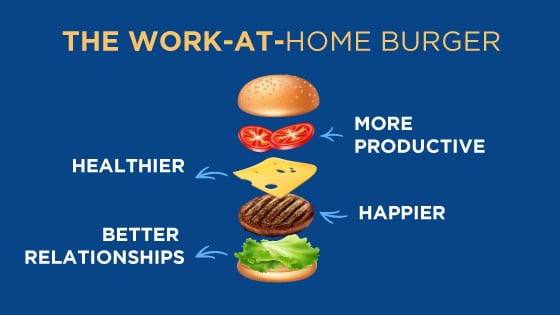
Are you hungry like I am? Let’s dig into the juicy science that makes working at home SUCH an appealing meal!
A Side of Productivity? Check!
A Stanford economist ran one of the best-known work-from-home experiments ever at Ctrip, China’s largest travel agency:
- Call center employees who volunteered to work from home were randomly split into two groups.
- One group kept working at headquarters, and the other group worked from home four days a week for nine months.
What the study found was nothing short of astonishing…
The home workers were 13% more productive2. That’s like getting an extra hour of work out of every eight-hour shift!
But why is this? Most of the gain came from time. People who worked from home:
- worked more minutes per shift
- took shorter breaks
- had fewer sick days
The rest came from getting more done per minute, thanks to a quieter, more convenient place to work. Their quit rate halved, too!
Oh, and one more thing. Later, the company let everyone choose again. Over half of the volunteers switched…and the productivity gain almost doubled, to 22%!
I can say that these findings are TOTALLY true! Here are some MORE great time-saving benefits of working from home:
- No commute
- No need to pack a lunch
- No make-up / hair (unless you do video calls)
- You *could* wear your pajamas (more discussion on this later)
- No checking traffic
- No stopping for gas
- No need to park or buy public transport tickets
- No schmoozing with people in the elevator
Want to find out more about the Ctrip study? Check out the lead researcher’s TEDxStanford talk here:
What about hybrid work, where you split the week? A newer randomized trial at the same company included 1,612 employees, and the hybrid group worked from home two days a week. Their quit rates dropped by a third! And over the next two years? Their performance reviews and promotions matched the people in the office3.
A Healthier You? Double Check.
In a 2015 survey of remote workers, 42% said they ate healthier than when they worked in an office4. And it’s no wonder:
- A healthy, fresh meal is just steps away in your kitchen
- No more bringing processed, junk food to the office for the sake of convenience
And don’t forget sleep: 45% of remote workers in the same survey said they were getting more sleep4! With less time spent on commuting, working from home lets you transfer your precious commute time to sleep time.
Happier, Too? Triple Check!
Did you know a 2013 survey found that 70% of workers would rather telecommute than work in the office?5
And it’s no wonder…people who work at home tend to be happier! In a 2019 survey by video conferencing company Owl Labs, 1,202 full-time U.S. workers were asked about their jobs6.
- They found that 71% of remote workers were happy in their jobs, compared with 55% of on-site workers. Remote workers were also 13% more likely to say they’d stay in their job for the next five years.
Why do people choose to work remotely? When asked, the survey respondents said:
- They had a better work-life balance (91%).
- They had increased productivity and better focus (79%)
- There was less stress with the job (78%), and
- They didn’t need a commute (78%)
So if you work from home, count your blessings! I’m SO happy to be able to call my home my office! And finally…
The Finale: Better Relationships? Ch-ch-ch-CHECK!
I personally believe that relationships are one of the MOST important parts of our lives. And, believe it or not, a Swedish study found that long commutes are hard on romantic relationships!
In the study, when one partner commutes 45 minutes or more to work…
The risk of the couple separating is 40 percent higher.7
And the reason is simple: daily commutes mean less time spent with loved ones.
- Breakfast? No more morning chats over a bowl of warm oatmeal.
- The kids? Forget about them.
- Random acts of hugging? Not unless they’re virtual!
Not to mention commuting is a lot of unwanted stress!
But working at home brings your loved ones closer! I certainly know this to be true.
I have been working from home for 13 years. And 3 years ago, my husband joined me.
Since we’ve both worked from home, we’ve been BLESSED to have more time for each other.
Really, who knew that working from home has SO many benefits?
Since the start of working from home…
I have meticulously kept productivity journals and have noticed some great patterns that I want to share with you.
I have had certain years where I got TONS done. In 2017 alone, I:
- Published a book (yay Captivate)
- Launched a new product (whoop People School), and
- Hired a new team member
And I have had other years (2010 & 2013) where it seemed like nothing happened at all.
Why!?
Because I fell into a dark, black hole during these “unproductive years.” My productivity literally fell from Mount Everest-levels to nada, all because I started falling victim to what I call…
The Seven Deadly Problems of Working From Home
Now, maybe you’re thinking… “How can you have so many problems working from home, even after working for years?”
But the thing with working from home is that it’s a slow drip…
The problems start slowly at first. And then you keep letting them slide (maybe I’ll just lie down in bed for oooone second).
And before you know it, all of a sudden you catch yourself sitting at the computer with a baby in your lap, remote control in one hand, and your phone in the other.
So, I’ve come up with my favorite strategies to counteract these seven problems and let you work from home effectively, productively, and—dare I say—enjoyably! I now LOVE working from home and think it is an incredible option for most people (including extroverts).
The key to working from home successfully is to understand your productivity triggers and to optimize your home life WITH your work life.
Special Note: We are so honored to help you work from home happily! If you are struggling to find the help you need, please note that all content found on this website is not to be considered professional medical advice. It is always best to consult a doctor or licensed therapist with any questions or concerns in regards to your physical or mental health. For a good resource for therapists, you can check out Mental Health America’s helpful list.
Here are the problems I found working at home and the steps you can take to work at home like a boss:
“Look, It’s a Bird!” Syndrome
The best thing about working from home is that you have everything you need nearby.
The worst thing about working from home?
You have everything you need nearby:
- Your desk is super close… but so is your bed.
- Your commute is super close… but so is your trek to the kitchen.
- Your computer screen is super close… but so is the TV and phone (yes, just having a phone sitting nearby can drag down your attention on harder tasks!8).
If you’ve faced any of these problems, you’ve got “Look, it’s a bird!” syndrome.
And distractions may cost more than you think. In one experiment, people who got interrupted actually finished their tasks faster…but they paid for it with more stress, more frustration, and more time pressure9.
Want to be more productive?
Now is when you have to think about removing triggers.
The Solution: Know Your Triggers
I want you to take away things that will destroy your productivity:
- Put the TV remotes and/or your iPad in a drawer far away. No joke, I have turned on the TV “just for a minute” during lunch only to have it on in the background for 2 hours.
- If you do not normally work with your cell phone on, put it far, far away.
- Ask your partner or kids or neighbor to lock you out of Netflix or Hulu. It gets very tempting at around 3pm….
- Remove anything that you know distracts you—strip the sheets off your bed if you must.
I want you to add things that will help you be more productive:
- Get a great set of noise-canceling headphones.
- Put a sign on your door that says “Do Not Disturb” or “Leave Packages at Door”
- Put a coffee maker in your bedroom or home office so you can avoid the kitchen entirely (snacks, dishes, kids).
- Put healthy snacks in a drawer in your desk so you do not go wandering for a snack.
- Pre-make your lunches just like you would do at work–pre-made salads and sandwiches do best.
Failure to Launch
The hardest part about working from home is not having a clear start time or end time, or workspace versus personal space. Typically work and home begin to blend together so you have to WORK at separating the two. This begins with time.
There are also some downsides of working from home:
- No colleagues to say hello to (this could actually be a benefit if you are an introvert)
- No designated office space
- Kids, spouse, pets as distractions
- Laundry, dishes, errands as distractions
- TV, iPad, bed as distractions
- No office snacks (if you are lucky enough to have this at work!)
- No office coffee bar (if you are lucky enough to have this at work!)
The Solution: Punch In (and let everyone know)
The best way to combat the downsides and increase the upsides is to create an official start time to your work day at home.
Do not take this step lightly. Take into account:
- Your morning chores
- Potential distractions in the house like pets or kids or roommates
- Your new at-home, get ready routine (no suit? no makeup?)
- Your new timeline
Then remove tasks that can disappear from your work day:
- No commute
- Easier to get ready
- No packing a lunch
What time should your start time be? For example, your old routine might look like this:
- 7:00 a.m. — Wake-up, shower, make-up, get dressed
- 7:30 a.m. — Get kids ready + breakfast
- 8:00 a.m. — Out the door
- 9:00 a.m. — At desk
Your new routine could change to:
- 7:00 a.m. — Wake-up, shower
- 7:30 a.m. — Get kids ready
- 7:45 a.m. — Start laundry + do dishes
- 8:00 a.m. — Turn on Computer
In other words, your extra time allows you to do some extra household chores before you start. And maybe you start an hour early so you can finish an hour early when the kids get home.
But what about waking up? Since I’m in my thirties, I like to wake up before 8!
But the bottom line is… Everybody has a different sleep schedule! You could be a night owl who wakes up later, or a morning bird who wakes up when everybody’s still asleep.
And I DON’T believe in setting an alarm… most of the time! I found that sleeping at a (usually) consistent time is the most natural alarm. What works best for you?
My new wake-up time is: ________________
You want to create a new start time accounting for your wake-up time, old tasks you no longer have to do, and new tasks you now have time to do.
My new start time is: ________________
Once you pick your new start time, make it known! Everyone in your home should know this, whether they will be home or not. If people are home, tell everyone:
“I’m starting work now. Bye!”
Your official start time is sacred; it will set up your entire day.
Not Finding Your Groove
Ever wonder why sometimes you’re more productive, and other times you feel like a baby trying to learn molecular biology?
One English high school tried a later bell.
In a study led by a sleep researcher at the Open University, the school moved its start time from 8:50 to 10 a.m. for students aged 13 to 16. Student illness dropped by more than HALF, and more students made good progress in their national exams10.
Why?
Because everybody has their own time of day when their sparks fly, or when their brain starts functioning properly. And it isn’t always first thing in the morning.
So if you are lucky enough to work anytime you want, capitalize on that opportunity!
Otherwise, you’ll be wasting that precious time where you could be making magic happen.
The Solution: Work Your Rhythms
You have a wonderful opportunity if you work from home. You can re-evaluate your most optimal schedule. When I reviewed the science of productivity I learned that everyone has different rhythms. The time at which you choose to perform a task is incredibly important. Not all times are created equal. Think about your typical daily and weekly tasks, and make a basic list. This might be:
- Emails
- Researching
- Team Calls
- Writing
- Paperwork
Now think about when you do best at these tasks. For example, I used to do all of my email first thing in the morning. Then I read Sex Sleep Eat Drink Dream: A Day in the Life of Your Body by Jennifer Ackerman. It follows the body through a typical day and makes the case for timing what you do around your body’s natural rhythms.
I was wasting all this good juice! I was most fresh in the morning, and didn’t really need that energy for silly emails. I was much better off spending my tired afternoons corralling emails and putting my morning juice into writing and strategizing.
- Look at your tasks and assign them ideal times. You also might think about what day of the week is best. For example, I find team meetings on Monday are not nearly as productive because not enough of the week has happened to review. After you have broken down tasks and times, begin shuffling your schedule to accommodate.
- A fun tool called Inbox Pause can help prevent distraction by temporarily keeping incoming emails from reaching your inbox!
- Watch the clock on ethical calls. In one series of experiments, people lied and cheated less on morning tasks than on the same tasks in the afternoon. Researchers call it the “morning morality effect”11. It seems to happen because moral awareness and self-control dip as the day wears on. So when a team decision has an ethical side, try to put it on the morning agenda.
- Consider scheduling in your breaks. At home, it is easy to wander to the kitchen…the couch…the bedroom at any time. If you find yourself taking more breaks at home, schedule them in.
Sitting, and Sitting, and Sitting…
You might have heard that the longer people sit, the more likely they are to experience an early death.
And there’s real research behind it. An American Cancer Society study followed 127,554 men and women. Sitting six or more hours a day in your free time, compared with less than three, was linked to a higher risk of death12.
So how many hours EXACTLY do workers sit at their desks?
Well, a report by the office supply company Fellowes looked into exactly that:
- 45% of UK office workers spend more than six hours a day at their desks13.
- Add a commute and an evening on the couch…and it’s easy to spend most of your waking hours sitting down.
The Fellowes team also built a super-creepy life-sized model named Emma, who is designed to represent what 20 years of poor posture from sitting can do to your body.
You can check out the YouTube video of Emma here (Warning: did I mention she’s creepy??):
Emma has a number of ailments from sitting for too long:
- A permanently bent back caused by hours of sitting in a poor position
- Varicose veins from poor blood flow
- A round stomach from sedentary working
- Dry, red eyes from staring too long at a computer screen
- Swollen wrists and ankles from repetitive movements
- Sallow skin from over-exposure to artificial light
- Eczema caused by stress
Now all these symptoms make me SHUDDER just by reading them. And I’m headed well into the direction of the 20-year mark!
But, the good news is… You CAN counteract this problem.
The Solution: Get Your Move On!
Remote workers have an amazing ability: they can get up, go for a walk… even do some Zumba or twerking if they want to!
Researchers at the University of Bristol and Leeds Metropolitan University found that on the days office workers exercised, they felt14:
- They managed their time more effectively
- They were more productive
- Their interactions with coworkers went more smoothly
And the icing on the cake? Their mood got better on the days they exercised, too!
And as an at-home worker, you can get your exercise in a variety of ways:
- Go to the gym
- Have a quick jog in the neighborhood
- Try some calisthenics
- Buy a cheap jump rope
- Have a yoga session (in class or even in your own home!)
- Stretch before, during, and after working
You can even invest in a standing workstation if that’s your thing. In fact, standing desks have been linked to a big productivity bump!
Researchers from Texas A&M tracked 167 call center employees for six months. Some worked at traditional seated desks, and the others had desks they could raise to stand.
The results? The people with stand-capable desks were about 45 percent more productive each day15. They also chose to stand about an hour and a half longer each day16.
If you don’t have a standable desk, get creative!
- Move your laptop to the tall kitchen counter
- Find a big box to make your desk even higher
- Make some laptop space in your pantry
The list is endless! But the bottom line is…
Sitting kills productivity.
So make your sitting minutes count, and don’t sit too much!
Finding Your Space
There’s something amazing about having a separate space in your home you can call your “work space.”
A place free of distractions and with all your essential needs can really boost your productivity through the roof! But for the longest time, I always struggled finding that magical place to work.
But possibly one of the BIGGEST mistakes to working from home was quite simple…
I was working in my bedroom.
And I’m not the ONLY one guilty. Plenty of people end up answering emails from under the covers!
But why is working in the bedroom so bad (besides the temptation to just cuddle up in those soft sheets)?
According to the Division of Sleep Medicine at Harvard, “Keeping computers, TVs, and work materials out of the room will strengthen the mental association between your bedroom and sleep.”17
No wonder—in my bedroom, the feelings associated with work and sleep blended together!
So, in order to find my magical place, I had to start somewhere else…
The Solution: Make a Work Palace
I am a big fan of LOVING your work space.
I chose to build my space in a separate room in my house, so I ONLY associate it with productive work.
Even if it is a small side counter in the kitchen, you can make it awesome. I call this your work palace. It should make you feel the 3 Ps:
- Proud
- Productive
- Professional
What does your workspace say about you? There is actual research on snooping that found your workspace says a lot about your personality (see next step). Here are my work from home must-haves:
-
A Mega-Large Water Bottle – Less need to keep getting up to go to the kitchen.
-
Amazing Headphones – noise canceling, yes please.
-
Something Inspiring – I have a Harry Potter wand at my desk. I wave it at the computer when I get a bad email and I swear it helps. I also have a cute bamboo plant which reminds me to breathe.
-
A Headset – for video calls or phone calls.
-
Post-It Notes – Always have these by your desk – they help you remember the little things and stay on task.
-
Gum – Did you know that gum might help you at work? In one study, people who chewed gum during the workday reported less stress and rated their own work performance higher! Don’t tell your dentist18.
Curious about the science of chewing gum? Watch our quick video below:
Your Best Friend’s Name is “Work”
If you’ve ever experienced the following:
- Not seeing the sunlight for days
- Your mom/friends/spouse/kids/dog/___ wondering where you’ve been
- Stronger-than-normal body odor
- Difficulty remembering the last time you’ve talked to someone (other than yourself)
- A feeling of hopelessness
Or a combination of any of the above, you might have been spending too much time with Work.
It’s time for some new friends.
In the 2023 State of Remote Work survey, 3,000 remote workers named their biggest struggles. What came in second? Loneliness. The only thing ahead of it was “staying home too often because they don’t have a reason to leave”19.
A study that followed 7,601 UK employees over time found the same pattern. As people worked remotely more often, their loneliness tended to rise20.
And this is about more than your mood. People with stronger social relationships had about a 50% greater chance of survival21.
The same UK study looked at social media, too. People who actively posted and commented online were less affected by the loneliness.
Scrolling? Didn’t help at all. So if you reach for your phone on a break…talk to someone instead of just opening the feed!
The Solution: Leverage Your Extroversion
If you are an introvert working from home – congratulations! You have struck gold.
If you are an extrovert working from home – it will be ok! I can help.
If you are an ambivert working from home – this could be good. Let’s work it out.
Many people do not realize how much working from home will impact their social life, feelings of connectivity, and belonging.
If you are an ambivert or extrovert then you need to be prepared to ensure you get enough social time.
- Book times with friends after work.
- Do happy hour with work colleagues. Even though you are not in the same office you can still get together!
- Join a sports team, take an art class, learn a new skill.
- Do family dinners.
- Make friends as adults – 5 non-awkward steps = )
Try This: Before you close your laptop today, text one person you haven’t talked to in a month and suggest a specific day. “Coffee Thursday at 8?” is a lot easier to say yes to than “We should hang out sometime!”

By the way, according to research everyone has 5 main personality traits and you can be high, medium, or low on each trait. I cover each of these in-depth in my book, Captivate: The Science of Succeeding with People.
A quick overview of each personality trait:
- Extroversion: How much you like being around people and how outgoing you are.
- Openness: How curious and open to new experiences you are.
- Conscientiousness: How organized and detail-oriented you are.
- Agreeableness: How much you like working on a team and how easily you say yes.
- Neuroticism: How much you worry and how emotionally stable you are.
Take Our Free Personality Quiz Here
Working from home means you can be flexible and can be optimized to suit your strengths and weaknesses. Looking at personality science when working from home is extremely useful. We already talked about extroversion, but you can also optimize for the others.
For example:
-
If you are high in conscientiousness then you are very organized and detail-oriented. You should make sure to keep your workspace sacred (see Step #5).
-
If you are low in conscientiousness then you should make sure to bring in tools to help you stay organized – wall calendars, productivity planners, post-it notes & a hyper-organized best friend.
-
If you are high in openness then you should order in a new place for lunch every day, or try a new playlist every day while you work.
-
If you are low in openness you should pick your favorite meals and place pre-orders, and create your go-to work playlist that auto-starts every day.
Not Charging Your Batteries
Do you have a hard time disconnecting from work like me? You’re not the only one.
In that same 2023 survey, 22% of remote workers said they struggle with not being able to unplug19.
So why are we so addicted to working more?
- We want to simply get more done.
- It’s hard to stop working when nobody tells you work’s over.
- If you’ve got deadlines, there’s ALWAYS something more to do.
The Solution: Punch Out
Make a clear start to your work day AND make a clear end to your at-home work day. This is critical for work-life happiness. When working from home it is very easy to have your work creep into family time and personal time. Make a clear end time and actually punch out.
- Shut down your computer.
- Turn off your desk light.
- Silence your work emails.
This is mostly symbolic, but will also ensure you do not hear a dreaded ping from the other room. And just like the start bell, tell your family, roommates, partner, cats when you are done for the day so they can help keep you accountable.
Switching off is a skill you can train.
Programs that teach people to mentally leave work at the door help, and longer ones help more22. Our advice? Pick one shutdown routine short enough to do on a crazy Friday, and stick with it for a few weeks.
Here’s a five-minute shutdown you can copy tonight:
- Write tomorrow’s first task on a sticky note and stick it on your keyboard. (“Finish slide 4 of the budget deck.”)
- Close every tab. Tomorrow-you gets a clean screen.
- Tidy the desk for 60 seconds. Mug to the kitchen, papers in one stack.
- Change the soundtrack. Swap your focus playlist for whatever you’d play while making dinner. (Yes, even if the only one listening is the cat.)
- Leave the room. Take a walk around the block if you can…it’s your new commute home.
Bonus Step: Don’t Be Silly
Whenever I hear advice for people working from home, they seem to remove all the benefits for no good reason. Have you ever heard…
“Get dressed like you are going to work.”
Why?! Unless it makes you feel more productive, why would you waste all that time getting dressed and then having even more dry cleaning, laundry, ironing etc? Wear what will make you most productive! For me that’s yoga pants, slippers and a comfy blouse that is still nice enough for video calls. Boom! PJs on the bottom, work-ready on top!
So instead, dress to be productive. Whatever that means to you.
Many of these steps might involve someone you live with. Be sure to send them this article, have a house meeting, and get buy-in. How can they help you work more productively from home? How can you help them more now that you are home?
Two Newer Problems Hybrid Work Created
The seven problems above are classics. They’ve been around as long as kitchen tables have doubled as desks. Then video calls took over the workday, and half the team started coming in on different days…and suddenly there were two more.
The Camera That Never Blinks
“Can everyone turn their cameras on?”
It sounds harmless. But by your fourth call of the day, it can feel like you’ve been onstage since 9 a.m.
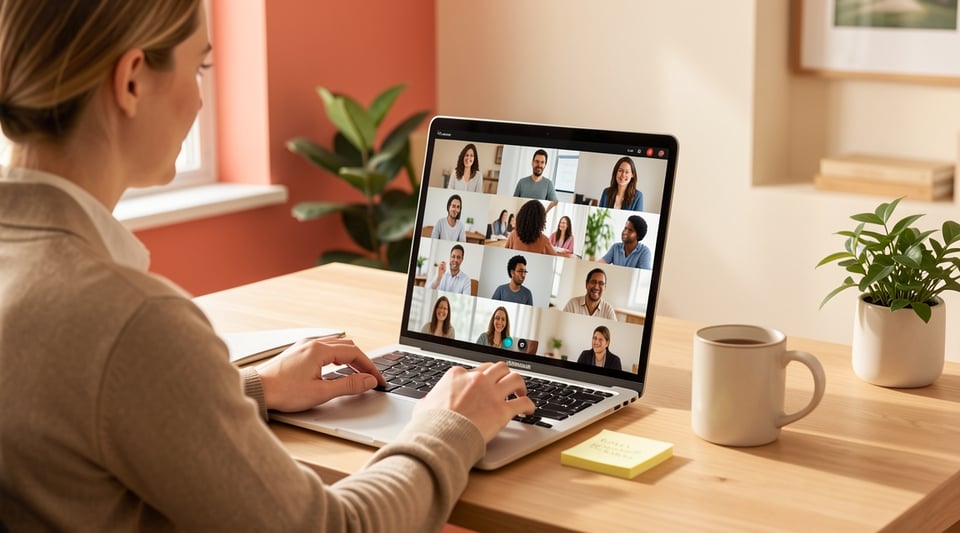
That feeling is real. Employees felt more drained on the days they kept their cameras on. And the more tired they were, the less they spoke up in meetings23. The camera hit women and newer employees the hardest.
Why is the camera so tiring? A big part is performing. When your face is on screen all day, you’re managing how you come across the whole time.
So what can you do? You don’t have to go dark in every meeting, since some calls really do need your face. Here’s a simple rule set for choosing the camera on purpose:
| Meeting | Camera | Why |
|---|---|---|
| 1:1 with your manager | On | Your reactions matter most here |
| First call with a new client | On | It’s your first impression |
| Brainstorm with your team | On, self-view hidden | You get the energy without staring at yourself |
| 40-person all-hands | Off | Nobody is looking for you in a grid of 40 |
| Status update you mostly listen to | Off | Save your energy for the calls where you talk |
Try This: In your next video call, look for a “hide self-view” setting (many platforms have one). You’ll still be on camera for everyone else. You just won’t be staring at yourself the whole time!
Out of Sight, Off the Shortlist
Here’s a three-line message you can send your manager every Friday:
Shipped this week: Finished the Q3 vendor comparison and sent it to finance. Stuck on: Waiting on legal’s review of the new contract. Next week: Kickoff call with the design team on Tuesday.
It takes five minutes. And your manager will actually know what you did this week!
Why bother? Because when you’re out of sight, it’s harder for people to see your work…and to give you feedback on it.
Researchers studied software engineers at a Fortune 500 company. Sitting near their teammates increased the feedback engineers got on their code by about 18%24. The gains went mostly to younger, newer engineers.
So is working from home a career killer? Not necessarily!
In the original Ctrip experiment, people worked from home four days a week. They got promoted less often than office workers with the same performance2.
The newer hybrid trial had people in the office three days a week. Their promotions over two years were the same as the office crowd’s3.
The risk comes from being invisible. And visibility is a people skill you can practice, which is great news! A few ways to stay on the radar:
- Send the Friday update. Your manager gets a record of your wins without having to ask. (More on this in our guide to getting credit for your work.)
- Ask for feedback out loud. “What’s one thing I could do better on this draft?” gets you the notes you’d have heard walking past a desk.
- Plan your office days around people. If you’re hybrid, come in on the days your team is there.
- Turn your camera on for the calls that matter. A 1:1 or a presentation is a good place to start (see the table above).
- Have a real conversation with someone outside your team once a week. A 15-minute virtual coffee counts.
- If you’re early in your career, time near senior colleagues is worth even more. Get to the office when you can. And ask someone senior to look over your work…that’s the feedback remote juniors tend to miss.
I love working from home, but you have to work to make it work for you.
You’ve got this!
Frequently Asked Questions
Is Working From Home More Productive?
It can be! In a nine-month experiment at a Chinese travel agency, call center staff who worked from home were 13% more productive, mostly because they worked more minutes per shift2. The catch is that it depends on your setup, which is what the seven fixes above are for.
Is Hybrid Work Better Than Working From Home Full Time?
The research on hybrid is encouraging. In a randomized trial where employees worked from home two days a week, quit rates dropped by a third, and performance reviews and promotions over two years matched the office group3.
How Do I Stay Focused When I Work From Home?
Start by moving your phone into another room. Just having one nearby can drag down your attention on harder tasks8. Then set an official start time, tell everyone you live with, and put your hardest work in the hours when you feel sharpest.
Where Should I Set Up My Home Office?
Anywhere but your bed. Harvard’s Division of Sleep Medicine advises keeping computers and work materials out of the bedroom so your brain links that room with sleep17. A corner of the kitchen counter works better than the comforter!
Does Working From Home Make You Lonely?
It can. As people in one UK study worked remotely more often, their loneliness tended to rise20. Book social plans outside work with a specific day and time attached, and spend your phone breaks talking to someone instead of scrolling.
Should I Keep My Camera On in Video Meetings?
Not for every call. Employees felt more drained on the days they kept their cameras on23. Keep it on for 1:1s, first client calls, and presentations. For big all-hands and listen-only updates, turning it off is usually fine.
How Do I Get Noticed at Work When I’m Remote?
Make your work visible on purpose. Engineers who sat near their teammates got about 18% more feedback on their code24, so if you’re remote, ask for it out loud. Send your manager a three-line Friday update (Shipped / Stuck on / Next week), and ask for specific feedback on your drafts.
How Do I Stop Working Late When My Office Is at Home?
Give your day a clear end with a short shutdown routine: write tomorrow’s first task on a sticky note, close every tab, and leave the room. Switching off is a skill you can train, and longer practice helps more22.
Work From Home Takeaway
- Pick your start time and your shutdown routine today, and tell everyone you live with what they are.
- Move your phone into another room for your next block of focused work.
- Book one social plan outside of work this week, with a specific day and time attached.
- Send your manager a three-line Friday update this Friday, using the Shipped / Stuck on / Next week format.
- Hide self-view in your next video call, and turn your camera off for one meeting where you’re mostly listening.
Want more ways to get more done in less time? Check out these unique productivity tips.