Ever notice how your Mom won’t stop calling you? Or that teens today speak almost exclusively in emoji? Or that your Dad still writes “Dear Vanessa” in his text messages?
Each generation has its own communication fingerprint, shaped by the technology, economy, and culture they grew up with. And right now, up to five generations are working, living, and trying to talk to each other at once. That’s a first in modern history!
It’s easy to lean on lazy stereotypes here, like “Boomers hate technology” or “Gen Z only texts.” Here’s how to sharpen your people skills and communicate with ANYONE, whatever their birth year.

What Is Generational Communication?
Generational communication means adapting how you share information, give feedback, and build rapport to fit the preferences of someone’s generational cohort. Those preferences grow out of the technology, cultural events, and social norms of their formative years.
Get it right and you’ll hit less friction and build trust faster across age groups!
The Stereotype Trap: Why Most Generational Advice Fails
In 2023, the Pew Research Center changed how it reports on generations. It said the standard generational definitions “may be too broad and arbitrary” to capture real differences. From now on, it would only compare generations when it has decades of comparable data.1
Why is someone born in 1996 a Millennial when someone born in 1997 is Gen Z?!
About 150 demographers and social scientists had signed an open letter urging Pew to stop promoting generation labels. One of them, a sociologist, put it more bluntly: generation labels “have no basis in social reality.”2
A report says “neither generation nor age has been shown to be a reliable predictor of work-related outcomes.” Needs also vary a lot within every age group.3 So the 28-year-old who LOVES a phone call and the 63-year-old who lives in Slack are both completely normal!
So why use the labels at all? Because they’re useful shorthand. Generational labels give you clues about someone’s likely communication preferences, but the person in front of you always matters more than the label.
Generational labels give you clues about someone’s likely communication preferences, but the person in front of you always matters more than the label.
Use the label to pick your opening move. Then drop it the moment the person tells you something better.
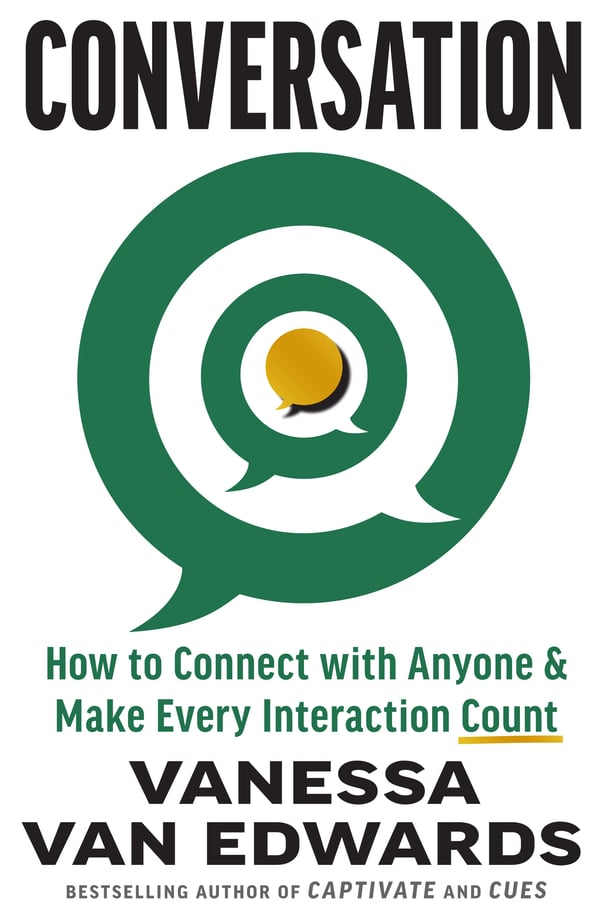
A new book by Vanessa Van Edwards
Every conversation is an opportunity.
If conversations have gotten harder, more awkward or less satisfying, you’re not imagining it. We’re simply out of practice. It’s time to find the joy in talking to each other again.
The Science Behind Generational Communication
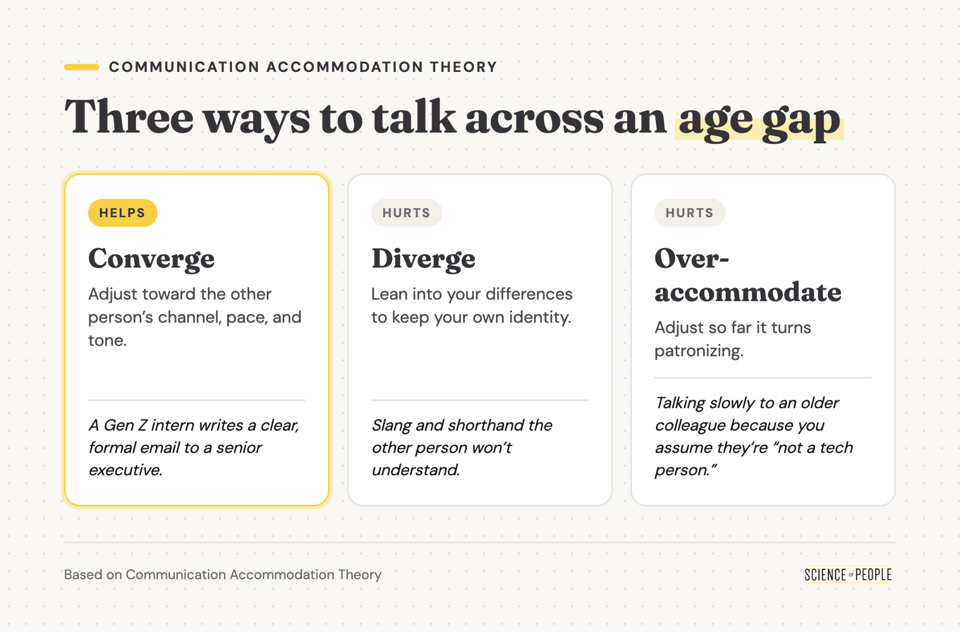
Communication Accommodation Theory (CAT) explains why, when, and how people adjust the way they talk during a conversation.4 In plain language, CAT describes what happens when you talk to someone from a different group, including a different age group. You naturally do one of three things:
- Converge: You adapt your style to match theirs. A Gen Z intern writing a formal email to a Boomer executive is converging.
- Diverge: You emphasize your differences to maintain your identity. Using generational slang the other person won’t understand is diverging.
- Over-accommodate: You try too hard to adapt, which is patronizing. Speaking slowly to an older colleague because you assume they’re “tech-illiterate” is over-accommodating.
What pushes you toward one or the other? A big piece is “age metastereotyping”: what you think other generations think of you. A review of age stereotypes at work argues that these guesses help shape how conversations across age groups go.5
Sound familiar? A Gen Z worker who believes a Boomer sees them as “lazy” may over-compensate with a four-paragraph email about a two-line question. A Boomer who thinks Gen Z sees them as “out of touch” may just stop using the team chat.
(If you’ve done one of these this week, you’re not alone.)
Swap Over-Accommodation for Convergence
Over-accommodation usually comes from a kind place. That’s exactly why it’s so easy to miss in yourself!
Here’s what it sounds like, and what to say instead:
| If you catch yourself saying… | Try this instead |
|---|---|
| “Don’t worry, I’ll go slow. The shared drive is a little techy.” | “How do you usually organize your files? I’ll set it up to match.” |
| “You’ve probably never heard of this app, but…” | “Have you used this app before? If not, I can show you the two buttons that matter.” |
| (to a 24-year-old) “I know this is a lot of responsibility for someone your age.” | “This is a big account. What would help you feel ready to run it?” |
In each line on the right, you check what the other person knows or wants BEFORE you explain anything.
And yes, it goes both ways. A senior colleague who walks a 30-year-old through “how client calls work” when they’ve already run dozens is over-accommodating too.
Try This: Watch for the second explanation. The first one is information… the second one is usually you managing an assumption. When you feel it coming, ask instead: “How much of this do you already have?”
The 5 Generations (and Their Communication Styles)
Use this table as a quick reference for the generations you’ll work with today.6
| Generation | Birth Years | Current Age | Came Up Communicating On |
|---|---|---|---|
| Silent Generation | 1928–1945 | 81–98 | Letters, the party line, the family telephone in the hallway |
| Baby Boomers | 1946–1964 | 62–80 | Landlines, the answering machine, memos and the fax |
| Generation X | 1965–1980 | 46–61 | The family PC, email, AIM, the first mobile phones |
| Millennials | 1981–1996 | 30–45 | Texting, MSN and Facebook, email as the default at work |
| Generation Z | 1997–2012 | 14–29 | Group chats, DMs, short video, voice notes |
| Generation Alpha | ~2010–2024 | 2–16 | Tablets, YouTube, voice assistants, shared game worlds |

1. Communicating With Gen Z (Born 1997–2012)
Gen Z is no longer “kids 15 and younger.” The oldest members of this generation are approaching thirty and well into their careers! If you manage a team, your newest hires are probably Gen Z!
What they value: Speed, authenticity, and purpose. In fact, 86% of Gen Zs said purpose is key to their workplace satisfaction and well-being. And 44% said they had rejected employers based on their personal ethics or beliefs!7
They grew up with any fact, video, or song at their fingertips, so they expect communication to be direct and honest.
Communication preferences: When Gen Z needs to reach a colleague, more than half would send a chat message, compared with 44% of Gen X and 35% of Boomers. Even so, in-person contact is still the top way every generation prefers to reach a coworker.8
What they avoid is the unscripted call, the one with no warning and no subject line.
The Phone Anxiety Paradox: Quick quiz. In a 2024 UK survey, what share of 18- to 34-year-olds said they assume a surprise call means bad news? a. 18% b. 34% c. 56% d. 80%
If you guessed c, you’re right! Over half (56%) said they assume an out-of-the-blue call means bad news. And 23% said they never pick up calls at all. Yet 68% said they prefer to talk on the phone with friends and family when a time is arranged in advance.9
So they’ll take the call. They just want a warning first!
Voice notes are a middle ground, giving them the warmth of a human voice without the pressure of real-time conversation. And a quick heads-up text makes the call much easier to say yes to.
Action Step: Text before you call. A quick “Hey, can I call you about the project update?” removes the ambush for the price of one message.
For quick items, use their channel: Slack, Teams, or a text. For important conversations, suggest meeting face-to-face. And skip the long lectures and dense email chains… break information into chunks someone can scan on a phone.
(And if you’re the one who dreads the call, these steps for conquering phone anxiety work at any age.)
Watch this video of a baby whose iPad skills are better than my own:
2. Communicating With Millennials (Born 1981–1996)
Millennials grew up right alongside the internet, and they’re at home on just about every platform your team uses. This generation LOVES self-expression!
What they value: Self-expression, collaboration, and purpose. Millennials love to add their own mark and have their opinion represented.
89% of millennials said purpose is key to workplace satisfaction and well-being.7 They prefer frequent, informal feedback over annual reviews.
Communication preferences: They’re at home on instant messaging and collaborative platforms like Slack, and they’d much rather be brought in early than briefed late. They want to feel understood and socially accepted when you communicate with them.
Action Step: Ask their opinion early. Approach a Millennial in the brainstorming stage, before you have an idea fully formed. Instead of presenting a finished plan and asking for approval, try: “I’m thinking through how to handle the client presentation. What would you do?”
That builds buy-in and shows them you see them as a creative partner who helps shape the idea. Then follow up on a collaborative platform where they can respond on their own time.
If you want to deepen your ability to connect with anyone in conversation, check out our guide on how to talk to anyone.
Approach a Millennial in the brainstorming stage, before you have an idea fully formed, and they’ll treat your project like their own.
3. Communicating With Gen Xers (Born 1965–1980)
Gen Xers are the “Sandwich Generation,” squeezed between aging Boomer parents and Millennial or Gen Z children. According to Pew Research, 54% of Americans in their 40s and 45% of those in their 50s are sandwiched. They have a living parent age 65 or older while also raising a minor child or financially helping an adult child.10
That’s a lot of people to look after!
This generation often gets overlooked in generational articles, but they’re the natural mediators in the workplace. They’re comfortable with both analog and digital tools, which makes them great translators between Boomers and younger workers.
What they value: Autonomy, efficiency, and shared responsibility. They want partners and helpers who then let them get on with it. They’re typically the ones providing emotional and financial support to everyone else. So they REALLY appreciate it when someone takes pressure off their plate for once.
Communication preferences: Direct, concise, and results-oriented. “Tell us the task, we’ll deliver.” They prefer email with clear subject lines and are comfortable with phone, video, or project management platforms.
Action Step: Anytime you reach out to a Gen Xer, frame your message around reducing their burden.
Think: “How can I offer help instead of asking for it?” Then watch what it does to the message:
| Instead of | Send |
|---|---|
| “Can you help me with this report?” | “I’ve drafted the report and just need your quick review on section three. Should take about 10 minutes.” |
| “Do you have time to talk about the vendor issue?” | “Vendor issue: I’ve got two options written up, need you to pick one. Five minutes, any time today.” |
| “Thoughts on the deck?” | “Deck’s attached. Slide 6 is the only one I’m unsure about.” |
You’ll usually get a faster reply, and a grateful one.
4. Communicating With Boomers (Born 1946–1964)
Baby Boomers are a generation in transition. Some are in comfortable retirement, while others are still actively working, and many plan to keep working. In a 2024 Transamerica Institute survey, 56% of Boomer workers said they’re working or expect to work past age 70, or don’t plan to retire at all.11
What they value: Respect, tradition, and face-to-face connection. In a 2020 survey of U.S. consumers, 55% of Boomers said they’d rather do business in person, while 72% of non-Boomers preferred digital.12
They view phone calls and face-to-face meetings as the gold standard for sincerity and commitment. And career is often central to their identity.
Communication preferences: Email is their primary professional tool, and many treat it as a formal record, closer to a memo than a chat window.
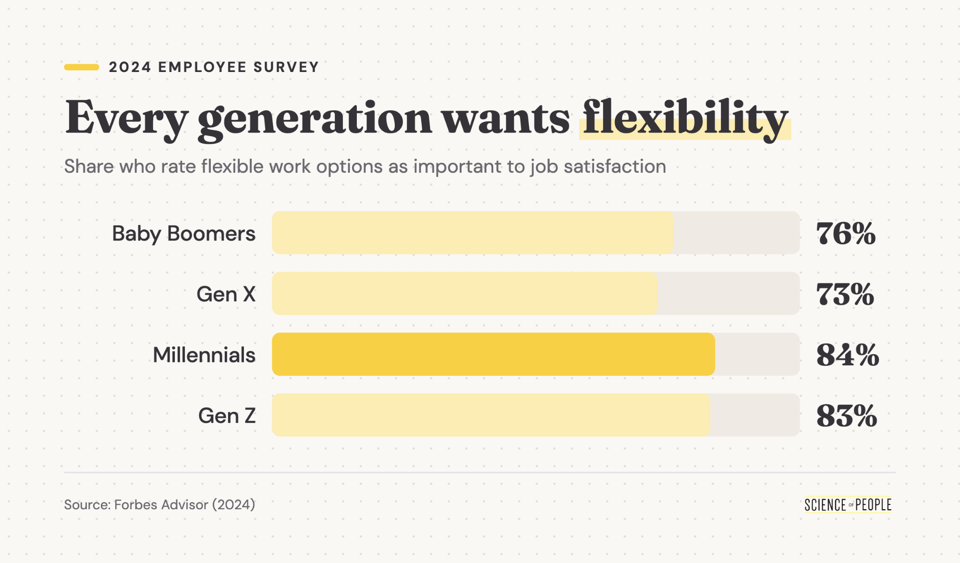
A common myth: “Boomers hate remote work.” Nope! Flexible work ranks high for every generation, Boomers included. (You’ll see the numbers in section 9.)
Action Step: Lead with respect. Whether you’re discussing a new idea or working through conflict, acknowledge a Boomer’s experience and expertise before jumping to your point.
Try: “I really value your perspective on this because you’ve handled situations like this before. Here’s what I’m thinking…”
For important conversations, pick up the phone or schedule a face-to-face meeting. Save Slack for the small stuff.
Wait, doesn’t that clash with the heads-up text from section 1? Yep… and it should. With a Boomer colleague, the channel you pick is part of the message.
5. Communicating With the Silent Generation (Born 1928–1945)
The Silent Generation has seen more change than any of us can imagine, from the Great Depression to smartphones! Most are now retired.
What they value: They want to enjoy life and share the lessons they’ve learned. They appreciate formality, courtesy, and being listened to without being rushed.
It’s easy to fake attention with someone in their nineties. You nod at the right moments and say “wow.” The whole time, you’re waiting for the story to reach a place where you can leave.
They can usually tell.
So what do you do instead? Ask a question about a story you’ve ALREADY heard. (Our guide to listening skills has more moves like this.)
Someone who has told you about their first job three times has told you the three-times version. Ask what the building looked like, who else was there, or what they were paid. You’ll often get something that never made it into the first three tellings, because nobody asked!
Action Step: Let them communicate with you however they prefer, whether that’s a handwritten note, a phone call, or a long conversation over their favorite dessert. Listen actively, ask one follow-up question about a detail instead of the plot, and resist the urge to check your phone.

6. Communicating With Gen Alpha (Born ~2010–2024)
Generation Alpha is the newest cohort, born from 2010 to 2024 by McCrindle Research’s definition. They’re not in the workforce yet, but their influence is already significant. McCrindle calls them the most technologically savvy generation ever.13 (No surprise to anyone who’s handed a toddler a phone!)
What they value: Visual, short-form, emotionally direct content. They favor creative self-expression and expect technology to be part of every interaction.
Give a Gen Alpha kid written instructions for something physical, like changing a bike tire, and watch what happens.
Five numbered steps on a sticky note tend to produce nothing much. The same five steps recorded as a forty-second phone video? Those might well get done on the first try.
Why? You can wind a video back to the part where the lever goes under the rim. (Honestly, adults do it too.) We dig into what all that screen time means for kids’ conversation skills in the last generation to learn conversation.
Action Step: If you’re communicating with Gen Alpha as a teacher, parent, coach, or mentor, lean into visual and interactive formats. Record the demo instead of writing the numbered list. Use short videos, interactive polls, and gamified learning where you’d otherwise hand over a worksheet.
7. Use the Channel-Match Technique
A surprising amount of generational friction comes down to the channel somebody picks. Sending a Gen Z team member a formal email about a quick scheduling change feels like overkill. Texting a Boomer about a sensitive project feels dismissive.
Defer to the person you’re contacting. Use the channel most likely to reach them, even when you personally prefer another.
How to do it:
- Before reaching out, ask yourself: “What channel would this person choose?”
- For quick, low-stakes items with Gen Z or Millennials: text, Slack, or Teams
- For complex or sensitive topics with Boomers or Gen X: phone call or face-to-face
- For formal records across all generations: email
- When in doubt, ask directly: “What’s the best way to reach you about this?”
Pro Tip Create a Team Communication Agreement. Don’t leave channel preferences to guesswork.
Have your team decide: Slack for quick questions, email for official records, phone for emergencies, face-to-face for relationship-building. Post it somewhere visible. When everyone knows the rules, there’s a lot less guessing.
What does a filled-in agreement actually look like? Here’s one for a six-person team:
| Channel | Use it for | Expected reply |
|---|---|---|
| Slack or Teams chat | Quick questions, scheduling, FYIs | Same workday |
| Decisions, client details, anything you’d want on record | Within 24 hours | |
| Phone call | Urgent problems and anything with emotion attached | Text first, unless it’s an emergency |
| Face-to-face or video | Feedback, kickoffs, getting to know each other | Put it on the calendar |
| The #kitchen channel | Birthday cake announcements | No reply needed (just come get cake) |
Ten minutes in a team meeting is enough to fill this in. In our experience, the “Expected reply” column heads off more arguments than the channel column does!
When you’re torn between two options for a single message, this guide on whether to call or email settles most cases. And if your team is spread across time zones as well as generations, our guide to virtual team communication picks up where this leaves off.
Watch for tone mismatches too. A “K” text can seem passive-aggressive to a Millennial. ALL CAPS can feel like yelling to Gen Z. A formal email can seem cold to someone who prefers casual chat.
When you sense friction, clarify intent: “Just sending this quickly, no urgency” or “Wanted to flag this before our meeting.”
Learn What Your Punctuation Is Saying
Which of these two replies feels warmer?
A: Sounds good
B: Sounds good.
Some people pick A without hesitating. Others see the two as identical and wonder what the question is… and both are correct!
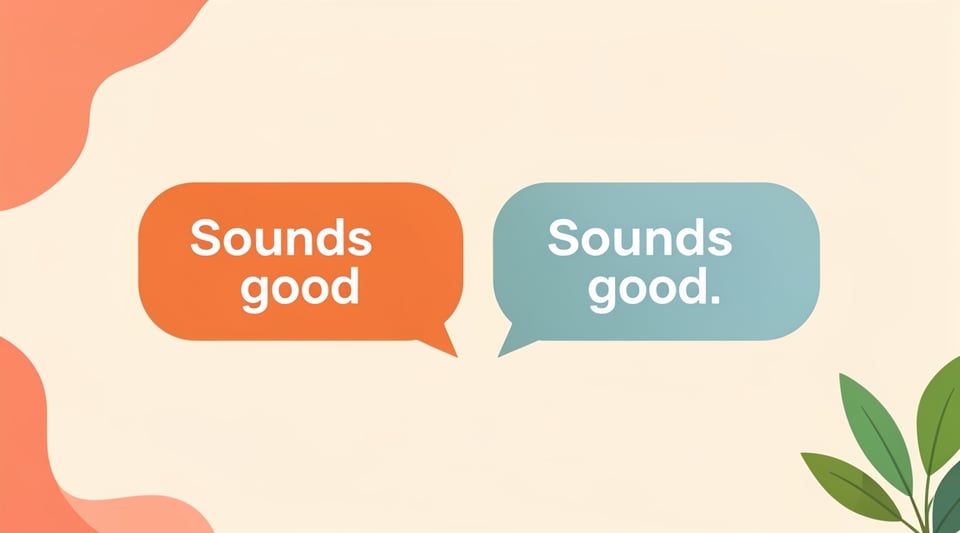
In one 2016 study, people read short exchanges where the reply either ended in a period or didn’t. As text messages, the replies with a period were rated less sincere. The same exchanges as handwritten notes showed no such difference.14
Emoji split the same way. In another study, accuracy at reading emojis dropped with age for surprised, fearful, sad, and angry faces. Happy came through at every age.15 So one person reads 🙏 as “thank you” and another reads it as a small apology… and neither is wrong.
The same reply can read very differently by age:
| What you send | How it reads to a younger colleague | How it reads to an older colleague |
|---|---|---|
| “Sounds good.” | Clipped. Possibly annoyed. | Correct. |
| “Sounds good” | Warm, normal | Slightly careless |
| “Sounds good!” | Warm, normal | Enthusiastic |
| “SOUNDS GOOD” | Shouting, or joking loudly | Shouting |
| “👍” | Dismissive, sometimes hostile | Friendly agreement |
| No reply for four hours | Something is wrong | Perfectly normal |
Check out our video on getting the written stuff right:
Action Step: Reread your next three work messages before you send them and check ONLY the last character of each.
Ended a two-word reply to a younger colleague with a period? Add a word instead. “Sounds good, thanks” puts the warmth back.
Say How Fast You Actually Need an Answer
A slow reply sends a message too… and everybody reads it differently. Four hours of no reply from you might mean “busy.” Or “mad.”
Which one? Nobody ever checks!
You may have seen charts that give each generation a response speed (Gen Z in ten minutes, Boomers in a day). Real people don’t sort that neatly.
Who do YOU text back the fastest? Probably whoever you’re closest to, whatever their birth year.
Action Step: Put the window in the message. “No rush, sometime this week” and “I need this before 3” are ten words between them, and they save the other person from guessing what your silence means.
If you’re the one going quiet, send a four-word holding reply (“seen this, replying tomorrow”).
8. Try Reverse Mentoring to Bridge the Gap
Reverse mentoring, where junior employees mentor senior leaders, is a simple way to bridge generational divides. Jack Welch is credited with pioneering the concept at General Electric in 1999. He assigned his top 500 executives to find younger employees who could help them build their internet skills.16
Does it work? The first cohort of Millennial reverse mentors had a 96% retention rate.17
Almost everyone stayed!
The senior picks up updated know-how and a younger perspective, and the junior mentor gets real leadership practice.18 At EY, a reverse mentoring pilot paired younger staff with older colleagues so the younger partner could share digital and AI know-how.19
Action Step: You don’t need a formal corporate program to try this. Identify one person from a different generation on your team. Set up a monthly 30-minute coffee chat where you each teach the other something.
A Gen Z team member might walk a Boomer through using AI tools. The Boomer might share strategies for navigating organizational politics that took decades to learn. It works best when the curiosity flows BOTH ways.
Here’s a 30-minute agenda you can copy:
| Minutes | Who teaches | What it might look like |
|---|---|---|
| 0–3 | Both | Each person names one thing they want to learn today |
| 3–15 | Junior mentor | How to get a clean meeting summary out of an AI notetaker |
| 15–27 | Senior mentee | How a budget request actually gets approved, and who to talk to first |
| 27–30 | Both | Pick next month’s topics and book the slot |
I once spent a whole lunch learning keyboard shortcuts from a much younger colleague… best lunch of the quarter. For the mentoring basics that work in either direction, see these tips for being a great mentor.
Reverse mentoring works best when the curiosity flows both ways.
9. Lead With the Values Every Generation Shares
Generations agree on far more than they disagree on!
Flexibility is valued by 84% of Millennials, 83% of Gen Z, 76% of Boomers, and 73% of Gen X.20 Purpose, respect, and growth come up for every generation, too.
Where do most communication breakdowns start? With the assumption itself. We decide the other generation is fundamentally different, and then we talk to that idea instead of the person in front of us.
When a new CEO took over at Microsoft in 2014, his first company-wide email used collective pronouns (“we,” “our,” “us”) about 60 times in roughly a thousand words.21
Is “we” actually persuasive? In politics, at least, it tends to be. Across Australian federal elections from 1901 to 2010, the winner used more “we” and “us” than the loser in 80% of the elections analyzed. Winners said “we” or “us” about once every 79 words (losers, about once every 136).22
Action Step: In your next team meeting or email, replace “I need you to…” with “We’re working toward…” For more on building charisma in your leadership communication, start here. Frame goals around shared values like impact, growth, and respect. When people feel like they’re on the same team, age matters a lot less.
10. Run a Metastereotype Check Before a Tense Conversation
A manager in her late fifties rewrites a Slack message to a 26-year-old on her team four times. Each draft gets longer. She adds a line about how he’s “probably way more on top of this stuff,” then one about how “things are done differently now.” Then she buries the actual point under “Not a huge deal!!”
He never said she was out of touch. She’s writing to what she assumes his generation thinks of her.
(Guilty. I’ve sent that exact message!)
That guess is a metastereotype, the same thing we met in the science section up top. Want to catch yours before you hit send?
Try This: Before a tense message or meeting with someone from another generation, ask yourself three questions:
- What has this person actually said or done?
- What am I assuming their generation thinks of me?
- If I deleted every line written to that assumption, what would be left?
Here’s her message before and after the check. Spot the difference?
| Before | After |
|---|---|
| “Hey! I know you’re probably way more on top of this stuff than me, and I’m sure things are done differently now, but I wanted to quickly mention that the client deck went out with last quarter’s numbers. Not a huge deal!! Just maybe double-check next time?” | “Quick flag: the client deck went out with last quarter’s numbers. Can you send a corrected version by 3? Next time, let’s both check the data tab before it goes.” |
The age references, the hedging, and the double exclamation point are gone. The request is still there… and now he can actually SEE it.
It works in the other direction, too. A 24-year-old who assumes a senior colleague sees her as entitled might pad every request with three apologies.
The same three questions help. Cut the lines written to the stereotype, and keep the ask. If the tense conversation is feedback, these scripts for coworker feedback give you the next line.
11. Talk About AI Before It Turns Into a Fight
The 26-year-old who drafted the client summary with AI doesn’t mention it, because they’re not sure what the reaction will be. The 58-year-old reads a suspiciously smooth paragraph and says nothing, because raising it feels like an accusation.
Give it six months. Now you have two people who each think the other is being dishonest about the same document.
Yikes.
Action Step: Make the disclosure norm explicit and boring, before anyone has a reason to be defensive. One line in your team agreement does it: “Say when you’ve used AI on something, and say what you checked.”
Then use it yourself first, out loud, on something low-stakes. Nobody on the team should have to guess what anyone else did!
What to Do When Someone Doesn’t Match Their Label
Everything above is a first guess. Sooner or later you’ll meet the 68-year-old who answers email in four-word fragments and the 24-year-old who sends three-paragraph memos with headers.
And they’ll be on the same team, each convinced the other one is the odd one!
When the person contradicts the profile, go with the person. The label was only ever a first guess.
So what do you say? Try one of these:
“Quick check so I stop guessing. Do you want this kind of thing in Slack or email?”
“Is it easier if I just call you, or would you rather I write it up?”
Pro Tip Ask once, then write the answer down where you’ll see it, like your contacts app or the shared team doc. The hard part is remembering the answer three weeks later.
The Multigenerational Advantage
Multigenerational teams are a competitive advantage when communication works.
That “when” REALLY matters. In one large study, more age-diverse companies tended to develop a climate of age discrimination, and that climate went with lower employee commitment and weaker company performance.23
The primary challenge? Communication breakdowns. They often start with how people treat each other across the age gap. Think of the eye-roll at an emoji, or the assumption that the new hire can’t handle a client. But that’s a solvable problem.
A Bentley University report that reviewed the research found the differences between generations are minimal and nuanced. Job-hopping isn’t unique to younger generations: Pew data cited in the report show young workers’ job tenure has looked about the same for decades. And ageism cuts both ways. In a Glassdoor survey the report cites, 52% of 18–34-year-olds had witnessed or experienced ageism at work, compared to 39% of those over 55.24
The young end of the office gets it too… handed the note-taking and asked how long they’ve been doing this.

Frequently Asked Questions
What are the 5 generations in the workplace?
The five generations currently in the workplace are the Silent Generation (born 1928–1945, mostly retired), Baby Boomers (1946–1964), Generation X (1965–1980), Millennials (1981–1996), and Generation Z (1997–2012). Generation Alpha will begin entering the workforce around 2028.
What is the primary challenge when managing a multigenerational team?
Communication breakdowns, and the age assumptions behind them. In one large study, more age-diverse firms tended to develop a climate of age discrimination, which went with lower commitment and weaker performance. Different preferences for channels (email vs. Slack), tone (formal vs. casual), and feedback frequency (annual reviews vs. real-time input) create friction that’s often mistaken for personality conflict.
Are generational differences at work actually real?
Partly. Habits like which channel someone reaches for do differ by age. But a 2020 National Academies report found that neither generation nor age has been shown to reliably predict work-related outcomes, and that needs vary a lot within every age group. Pew Research Center has also changed how it reports on generations, calling the standard definitions potentially “too broad and arbitrary.”
What are the four benefits of multigenerational work teams?
Teams that work well across ages tend to get four benefits: more perspectives to draw on when solving problems, knowledge transfer through intergenerational mentoring, a culture with less age bias (age-diverse firms that slid into an age-discrimination climate saw lower commitment and weaker results), and broader market insight because a multigenerational team better reflects a diverse customer base.
Which generation is hardest to work with?
No credible research ranks one generation as objectively “harder” to work with. However, Gen Z often challenges managers because of their willingness to reject assignments or employers that clash with their values. According to Deloitte’s 2024 survey, 50% have rejected work assignments and 44% have rejected employers over ethics. You could also read that as a push for better workplaces.
Why does a period at the end of a text message seem rude?
Because in a medium where the full stop is optional, adding one looks deliberate, and people read meaning into it. In a 2016 study, people rated short text replies ending in a period as less sincere than the same replies without one, and the same exchanges as handwritten notes showed no such difference. When a reply is very short, add a word instead of a full stop.
How has technology changed the way different generations communicate?
Each generation has its own mix of favorite tools. Gen Z and Millennials lean toward instant messaging, voice notes, and collaborative platforms. Gen X adapts fluidly across tools. Boomers prefer email and phone calls for professional communication. No generation is “anti-technology.” In one 14-country survey, about a third of Boomers (35%) said they’d reach a colleague with a chat message. The difference is in which tools each generation trusts for which type of conversation.
How do I bring up AI use with a colleague from a different generation?
Make it a stated team norm before it becomes a specific accusation. Agree that people say when they’ve used AI on a piece of work and what they checked afterward, and model it yourself on something low-stakes first.
How can different generations work together effectively?
The most effective strategies include reverse mentoring (pairing junior and senior employees for mutual learning), creating team communication agreements that specify which channels to use for different types of messages, leading with the values everyone shares, and practicing communication accommodation: consciously adapting your style to meet the other person where they are.
Communicating With Different Generations Takeaway
Generational communication comes down to the flexibility to meet people where they are. Strong communication skills are the foundation. Here are your key action steps:
- Learn Communication Accommodation Theory. Converge toward the other person’s style without over-accommodating. Match their channel, pace, and tone.
- Text before you call when reaching out to Gen Z. Remove the ambush factor.
- Ask Millennials for input early in the brainstorming stage to build buy-in.
- Reduce the burden when communicating with Gen X. Frame requests as time-savers.
- Show respect first with Boomers. Acknowledge their experience before presenting your idea.
- Create a Team Communication Agreement so everyone knows which channel to use for what.
- Try reverse mentoring. Pair up with someone from a different generation for monthly mutual learning.
- Run a metastereotype check before your next tense cross-age message. Delete every line written to what you assume their generation thinks of you.
- Check the last character of your next three messages. A period on a two-word reply can sound colder than you meant.
- Make AI use a stated team norm before it turns into a quiet accusation.
Generational communication is about developing the flexibility to meet people where they are.
For more science-backed strategies on connecting with people, explore our guide on how to make a great first impression.
- Pew Research Center
- Philip N. Cohen, The Washington Post (reprinted in The Herald)
- National Academies of Sciences, Engineering, and Medicine
- Dragojevic, Gasiorek & Giles, The International Encyclopedia of Interpersonal Communication (Wiley)
- Finkelstein, King & Voyles, Work, Aging and Retirement
- Pew Research Center
- Deloitte
- Jabra, Mind the Gap (2024)
- Uswitch
- Pew Research Center
- Transamerica Institute
- Mobiquity
- McCrindle Research
- Gunraj et al., Computers in Human Behavior
- Chen et al., PLOS ONE
- Sarıoğlu, Özdemir & Görgün, Frontiers in Communication
- Jordan & Sorell, Harvard Business Review
- Marcinkus Murphy, Human Resource Management
- Fortune
- Forbes Advisor
- Microsoft
- Steffens & Haslam, PLOS ONE
- Kunze, Boehm & Bruch, Journal of Organizational Behavior
- Bentley University Center for Women and Business