Before you say a word, the way you’re holding yourself has already spoken. People read your shoulders, your spine, and where you put your weight in an instant, and so do you. So how much does posture actually shape how confident you seem, and how confident you feel?
What Your Posture Communicates to the Room
Posture is one of the very first things other people read off you, and they do it fast. Stand open and upright and you look confident, composed, and credible. Fold inward and you seem nervous or unsure, even when you’re not: shoulders rounded, chest collapsed, arms wrapped across your body.
Open vs. Closed: What Each One Looks Like
You don’t need a catalog of poses. It really comes down to two directions your body can go:
- Open and upright. Shoulders back and down, chest open, head level, feet planted, arms relaxed and away from your torso. You take up a comfortable amount of space. This projects self-assurance and ease.
- Closed and contracted. Slouching, hunching, arms crossed tight, hands drifting to your neck. We rarely do this on purpose. It tends to creep in when we feel small in the moment, and it conveys stress or defensiveness.
So catch yourself drifting closed, and choose open instead.
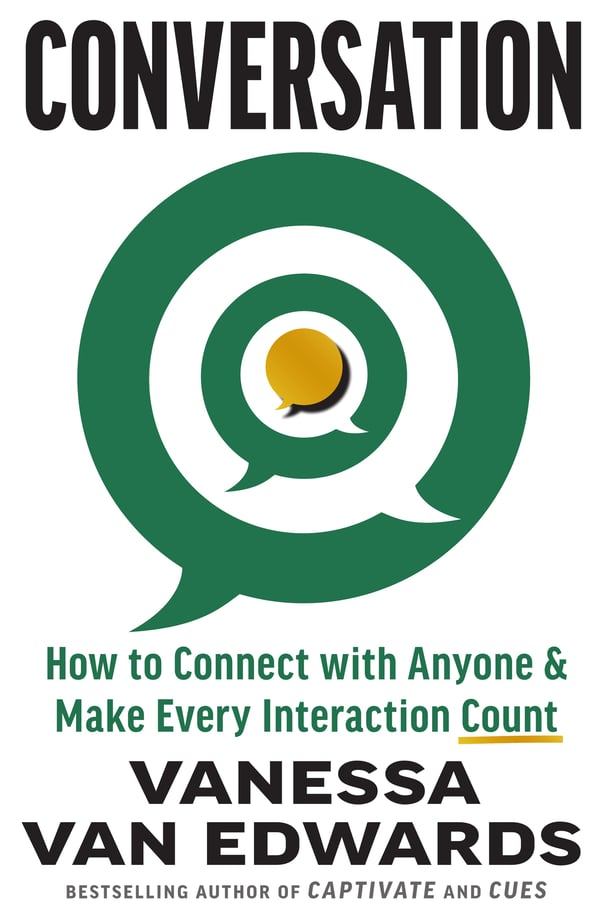
A new book by Vanessa Van Edwards
Every conversation is an opportunity.
If conversations have gotten harder, more awkward or less satisfying, you’re not imagining it. We’re simply out of practice. It’s time to find the joy in talking to each other again.
One Honest Caveat
Carrying yourself well changes how others see you, and that’s genuinely valuable. What it won’t do is magically rewire how you feel inside or stand in for real preparation. So treat confident posture as a reliable signal you can switch on in the moment, then back it with actual readiness and skill.
Simple Ways to Carry More Presence
Reset on a Cue
Right before a higher-stakes moment, like a call, a meeting, or walking through the door, run a quick reset: roll your shoulders back and down, lift your chest slightly, level your head, plant your feet, and take one slow breath (box breathing works well here). It takes five seconds and it changes the picture you present.
Run a Few Presence Checks a Day
Set two or three random alarms. When one goes off, ask yourself: Am I slumped or closed off right now? Then drop your shoulders, lift your chest a touch, unclench your jaw, and breathe. Small corrections, repeated, retrain your default.
Let It Become the Default
Those little adjustments add up, and you’re slowly rewriting the posture you fall into without thinking. If you want to speed it up, jot down one moment each evening when you felt genuinely present and steady. Noticing it makes it easier to find again.
Your Posture Matters
For the next 24 hours, just notice your posture with curiosity. When do you open up? When do you fold in? Then pick one moment tomorrow, before a phone call, on your commute, or walking into work, and consciously carry yourself open. Take up your space, breathe, and stand like you belong there.
For more on this, see 23 Confident Body Language Cues Every Woman Should Know, or build the inner game with our work on charismatic traits.
A Note and Apology to Dr. Amy Cuddy
In 2016, we published an article about power posing and Amy Cuddy’s work that contained inaccuracies and omissions. That article has been removed, and we owe Dr. Cuddy—and you, our readers—a sincere apology and a correction of the record.
What We Got Wrong
- We claimed Dr. Cuddy hadn’t embraced criticism or done further research, and then didn’t update the article as she confirmed her research. We sincerely apologize for not staying current on this.
- We referred to her as “Mrs. Cuddy” rather than Dr. Cuddy, dismissing her PhD and her academic achievements. That was unacceptable, and we sincerely apologize to Dr. Cuddy for it and for her remarkable career.
- We wrote “While we wait for Cuddy to do more research,” and in doing so overlooked her already-extensive published work. We should have done a far more thorough job.
We deeply regret these errors. We are truly sorry, and we are committed to doing better.