Ever feel like you don’t know what to do with your hands? Do you put them in your pockets? Move them around? Hold them in your lap?
You’re not alone if you aren’t sure what to do with your hands.
While you’re agonizing over where to put your hands, your audience is already reading them. A 2025 study from the UBC Sauder School of Business analyzed over 2,184 TED Talks, isolating more than 200,000 individual hand gestures, and found that speakers who used specific types of hand movements were rated significantly more persuasive, competent, and clear.
When Vanessa Van Edwards analyzed hundreds of TED Talks at Science of People, the most popular speakers averaged 465 hand gestures in an 18-minute talk. The least popular? Just 272. That’s nearly double.
Your hands are a tool you haven’t learned to use yet. Here’s how to use them like a pro.

Why Your Hands Matter More Than Your Words
It’s easy to assume that keeping still looks polished and that gesturing is what nervous speakers do. The research points the other way.
Your hands are doing three jobs at once.
They help your audience process information. The TED Blog found that gestures engage the brain visually alongside listening, so a speaker takes less effort to follow. When you “draw” an idea with your hands, your audience doesn’t have to work as hard to picture it.
They help YOUR brain think. Research from the American Psychological Association shows that gesturing while speaking frees up working memory, making it easier to retrieve words and organize your thoughts. People who gesture during brainstorming generate more ideas, more original ideas, and more detailed ideas than those who keep their hands still. Gesturing also creates multiple memory pathways, auditory, visual, and physical, which leads to better recall even weeks later.
They trigger trust. Our brains are hardwired to look at people’s hands, an ancient survival mechanism from before spoken language, when humans needed to quickly assess whether a stranger was carrying a weapon. When you hide your hands, your listener’s brain goes on mild alert, even in a modern conference room.
The most popular TED speakers averaged 465 hand gestures in 18 minutes, nearly double the least popular speakers.
So which gestures actually work? The UBC study found that generic emphasis gestures, fist pumps, vague pointing, had almost no positive effect. What worked were specific, purposeful movements called “illustrators.”
The 12 Hand Techniques That Change How People See You
1. Use Illustrator Gestures to “Draw” Your Ideas
Illustrator gestures are hand movements that visually depict what you’re saying, spreading your hands apart to show something is “big,” moving your hand upward to show growth, or tracing a timeline left to right. The 2025 UBC study found that these gestures are the single most effective type, outperforming generic emphasis gestures on every measure.
In the study, 1,600 participants watched identical sales pitches with varying hand movements. Speakers who used illustrators were consistently rated as more clear, more competent, and more persuasive, even when saying the exact same words as speakers who used generic gestures or no gestures at all.
Even a 5-minute training session on illustrator gestures helped people become noticeably better communicators.
How to build your illustrator vocabulary:
- Identify your 3 key points before any presentation or important conversation.
- Decide what each point “looks like” spatially. Growth? Move your hand upward. A comparison? Hold one idea in your left hand, the other in your right. A timeline? Trace it left to right.
- Practice drawing them in the air while you rehearse. It will feel exaggerated at first, that’s normal.
Script example: If you’re pitching a product, say “Our revenue grew 40%” while sweeping your hand upward from waist to shoulder height. When you say “We started small,” hold your hands close together. When you say “Now we serve three markets,” spread them wide.
Action Step: Before your next meeting or presentation, choose three key phrases and assign each one a hand movement. Practice the combination five times. That’s your 5-minute training session, and according to the UBC research, it’s enough to make a measurable difference.
2. Show Your Palms to Build Instant Trust
Open, upward-facing palms are one of the most universally recognized trust signals in human communication. Body language researcher Allan Pease tested this by having speakers deliver the same presentation to different audiences, changing only their palm orientation. Audiences who watched the palm-up version remembered about 40% more of the content and described the speaker as “friendly,” “engaging,” and “laid-back.” The palm-down version? “Authoritative” and “pushy.”
Palm-up requests tend to get agreement more often than palm-down ones, which come across as an instruction. Compliance is about 52% for palm-down and 28% for finger-pointing. Nothing changes but the angle of the hand.
This works because of evolutionary wiring: an open palm historically signaled “I’m unarmed, I’m not a threat.” That signal still works on the modern brain.
How to use it:
- When making a request or asking a question, turn your palms upward.
- When offering an idea in a meeting, flash your open palms briefly. Vanessa Van Edwards calls this the “Open Palm Flash” and recommends it as one of the simplest trust-building gestures you can use.
- When you want someone to open up, keep your palms visible and relaxed.
Action Step: In your next one-on-one conversation, consciously show your palms when asking a question. Notice whether the other person seems more forthcoming.
3. Master the Steeple for High-Stakes Moments
Press the fingertips of both hands together, palms apart, forming a shape like a church steeple. Former FBI special agent Joe Navarro calls this “the most powerful high-confidence tell” a person can display.
The steeple works because it comes from the limbic system, the part of the brain that produces honest emotional responses. When someone genuinely feels confident, the brain allows the fingers to spread apart and rise. When confidence drops, the steeple collapses into interlaced fingers or hand-wringing. This is why Navarro considers it so hard to fake convincingly.
Angela Merkel made a variation of this gesture, the “Merkel Diamond”, her signature for sixteen years as German Chancellor.
Former FBI agent Joe Navarro calls steepling “the most powerful high-confidence tell” a person can display.
When to use it:
- Making a key recommendation in a meeting
- Answering a tough question with authority
- Listening while someone presents a proposal you’re evaluating
Where to hold it: Between waist and chest level. A 2015 study found that leaders who steepled at visible heights were rated significantly higher on positive perception than those who used defensive gestures. Navarro also notes that women often steeple below the table, which diminishes the effect. Bring it above the table so the confidence signal is visible.
The overuse trap: Constant steepling combined with a tilted-back head looks arrogant. Use it for your strongest moments, then return to a neutral position.
4. Replace Pointing With the “Clinton Thumb”
Finger-pointing triggers a visceral negative reaction in audiences. In Pease’s research, audiences described pointed-at speakers as “aggressive,” “rude,” and “overbearing”, and compliance dropped to just 28%.
The fix is a closed fist with the thumb pressed against the index finger. Originally used by JFK, it was refined by Bill Clinton’s campaign team after focus groups found his natural finger-pointing was perceived as “preachy” and “accusatory.” Former FBI agent Joe Navarro describes it as a “modified precision grip” that subconsciously signals: “I have a firm grasp on this subject.”
The gesture has since been adopted by Obama, Blair, Trudeau, and politicians worldwide. Julia Louis-Dreyfus even coined a term for it, the “thist” (thumb + fist), and incorporated it into her portrayal of President Selina Meyer on Veep.
How to practice:
- Make a relaxed fist with your dominant hand.
- Rest your thumb lightly on top of your curled index finger.
- Use it when emphasizing a number, a key phrase, or a call to action, like a gentle “beat” that punctuates your words.
Action Step: The next time you catch yourself pointing during a conversation, switch to the Clinton Thumb. It projects the same authority without the aggression.
5. Establish a “Home Base” Position
Constant motion becomes noise. If your hands never stop moving, your audience can’t distinguish your important gestures from your filler. You need a neutral resting position, a “home base” you return to between purposeful movements.
Three home base options:
- Arms hanging loosely at your sides. This feels awkward at first but looks the most natural and confident to an audience. The Buckley School of Public Speaking recommends this as the default.
- Hands lightly clasped at waist level. A comfortable neutral that keeps your hands visible and ready to gesture.
- One hand resting on the other in front of you. A relaxed variation that works well in conversation.
The key rule: After each gesture, return to your home base. Think of it like a musician returning to the root note between melodies.
Action Step: Stand in front of a mirror and try all three positions. Pick the one that feels most natural. Practice returning to it after making a gesture.
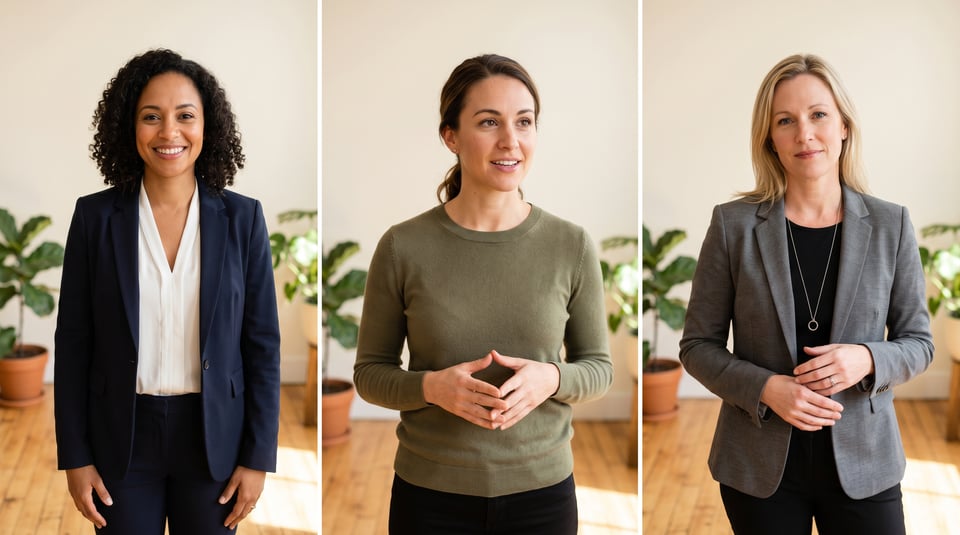
6. Stay in the “Power Zone” (Waist to Eyes)
Gestures below your waist look uncertain and weak, like you’re trying to hide them. Gestures above your eyes look manic or out of control (unless you’re intentionally showing something enormous).
The sweet spot is between your waist and your eyes. Science of People calls this the “power zone”, the region where every purposeful gesture should live.
Quick self-check: Record yourself speaking for 60 seconds. Watch it back and notice where your hands go. If they’re consistently below your belt or above your head, consciously bring them into the power zone during your next rehearsal.
Pro Tip When you want to emphasize something as particularly important, bring your gesture to the upper part of the power zone (chest to chin level). For calmer, conversational points, keep gestures in the lower part (waist to chest).
7. Use Palm-Down Gestures Sparingly for Authority
If palm-up signals openness and trust, palm-down signals control and finality. It’s the gesture of someone settling a room, making a decision, or giving a directive.
In Pease’s research, audiences described palm-down speakers as authoritative, which is useful when you actually need it. Overuse makes you seem domineering.
When to use palm-down:
- Closing a negotiation point: “Here’s what we’re going to do.”
- Calming a tense meeting: a slow, downward press of both palms signals “let’s settle down.”
- Making a final decision after discussion: the palm-down motion signals the conversation is closing.
When to switch to palm-up:
- Building buy-in: “What do you think about this approach?”
- Inviting collaboration: “I’d love your input.”
- Opening a brainstorm: “Let’s explore some options.”
Action Step: In your next meeting, consciously use palm-up during the discussion phase and switch to palm-down only when you’re ready to make a decision or close a point. Notice how the room responds to each.
8. Keep Your Hands Visible
When you hide your hands, in pockets, under a table, or behind your back, your listener’s brain goes on mild alert. It’s that ancient survival mechanism at work: before spoken language, humans needed to see whether a stranger’s hands were safe.
In mock jury trials, attorneys and witnesses who hid their hands were rated as less honest and less open. Speakers who grip a lectern with both hands for extended periods signal high anxiety to their audience.
Practical rules:
- In meetings: Keep your hands on the table and out of your lap.
- When standing: Let them hang at your sides or gesture, never shove them in your pockets for more than a moment.
- On stage: If you’re using a lectern, touch it lightly with one hand at most. Better yet, step away from it.
- During first meetings: Visible hands are especially important when trust hasn’t been established yet.
Action Step: For one full day, notice how often you hide your hands, in pockets, under your desk, behind your back.
9. Nail the Handshake in the First 7 Seconds
Research from the University of Iowa found that handshake quality directly influences hiring recommendations in job interviews, with interviewers forming judgments within the first 2 to 7 seconds of meeting someone. That’s before you’ve said a single word about your qualifications.
The handshake protocol:
- Offer first. Initiating the handshake projects confidence.
- Stand if you’re seated. It signals respect and puts you on equal footing.
- Match grip firmness. Too firm feels aggressive; too limp feels disengaged. Mirror the other person’s pressure.
- Maintain eye contact and smile. The handshake is a multi-signal moment. Your face matters as much as your hand.
- Keep it to 2-3 seconds. Longer feels like you’re holding someone hostage.
Reading the room: Not everyone is comfortable with handshakes. If someone hesitates or doesn’t extend their hand, a warm smile and a small wave is a perfectly professional alternative.
Pro Tip A vertical handshake (neither palm up nor palm down) signals equality. To subtly signal warmth, rotate your hand slightly so your palm faces upward.

10. Adapt Your Gestures for Video Calls
With remote and hybrid work now standard, your gestures need to work on camera too. The challenge is that most webcam setups show only your face and cut off your hands entirely.
Sit back from the camera so your upper body and hands are in frame. About 90% of information processed during video calls comes from visual data, so strategic hand gestures significantly boost your message.
Video call gesture rules:
- Test your frame. Before the call, check that the camera captures you from roughly mid-chest up, with room for your hands to enter the frame.
- Gesture deliberately. Use illustrators and open palms just as you would in person, but keep movements slightly smaller, what looks normal in a conference room can look frantic in a Zoom box.
- Don’t let your hands obscure your face. Keep gestures at chest level rather than up by your chin.
- Return to home base. On camera, constant hand movement in the frame is even more distracting than in person.
Action Step: Before your next video call, do a quick camera check. Sit back far enough that your hands are visible when you gesture at chest height. Ask a colleague if your gestures look natural on screen.
11. Let Open, Upright Posture Carry Your Hands
Your hands don’t work in isolation. Your posture is the frame your audience reads them in. An open, upright stance, shoulders back, chest unguarded, arms free to move, looks confident and approachable. A slumped, hunched-over stance does the opposite, and it physically pins your hands into hiding.
This is about the outward signal you send. Standing tall won’t rewire your biology, but it changes what others see, and it gives your gestures room to live in the power zone instead of getting trapped against your sides.
An open, upright stance looks confident to your audience, and it frees your hands to gesture instead of hide.
How to use it:
- Before a big presentation, interview, or difficult conversation, take a moment to stand tall: roll your shoulders back, lift your chest, and let your arms hang loose and ready. Do this privately, in a hallway, your car, a quiet corner.
- Keep the posture open during the interaction itself. Uncross your arms, keep your chest unguarded, and let your hands stay visible and active.
- Combine with deep breathing. Exhale slowly while you settle into the stance, relaxed shoulders make your gestures look natural instead of stiff.
Action Step: Before your next high-stakes moment, find a private space and reset your posture: shoulders back, chest open, arms loose. Then carry that open stance into the room so your hands have room to work.
12. Stop Fidgeting
Playing with a ring, tapping a pen, twirling your hair, clicking a retractable pen cap. These feel like harmless nervous habits, and they cost you more than you’d guess.
About one in three people experience a phenomenon called misokinesia, a strong negative emotional reaction when watching someone fidget. They feel frustration, anger, or intense distraction. That means roughly a third of any audience you’re speaking to may be actively irritated by your pen-clicking, and they’re not hearing your words anymore.
Research from the Netherlands found that when your hand gesture contradicts your words, like shaking your head “no” while saying “yes”, audiences are about 40% more likely to misinterpret what you said.
How to stop:
- Identify your fidget. Ask a trusted friend or record yourself. Most people don’t realize they fidget.
- Remove the trigger. If you click pens, don’t hold one. If you play with your ring, leave it in your pocket before a presentation.
- Channel the energy. Nervous energy doesn’t disappear. Redirect it into purposeful illustrator gestures. Instead of tapping the table, use that hand to “draw” your next point in the air.
- Use the home base technique from #5. Having a deliberate resting position gives your hands somewhere to go that isn’t fidgeting.
If you’re someone whose hands shake when nervous, speaker coach David Nihill recommends two practical tricks: use a lapel mic instead of a handheld one, and opt for a partially full water bottle over a glass (the weight stabilizes your hand and hides trembling).
Action Step: Before your next presentation, do a “fidget audit.” Remove any objects from your hands and pockets. Set your home base position. And remember: one-third of your audience will thank you.
A new book by Vanessa Van Edwards
Every conversation is an opportunity.
If conversations have gotten harder, more awkward or less satisfying, you’re not imagining it. We’re simply out of practice. It’s time to find the joy in talking to each other again.
Cultural Caution: 5 Gestures That Don’t Translate
Hand gestures that are perfectly fine in one culture can be deeply offensive in another. Before your next international meeting or trip, scan this list from Language Trainers:
- Thumbs up. Means approval in the West but is an insult in Iran, Iraq, and parts of Greece.
- The “OK” sign (thumb and index finger forming a circle). Vulgar in Brazil, Turkey, and Greece. Means “zero” or “worthless” in France.
- The V-sign (palm facing inward). A major insult in the UK, Australia, and New Zealand.
- Pointing with one finger. Considered aggressive in China, Japan, and Indonesia. People in these cultures point with their whole hand or thumb instead.
- Using the left hand. Considered unclean in many Middle Eastern, Indian, and African cultures. Using it to eat, offer money, or gesture is a serious faux pas.
Pro Tip When in doubt internationally, keep your gestures to open palms and illustrators. These are the most universally safe and positive.

Your “Hands Action Plan” by Situation
Here’s a quick-reference cheat sheet you can review before your next big moment.
When you’re nervous:
- Start in your home base position (arms at sides or hands lightly clasped at waist)
- Take a deep breath. Exhale, feel your feet on the ground, and drop your shoulders, your hands will naturally relax
- Use a lapel mic instead of a handheld one
- Opt for a partially full water bottle over a glass (hides shaking)
- Channel nervous energy into 2-3 pre-planned illustrator gestures
When you’re presenting:
- Keep all gestures in the power zone (waist to eyes)
- Use illustrator gestures to “draw” your key points in the air
- Return to home base between gestures, constant motion becomes noise
- Show open palms when you want the audience to trust your message
- Use the steeple when making your strongest recommendation
When you’re in conversation:
- Keep your hands visible, especially during first meetings
- Show open palms when you want to build rapport or invite openness
- Use the steeple when you want to project confidence during a key point
- Replace pointing with an open hand to direct attention
- Match your gestures to your words, mismatches cost you credibility
When you’re on a video call:
- Sit back so your upper body and hands are in frame
- Gesture slightly smaller than you would in person
- Keep hands at chest level and clear of your face
- Return to home base between gestures
Even a 5-minute training session on illustrator gestures helped people become noticeably better communicators.
What to Do With Your Hands Takeaway
Your hands are one of the most powerful communication tools you have, and almost nobody trains them. Here’s where to start:
- Illustrator gestures beat everything else. “Draw” your ideas in the air. Spread your hands for “big,” move upward for “growth,” trace timelines left to right. The 2025 UBC study found these are the only gesture type that consistently boosts perceived competence and persuasion.
- Visible palms equal trust. Open, upward-facing palms trigger an ancient “friend, not foe” signal. Palm-up requests achieve roughly 84% compliance, three times higher than finger-pointing.
- Stay in the power zone. Keep all purposeful gestures between your waist and your eyes. Below looks weak. Above looks manic.
- Stop fidgeting, one-third of people hate it. About 33% of any audience experiences a strong negative reaction to watching someone fidget. Channel that energy into purposeful gestures instead.
- Your hands help YOUR brain too. Gesturing frees up working memory, improves word retrieval, and boosts creativity. When you gesture, you think better.
The best news from the research? You don’t need months of practice. The UBC study found that even a 5-minute training session on illustrator gestures produced a measurable improvement. Pick one technique from this list, practice it for five minutes before your next meeting, and watch what happens.
Frequently Asked Questions
What should I do with my hands during a presentation?
Keep your hands visible and use purposeful “illustrator” gestures, movements that visually depict what you’re saying, like spreading your hands apart for something big or tracing a timeline left to right. Stay in the power zone between your waist and your eyes, and return to a neutral home base position (arms at sides or hands lightly clasped at waist) between gestures. Avoid gripping the lectern, shoving your hands in your pockets, or fidgeting with objects.
How do hand gestures affect communication?
Hand gestures make speakers more persuasive, more trustworthy, and easier to understand. A 2025 UBC study of over 2,184 TED Talks found that speakers who used illustrator gestures were rated significantly higher on competence and clarity. Gestures also help the speaker’s own brain, research from the American Psychological Association shows they free up working memory and improve word retrieval.
What hand gestures should I avoid?
Avoid finger-pointing (triggers defensiveness and irritation), hiding your hands (triggers evolutionary distrust), fidgeting with objects (irritates about one-third of people who experience misokinesia), and mismatched gestures that contradict your words (causes about 40% more misinterpretation). Also be cautious with gestures in international settings, thumbs up, the OK sign, and the V-sign carry offensive meanings in some cultures.
Do hand gestures actually help you think better?
Yes. Research from the American Psychological Association shows that gesturing while speaking frees up working memory, making it easier to retrieve words and organize thoughts. People who gesture during brainstorming generate more ideas and more original ideas. Gesturing creates multiple memory pathways (auditory, visual, physical), leading to better recall even weeks later.
What is the best hand position for public speaking?
The best default is a neutral “home base”, arms hanging loosely at your sides or hands lightly clasped at waist level. From there, use purposeful gestures in the power zone (waist to eyes) to emphasize key points, then return to home base. The steeple (fingertips touching, palms apart) is effective for projecting confidence during your strongest moments, and open palms build trust when you want the audience to believe your message.
Does my posture affect how my hand gestures land?
Yes, posture is the frame your audience reads your gestures in. An open, upright stance (shoulders back, chest unguarded, arms free to move) looks confident and approachable, and it physically gives your hands room to gesture in the power zone. A slumped, closed-off stance does the opposite and tends to pin your hands into hiding. This is about the outward signal others see, so before a big moment, reset to an open posture and carry it into the room.