Have you ever set out to write a simple e-mail only for it to turn into a ten-paragraph essay? Oops… should have just picked up the phone and called.
We’ve all been there. But which one is better, a call or an e-mail? It depends. And “it depends” is useless when there’s a message in front of you right now, so let’s get specific.
If you want to know when to e-mail and when to make a phone call, read on for tips and strategies for EVERY situation!
Advantages and disadvantages of calling versus e-mailing
Some people think e-mail is just as good as actually talking. It’s faster, it’s safer, and nobody catches you off guard.
The research disagrees, and the gap is wider than you’d guess.
A 2021 experiment found that interactions including voice (phone, video chat, and voice chat) built stronger social bonds than text-based ones like e-mail and texting, with no increase in awkwardness. People also kept underestimating how much closer they’d feel after talking. We brace for the awkwardness and forget how good the connection feels.
So when you talk rather than type, there are real social and emotional benefits, good for your own well-being and for the person you’re speaking with.
Why? Because the words are only half the message.
Your tone, your volume, and the rhythm of how you talk all tell the other person who you are, what you mean, and whether they want to work with you.
Before you pick a lane, here’s a quick rundown of the pros and cons. These shift depending on the situation, personal or professional, so let your own judgment have the final say.
| Pros of e-mail communication |
|---|
| Ideal for sharing simple data and facts—who, what, when, and where |
| Helpful for multiple recipients of the same message |
| Ability to carefully craft message |
| Great for record-keeping purposes |
| Efficient for those working different schedules or in different time zones |
| Can be drafted and scheduled for a later date |
| Efficient for simple message |
| Cons of e-mail communication |
|---|
| Can be undelivered or lost in the inbox |
| The tone of voice can be easily misinterpreted |
| Complex concepts can result in multiple back-and-forth conversations |
| Pros of phone calls |
|---|
| Building relationships and developing personal connections |
| Quick response to questions |
| Can efficiently go back and forth on questions or clarify complex materials |
| Less likely to be misinterpreted |
| Cons of phone calls |
|---|
| May catch the recipient off guard |
| Requires a quiet environment |
| Requires you to know your material instead of using something scripted |
| Might go to voicemail (and be deleted or ignored!) |
| May take more time to reach the person (phone tag!) |
Pros and cons sorted. Now for the real situations, and what to do in each one.
12 Scenarios When a Phone Call Is Likely the Better Option
1. After a conflict
It might feel easier to avoid your coworker and send an e-mail, but a conversation can go a long way toward healing hurt feelings and mending the relationship.
When you talk, your words and your tone both carry your meaning, so there’s far less room for the other person to read you wrong. A call also takes a little vulnerability, and vulnerability is what rebuilds trust.
Even when you’re sure you owe nobody an apology, something as small as “Let’s figure out a way through this. How can we move forward?” can carry you into the next interaction with a lot less weight on your chest.
Want to sharpen your conflict resolution game? Become a Jedi with these 9 winning conflict resolution tips.
2. If you need an immediate response
A supplier needs an answer by end of day to keep a critical part of your supply chain moving. You can’t sign off on it yourself, and the one person who can is somewhere over the Atlantic with their phone in airplane mode.
Call. Right now. Even if it rolls to voicemail, you can flag that this is time-sensitive and the clock is ticking.
Then back it up with an e-mail. “URGENT REPLY REQUESTED” in the subject line, so it’s impossible to miss.
Just save this for the genuinely urgent stuff. Cry wolf and people stop picking up.
3. When you’re concerned about someone
You know the coworker who’s usually all jokes and suddenly went quiet on the group chat? Or the one buried under a brutal assignment, or quietly carrying a sick family member at home?
That tender, personal stuff is almost always better by phone or in person. That’s where real empathy comes through, human to human.
And there’s a catch: a caring e-mail in a work inbox can feel oddly stiff, even when your heart’s fully in it. A quick call or voicemail, though? That kind of reach-out can stay with someone for a long time.
4. When you are resigning from a job
You’ve found your next career move and have to tell your current boss you’re leaving. It may be easier to send a carefully worded e-mail, but quitting almost always goes better as a call, or better yet a walk down the hall to say it to their face.
Two reasons.
First, you’ve built some kind of relationship with this person. Telling them directly honors that, and quietly says they mattered in your story.
Second, however you feel about them, leave on a good note. You never know when you’ll need a reference, or when your name comes up in a room you’re not in. Leave a good imprint.
Then follow the conversation with a formal letter of resignation to your boss or HR, so everyone’s got it on paper.
5. When you’re asking for a favor
A pipe bursts at home and you need a coworker to cover your conference call. Or you want an intro to a sales rep at another company. Either way, you’ve got to ask for help.
E-mail or text feels easier, sure. But how you ask changes how often you hear yes.
One study of how people ask for help ran two experiments. In the first, asking in person beat every mediated channel it was up against, video and audio calls included. The second dropped in-person, added e-mail, and found audio and video calls both beat it. No single experiment put all four side by side, so trust the ordering; the size of any gap is far less certain.
So next time you need a reference letter, skip the e-mail. Call your former boss, laugh about that one disastrous launch you both survived, then make the ask. That little spark of shared history makes them far more likely to write you something glowing.
Bottom line: if you have a request, it’s likely better to call, and if it’s a significant ask, try to do it in person.
6. If you’re turning down a job offer
You’ve made it through a lengthy interview process and have a job offer on the table. But after careful consideration, you’ve decided to turn it down. Figuring out whether to call or e-mail can be tricky.
As in the other scenarios, the guiding principle is the relationship. If you clicked with the hiring manager, a personal call is the classy move.
Here’s a sample script to keep you in good standing:
Hello, [hiring manager name.]
[Insert nicety]
I wanted to follow up on your offer for the [position name.] I appreciate the opportunity you’ve offered.
It was a difficult decision, but I’ve concluded that it’s best for me to [move in another direction / stay in my current position] and [insert brief reason why].
I hope we can stay connected through [LinkedIn / professional organization].
Thank you again for your time.
Can’t reach them by phone, or honestly feel like e-mail fits the relationship better? A written reply is perfectly fine. Grab How to Decline a Job Offer (with templates) and tweak one to fit your situation.
7. If you’ve taken too long to respond
It happens to everyone. An e-mail slides past you, gets buried under forty newer ones, and surfaces a week later with a guilty little jolt.
No wonder. The Harvard Business Review found the average businessperson gets over 100 e-mails a day, with another 200 already sitting in the inbox waiting for a reply.
But if the one you dropped is important, or it’s from your boss, calling is usually your best move. Owning the slip out loud (“totally my fault, this got away from me”) is honest and human in a way a written apology rarely is. Bonus: a call doesn’t pile onto their overflowing inbox, and your reply doesn’t go languishing in it either.
If a drowning inbox sounds painfully familiar, read 14 science-backed ways to protect your productivity for some relief.
8. When there’s bad news
The deadline just got yanked forward, the budget’s been slashed, or a role is being cut.
Nobody volunteers to be the messenger in a moment like that. But if you’re the one delivering it, speak to the person instead of sending an e-mail.
A conversation strips out the misreadings and worst-case spirals an e-mail invites. It also gives you room to be human about it—empathetic, steady, actually present. Leave plenty of time to answer questions and clear up details, because rushing bad news only makes a hard moment harder.
9. When there’s good news
Hit a major milestone? Coworker just got promoted? A client raved about your team’s presentation?
Pick up the phone. Good news deserves a voice on the other end, big win or small.
Genuine recognition makes people feel seen for the work they poured in, and it tightens the bonds between teammates. And celebrating the little wins? That’s what gives people the nerve to go chase the bigger ones.
Then send a follow-up note of congrats for their “feel good” file.
10. When the information is complex
Some messages come with backstory and need real give-and-take. They’ll spawn a dozen questions the second the other person hits paragraph two.
Those are better handled by talking. When you can explain the context out loud and field questions in real time, you’ll both get there faster than you would in a sprawling nine-reply thread.
And a question you can’t answer on the spot? Perfect excuse to follow up by e-mail later with the answer plus a tidy recap of what you covered.
One more thing: you don’t have to start and finish on the same channel. Sometimes the smart play is an e-mail to tee up a call, especially when there’s no relationship yet and a cold call would feel like an ambush.
11. When the message might be misinterpreted
You hit send, then immediately reread it and think: wait, does that sound passive-aggressive? Written words come with no tone of voice, so your reader supplies their own, and it’s often not the one you meant. Cue the hurt feelings, the quiet resentment, sometimes a working relationship that never quite recovers.
How bad is it? In a 2005 study from New York University and the University of Chicago, people e-mailed a mix of sarcastic and serious statements and readers tried to sort which was which. Readers got it right about 56% of the time, close to a coin flip, while the senders were confident they’d come through clearly. The researchers put it down to egocentrism: you can’t unhear the tone playing in your own head as you type.
That’s one narrow test of one kind of tone, so hold the size of it loosely. The warning still stands: the voice you hear while writing isn’t the one that arrives.
So read your e-mail aloud a few times, in different tones. Does it ever come out sarcastic, sharp, or cold? If there’s even a whiff of it, rewrite it, or just call.
12. When you’re trying to establish a relationship
New to the company, new to the role, or in sales staring at a list of contacts who don’t know your name yet? The fastest way to actually connect is to pick up the phone.
A call lets your personality and your voice come through, and that’s where trust starts. It also tells the other person, without you saying it outright, that they’re worth your time. And who doesn’t love feeling like that?
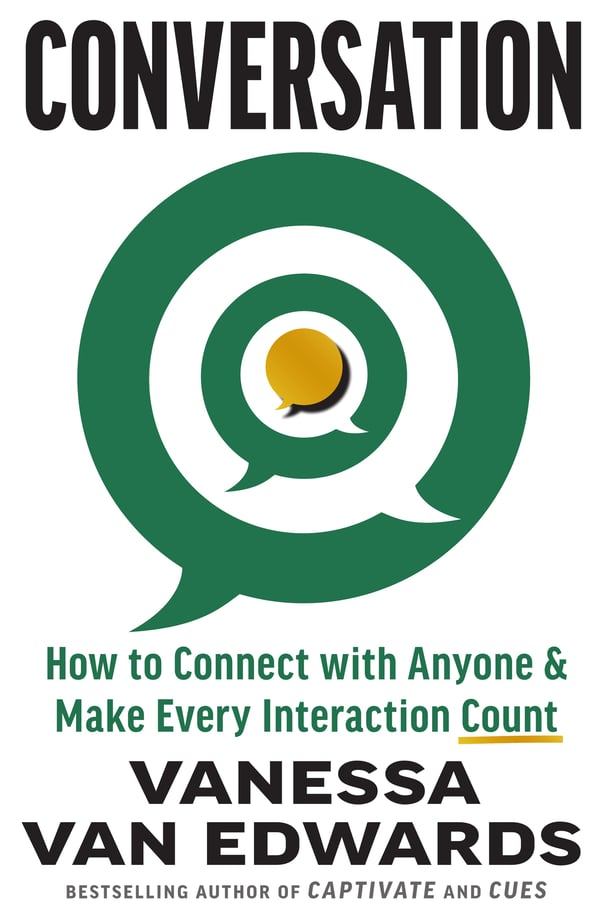
A new book by Vanessa Van Edwards
Every conversation is an opportunity.
If conversations have gotten harder, more awkward or less satisfying, you’re not imagining it. We’re simply out of practice. It’s time to find the joy in talking to each other again.
What if you dislike making phone calls?
If your stomach drops at the thought of dialing, you’re in good company. Phone anxiety is incredibly common.
Read: 12 steps to conquering your phone anxiety through voice tone, volume, cadence, and speech patterns. You’ll be a phone ninja before you know it.
Now flip the coin. Sometimes typing genuinely beats dialing.
5 scenarios when an e-mail is likely the better option
When the person prefers e-mail
Once a relationship is solid and there’s real trust, you know each other well enough to read the tone behind the words. The risk of a misfire drops way down.
And if you’re still building rapport with someone and they’ve asked you to e-mail them? Honor that. Start there, build through e-mail, and let them come to the phone when they’re ready. You don’t win people over by steamrolling what they asked for on day one.
When the message is simple
Sharing plain data (the who, what, when, and where) is usually a job for e-mail. Easy to send, easy to forward, easy for anyone who needs it to find it again later.
But if you’ve traded two e-mails and the thing is still murky? Stop typing. Pick up the phone or grab them in person. Use your best judgment and the context to decide.
When you need to update several people at once.
Can’t get everyone in a room? An e-mail and the thread that follows keeps the whole group in the loop at once, without you repeating yourself five times.
When you want to follow up a conversation confirming details
Sometimes you want the conversation on the record, especially after a first call, where you might’ve caught the other person off guard and they weren’t fully ready to dig in. After a long talk, a quick e-mail summary makes sure you both walked away with the same understanding.
When you want an electronic paper trail
Sometimes you just need it in writing, for legal reasons or plain old cover-yourself. A written record gives you a history, so when a question surfaces months later, the answer’s right there.
The flip side, and it’s a big one: if you wouldn’t want it showing up on the news, in court, or in your boss’s inbox, ask whether it should be written down at all.
Make the Right Call, Every Time
You’ve got what you need to pick the right channel for the moment instead of defaulting to whatever’s easiest. When you’re stuck, run through these four:
- Communication is about relationships. Are you building a connection, or keeping one alive?
- Know your content. Short and sweet, or layered and complex?
- Read your e-mail aloud in a few tones. Could it be misread?
- If you wouldn’t want it on the front page of the newspaper, don’t put it in writing.
And if you’re about to call a new colleague but want fresh ideas for breaking the ice? Grab our 68 Killer Conversation Starters and turn that first call into one they’ll actually remember.