I LOVE playing games. Board games, people games, talking games, guessing games, and hosting game nights. I also find it’s one of the best ways to connect with people.
So I came up with the best games to play with every kind of friend for different scenarios. For example:
- Is there a game that is best for connecting new friends?
- Do you know of any good learning games I can play with my kids?
- Do you know the best strategy board games?
- Are there any games you can play virtually?
The answer is yes, yes, and yes!
And you’re in good company. Over 70% of gamers already play their games with a friend, and cooperative play tends to carry helpful behavior back into real life.
Here is a big list of my favorite games, broken down by category, whether you’re meeting new people, reconnecting with old friends, hosting a massive group, or looking for something you can play right now with zero equipment.
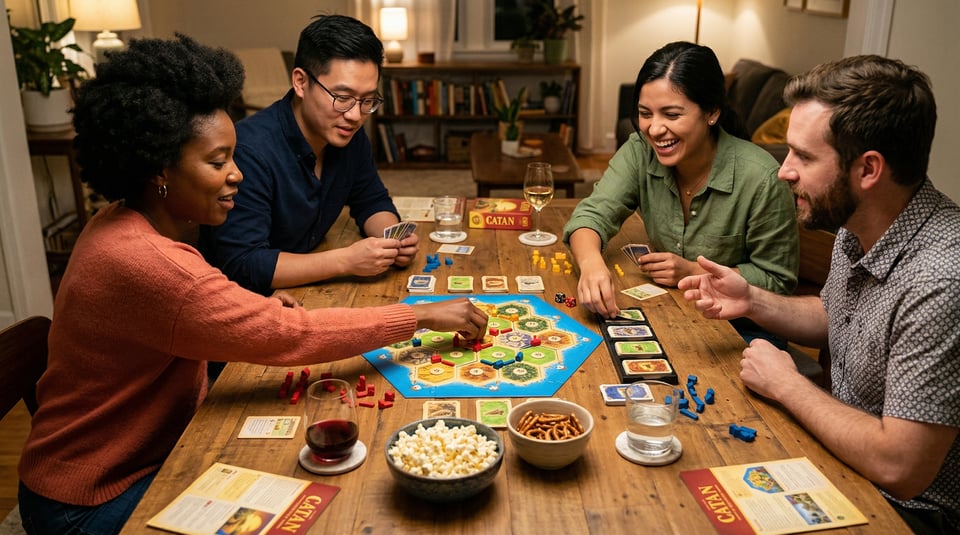
Why Games Are the Ultimate Friendship Hack
Evolutionary psychologist Professor Robin Dunbar at the University of Oxford ran six studies on laughter. People who laughed in groups had measurably higher pain tolerance afterward, which is one of the signs researchers use to detect a rush of endorphins.
Primates bond through one-on-one grooming. Humans, Dunbar argues, evolved laughter as a way to bond with multiple people at once. As he put it:
“Social laughter is grooming from a distance… it allows us to trigger the endorphin hit in several people at once.”
Games that make you laugh are doing exactly what evolution designed—building trust and connection in groups.
There’s a nuance here that’s easy to miss. The type of game matters depending on who you’re playing with. Research on cooperative versus competitive play suggests cooperative games raise trust and helping behavior among new acquaintances, while playful competition energizes friendships that are already established.
In other words, don’t break out the ultra-competitive strategy game with people you just met. Save that for your best friends who can handle trash talk.
| Friendship Stage | Best Game Type | Why It Works | Examples |
|---|---|---|---|
| Meeting new people | Cooperative / Icebreaker | Builds trust without pressure | Codenames, Wavelength, Two Truths and a Lie |
| Casual friends | Party / Social deduction | Creates shared memories and inside jokes | Monikers, Jackbox, Avalon |
| Close friends | Competitive / Strategy | Playful rivalry energizes established bonds | Catan, Wits & Wagers, Mario Kart |
| Best friends | High-stakes co-op | Deepens trust through shared challenge | Pandemic, Helldivers 2, Escape rooms |
Now, on to the games.
Best Group Games
These are the crowd-pleasers. They work for mixed groups of four to ten people where not everyone knows each other well.
#1: Cranium
Players: 4+ (teams) | Time: 60 minutes
Cranium is the Swiss Army knife of group games because it rotates through four categories: drawing, acting, trivia, and word puzzles. That rotation is the whole trick. Everyone gets a moment where they shine, whether they’re the artist, the performer, or the walking encyclopedia.
Pro Tip Cranium works especially well for groups where people have different strengths. The quiet trivia buff and the dramatic actor both get their moment.
#2: Bowl of Nouns
Players: 6+ | Time: 30–45 minutes | Equipment: Paper slips, a bowl, a timer
This zero-cost game is a three-round escalation of chaos. Everyone writes 3–5 nouns (people, places, things) on slips of paper and tosses them in a bowl. Round one: describe the word without saying it. Round two: one-word clues only. Round three: charades.
The magic is that by round three, the group has built a shared language of inside jokes from the earlier rounds. Someone miming “Abraham Lincoln” becomes hilarious when you remember your friend’s terrible round-one clue about him.
Action Step: Keep the nouns specific and fun. “Beyoncé’s left shoe” is more entertaining than “shoe.”
#3: Would You Rather
Players: 3+ | Time: Flexible | Equipment: None
The simplest game on this list, and one of the most revealing. Take turns posing dilemmas: “Would you rather have the ability to fly but only three feet off the ground, or be invisible but only when no one is looking?” The answers spark debates that can last longer than the game itself.
This is a perfect warm-up game for the first thirty minutes of a gathering, before transitioning to something more structured.
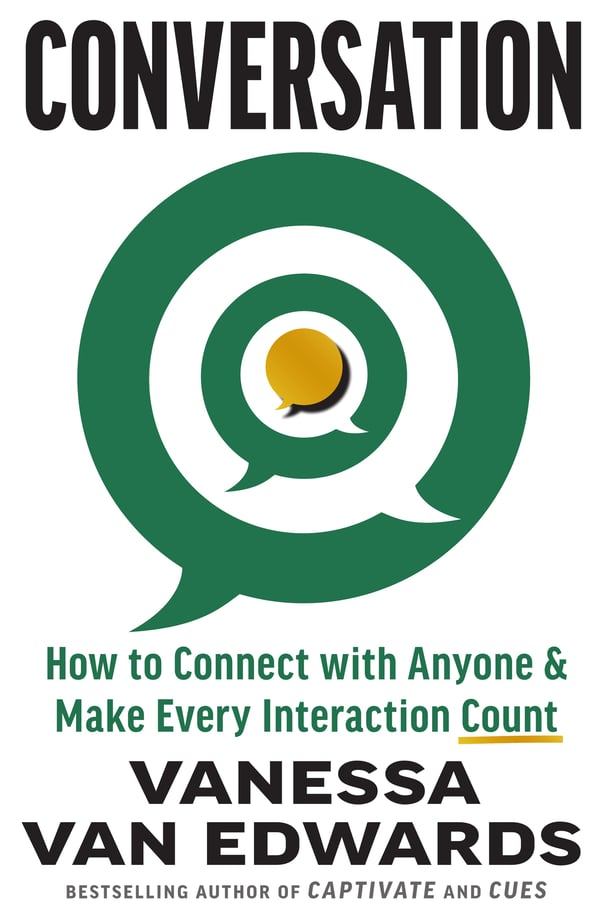
A new book by Vanessa Van Edwards
Every conversation is an opportunity.
If conversations have gotten harder, more awkward or less satisfying, you’re not imagining it. We’re simply out of practice. It’s time to find the joy in talking to each other again.
Best Strategy Board Games
For the friend group that likes to think. These games reward planning, negotiation, and the occasional backstab.
#1: Catan
Players: 3–4 (up to 6 with expansion) | Time: 60–90 minutes
Formerly known as Settlers of Catan, this game has sold over 45 million copies worldwide and just released its 6th Edition for its 30th anniversary. Players collect resources (wood, brick, sheep, wheat, ore) and trade with each other to build settlements on a hex-tile island.
What makes Catan brilliant for friendships is the negotiation. You have to trade with other players to win, which means every game becomes a masterclass in persuasion, deal-making, and reading people. You’ll learn more about someone’s personality in one game of Catan than in ten dinners.
Pro Tip For first-timers, use the suggested beginner layout in the rulebook. It’s balanced so nobody gets a terrible starting position, which prevents early frustration.
#2: Quantum
Players: 2–4 | Time: 60 minutes
A hidden gem that deserves more attention. Players use dice as spaceships, and the number on the die determines what kind of ship it is (fast scout, heavy battleship, and so on). It’s pure strategy with no luck after the initial setup, and games are tight enough that the outcome often comes down to the final turn.
#3: Terraforming Mars
Players: 1–5 | Time: 120+ minutes
This is the deep-end pick. You take on the role of a corporation making Mars habitable by raising the temperature, oxygen level, and ocean coverage. Each player builds an engine of cards that combo together in satisfying ways. It’s long, it’s complex, and it’s the kind of game where you think about your next move in the shower.
Special Note Terraforming Mars is best for groups who already enjoy strategy games. Introducing a newcomer to board gaming with this one is like teaching someone to swim by dropping them in the ocean.
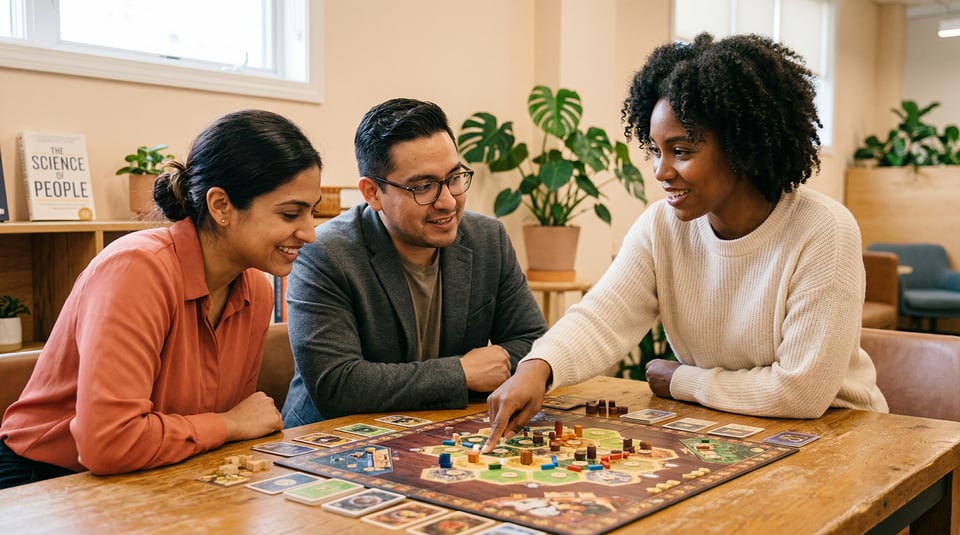
Best Educational Board Games
Games that make you smarter without feeling like homework.
#1: Predictably Irrational
Players: 2–6 | Time: 30–45 minutes
Based on Dan Ariely’s behavioral economics bestseller, this game presents real psychological experiments and asks players to predict how people actually behaved. You’ll learn about cognitive biases, irrational decision-making, and why humans are wonderfully weird—all while competing to see who understands human nature best.
#2: Codenames
Players: 4–8+ | Time: 15–30 minutes
Two teams. A grid of 25 words. Each team’s spymaster gives one-word clues that connect multiple words on the grid. Your team tries to guess which words belong to you while avoiding the other team’s words, and the dreaded assassin card.
Codenames is the rare game that’s both a party game and a brain game. The spymaster role forces creative lateral thinking (“how do I connect dog and moon with one word?”), and the guessing role rewards team communication and trust.
Best 2-Player Board Games
For when it’s just the two of you and phones aren’t cutting it.
You’ll learn more about someone’s personality in one game of Catan than in ten dinners.
#1: 7 Wonders — Duel
Players: 2 | Time: 30 minutes
The two-player spinoff of the civilization card game 7 Wonders. You draft cards from a shared display to build your ancient civilization, aiming for military dominance, scientific supremacy, or raw victory points. Three different ways to win means every game unfolds differently.
#2: Hive
Players: 2 | Time: 20 minutes
Chess meets insects. Each piece (ant, beetle, grasshopper, spider, queen bee) moves differently, and the goal is to surround your opponent’s queen. There’s no board. Pieces are placed on any flat surface. It’s portable, waterproof (the travel version uses bakelite tiles), and endlessly replayable.
#3: Sushi Go!
Players: 2–5 | Time: 15 minutes
A card-drafting game where you collect sets of sushi to score points. Pick a card, pass the rest. Adorable art, dead-simple rules, and enough strategy to keep it interesting. This is the gateway game for someone who says they “don’t like board games.”
Best Family Board Games
Games that work across generations. Grandma and your twelve-year-old can both enjoy these.
#1: Pandemic
Players: 2–4 | Time: 45–60 minutes
The irony of recommending a game about stopping global disease outbreaks isn’t lost on anyone, but Pandemic remains one of the best cooperative board games ever made. Each player takes a unique role (medic, scientist, researcher) and works together to cure four diseases before they spread across the world.
What makes Pandemic exceptional for families is that it teaches collaborative problem-solving without anyone feeling left out. There’s no elimination, so everyone stays in until the group wins or loses together. Cooperative games like this act as a “social lubricant” by giving players a structured reason to communicate, listen, and consider each other’s perspectives.
#2: Taboo
Players: 4+ (teams) | Time: 30–60 minutes
Describe a word without using the five most obvious related words. “Describe ‘beach’ without saying sand, water, ocean, sun, or vacation.” The buzzer-wielding opponent watching your every word adds delicious pressure. Taboo reveals who in your family is a creative communicator and who panics under a time limit.
#3: Monopoly
Players: 2–8 | Time: 60–180 minutes
Yes, Monopoly. The game everyone loves to hate. Play by the actual rules (auction every property that isn’t purchased on landing, no money on Free Parking) and games take about sixty minutes instead of four hours. The house rules that make Monopoly miserable are the ones people added over generations.
Pro Tip Agree on a firm end time before starting. “We play for ninety minutes, then whoever has the most assets wins.” This single rule change transforms the experience.
Best Board Games for Large Groups
For when you’ve got eight or more people and need something that doesn’t collapse under the weight of too many players.
#1: Mafia
Players: 7–20+ | Time: 30–60 minutes | Equipment: None (or a deck of cards)
The original social deduction game. One player narrates while the group closes their eyes. Secret “mafia” members silently choose a victim each night. During the day, everyone debates who the mafia members are and votes to eliminate a suspect. Lying, bluffing, and reading body language are the entire game.
Mafia is a masterclass in group dynamics. In most groups, whoever stays quiet through the first few minutes tends to stay quiet all night. Mafia fixes that by forcing everyone to participate. You have to defend yourself or accuse someone else.
Action Step: If you’re the narrator, keep rounds short (2–3 minutes of discussion maximum). Long debates drain the energy.
#2: Cards Against Humanity
Players: 4–20+ | Time: 30–90 minutes
The fill-in-the-blank game that weaponizes dark humor. One player reads a prompt card; everyone else submits their funniest (or most terrible) answer card. It works best with a group whose humor you already know, and when the chemistry is right it generates the kind of uncontrollable laughter that Dunbar’s research links to an endorphin effect.
Special Note Cards Against Humanity works best with close friends who share a similar sense of humor. With acquaintances or mixed groups, consider the family edition or a different party game to avoid awkward moments.
#3: Spoons
Players: 3–13 | Time: 15–30 minutes | Equipment: A deck of cards, spoons (one fewer than the number of players)
The fastest card game you’ll ever play. Pass cards around the circle trying to collect four of a kind. The moment someone does, they grab a spoon from the center, and everyone else lunges for the remaining spoons. The person left empty-handed earns a letter (S-P-O-O-N). Spell the whole word and you’re out.
Spoons is controlled chaos. It’s physical, it’s loud, and it’s the perfect palette cleanser between heavier games.
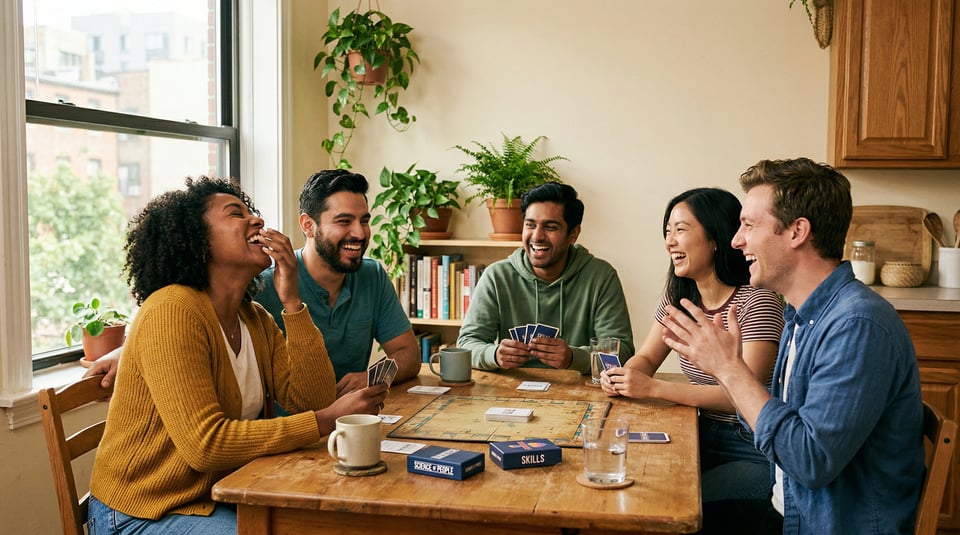
Best Board Games for Kids
Games that keep kids engaged without making adults want to flip the table.
#1: Candy Land
Players: 2–4 | Ages: 3+ | Time: 15–20 minutes
The classic first board game. No reading required and no strategy to learn. You draw a card and move to the matching color. It’s pure luck, which means a three-year-old has the same chance of winning as an adult. That equality is exactly why it works.
#2: Apples to Apples
Players: 4–10 | Ages: 7+ | Time: 30 minutes
The family-friendly precursor to Cards Against Humanity. A judge plays a green adjective card (“Scary”), and everyone plays the red noun card from their hand that best matches it. The judge picks their favorite, and the arguments about why “Grandma” is scarier than “Sharks” are the whole point.
Best Board Games for Adults Based on Movies
For the friend group that bonds over shared fandoms.
#1: Game of Thrones: The Board Game
Players: 3–6 | Time: 120–240 minutes
A grand strategy game of alliances and betrayal set in Westeros. Each player controls one of the great houses and competes for the Iron Throne through military conquest, political maneuvering, and, inevitably, broken promises. If your friend group can survive this game with relationships intact, you can survive anything.
#2: Clue: Harry Potter Edition
Players: 3–5 | Time: 30–45 minutes
The classic whodunit reskinned for Hogwarts. Instead of Colonel Mustard in the library, you’re figuring out who attacked a student, what spell they used, and where in the castle it happened. The board includes a moving Hogwarts feature that changes room access each turn.
#3: Star Wars Battleship
Players: 2 | Time: 20–30 minutes
Classic Battleship with Star Wars ships. It’s simple, it’s nostalgic, and it’s a perfect low-stakes two-player game for winding down after a movie marathon.
Best Active Board Games
For when sitting still isn’t an option.
#1: Twister
Players: 2–4 | Time: 15–30 minutes
The game that turns your living room into a pretzel factory. “Right hand, blue. Left foot, green.” Physical comedy is guaranteed, and it’s one of the few games where being bad at it is more fun than being good.
#2: Rollick
Players: 6+ (teams) | Time: 30 minutes
Team charades on steroids. Instead of one person acting, the entire team acts out the clue simultaneously while one guesser tries to figure it out. Watching six adults silently mime “washing machine” in unison is worth the price of admission.
#3: Reverse Charades
Players: 6+ (teams) | Time: 30 minutes
Same concept as Rollick: the team acts, one person guesses. The twist is the speed: you’re trying to get through as many words as possible in sixty seconds, so the acting gets increasingly frantic and absurd.
Best Digital Board Games
Classic board games with digital versions you can play on your phone, tablet, or computer. Good for long-distance friends.
#1: Ticket to Ride
Players: 2–5 | Platforms: iOS, Android, Steam, Switch
The beloved train route-building game, beautifully adapted for screens. Collect cards, claim railway routes across the map, and connect cities. The digital version handles all the fiddly scoring and includes AI opponents for solo play.
#2: Tokaido
Players: 2–5 | Platforms: iOS, Android, Steam
A peaceful journey along Japan’s famous East Sea Road. Players compete to have the most enriching travel experience by visiting hot springs, collecting panoramas, tasting local cuisine, and buying souvenirs. It’s the most relaxing competitive game you’ll ever play.
#3: Potion Explosion
Players: 2–4 | Platforms: iOS, Android, Steam
A match-three puzzle game disguised as a board game. Pull colored marbles from a dispenser to brew potions. When matching colors collide, they “explode” and create chain reactions. Satisfying mechanics and quick turns make it perfect for mobile play.
Best Online Multiplayer Games
For the friend group scattered across cities (or continents).
Cooperative games increase trust and helping behavior among new acquaintances, while playful competition energizes established friendships.
On PC / Console
- Split Fiction (2025). From the creators of It Takes Two. A mandatory two-player co-op where you and a friend play through interconnected sci-fi and fantasy stories. If you loved It Takes Two, this is your next obsession.
- Helldivers 2. Up to four players battle alien swarms with hilariously punishing friendly fire. The chaos is the point.
- Lethal Company. Four-player horror-comedy where communication is the difference between survival and screaming.
- Monster Hunter Wilds (2025). Hunt massive beasts with friends in a living ecosystem. Deep combat, gorgeous worlds, hundreds of hours of content.
Cross-Platform (Play With Anyone)
- Among Us / Goose Goose Duck. Social deduction games that work across PC, console, and mobile. Among Us is the classic; Goose Goose Duck adds more roles and complexity.
- Roblox. The world’s most-played game with roughly 380 million monthly active users. It’s a platform with millions of player-created experiences, from obstacle courses to role-playing worlds.
App Store Picks
- Spaceteam (2–8 players). A cooperative shouting game where everyone has different controls and instructions. Pure chaos.
- Heads Up!. Hold your phone to your forehead while friends give clues.
- Gartic Phone (free, browser-based). The gold standard for online drawing games. Think Telephone meets Pictionary.
- Jackbox Party Packs. The newest Jackbox Party Pack 11 (October 2025) includes five new games like Doominate (comedy writing), Legends of Trivia (cooperative RPG trivia), and Cookie Haus (cookie decorating). Players join via phone browser, so nobody needs to download anything.
10 Games You Can Play Right Now With Nothing
No board, no cards, no app, no equipment. Just people.
- Two Truths and a Lie. Share three “facts” about yourself. The group guesses which one is false. Best for new groups.
- 20 Questions. One person thinks of something; everyone else gets twenty yes/no questions to guess it.
- Charades. Act out a word or phrase without speaking. Split into teams for added competition.
- Mafia / Werewolf. Social deduction for 7+ players (described above).
- Psychiatrist. One person leaves the room. The group adopts a secret rule (everyone answers as the person to their left, everyone lies about one thing, etc.). The “psychiatrist” returns and asks questions to figure out the rule.
- Wink Murder. A secret “murderer” eliminates players by winking at them. Everyone else tries to catch the killer before it’s too late.
- The Movie Title Chain. Name a movie. The next person names one starting with the last letter of the previous title. Can’t think of one in five seconds? You’re out.
- Concentration (Category Game). Set a rhythm (slap-slap-clap-clap). On each clap, name something in a category. Break the rhythm and you’re out.
- Human Knot. Stand in a circle, grab two different people’s hands across from you, then untangle without letting go.
- Would You Rather. Take turns posing impossible dilemmas. No winners, just arguments.
How to Host the Perfect Game Night
The host sets the tone, watches the energy in the room, and keeps the evening from derailing. Here’s a framework that works:
The Rule of Three Games:
- Warm-up (10–15 minutes): Something light and inclusive, like Would You Rather or Two Truths and a Lie. This gets everyone talking before the “real” game starts.
- Main event (45–90 minutes): Your centerpiece game. Catan, Codenames, Pandemic, Jackbox, whatever fits the group.
- Backup (15–30 minutes): A quick game in your back pocket for when the main event ends early or energy dips. Spoons, Sushi Go!, or a Jackbox game work perfectly.
Hosting tips that actually matter:
- Pre-learn the rules. Never crack open a new game at the party. Watch a YouTube tutorial beforehand and be ready to teach in under three minutes.
- Allow thirty to sixty minutes of socializing before starting the first game. People need time to settle in.
- Clean snacks only. Greasy chips ruin cards and game components. Stick to grapes, pretzels, popcorn, and anything you can eat with one hand.
- Set a clear start time for games. “We’re starting Catan at 8” gives stragglers a deadline and early arrivals something to look forward to.
Action Step: Text your group right now and pick a date. The biggest barrier to game night is simply scheduling it. For more hosting ideas, see our complete guide to hosting a game night.
What Is the Best Board Game for Adults?
Codenames remains the best all-around board game for adults. It works with four to eight or more players, takes fifteen minutes to learn, plays in about thirty minutes, and scales beautifully from casual to intensely competitive. The spymaster role rewards creative thinking, the guessing role rewards teamwork, and every game generates moments worth talking about afterward.
If you want something deeper, Catan is the gold standard for strategy games that don’t require a PhD to learn. And if your group leans toward cooperative play, Pandemic is the best co-op experience on the market.
What Are the Most Popular Games in the World Right Now?
These are among the most-played games globally by monthly active users:
| Rank | Game | Monthly Active Users |
|---|---|---|
| 1 | Roblox | ~380 Million |
| 2 | Minecraft | ~170 Million |
| 3 | Fortnite | ~110 Million |
| 4 | Free Fire | ~100 Million+ |
| 5 | Counter-Strike 2 | ~35 Million |
Roblox is the #1 game in the world by player count, with users spending over 10 billion hours per month on the platform. For competitive multiplayer, Counter-Strike 2 and League of Legends dominate PC playtime. For co-op multiplayer, Helldivers 2 and Split Fiction are the current favorites.
Frequently Asked Questions
What are the top 7 party games?
The top party games for groups are Codenames, Monikers, Telestrations, Herd Mentality, Wits & Wagers, Wavelength, and Jackbox Party Packs. Each works for different group sizes and energy levels. Codenames is best for word lovers, Monikers for actors, and Jackbox for mixed groups where everyone has a phone.
What games can you play with 7 people?
7 Wonders is designed for up to exactly seven players. Diplomacy requires exactly seven. The Resistance: Avalon hits its sweet spot at seven (four good vs. three evil). Secret Hitler, Codenames, and Spoons all work well at seven too. For sports, water polo, handball, and rugby sevens are all played with seven per side.
What are some fun multiplayer games to play online?
For pairs, Split Fiction (2025) is the best co-op experience available. For groups of four, Helldivers 2 and Lethal Company are top picks. For social deduction with any group size, Among Us and Goose Goose Duck work across all devices. For party games over video call, Jackbox Party Packs and Gartic Phone (free, browser-based) are the gold standard.
What is the 20 Questions game?
One person thinks of a person, place, or thing. Everyone else takes turns asking yes-or-no questions to narrow it down: “Is it alive?” “Is it bigger than a car?” “Would I find it in a kitchen?” The group gets twenty questions total to guess correctly. It requires zero equipment, works with any number of players, and is one of the best games for road trips or waiting rooms.
What game is $1,000,000 on Steam?
A game called Spooky Men was listed on Steam for $999,999.99 as a publicity stunt by its developer. It is considered a joke. The most expensive “legitimate” game on Steam is Train Simulator Classic, which costs over $10,000 if you buy all its DLC, because thousands of individual locomotives and routes are sold separately.
Games to Play With Friends Takeaway
Playing games together triggers the same endorphin response that laughing in a group does. Here’s how to put this into action:
- Match the game to the relationship. Cooperative games (Codenames, Pandemic) for new friends. Competitive games (Catan, Wits & Wagers) for established ones.
- Start with zero-equipment games. Two Truths and a Lie, Would You Rather, and 20 Questions work anywhere, anytime, with anyone.
- Host a game night this month. Use the Rule of Three: one warm-up game, one main event, one backup. Text your group and pick a date.
- For long-distance friends, go digital. Jackbox Party Packs, Gartic Phone, and Among Us all work over video calls with minimal setup.
- Don’t overthink the game choice. In a 20-year French study, board game players had about a 15% lower rate of dementia than non-players, though the gap faded once the researchers accounted for how the two groups started out. The best game is the one you actually play.
The best game is the one you actually play.