
In This Article
Learn 23 research-backed confident body language cues for women, from open posture to eye contact techniques that project authority and warmth.
In the dating scene, the business world, and in social situations, women need ways to show their confidence. Body language is a great way to assert control and communicate strength and power. What should and shouldn’t women do with their body language?
Watch our video below to learn how to be more confident:
In this article, you will learn:
- why the way you hold your purse can speak volumes about your personality
- why pointing can break your confidence (and what to do instead)
- how to instantly build rapport with anyone, just by shifting your feet
- my 3 favorite confident poses, the ones I use right before a big moment
Let’s take a look at what makes people confident. But first, try testing your overall body language skills!
The Science of Confident Body Language
First, what makes a powerful person? Powerful people have these 5 traits:

- They make themselves physically bigger… but not too big.
- They are more assertive.
- They are more confident.
- They stand and sit like they belong in the room.
- They react less to stress.
So how do you GET these traits? You’re not due for a life of doom and gloom if you don’t have confidence. You can practice the outward cues instead, starting with an open, upright posture.

Start With Your Posture
How you sit or stand tells the people around you what to think before you say a word. Sit tall while you rehearse a talking point, or walk into an interview with your shoulders back, chest open and head level, and the people watching will take you as more competent than if you hunch over your phone in the waiting room. Collapse into a slump and they read the opposite: low energy, low status, checked out.
You don’t have to wait until you feel confident to look it. Taking up a comfortable amount of space is something you can do on purpose, thirty seconds before the moment that matters.
The Gender Double Bind
Before diving into specific cues, it’s important to name a challenge women face that men generally don’t: the gender double bind. Research by Bowles, Babcock, and Lai (2007) documented that women who display assertive nonverbal cues like strong eye contact, open posture and a firm voice are often rated as less likable than men displaying the identical behavior1. A separate study by Heilman and Okimoto (2007) found that women in leadership roles who behaved assertively faced social penalties that their male counterparts did not2.
So be strategically flexible. The most effective female communicators develop what researchers call “nonverbal agility,” the ability to switch between authority cues (steepling, wide stance, deliberate eye contact) and warmth cues (genuine smiling, open palms, nodding) depending on the context. Treat it as a dial you can turn, and adjust your warmth-to-authority ratio to the audience and the moment.
Sounds pretty cool, right? Now here are some tips for women on how they can use body language to be more powerful:
Confident Body Language Don’ts:
Now that you know you can GAIN confidence, did you also know you can easily LOSE it?
Avoid these confidence-crashing, awkward body language cues, and stop them immediately when you catch yourself:
1. Don’t Bobblehead
A common body language mistake women make is to overnod. This happens during conversations when a woman wants to show agreement or congeniality and nods as the other person speaks. From afar, this looks a bit like a bobblehead doll. While it can show friendliness, it is also the sign of a pushover. So be sure to nod only when you really agree with someone.

2. Don’t Fake Smile
Women have been taught from a young age to “smile and nod” while in conversation in order to be likable. The problem is fake smiling is not only a sign of weakness, but it’s also disingenuous.


Instead of plastering a smile on your face, save your pearly whites for when you first meet someone and when you actually find something agreeable. This will make people appreciate your gorgeous grin.

And by the way, do you want to know how to make people not only appreciate your grin but your personality, too? Learn to captivate everyone you meet with the first comprehensive, science backed, real-life manual on human behavior.
3. Don’t Peer Over Your Glasses
Judge Judy’s signature move is to disdainfully peer over her glasses at the people in her courtroom.
Nonverbally, this is a cue of superiority and scorn. If you wear glasses, try not to peer over them at people. It makes you look distant and snobby!

4. Don’t Self-Touch
When women are nervous, they tend to tuck their hair behind their ears or fiddle with their jewelry. These are low confidence, submissive gestures.
Women also toss their hair or touch their neck when flirting because it exposes the armpit. This releases sex hormones, shows the curvature of the neck, and highlights shiny, healthy hair. You do NOT want to do this in a business situation because it is the opposite of showing professional power.
5. Don’t Purse Block
Purse blocking is when you hold your purse in front of your body. Famous people, like politicians and movie stars, want to appear less nervous in public, so instead of touching their arms, they may subconsciously replace one nervous cue with another by holding their purse in front or blocking their body with their purse.
Avoid these other similar blocking cues:
- holding your briefcase in front
- holding a glass with both hands
- playing with a bracelet, watch, shirt cuff, or other object near your arm

6. Don’t Mismatch
Dr. Spencer Kelly, a neuroscientist at Colgate University, conducted a study and found that when we hear someone speak words that do not match their gestures—for example, someone says, “You have to go left,” but points to the right—our brain “hiccups” when we see this. When we mismatch, the brain needs time to process the meaning of gestures and words, and comprehension suffers3.
Women especially might have this problem since we might feel anxious or unsure about using confident gestures. But you don’t need permission to feel confident!
I want you to know it’s totally OK to use large, sweeping gestures if that’s what you’re feeling. Avoid the mismatch by paying close attention to how you gesture with friends, or record yourself giving a short 5-minute speech. Does it look natural? Are you talking about being confident but have your hands too close? You might be amazed at how many times you say one thing, but your body says the opposite.
Pro Tip: What are the best hand gestures to use when speaking? My research lab at Science of People analyzed the most popular TED Talks of all time and looked for the gestures the presenters used. Read about the gestures here: The Best Hand Gestures and Their Meaning
7. Don’t Wrist Pop
Women love to stand with one hip popped out or a wrist popped out to the side. Oddly, a limp wrist or exposed wrists are a sign of submission, and both women and homosexual men tend to do this subconsciously when they are in a room with people they want to attract.
This is why while smoking, many women hold the cigarette with one wrist turned out and exposed. If you want to show power, don’t expose your wrists.
8. Don’t Point
Be careful not to point at people or up in the air while making points. It often triggers people’s memories of a school marm or nagging mom.
If you want to gesture while you speak, use an open palm or the OK thumb-to-index-finger gesture instead. Psychologically, it is suggested that you can subtly use the OK sign to let others know you’re confident and self-assured, by lightly resting the thumb and index finger on your leg. This will trigger unconsciously in your conversation partner to make them feel YOU are confident4.

The open palm and the OK gesture are both positive nonverbal cues and help you look more approachable and confident.
Confident Body Language Do’s:

9. Point Your Feet
The feet are a direct reflection of a person’s attitude. When the feet are pointed directly toward another person, this is a sign of genuine interest.
If, on the other hand, the feet are pointed away or toward the exit, this may mean that person is thinking more about leaving than talking to you. When speaking with people in positions of power, be sure to point your feet toward them because it shows them you are engaged and respectful.
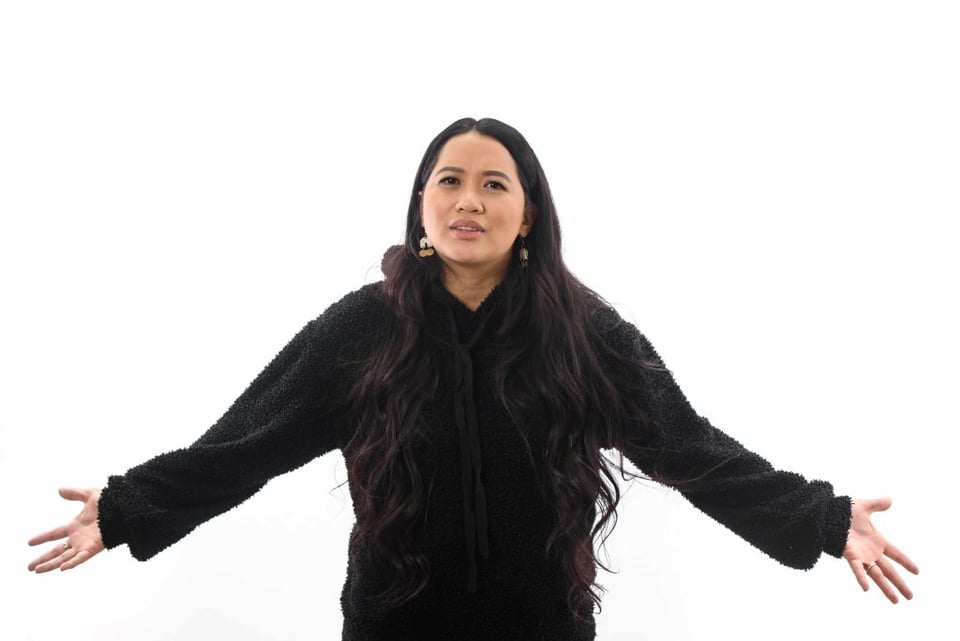
10. Claim Your Territory
Did you know the average stance for women is less than 6 inches between their feet, but 6 to 10 inches for men5? Widening your stance can help you appear more powerful and give the message that you cannot be pushed around. This “claiming of territory” is a subconscious cue to men that you are feeling confident.
When women are nervous, they tend to take up as little space as possible—crossing their legs and tucking their arms into the chair or folding them over their chest—but this looks weak. If you are nervous or anxious, and your ankles are crossed, uncross your feet, put them on the ground, and squeeze your toes to release the pent-up anxiety (nobody will know but you)5.
Pro Tip: Don’t stare at your phone. Introverts tend to check their phone when they are nervous, but this puts you right into defeated body language. So try to avoid checking your phone when you want to feel confident; and again, try to relax and take up a comfortable amount of space. I know someone who carries a newspaper around with him because that is an easier way to take up space.
Just look at a before and after of one presenter who went from closed to open body language. See the huge difference it makes!

11. Speak Loud and Low
Science shows that people who speak louder are perceived as more dominant6. I see time and time again women who speak as if they’re asking for permission. Since women with lower voices are also perceived as more dominant6, it’s a good idea to speak louder and lower for maximum confidence.
Former United Kingdom Prime Minister Margaret Thatcher underwent an astonishing vocal transformation. Before, her voice was very soft, and after some years, her voice radically shifted to a deep and authoritative voice. This helped her in her political career to gain competence with the men:
Along with a deeper and louder voice, try these vocal tune-ups:
- Keep your voice fluent. Try not to hesitate when you can avoid it.
- Reduce the length of pauses when taking turns to speak.
- Use more vocal pitch variation.
- Try speaking slightly faster than normal.
Remember, your goal is to sound natural and relaxed while making these small tweaks. So, if you start sounding like an obnoxious monkey, it’s probably better to use your normal voice. Want more in-depth tips? Check out my guide on how to sound confident: How to Speak with Confidence and Sound Better
12. Carry One Item
Studies have shown that people who carry more than one item—like a purse and a briefcase or a briefcase and a coat—are perceived to be less organized and more forgetful. Lower-status people also carry bulky briefcases, signaling they have lots of work to do.
Higher up, slimmer briefcases display that only vital papers are being carried7. So, before going into a meeting or event, be sure to consolidate your bags and briefcases, leave extra things in the car, and give your coat to the receptionist to hang so you do not have to carry it into the room.
13. Control Your Breath
I’ve spoken before about the power of meditation and the calming effect of the breath. Whenever you’re feeling the nerves or anxiety kick in, imagine a string is pulling your head up, but remain grounded. This will cause you to breathe more on the in breath and cause you to feel more positive and confident.

14. Steeple
Steepling is when someone brings their hands up in front of their chest and presses the tips of their fingers together. This is a gesture of confidence and self-assuredness. This can easily be done to inspire self-confidence and the confidence of others before or during a meeting or event.

15. Backstep
In a 2008 study by Radboud University, researchers found that stepping backward may boost your capability to deal with tough mental situations8. I find this is also true for those anxious, tough moments. If only I knew this trick in high school! Take a step backward the next time you’re stressed from a presentation or on stage. This will help you ground yourself and feel confident by not only “mentally” stepping back but also physically.

16. Use Your Good Side
Do you prefer people on your left or right side? This is a little-known psychological trick, but many people might feel confident and amazing when talking to people on one side, while chatting with a person on their other side may make them feel weak and anxious.
For me, I found over the years that I prefer people to be on my left. When they are on my right, I tend to feel awkward and slightly uncharismatic. What about you? Implement the “good side” technique by placing people on your preferred side5.

17. Gesture in the TruthPlane
The TruthPlane is the horizontal area of your belly that extends from your navel. In traditional Chinese medicine and martial arts, a finger width below the belly button is the lower dantien, or red field—a powerhouse for pure energy8. Using hand gestures in this area wins trust and lets the audience know you are genuine. It also has the added effect of making you feel calm, controlled, and collected.
Sometimes when we’re nervous, our hands tend to go closer to our bodies. For women, especially, having large arm movements may not be the “default” way to gesture. But if you’re feeling a little nervous, gesturing in the TruthPlane is a great way to feel grounded and confident.
18. Use the Triple Nod
The triple nod is the nonverbal equivalent of the ellipses or three periods. It is a nonverbal cue for someone to keep talking.
If you are unconfident and aren’t great at making conversations, you want to encourage the person you are speaking with to keep talking. Once they are done speaking and pause, nod three times in quick succession and they will often continue. If not, you can pick up where the conversation left off, but this is a great way of showing engagement and lengthening a discussion.

19. Make Extra Eye Contact
Do you look at others enough during a conversation? Eye contact is a surefire way to show confidence. People with more dominant personalities, people who initiate speech more in groups, and people who attain a higher status in groups are less likely to be the first to break eye contact6. Nervous women don’t make enough eye contact, and this can be a deal breaker that says, “I’m unconfident!” during business meetings.
One effective tip to make eye contact is to notice the eye color of everyone you meet. You don’t have to say it out loud or even remember it, just notice it9.
Another quick tip: After parting ways or making your graceful exit, make a little extra 1-second eye contact. Just enough to say, “I hate to let you go”5. The extra eye contact signals warmth and confidence—and you’ll make a better lasting impression.
20. Anchor
An anchor is an object, experience, or sensation that reignites certain experiences from your past. You can come up with random objects associated with some positive stimuli that you can use to anchor yourself before an important event5. Some anchors you can use are:
- eating a Tic Tac
- wearing your favorite perfume or scented lotion
- playing your favorite song
- looking at a powerful picture
- reciting a positive affirmation
- even squeezing your toes in your shoes
Even Wall Street tycoon Jordan Belfort uses essential oils10 as an anchor to prime himself in selling mode. Whatever anchor you choose, be sure to use it only when you really need to be ultraconfident.
3 Confident Female Poses to Use Before a Big Moment
Some of my readers have asked me, “Vanessa, how are you so confident?” Besides the years of public speaking I’ve done, I’ve also got some secret sauce: I take up an open, grounded stance right before my big moments. (And preferably in private!)
Here are my 3 favorite open, confident poses to use before a speaking event, a special date, or giving a presentation.
21. Victory Pose
The definition of a victory pose is when a person raises their arms in the air. You’ll see this pose in football (or soccer) players when they score a goal.
They may also jump in the air or make a downward beat with a raised right fist. This is to “mimic” and symbolically demonstrate beating down on the heads of the opposing team7. Or you might see someone dancing with the victory pose:
Do the victory pose to feel like you’re basking in your glorious win. Think of all the times in your life you’ve really felt like a victor—a more recent one is when I finally got my 500k subscriber YouTube award! Woohoo!
The Roman Triumph Long ago, a successful general and his army entered Rome through a triumphal arch, parading through the city streets with the victorious general riding on a 4-horse decorated chariot. The general was dressed in the attire of a god and his face reddened with vermilion to simulate the blood of his sacrificial victims7. The general had the highest possible status display; often requiring the death of at least 5,000 enemies in order to be recognized.
Today, the Roman triumph can be seen in cup winners who carry out a lap of honor at special events or motor racers who sit on top of a car for a special lap of honor.

22. The Catapult
The definition of catapulting is when someone puts their hands behind their head, with their elbows flared out. They may also be leaning back in a chair with their legs splayed forward.
Catapult to feel confident and in control. If you’re the boss or manager, this may even come naturally to you! If you’re around superiors, though, catapulting is probably the last thing that will come naturally to you. That’s because this pose makes you physically big and is generally reserved for high-status individuals only.

23. The Grounded Stance
The grounded stance, a favorite of the alpha female, is when you have your feet wide apart, hands on your hips, and stand straight and tall, like you’re ready to take on the world. I use this one a lot right before going on stage, like on my TED Talk:
Warning: Be careful of overusing this one. Leaning on it too heavily can overemphasize your authority and cause negative effects, similar to oversteepling. Using it at the wrong moment can instantly kill rapport. For example, if a sad, grieving employee confesses a mistake she made, but the manager instantly plants herself in this wide, towering stance, this hands the manager too much dominance, making her seem like a bully since she already has the upper hand.
How to Dominate in Any Interaction
There are times you want to be the biggest, baddest woman in the room. Whether you’re trying to show who’s boss, trying to play “bad cop” in a negotiation, or even a mother trying to settle down her aggressive child, here’s how to dominate any interaction6.
- Put a barrier between you and the others, such as a desk.
- Position yourself physically higher. If you have prep time, make sure your seat is higher than theirs.
- Sit in a relaxed posture, and press with your hands behind your head (catapulting).
- Take up space. Place your objects scattered on your desk, splay your legs out, and invade others’ space.
- Avoid oversmiling. Keep your face neutral for the most part, and avoid nodding in agreement.
- Press your palms firmly down on the table in front of you for added effect.
- Do not use speedy or jerky movements. Keep it smooth. Keep your thumbs sticking out if your hands are in your pockets.
- Shake hands so your hand is on top during a handshake.
I don’t advise dominating unless you absolutely have to. It’s neither a good way to win friends nor impress others. However, once in a blue moon, you might find yourself in a scenario where you have no other choice.
3 Confident Cues Most Guides Overlook
Beyond the 23 core cues above, here are three underrated moves that can quietly amplify your presence:
The Firm Handshake
A firm (not crushing) handshake is one of the most underrated confidence signals. Research from the University of Iowa found that handshake quality was a stronger predictor of hiring recommendations than physical appearance or dress11. The key elements: dry palm, full palm-to-palm contact, two to three pumps, and moderate grip strength. Women who match the firmness of their counterpart are rated as more confident and competent in first impressions.
The Slow Smile
Try the slow smile: let it build over one to two seconds when you first see someone, rather than flashing an instant grin. Research on “felt” versus “unfelt” smiles shows that slower-onset smiles are perceived as more authentic and more flattering to the recipient12. It shows that your warmth is a genuine response to them. This small timing shift can make a big difference in how trustworthy and confident you appear.
The Level Chin
Many people unconsciously tilt their chin down when nervous (a protective instinct shielding the throat) or tilt it up when trying to project authority (which can look like arrogance). The sweet spot is a level chin, parallel to the floor. It projects calm self-assurance without reading as either submission or dominance. Pair it with relaxed shoulders and steady eye contact for maximum effect.
Bonus 24: The #1 Most Confident Cue
Here’s an ultimate bonus for you. How do you look really confident? Do you stand in a wide, grounded stance or steeple like Kevin O’Leary?
It turns out the #1 thing you can do to look and feel confident is…
The full frontal.
The full frontal pose is when your neck, belly, and privates are not being blocked5. Your hands are at the side of your body or behind your back, and you have an open, relaxed posture.
The full frontal gesture is used by the most confident person in the room, who does not have to overemphasize their gestures. Women who can feel relaxed are likely the most confident. The full frontal gesture can even indicate a shy person who mastered their own body language.
Overall, you want to make sure that your body language is aligned with your words. If you are telling people you are confident, show confidence. Body language can give you a nonverbal edge in your interactions, so be sure to check out the rest of our articles in our Body Language Guide.
FAQ
Does an open posture actually make you look more confident?
Yes. People take an upright, open posture as a sign of confidence and engagement before you say a word. It won’t change your body chemistry, and it doesn’t need to. Stand and sit as though you belong in the room, and observers are far more likely to treat you that way.
How long does it take for confident body language to feel natural?
Most people report that deliberate body language adjustments start feeling automatic within two to four weeks of consistent practice. Start by picking one or two cues from this list, like maintaining eye contact or standing with a wider stance, and practice them daily. Over time, your brain forms new motor habits and the behavior becomes second nature.
Can confident body language backfire for women?
Yes, research on the gender double bind shows that women displaying assertive cues can sometimes be perceived as less warm or likable1. The key is nonverbal agility, blending authority cues with warmth cues. For example, pair a firm handshake with a genuine smile, or balance a wide stance with open palms. Context matters: in a negotiation, lean toward authority cues; in a team meeting, blend in more warmth.
What’s the single fastest confidence hack?
The full frontal pose (Bonus #24 above). Standing with an open torso is the quickest way to both look and feel confident: nothing blocking your neck, chest, or midsection, and hands at your sides or behind your back. It requires no special setup and works in any setting.
Does voice pitch really matter for women’s perceived confidence?
Yes. Studies show that speakers with lower-pitched voices are perceived as more authoritative, competent, and dominant6. Former UK Prime Minister Margaret Thatcher famously trained her voice to be deeper and slower, which contributed to her commanding presence. You don’t need to alter your voice dramatically. Even a slight downward shift, combined with speaking at a moderate pace and full volume, can make a noticeable difference.
Side Note: As much as possible we tried to use academic research or expert opinion for this master body language guide. Occasionally, when we could not find research we include anecdotes that are helpful. As more research comes out on nonverbal behavior we will be sure to add it!


