People ask me all the time: “What’s the one book I should read to get better at talking to people?” And my honest answer is always: it depends on where you’re stuck. The book that’ll help someone who dreads networking events is completely different from the one a manager needs for giving tough feedback.
I’ve read every major book on conversation, communication and connection, some of them multiple times. Two of them are mine! And I’ve spent the last two decades studying the science behind what actually makes conversations work. So this is my honest guide to the 11 best books available right now, including where each one shines and where other authors do it better than I do.
What sent me down this rabbit hole in the first place was noticing who comes across best in conversation: the people who ask the better question, and then actually listen to the answer. And most of us have that backwards. We think we need to be impressive.
That single finding captures what every book on this list teaches in its own way… conversation is a skill any of us can learn. And the right book can teach you that skill faster than years of trial and error!

What Are Conversation Skills?
Conversation skills are the learnable techniques that help you connect with anyone, from strangers at a networking event to colleagues in a tense meeting. These skills include asking better questions, reading nonverbal cues and matching the emotional tone of a discussion. The right book can accelerate our progress dramatically!
The keyword there is learnable, and it applies to all of us! Research from the University of Chicago across twelve experiments with over 1,800 participants found that people consistently overestimate how awkward deep conversations will be, and underestimate how much they’ll enjoy them. We stay stuck in shallow small talk because we never give ourselves the chance to discover that going deeper actually feels great!
So which book gets us there fastest? That depends on your specific challenge.
How I Evaluated These Books
I have two books on this list, so let me be upfront: I genuinely learned something from every single book here. This is an honest comparison based on four criteria I care about as both a reader and a researcher:
I have two books on this list, so let me be upfront: I genuinely learned something from every single book here.
- Science-backed rigor. Is the advice grounded in peer-reviewed research, or is it opinion dressed up as fact?
- Actionability. Can you use this today? Does the book give you specific scripts, steps, and techniques, or just theory?
- Recency. Communication has changed. Does the book address modern challenges like remote work, digital communication, and phone addiction?
- Audience fit. Who is this book really for? A book that’s perfect for introverts might not help a manager dealing with workplace conflict.
Here’s how the books compare across these criteria:
| Book | Author | Year | Science-Backed | Actionable | Best For | Key Strength |
|---|---|---|---|---|---|---|
| Supercommunicators | Charles Duhigg | 2024 | ★★★★★ | ★★★★☆ | Understanding why conversations fail | The “three conversation types” model |
| Talk | Alison Wood Brooks | 2025 | ★★★★★ | ★★★☆☆ | Science-minded readers | Most research-dense; Harvard-backed |
| Crucial Conversations | Patterson et al. | 2021 (3rd ed.) | ★★★★☆ | ★★★★★ | High-stakes workplace talks | Best for conflict and tough feedback |
| Conversation | Vanessa Van Edwards | 2026 | ★★★★★ | ★★★★★ | A complete conversation system | Most current + practical blueprint |
| The Next Conversation | Jefferson Fisher | 2025 | ★★★☆☆ | ★★★★★ | Anyone who dreads arguments | De-escalating conflict with scripts |
| How to Win Friends… | Dale Carnegie | 1936 | ★★☆☆☆ | ★★★★☆ | Beginners; timeless principles | 30M+ copies; foundational classic |
| We Need to Talk | Celeste Headlee | 2017 | ★★★☆☆ | ★★★☆☆ | Digital-age conversationalists | 35M+ TED talk view credibility |
| The Fine Art of Small Talk | Debra Fine | 2005 | ★★☆☆☆ | ★★★★★ | Introverts; networking dreaders | Scripts for the full conversation lifecycle |
| Just Listen | Mark Goulston | 2009 | ★★★★☆ | ★★★★☆ | Managers; negotiators; sales pros | Getting through to resistant people |
| Captivate | Vanessa Van Edwards | 2017 | ★★★★☆ | ★★★★★ | “Recovering awkward people” | First impressions + personality decoding |
| Talk Like TED | Carmine Gallo | 2014 | ★★★★☆ | ★★★★☆ | Presenters and public speakers | Data from 500+ TED Talk analysis |
Now let’s dig into each one!
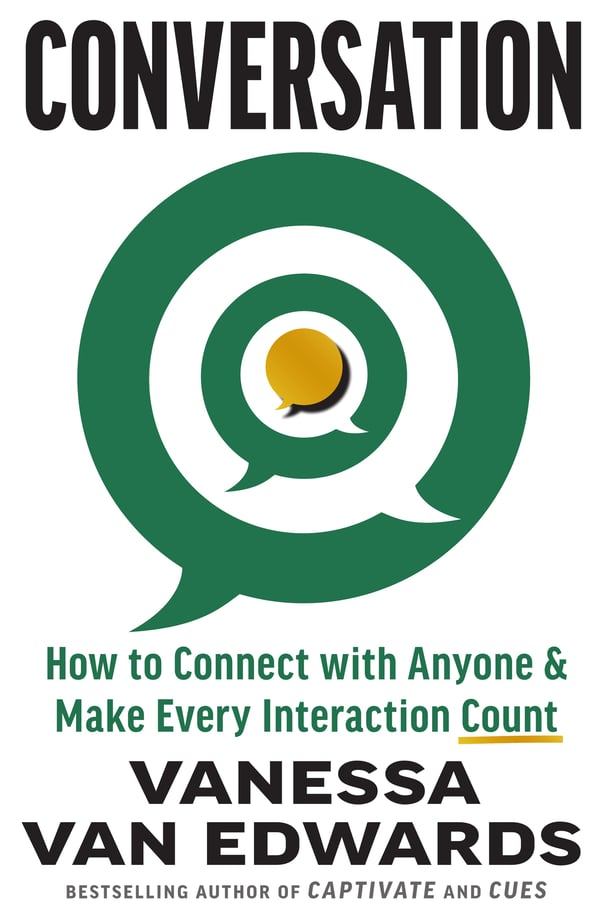
A new book by Vanessa Van Edwards
Every conversation is an opportunity.
If conversations have gotten harder, more awkward or less satisfying, you’re not imagining it. We’re simply out of practice. It’s time to find the joy in talking to each other again.
1. Supercommunicators by Charles Duhigg (2024)
Best for: Anyone who wants to understand why conversations go wrong, and how to fix them in real time.
Charles Duhigg, the Pulitzer Prize-winning journalist behind The Power of Habit, spent years studying what makes certain people magnetic communicators. His answer is disarmingly simple… every conversation is one of three types, and miscommunication happens when two of us are in different modes.
| Conversation Type | The Question It Answers | Focus |
|---|---|---|
| Practical | “What’s this really about?” | Facts, logic, problem-solving |
| Emotional | “How do we feel?” | Vulnerability, validation, being heard |
| Social | “Who are we?” | Identity, belonging, how we relate |
The framework clicks the moment we recognize the pattern! Someone comes home after a draining day and starts venting; their partner immediately jumps into fix-it mode: “Well, have you tried talking to your manager about it?” They wanted someone to say, “That sounds awful.” Two people, two different conversations: one Emotional, one Practical. Duhigg’s Matching Principle gives you the language to name what is going wrong.
The book’s “Looping for Understanding” technique is one I now use constantly: Ask a question → Repeat back what you heard → Ask if you got it right. It sounds basic… In practice, it changes the whole temperature of a hard conversation!
Key takeaway: Before you can change someone’s mind, you have to join them in the conversation they’re actually having.
Strengths: Intuitive model you can apply immediately. Compelling storytelling, from CIA recruitment to the Big Bang Theory writers’ room. Modern and research-backed.
Weaknesses: Readers already well-versed in emotional intelligence may find the insights more foundational than groundbreaking. Less tactical than negotiation-focused books.
2. Talk by Alison Wood Brooks (2025)
Best for: Science-minded readers who want the most rigorous, research-backed understanding of how conversations actually work.
If Supercommunicators gives you the “what,” Alison Wood Brooks’ Talk gives you the “why”, drawn from her decade of research at Harvard Business School on how conversations actually work.
Her TALK framework breaks conversation into four learnable pillars:
- T (Topics): Even 30 seconds of planning what to discuss before a conversation dramatically reduces anxiety and improves outcomes.
- A (Asking): Follow-up questions are the book’s single strongest rapport-builder, because they are the one move that proves you were listening.
- L (Levity): “Find the fun.” Even a joke that falls flat shows confidence.
- K (Kindness): Great listening is expressed through active verbal responses. Brooks calls this a “stewardship mindset.”
One of her most powerful concepts is the Liking Gap: the research behind it found that people almost always like us more than we think they do after a conversation. That inner critic telling us we were awkward? It’s almost certainly wrong.
Key takeaway: Conversation is a coordination game, and most of us are playing it blind. The TALK framework gives you a map.
Strengths: The most research-dense book on this list. Publishers Weekly called it “lucid and pragmatic.”
Weaknesses: The academic sections can feel dense for readers wanting a quick self-help fix. Fewer specific scripts compared to more tactical books on this list.
3. Crucial Conversations by Patterson, Grenny, McMillan, Switzler (3rd Edition, 2021)
Best for: Professionals, managers, and anyone who needs to handle high-stakes, emotionally charged discussions where opinions differ.
With over 5 million copies sold and translations in twenty-eight languages, Crucial Conversations is the gold standard for the conversations you dread most.
The core concept is the Pool of Shared Meaning… the idea that we make better decisions when everyone feels safe enough to share their perspective. When people go silent or become aggressive, it’s because they don’t feel safe. Your job is to restore that safety.
The book’s STATE Your Path framework gives you a step-by-step script:
- Share your facts: lead with observable data
- Tell your story: explain what you’re starting to conclude
- Ask for others’ paths: invite their perspective
- Talk tentatively: present your conclusions as a story you’re still testing
- Encourage testing: make it safe to disagree with you
Say you need to tell a direct report that their work quality has dropped. It’s common to either avoid the conversation entirely or deliver it so bluntly the person shuts down. The STATE framework gives you a third option: “I’ve noticed the last three reports had errors that weren’t there before [facts]. I’m wondering if something has changed on your end [story]. What’s your take? [ask].” It’s direct without being destructive.
Key takeaway: Create safety first. When we feel safe, we tell each other the truth, and truth leads to better decisions.
Strengths: Highly practical with specific scripts and mnemonic devices. The third edition addresses remote work and digital communication.
Weaknesses: Can feel formulaic if you follow scripts without genuine empathy. Less effective with truly hostile individuals.

4. Conversation by Vanessa Van Edwards (2026)
Best for: Anyone who wants a practical, science-backed system for everyday conversations, from networking events to dinner parties to difficult workplace discussions.
When I wrote Captivate in 2017, I focused on first impressions, the first five minutes of meeting someone. When I wrote Cues in 2022, I focused on the nonverbal signals that build (or break) trust. But readers kept asking me the same question: “Okay, I’ve made a good first impression. Now what do I actually say?”
Readers kept asking me the same question: I’ve made a good first impression. Now what do I actually say? That question became this book!
That question became Conversation.
The book is built around the Conversation Blueprint: a three-level framework for moving any relationship from casual acquaintance to lifelong ally:
- Level 1: Put People at Ease. Break the “How are you? / Fine, thanks” autopilot loop using conversational sparks. Example: swap “How was your weekend?” for “What was the highlight of your weekend?”
- Level 2: Connect Deeply. Move from facts to feelings. Uncover someone’s goals, worries, and values. This is where trust gets built.
- Level 3: Create Meaning. Discover someone’s self-narrative using Power Questions. This is where acquaintances become real friends.
The book also covers the First Ten Seconds, 9 Power Questions (three for each level of the Blueprint), and Authentic Assertiveness, a formula for saying the hard thing without damaging the relationship.
I’m biased, obviously! But I wrote this book because I saw a gap: most conversation books focus on either the science or the scripts. I wanted to build something that does both!
Key takeaway: Conversation has a blueprint. Once you know which level you’re on, you know what to say next.
Strengths: Most current research (2026). Combines body language insights from Captivate and Cues with verbal strategies. Highly practical with specific questions and scripts.
Weaknesses: Readers familiar with Captivate and Cues may find some overlap in foundational concepts.
5. The Next Conversation by Jefferson Fisher (2025)
Best for: Anyone who struggles with difficult conversations, arguments, or standing their ground without escalating conflict.
Jefferson Fisher is a fifth-generation trial lawyer from Texas who started posting short communication tips from the front seat of his pickup truck in 2022. Within two years, he had millions of social media followers and a New York Times bestseller. The reason? His advice is absurdly practical!
His core framework, the Three Cs:
- Control: Regulate your emotional “ignition phase.” Fisher’s signature move is the Intentional Pause, even a two-second pause before responding breaks autopilot and gives you back control.
- Confidence: Remove filler words and stop over-apologizing. His “Apology Tax” technique: swap “I’m so sorry, but I can’t make it” for “I appreciate the invite, but I won’t be able to make it.”
- Connection: The goal of any conversation is to make sure a next conversation is possible.
He also teaches a powerful reframe for handling defensiveness: when someone attacks, respond with an open-ended question. “I’m curious, what makes you say that?” turns a confrontation into a conversation.
Key takeaway: The person who controls the conversation is the one who stays calm the longest.
Strengths: Extremely current (2025). New York Times bestseller. Won an Audie Award for the audiobook. Highly actionable with specific scripts.
Weaknesses: Fisher is a lawyer, so expect less academic rigor than some competitors. Focused primarily on conflict, so less useful for general social skills.
6. How to Win Friends and Influence People by Dale Carnegie (1936)
Best for: Absolute beginners and anyone who wants a foundational philosophy of human connection.
Nearly ninety years after publication, this book has sold over 30 million copies and the Library of Congress ranked it the seventh most influential book in American history. The core insight is timeless:
“The deepest urge in human nature is the desire to feel important.”
Carnegie’s principles are deceptively simple… become genuinely interested in other people. Smile. Remember that a person’s name is the sweetest sound to them. Be a good listener! The only way to get the best of an argument is to avoid it.
Key takeaway: Make others feel important, and mean it, and everything else follows.
Strengths: The undisputed classic. Simple, immediately actionable advice. Timeless human psychology!
Weaknesses: 1930s anecdotes feel distant. No science citations. Doesn’t address digital communication.
Pro Tip Pair Carnegie with a modern, science-backed book like Supercommunicators or Talk. Timeless principles + current research is a powerful combination.
7. We Need to Talk by Celeste Headlee (2017)
Best for: Anyone who feels conversations have become shallow, distracted, or polarized, especially in the age of smartphones.
Celeste Headlee’s TED talk “10 Ways to Have a Better Conversation” has over 35 million views. This book is the expanded version, and her most powerful concept is conversational narcissism.
Your friend tells you they just got back from a trip to Italy. You have two options:
- Shift response (narcissistic): “Oh, I went to Italy last year! Let me tell you about this restaurant…” You’ve redirected the conversation to yourself.
- Support response (generous): “That’s amazing! What was the highlight?” You’ve kept the spotlight on them.
Her other standout principle is that “I don’t know” is a power move. Admitting ignorance builds trust faster than pretending to have all the answers.
Key takeaway: Be present or be gone. Half-presence is worse than absence.
Strengths: Addresses modern challenges like phone addiction and political polarization.
Weaknesses: Much of the advice mirrors her TED talk. More philosophical than tactical.

8. The Fine Art of Small Talk by Debra Fine (2005)
Best for: Introverts, engineers, and anyone who dreads networking events or elevator small talk.
Debra Fine was a painfully shy engineer before she transformed herself into a communications expert. She writes as someone who reverse-engineered charisma because she desperately needed it.
Her most useful concept is the Host vs. Guest Mindset. At any social event, you can either be a “guest” (waiting to be approached) or a “host” (taking responsibility for making others comfortable). Choosing the host mindset changes everything. Suddenly you have a job at the party, and having a job eliminates most of the anxiety.
The book also provides the FORM Method: Family, Occupation, Recreation, Miscellaneous.
Key takeaway: Small talk is the bridge to deeper conversation, business opportunities, and meaningful relationships. And it has a formula.
Strengths: Filled with actual scripts and specific phrases you can use tonight. Covers the full conversation lifecycle… how to approach, sustain and exit gracefully.
Weaknesses: Some scripts feel mechanical if followed too rigidly. The 2005 examples don’t address modern digital contexts.
9. Just Listen by Mark Goulston (2009)
Best for: Managers, sales professionals, negotiators, and anyone dealing with resistant or defensive people.
Mark Goulston is a psychiatrist who trained FBI hostage negotiators, and his core argument is that persuasion starts with what you get the other person to tell you.
His Persuasion Cycle maps the journey every resistant person takes: Resisting → Listening → Considering → Willing to do → Doing → Glad they did. The most powerful tool for moving someone through each stage is making them feel “felt.”
Goulston’s Magic Paradox technique is to state someone’s position more clearly than they have, and they’ll paradoxically open up. His Impossibility Question (“What would be impossible to do, but if you could, would dramatically increase your success?”) bypasses defensive filters entirely.
Persuasion starts with what you get the other person to tell you.
Key takeaway: Before you can influence anyone, you have to make them feel deeply understood, what Goulston calls feeling “felt.”
Strengths: Rooted in clinical psychology and high-stakes negotiation experience. Specific scripts throughout.
Weaknesses: Some techniques feel more suited to professional settings than casual conversation. Published in 2009, so some examples feel dated.
10. Captivate by Vanessa Van Edwards (2017)
Best for: “Recovering awkward people” and anyone who wants a science-backed social game plan for parties, meetings, and dates.
This was my first book, and I wrote it from a place of genuine desperation. I was the person who would show up to a party, beeline for the snack table, and spend the entire evening pretending to be very interested in the cheese plate. (The cheese was good. The social anxiety was not.)
Captivate is organized around three time horizons of any new relationship:
- The First Five Minutes: Visible hands build trust. The “Launch Stance” triggers a positive first impression. Use dopamine-triggering conversation starters to replace “So, what do you do?”
- The First Five Hours: Decode personality using the Big Five (OCEAN) model. Learn to be a “Highlighter”, someone who brings out the best in others.
- The First Five Days: Identify someone’s Primary Value. Use the Franklin Effect and strategic vulnerability to deepen trust.
The book’s core equation: Warmth + Competence = Charisma.
Key takeaway: Charisma is a balance of warmth (“I see you”) and competence (“I can help you”) that anyone can learn.
Strengths: Highly actionable with immediate “hacks” and step-by-step instructions. Written from a relatable “recovering awkward person” perspective.
Weaknesses: Focuses more on first impressions than sustaining deep conversations (which is exactly why I wrote Conversation). Published 2017, so some digital examples are now dated.
11. Talk Like TED by Carmine Gallo (2014)
Best for: Presenters, public speakers, and anyone who needs to communicate ideas persuasively to groups.
This is the outlier on the list… It’s focused on public speaking, yet the skills transfer to one-on-one conversation more than you’d expect! Gallo analyzed over 500 TED Talks and identified nine secrets:
- Emotional: Unleash your passion, master storytelling, have a conversation with the audience
- Novel: Teach something new, deliver jaw-dropping moments, use humor
- Memorable: Stick to 18 minutes, paint mental pictures, be authentic
The storytelling principles apply to any conversation where you need to make an idea stick.
Key takeaway: The best communicators tell stories, create surprise, and make you feel something.
Strengths: Data-driven, based on analysis of 500+ TED Talks. Specific examples from famous talks make the advice concrete.
Weaknesses: Focused on presentations more than one-on-one conversation. The “TED style” may not translate to all settings.

How to Choose the Right Book for You
Eleven books is a lot! Here’s how to pick the right one:
If you dread small talk and networking events → Start with The Fine Art of Small Talk by Debra Fine. Pair it with Captivate for body language and first-impression strategies.
If you need to have a tough conversation at work → Crucial Conversations is the gold standard. If it’s more of an argument, add The Next Conversation by Jefferson Fisher.
If you want the most science-backed approach → Talk by Alison Wood Brooks, paired with Supercommunicators by Duhigg.
If you want a complete system from first impression to deep connection → That’s what I built Conversation (2026) to be. If you want to start before October, begin with Captivate for first impressions and Cues for nonverbal signals.
If you’re an introvert → The Fine Art of Small Talk treats conversation as a technical skill. We Need to Talk emphasizes listening, a natural introvert superpower. Supercommunicators helps you read the room strategically.
If you deal with resistant or defensive people → Just Listen by Mark Goulston.
If you give presentations or speeches → Talk Like TED by Carmine Gallo.
The best conversation book is the one that addresses your specific stuck point.
Remember: the University of Chicago research found that people consistently overestimate how awkward deep conversations will be. The biggest barrier for most of us is simply starting…
Frequently Asked Questions
What is the best book for conversation skills?
There’s no single “best”. It depends on where we’re each stuck. For a complete, science-backed system, Conversation by Vanessa Van Edwards (2026) and Supercommunicators by Charles Duhigg (2024) offer the most current frameworks. For timeless principles, How to Win Friends and Influence People by Dale Carnegie has sold over 30 million copies for a reason. For high-stakes workplace conversations, Crucial Conversations (3rd edition, 2021) remains the gold standard.
What books help with social anxiety in conversations?
Start with books that address the mechanics of conversation. The Fine Art of Small Talk by Debra Fine was written by a former engineer who struggled with the same challenges. Captivate by Vanessa Van Edwards takes a “recovering awkward person” approach with actionable steps. Research from the University of Chicago shows that people consistently overestimate how awkward deep conversations will be, so the best book is one that gives you enough confidence to simply start talking.
What are the best communication books for introverts?
Introverts do best with strategies that work with the strengths they already have. The Fine Art of Small Talk treats conversation as a technical skill with specific formulas. Captivate helps you identify your “Thrive Locations” so you can pick settings that suit you. We Need to Talk by Celeste Headlee emphasizes listening, a natural introvert strength. Supercommunicators provides a “matching” framework for reading the room strategically.
Can you really learn conversation skills from a book?
Yes. Conversation is made of specific, learnable techniques. The key is choosing a book that gives you actionable moves and then practicing them in real conversations.
What is the difference between *Captivate* and *Conversation* by Vanessa Van Edwards?
Captivate (2017) focuses on first impressions: the first five minutes of meeting someone, reading personality, and building initial rapport. Conversation (2026) picks up where Captivate leaves off, focusing on what to actually say to move relationships from surface-level to deeply meaningful. Think of Captivate as the “how to meet people” book and Conversation as the “how to keep people” book.
Best Books on Conversation Skills Takeaway
Conversation is a skill, and like any skill, the right teacher accelerates everything:
- Identify your specific stuck point. Match your challenge to the right book using the comparison table above.
- Start with one book. Pick the one that addresses your most pressing challenge and commit to finishing it this month.
- Practice one technique per week. Pick one, whether that’s Duhigg’s Looping for Understanding, Brooks’ follow-up questions or Fisher’s Intentional Pause, and use it in every conversation for a week.
- Remember the Liking Gap. People almost certainly like you more than you think they do! Your inner critic is not a reliable narrator.
- Go deeper sooner. The University of Chicago research found that deep conversations are far more enjoyable than we predict. The next time you’re stuck in small talk, ask one question that goes beneath the surface.