Do you believe in yourself? You should.
A 2022 review in American Psychologist found1 that people who think well of themselves tend to go on to have better relationships, more success at school and work, and steadier mental and physical health. So this is about shifting how you see yourself, and stepping into a new stage of your life, one that’s actually filled with possibilities.
Want to start there? Watch Vanessa Van Edwards interview Donald Miller, author of Hero on a Mission, on being the hero of your own story.
What Does it Mean to Believe in Yourself?
Believing in yourself is different from confidence. Confidence is a skill: you can learn it, build it, sharpen it with better communication. Believing in yourself goes much deeper than that.
Confidence is the outward expression. The inner state it’s expressing is self-belief. And when you genuinely have it, it changes both how you treat other people and what you expect life to hand you.
Harness the Power of Believing in Yourself
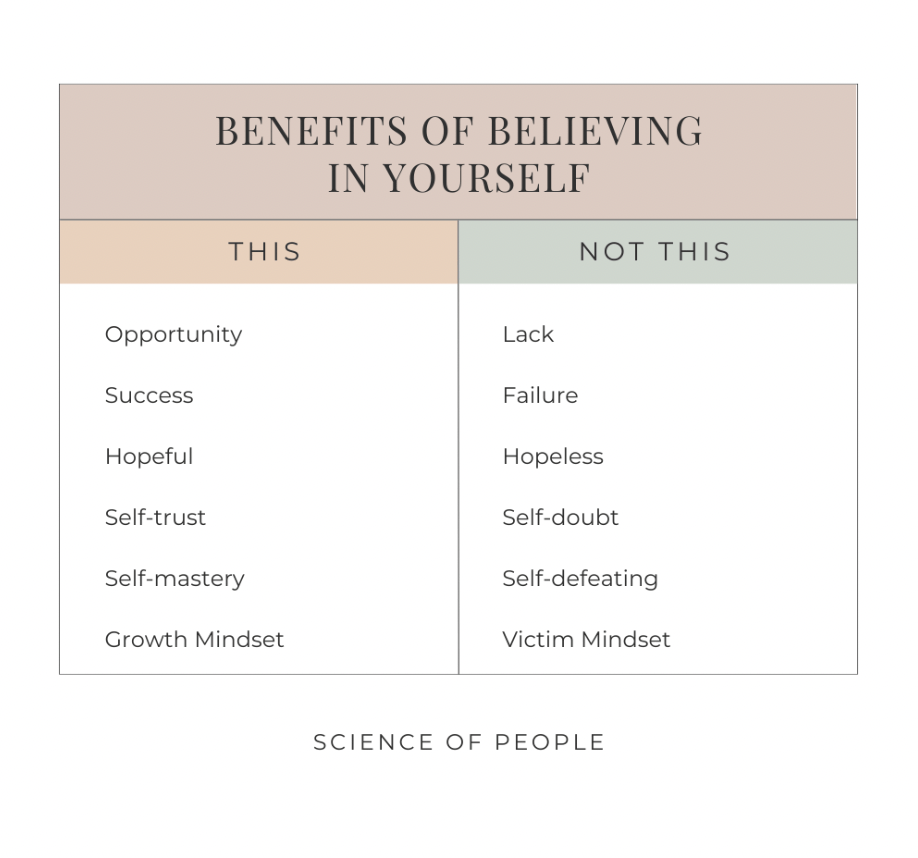
Lack of self-belief is demoralizing. It quietly steals your capacity for close relationships and stands between you and the things you want.
The good news? You can change that, and it starts with shifting how you see yourself.
Special Note We are so honored to help you believe in yourself! If you are struggling to find the help you need, please note that all content found on this website is not to be considered professional medical advice. It is always best to consult a doctor or licensed therapist with any questions or concerns in regards to your physical or mental health. For a good resource for therapists, you can check out Mental Health America’s helpful list.
Take the Lead
You have skills and strengths and a whole list of things people genuinely love about you. And you may have spent years riding in the back seat of your own life, picking up everyone else’s slack, never once asking for the wheel.
It’s time to take the lead.
Being a supporting character can feel safe. Maybe it’s the role your family nudged you into years ago, and now it’s the only role where you receive acceptance and affirmation.
Whatever the reason, and regardless of what anyone else expects from you, are you ready to start believing in yourself?
So how do you take the lead? Start with what you’re passionate about. Big or small, it doesn’t matter. Think of a few of your strengths, or something you simply love to do. Could you share it? Could you teach it?
Ideas:
- Teach a few friends how to make your favorite recipes
- Start a book club with your favorite genre of books
- Post movie reviews on your social media
- Lead with kindness. Do one of our unique kindness activities.
- Teach a free class at your local YMCA
- Volunteer with a group you are passionate about
Action Step: Draw a picture, or just close your eyes and picture it: you, taking the lead in your own story.
- What does that look like?
- Are you doing something surprising?
- Pursuing an unexpected dream?
- Expressing a dormant part of your personality?
Important Note Fair warning, this can feel uncomfortable at first. For you, and for the people around you. So if some of them act annoyed or a little hurt, don’t read that as a signal to shrink back. People are often genuinely surprised when your role shifts.
Think about it. If your coworkers are used to you quietly picking up the slack, or your family expects you to be the one who smooths over every conflict, those are your role identities. Other people’s expectations tend to shape them, and it can take a beat for everyone to adjust. If you want support while you redefine yours, talking to a therapist or coach helps.
Shift to a Growth Mindset
Ever get fired up watching a motivational video, then somehow never apply a word of it to your actual life?
If that’s you, a fixed mindset might be quietly holding you back.
A growth mindset changes everything.
A growth mindset is the belief that intelligence and success aren’t handed to some lucky few, they’re within your reach too. It also rewires how you see failure, treating it as a temporary state and a chance to grow.
And there’s real data behind this. In a survey of 600,000 students from 78 countries, “students with a strong growth mindset scored significantly higher on all subjects…compared with students who believed their intelligence was fixed”.
And YOU have control over your own mind. You decide what goes in, and you can reshape your thoughts over time. As you do, you’ll start to believe in the future, and in yourself, in ways you didn’t think were possible.
Pro Tip On your way to believing in yourself, loosen your grip on the idea of “failure.” A fixed mindset fixates on it.
A growth mindset, on the other hand, treats failures and mistakes as raw material for growth. And look, if it feels like you’ve had one failure after another and never quite measure up, believing in yourself can feel impossible.
But hear this—you are not a failure.
A new book by Vanessa Van Edwards
Every conversation is an opportunity.
If conversations have gotten harder, more awkward or less satisfying, you’re not imagining it. We’re simply out of practice. It’s time to find the joy in talking to each other again.
Action Step (5 Minutes):
Pull up your last mistake, or the last time you felt like a total failure. Now ask yourself:
- Was the whole thing a failure? Or was there one part that wasn’t a success?
- What did I do right in that situation?
- What can I learn from the mistake?
- Was it an actual failure, or did I fail to meet my expectations?
- Were my expectations for this realistic?
- Could I have accomplished more by asking for help?
Action Step (15 Minutes):
Journal your answers to the above questions, and then answer these questions:
- How can I look at this experience as an opportunity instead of something where I feel shame, anger, frustration, or sadness?
- What do I need when I feel like a failure? (e.g., affirmation, reassurance, exoneration, etc.)
Action Step (10 Seconds): Next time the “I’m a failure” feeling hits, say something true out loud instead of marinating in it. One honest limit here: a 2009 study in Psychological Science found that people with low self-esteem felt worse after repeating a positive self-statement2. So start with the lines below you can actually get behind, and leave the rest until they fit.
- I forgive myself for not meeting my expectations.
- I did my best, and I don’t have to criticize myself for not being able to do more.
- I am not a failure.
- Even though I made a mistake, I am not a mistake.
- It’s OK that I made a mistake. This is an opportunity for growth.
- It’s OK that I made a mistake. It doesn’t make me stupid.
- I have accomplished so much!
- I take responsibility for my actions but will not hold on to feelings of worthlessness.
- I am capable and intelligent.
- This moment will pass. It doesn’t define me.
- I didn’t accomplish what I had hoped, but I still accomplished a lot.
Build Confidence for a Healthier Self-Concept
Building confidence gives you a healthy self-concept, and a healthy self-concept is the foundation of believing in yourself.
Vanessa Van Edwards walks through 15 scientific strategies to build confidence. A few of the standouts:
- Strengthen your communication skills. Feeling confident is hard when you don’t know what to do in social situations.
- Practice confident body language. How you communicate is a big part of how others perceive you.
- Learn how to be assertive. Being assertive takes practice, but it will give you the confidence to speak up.
- Overcome imposter syndrome. It seems like most of us struggle with this sometimes! Reject negative self-talk and distorted perceptions.
- Cut down on social media. Social media is a heavily filtered view of life that often leads to making comparisons. If you feel envious or inadequate after scrolling social media, do yourself a favor and spend your time on something more beneficial for your mental health (e.g., journal, listen to a podcast, paint, run, etc.)
- Observe and model someone you admire. Confidence doesn’t require extroversion! Look for someone you admire, and look to them as a model to help grow your confidence.
Pro Tip Don’t try to do all of this at once. When you’re building new skills, pick one or two things at a time so you don’t get overwhelmed and quit by Tuesday. Bookmark or print this article and come back to the action steps as they resonate with you.
Action Steps:
- Practice walking into a room with confidence. Have a destination in mind to reduce hesitation (e.g., your friend, the host, a specific bookshelf, the copy machine, etc.). Keep your head up, and your body relaxed.
- Practice speaking. If you end sentences by trailing off or always sounding like you’re asking a question, practice finishing sentences with a period. When you’re getting ready for work in the morning, start with simple sentences like, “Thank you” and, “No thanks, I brought my lunch.” Then move on to longer sentences like, “According to the data, we are seeing an upward trend.” Think about things you would realistically say at work, and practice saying them confidently.
- Practice asking for what you want. If you find yourself giving in to the requests of others or ordering the same thing your friend ordered, you don’t believe in yourself. Next time you go out to eat, order something you want. If you melt under pressure, check the menu at home so you can make your decision in advance.
- Ask the person you admire to be your mentor. You can learn a lot by observing them from a distance, but imagine what you could learn if you gathered your courage and reached out to them. Good mentors improve your self-worth by calling out the best in you. Everyone should have a mentor, and it’s up to you to ask them to take that role in your life.
Find Out What People Think
One of the biggest things standing between you and self-belief? The nagging sense that nobody else believes in you either. They must be judging you.
You trip over your words in a meeting, and you replay it for hours, certain everyone now thinks you’re an idiot.
Your toddler spills juice down your shirt, and suddenly you’re convinced the whole room sees a slob.
You go out with friends and wonder if they’d even notice if you weren’t there, so you shrink into the background, saying less and less.
See the pattern? You stop believing in yourself because you’ve quietly decided no one else does.
And you probably have reasons. Broken friendships, relationships that went sideways, leftover scars from your school days, they all feel like proof that something’s wrong with you at the core.
You don’t have to keep guessing what other people think of you.
Pro Tip Instead of assuming everyone’s looking down on you, go find out how they actually feel.
Action Steps (Longer Version):
- Write down 3 words that describe how you think others view you.
- Next, write down the 3 words you would use to describe yourself.
- Finally, ask at least 3-5 people to describe you using 3 positive words.
- Journal what surprised you and how it felt seeing what people think about you. You can also look for connections between the words (e.g., maybe 2 of your coworkers described you as kind or compassionate, and a friend described you as thoughtful. Even though these words are all different, they are interconnected. This shows others view you as someone who feels deeply for others.)
- Enlist the help of a close friend or coach. If you aren’t sure how to process what others think about you, ask someone else to help walk you through the more profound message behind all these descriptor words.
Action Steps (Short Version): Ask 3 trusted people to describe you in 3 positive words. Then ask yourself: does that match what you believe about yourself? Maybe it’s time to change your perspective.
The whole point of asking is to swap your misperceptions for the truth. Instead of writing horror stories in your head about what people think of you, you just… ask. And what you hear back is usually far kinder than the version you’ve been telling yourself.
With those words in hand, you can start reshaping how you see yourself and step into your real identity, one that’s actually worth believing in.
Focus on Your 5 People and Ignore Everyone Else
So should you care what everyone thinks of you?
Nope.
Brené Brown recommends keeping a short list of 3 to 5 essential people, the ones you care about who genuinely care about you. Those are the opinions you actually let in. Everyone else? Sure, you can listen, but only up to a point. If their words tear you down, you don’t have to absorb a single one.
Part of believing in yourself is learning to tune out what toxic people think. If certain family members constantly underestimate you, set up boundaries. If a frenemy is forever dismissive, get them out of your life. If coworkers disrespect you, it’s time to get clear and believe in yourself anyway.
None of this is easy. Wanting people to like you, even admire you, is completely normal. But when someone’s holding you back or pushing you down, it takes real self-respect to look at them and decide: they’re wrong about me.
Pro Tip Start noticing your triggers. Is it the uncle who makes cutting remarks because he doesn’t think you’ve done enough? The coworker who somehow always leaves you feeling unqualified? Once you can name the trigger, you can self-regulate instead of instantly questioning your own worth.
Action Steps:
1. Plan ways to self-regulate when you’re triggered. Use positive self-talk as one of your self-regulating tools.
If a coworker criticizes you, say, “Their assessment doesn’t change my worth as a person.”
If a family member cuts you down, say to yourself, “I am valuable. I don’t accept their critical words.”
If a friend undermines you, say to yourself, “I feel hurt, but I choose not to withdraw.”
2. Have a response ready for belittling, demeaning, or dismissive comments.
Some people who take shots at you genuinely enjoy watching you react. Research on online trolling found trait sadism and psychopathy predicted who trolls; self-esteem added nothing on its own, though among people already high in sadism, higher self-esteem went with more trolling. So don’t give them the reaction. Meet the jab with something flat and breezily dismissive instead. Our favorite: “That’s an interesting perspective.” Then change the subject. A few examples:
- “That’s an interesting perspective. This is great weather we’ve been having. Do you have any plans for the weekend?”
- “That’s an interesting perspective. Great shirt you’re wearing. That color really suits you.”
- “That’s an interesting perspective. Hey, I’ve been meaning to ask you….”
Note If someone is regularly verbally abusive, you may need to set a boundary and tell them their words are hurtful and not acceptable.
Other ways to respond to rude people:
- “Thank you for sharing your thoughts on that, but I disagree.”
- “Why do you feel that way?”
- “I appreciate constructive feedback, but that was a harsh assessment. Would you like to rephrase your feedback?”
- “Thank you for sharing your thoughts on that, but I will make my own decision.”
- “This is the life I’ve chosen, and even though it doesn’t look like the life you wanted for me, I’m thrilled.”
- “I know you are concerned about me, and I appreciate your care about my future. I hope you can still be supportive even when you disagree with my choices.”
3. Let go of your need for approval.
If you keep absorbing everyone’s criticism and judgment, you’ll never believe in yourself. So start with this reframe: a lot of criticism says as much about the person delivering it as it does about you. Their mood, their stress, their own standards all color what comes out of their mouth. Some of it will still be worth hearing. The point is that you get to weigh it instead of swallowing it whole.
Ask yourself why you keep chasing other people’s approval, and start trading that self-criticism for self-compassion instead.
When you stop taking criticism to heart, it’s freeing, and it strengthens your ability to believe in yourself. You have full permission to stop listening to the negative voices, both other people’s and your own.
How to Believe In Yourself Again
Sometimes the belief was there, and then life took it.
A layoff arrives out of nowhere. A marriage ends, or an illness rewrites what your body can do. And the person who used to walk into rooms certain of themselves suddenly can’t remember what that felt like.
If that’s you right now, losing your footing doesn’t mean it’s gone for good. Self-belief is rebuildable.
Things that undermine believing in yourself:
- Divorce
- Breakups
- Loss of a job
- Loss of a loved one
- Friendship breakup
- Loss of skill or physical ability
- Loss of health
- An abusive relationship
- Trauma and other adverse experiences
- Bullying (experienced as a child or as an adult)
Hard seasons like these can wear down your confidence. Suddenly you second-guess every decision, doubt that anything good is coming, and feel like a failure at the smallest setback.
You aren’t a failure.
Good things can still happen.
You are absolutely capable of making your own decisions.
But be patient with yourself here. Recovering from these experiences takes time, and you’ll likely need outside support, from people who love you or from a mental health professional.
In the meantime, look for small ways to rebuild your confidence and restore your belief in yourself.
- Go out to eat on your own.
- Say “no” without feeling compelled to explain.
- If health has taken away your strength, learn a new skill that is less physically demanding.
- If losing a relationship caused you to lose friends, volunteer or enroll in a workshop to help you make new friends.
- Order something different when you go out to eat instead of what you routinely order.
- If you lost your job, take the opportunity to explore other career options.
- Create a new routine to replace your disrupted routine.
None of these are dramatic, and that’s why they work. One small act of autonomy at a time is how the belief comes back.
So pick one of them and do it this week. Then keep going with these ideas to build your self-worth.
How To Believe in Yourself FAQ
How to believe in yourself when nobody else does?
Start by questioning whether it’s even true. All-or-nothing thinking has a way of convincing you that absolutely nobody believes in you. So pause and ask: has a friend, coworker, teacher, or family member ever had your back? You may be surprised to find people view you far more favorably than you’ve been giving them credit for.
How to believe in yourself at work?
Focus on your core strengths and take an honest look at what you’ve already accomplished. If you need backup, ask your boss how you can put your skills to better use, and find yourself one encouraging coworker. If someone in the office, a colleague or a manager, keeps making you feel small, set boundaries and limit your time with them. And if the situation just won’t improve? It may be a sign to find a job that actually fits your strengths.
Why is believing in yourself important?
Because it opens your eyes to the potential right in front of you. It lets you actually see possibilities and feel the satisfaction of getting things done. Without it, you tend to get stuck feeling like a failure, never quite measuring up to your own expectations or anyone else’s. And that takes a real toll on your mental health.
What happens when you believe in yourself?
Everything looks different. Dreams start to feel possible, you spend less time feeling like a failure, and more time doing the things that actually make you happy. You feel more confident, and you find yourself genuinely enjoying learning new things.