Does posture affect confidence?
Yes! Posture can literally change your mindset. An Ohio State University study found that your posture works like a Thought Amplifier: it changes how much you trust your own thoughts. And the chest-out, shoulders-pinned-back way most of us try to “stand up straight” is biomechanically wrong.
Let’s fix your posture the right way, starting today.

Why Your Posture Is a “Thought Amplifier”
Researchers Pablo Briñol, Richard Petty, and Benjamin Wagner at Ohio State asked participants to write down three positive or three negative traits about themselves. While writing, half sat upright and half slouched forward. Then everyone rated how they felt about themselves overall.1
The results:
- Positive thoughts + upright posture = participants rated themselves the most positively. They believed their good qualities.
- Negative thoughts + upright posture = participants rated themselves the most negatively. They believed their bad qualities too.
- Slouched posture = it didn’t matter what participants wrote. The slouch made them doubt everything.
Posture changed how much people believed what they were already thinking. Sit tall while thinking “I’m capable and prepared,” and your body helps you trust that thought. Slouch while thinking the same thing, and your brain shrugs it off.
Your posture doesn’t change what you think. It changes how much you believe what you’re already thinking.
Other studies agree. A study by Nair et al. found that people who sat upright during a stressful task reported higher self-esteem and better mood compared to slouchers. And Wilkes et al. found that simply sitting upright reduced fatigue even in people already experiencing low mood.
The #1 Posture Myth: Why “Stand Up Straight” Backfires
One of the first things people do when they want to fix their posture is puff up their chest and yank their shoulders back.
This can make things worse:
- Your lower back over-arches. When you force your chest forward, your body compensates by increasing the curve in your lumbar spine, a condition called lumbar hyperlordosis. This compresses the small joints between your vertebrae.
- Your ribs flare outward. This stretches the abdominal wall and makes it harder for your core muscles to stabilize the spine.
- Your back muscles overwork. The erector spinae muscles must constantly contract to hold this exaggerated position, leading to fatigue and stiffness.
Forcing posture from the chest down ignores the lower body entirely. Instead, what you’ll want to do is focus from the ground up.
Let’s take a deep dive with posture expert Aaron Alexander, a certified Rolfer, licensed massage therapist, and certified personal trainer. His book, The Align Method, teaches a ground-up approach that replaces strain with stability.
Create true, meaningful confidence by starting at the feet.
A new book by Vanessa Van Edwards
Every conversation is an opportunity.
If conversations have gotten harder, more awkward or less satisfying, you’re not imagining it. We’re simply out of practice. It’s time to find the joy in talking to each other again.
The 5-Minute Posture Fix (No Equipment Needed)
Stand up and try this three-phase reset. It takes under 5 minutes.
Phase 1: Feet — Build Your Foundation
Your feet are the base of your entire posture chain. If they’re misaligned, everything above them compensates.
- Find your natural stance. Make a few quick jumps and notice where your feet land naturally. That’s roughly your ideal width, about hip-distance apart, toes pointing forward.
- Distribute your weight across three points: the heel, the base of your big toe, and the base of your pinky toe. Think of a tripod.
- Gently grip the floor with your toes. This activates your arches and creates a stable platform.
Stability test: If your posture is rock-solid, someone should be able to grip your shoulders and push down without toppling you over.
Phase 2: Pelvis — Find Your Neutral
Your pelvis is the bridge between your lower and upper body. If it tilts too far forward (anterior tilt), your lower back over-arches and your belly pushes out. If it tilts too far back (posterior tilt), your lower back rounds and your tailbone tucks under. Both create strain.
- Find anterior tilt. Stand tall and roll your hips forward, sticking your tailbone out. Notice the deep arch in your lower back.
- Find posterior tilt. Now tuck your tailbone under, as if zipping up tight jeans. Notice your lower back flatten and your glutes clench.
- Settle into neutral. Relax to the midpoint between the two. Your hip bones and pubic bone should sit on the same vertical plane. Imagine balancing a bowl of water on top of your pelvis without spilling it.
Cue: Imagine your tailbone heavy, like a string is gently pulling it down toward the floor. Your glutes shouldn’t clench and your belly shouldn’t push forward, the pelvis just rests in the middle.
Phase 3: Spine — Stack and Breathe
With your feet planted and your pelvis neutral, your spine finally has a stable base. Now stack the rest of your body on top, without forcing it.
- Lengthen up. Imagine a string at the crown of your head gently lifting toward the ceiling. Don’t pinch your shoulder blades together; let them rest down and slightly back.
- Lightly tuck your chin. Your ears should sit directly over your shoulders. It’s common to live with your head jutted forward; drawing your chin back an inch puts it back over your spine, where it belongs.
- Take three diaphragmatic breaths. Place a hand on your belly. Inhale through your nose for four counts and feel your belly expand outward (not your chest rising). Exhale slowly for six counts. This tells your nervous system to relax into the new alignment.
Cue: Stand tall while staying relaxed. If you feel like a soldier at attention, you’ve gone too far. Soften your shoulders and let your skeleton hold you up.
5 Exercises to Lock In Good Posture (60 Seconds Each)
The 5-minute reset gets you into alignment. These five exercises keep you there by strengthening the muscles that hold good posture automatically. Each takes 60 seconds. Do all five for a daily routine that research shows is more effective than a single long weekly session.
1. Chin Tucks (Fixes “Tech Neck”)
For every inch your head shifts forward from neutral, the effective weight on your cervical spine increases by roughly 10 pounds. Chin tucks reset your head position.
How to do it:
- Sit or stand tall. Look straight ahead.
- Draw your chin straight back, like you’re making a double chin. Don’t tilt your head up or down.
- Hold for 5 seconds. Release.
- Repeat 10-12 times.
Pro Tip If your neck feels strained, try chin tucks lying on your back with a small towel roll behind your neck.
2. Wall Angels (Opens Your Chest and Upper Back)
This is one of the most effective moves for thoracic mobility, the flexibility in your mid-back that lets you stand upright without strain.
How to do it:
- Stand with your back flat against a wall, feet about 6 inches from the baseboard.
- Press your lower back, upper back, and head against the wall.
- Raise your arms into a “goalpost” position (elbows at 90 degrees).
- Slowly slide your arms up overhead, keeping contact with the wall, then back down.
- Repeat 10-12 times.
3. Scapular Squeezes (Strengthens Your Shoulder Blades)
Weak mid-back muscles let your shoulders roll forward. This exercise targets the rhomboids and middle trapezius, the muscles that pull your shoulder blades together.
How to do it:
- Sit or stand with arms at your sides.
- Squeeze your shoulder blades together and down, as if holding a pencil between them.
- Hold for 5 seconds. Release.
- Repeat 12-15 times.
4. Cat-Cow (Restores Spinal Flexibility)
How to do it:
- Get on all fours, wrists under shoulders, knees under hips.
- Cow: Inhale, drop your belly toward the floor, lift your chest and tailbone.
- Cat: Exhale, round your spine toward the ceiling, tuck your chin and tailbone.
- Flow between the two positions for 60 seconds.
5. Forearm Plank (Builds Core Stability)
Your core muscles are the scaffolding that holds your spine upright against gravity. Without core strength, good posture is exhausting.
How to do it:
- Place your forearms on the floor, elbows directly under your shoulders.
- Extend your legs behind you, balancing on your toes.
- Keep your body in a straight line from head to heels, don’t let your hips sag or pike up.
- Hold for 20-30 seconds (build to 60 seconds over time).
Action Step: Stack these five exercises into a single 5-minute routine. Do it every morning for 2 weeks and notice how much longer you naturally hold good posture throughout the day.
Bonus: The Resistance Band Stretch for Confident Shoulders
If you have a resistance band and want to level up, this stretch from Aaron Alexander targets the tight chest and front-shoulder muscles that pull you into a hunch. Watch the video above for a full demonstration.
How to do it:
- Attach a resistance band to a sturdy hook or door anchor at about chest height.
- Stand facing away from the anchor. Loop the band over your right shoulder so it crosses your chest diagonally.
- Step forward until you feel gentle tension from the band pulling your shoulder back.
- Press your right shoulder blade down and back, away from your ear.
- Slowly reach your right hand behind you and rotate your palm outward. You should feel a deep stretch across your chest and the front of your shoulder.
- Turn your head to the left (away from the band) to add a gentle neck stretch.
- Hold for 20-30 seconds, breathing deeply. Repeat on the other side.


For more on this approach, check out Aaron Alexander’s The Align Method.
How to Fix Your Sitting Posture (The 90-Degree Rule)
Most of us spend hours a day sitting. Even perfect standing posture won’t help if your desk setup fights against you.
Follow the 90-Degree Rule based on OSHA ergonomic guidelines and the Mayo Clinic:
| Body Part | Ideal Position |
|---|---|
| Elbows | 90° to 120°, close to your sides, forearms supported |
| Hips | 90° to 100°, sitting all the way back in the chair |
| Knees | About 90°, same height or slightly lower than hips |
| Ankles | Slightly in front of knees |
| Feet | Flat on the floor (or on a footrest if they don’t reach) |
When you need a footrest: If your feet dangle after adjusting your chair to the right height, get a footrest. Dangling feet press your thighs against the seat edge, restricting blood flow and straining your lower back.

The Dynamic Sitting Principle: Even perfect posture becomes harmful if you hold it too long. Your best posture is your next posture.
- Move every 20-30 minutes, even small shifts count.
- Stand and stretch for 1-2 minutes every hour.
- Use the 20/20/20 rule: Every 20 minutes, look at something 20 feet away for 20 seconds. Your eyes need posture breaks too.
Can You Reverse Years of Bad Posture?
Yes, at almost any age.
Harvard Health states it is “almost never too late” to improve posture. Even older adults with decades of poor habits can make real improvements through targeted exercises.
Here’s a realistic timeline:
| What You’re Fixing | How Long It Takes |
|---|---|
| Initial awareness and reduced tension | About 2 weeks |
| Noticeable muscle strength improvement | 4–8 weeks |
| Visible changes in alignment | 3–6 months |
| Full habit reprogramming (for decade-long issues) | 6–12 months |
Is 30 too late? Not even close. At 30, your muscles respond well to training and you still have near-peak bone density. Starting before age-related muscle loss begins in the mid-30s is ideal.
Will it hurt at first? Probably, and that’s normal. When you start correcting years of slouching, you’re waking up dormant muscles and stretching tissue that has physically shortened over time. Expect about 2-3 weeks of mild muscle soreness, similar to what you’d feel starting any new exercise routine. If you experience sharp pain, numbness, or tingling, see a professional.
Pro Tip Don’t try to hold perfect posture all day from day one. Start with 10-15 minutes of mindful posture per hour and gradually increase. Think of it as training your body over time, the way you’d build any other habit.
Harvard Health says it’s “almost never too late” to improve your posture, even after years of slouching.
The Hidden Health Costs of Bad Posture
It’s Linked to Higher Mortality
A study following 1,353 older adults found that those with hyperkyphosis, a pronounced forward curve of the upper spine, had about a 44% higher rate of mortality over roughly four years, and the association held after accounting for age and other health factors. A later study of 610 older women put a useful limit on that: the raised mortality risk showed up in women who had both a pronounced curve and previous spinal fractures. Curvature on its own did not predict earlier death.2
It Reduces Your Lung Capacity
A pronounced forward curve compresses the ribcage, which restricts how fully you can expand your lungs. The figures you see quoted for exactly how much vary a great deal and mostly come from clinical settings rather than office workers, so treat the direction as the finding and the number as an open question.
It Disrupts Your Vagus Nerve
The vagus nerve, which controls your rest-and-digest response, heart rate variability, and gut function, runs along the front of your neck and down through your torso. When you slouch, you compress the pathways the vagus nerve travels along, which can dampen its signaling.
A 2022 pilot study found that slouching decreased vagal activity and increased sympathetic (fight-or-flight) dominance, while sitting upright did the opposite, raising vagal tone and shifting participants into a calmer, more recovery-oriented state. In plain terms, a full day of slouching keeps your nervous system in low-grade stress mode.
Yoga Poses That Improve Posture
Yoga is one of the most effective long-term approaches to posture improvement because it addresses all three requirements at once: flexibility, strength, and body awareness.
A 2020 review of thirty-four studies found that yoga activates brain areas linked to proprioception, your sense of where your body is in space. This means regular practitioners subconsciously correct their posture throughout the day, well beyond their time on the mat.
Five poses that target the specific muscle groups involved in posture:
- Mountain Pose (Tadasana). Stand with feet together, weight evenly distributed, arms at your sides. Engage your thighs, tuck your tailbone slightly, and lengthen through the crown of your head. This teaches your body what neutral standing alignment feels like.
- Cat-Cow, (Same as the exercise above.) Flow between arching and rounding your spine for 60 seconds.
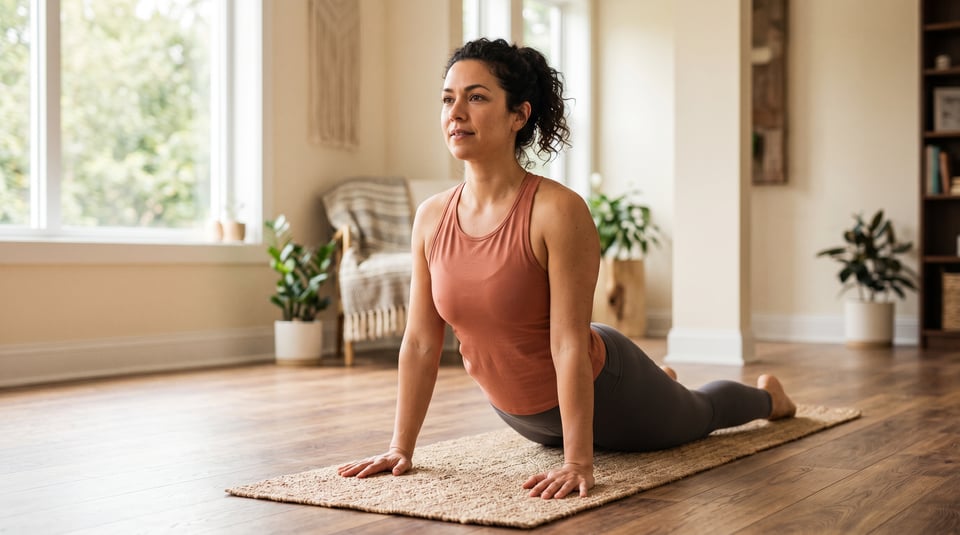
- Cobra Pose. Lie face down, place your hands under your shoulders, and gently press your chest off the floor. This strengthens the back muscles that counteract hunching.
- Bridge Pose. Lie on your back with knees bent, feet flat. Lift your hips by squeezing your glutes. Hold for 5 breaths. This strengthens glutes and opens tight hip flexors.
- Plank Pose. Hold a straight-body position on your hands (or forearms). Build to 60 seconds.
Research recommends practicing once or twice weekly for at least twelve weeks for measurable posture improvement.
Frequently Asked Questions
Can fixing your posture make you taller?
Yes, but you’re reclaiming height your body already has. People with typical desk-job posture often walk around 1 to 2 inches shorter than their body’s actual potential because of slouching and spinal compression. Correcting your posture lets you stand at your full skeletal height.
How quickly can you fix your posture?
You can feel a difference in minutes with the ground-up reset described above. For lasting change, expect about 2 weeks for initial awareness, 4-8 weeks for noticeable strength improvements, and 3-6 months for visible alignment changes. Consistency matters more than intensity.
Is it too late to fix bad posture at 25 or 30?
Not at all. Harvard Health says it’s “almost never too late.” At 25-30, your body is still highly responsive to change, neuroplasticity is strong and bone density is near its peak.
Can bad posture affect the vagus nerve?
Yes. A 2022 pilot study found that slouching decreased vagal activity and increased fight-or-flight dominance. Since the vagus nerve controls your rest-and-digest system, poor posture can contribute to feelings of anxiety and digestive discomfort.
Can fixing posture cause pain?
Mild muscle soreness during the first 2-3 weeks is normal, you’re waking up dormant muscles and stretching shortened tissue. Start gradually (10-15 minutes of mindful posture per hour) and build up. If you experience sharp pain, numbness, or tingling, consult a professional.
What does your posture say about your personality?
A 2024 study found that people with naturally upright posture tend to score higher on traits related to social dominance and confidence, while those with flat or sway-back postures tend to be more introverted.
Can bad posture reduce your lifespan?
In a study of 1,353 older adults, those with hyperkyphosis, a pronounced forward curve of the upper spine, had about a 44% higher mortality rate over roughly four years. That is a spinal condition rather than everyday slouching, and a later study found the risk concentrated in people who also had spinal fractures. Slouching at a desk is worth fixing for comfort and confidence; it is not the same thing.
How to Fix Your Posture Takeaway
Your posture action plan, three things to do today:
- Try the 5-minute ground-up reset right now. Stand up and work through the three phases: feet (find your tripod), pelvis (find neutral), spine (stack and breathe). It takes 90 seconds once you know the sequence.
- Set a phone alarm every 30 minutes. When it goes off, check your posture and do a quick reset. The goal is to catch the slouch before your tissues settle into it.
- Do the 5-exercise routine daily for 2 weeks. Chin tucks, wall angels, scapular squeezes, cat-cow, and a forearm plank. Five minutes total. After 2 weeks, notice how much easier it is to hold good posture without thinking about it.
For a deeper dive into the ground-up approach, check out Aaron Alexander’s The Align Method.
A 5-minute daily posture routine beats a 60-minute session once a week.