In This Article
Do you need to end a friendship? Sometimes we have to break up with friends. See why fake friends can be so damaging and how to protect yourself.
Your fake friends are ruining you. I know it sounds harsh, but if you want to be truly happy you have to:
- Combat frenemies
- End ambivalent relationships
- Stop toxic “friends”
Watch our video below to learn more about fake friends and why they are ruining you:
is a frenemy?**
A frenemy is someone who you are friendly with, despite a fundamental dislike or rivalry. Frenemies might want you to do good on the surface, but behind your back they will gossip about you and may even be jealous of your accomplishments and successes.
How to Spot a Frenemy
Frenemies may be more common than you think. And here’s why: social neuroscientist John Cacioppo explains that humans evolved to prioritize avoiding enemies rather than making friends. Why is this?
Let’s say we make a friend who actually turns out to be our enemy. That could mean death. But if we instead label a potential friend as an enemy, that’s totally okay. We won’t make friends as fast, but at least we won’t die.
So it’s perfectly normal to have frenemies in your life. It’s just our biological system making sure we don’t get backstabbed in the middle of the night. The key point here is to identify your frenemies so you can either become real friends… or get rid of them.
I think there are three types of fake friends. Which kind sounds familiar?
1. The Jealous Frenemy
This is the most common type of frenemy. In fact, jealousy is often the emotion that flips friends into enemies. And it goes both ways…
- A colleague is jealous of a promotion.
- You are jealous of a colleague’s promotion.
- A wingman is jealous of your righteous ability to attract babes.
- You are jealous of your wingman’s righteous ability to attract babes.
- Someone is jealous of your raise / hair / smarts / personality / humor / car / ____.
- You are jealous of someone’s raise / hair / smarts / personality / humor / car / ____.
The Problem: Jealousy is an insidious little beast. It destroys trust, respect, and admiration. I believe that it is almost impossible to have a healthy relationship where there is jealousy brewing.
Bottom Line: Either get over the jealousy, or get over the person.
2. The Undermining Frenemy
When you have an undermining frenemy, you constantly are faced with challenges such as these:
- You landed a new client! Should you tell your friend?
- You lost five pounds! Will your friend enable bad behavior if you go out to lunch?
- You want to invite some new friends over. Should you invite “that” friend?
Undermining frenemies are usually great at passive-aggressive comments, sarcastic tones, and enabling your bad behavior.
The Problem: These kinds of frenemies are the worst! Why? You hope they will be supportive, but they often aren’t.
Bottom Line: Fool me once, shame on you. Fool me twice, shame on me. Don’t keep hoping. Cut this person out.
3. The Unsure Frenemy
Humans hate having unfinished business. We also hate not knowing where we stand with someone.
- I think he is a close friend…but is he close friends with everyone?
- I think she likes me…
- Are we business friends or actual friends?
- He knows me, but I’m not sure if we are just acquaintances or actual contacts.
- Are we LinkedIn-type contacts or Facebook-type contacts?
The Problem: You just aren’t sure. Where do you stand? Do they help or support you? You are constantly on guard and second-guessing them. This kind of ambivalence takes a lot of energy because you are in a constant state of not knowing.
Bottom Line: Have a talk. Sort it out. Put it all out on the table and learn how to develop self-improvement skills.
More steps below…
10 Signs of Fake Friends
A fake friend is slightly different than a frenemy.
What is a fake friend?
A fake friend is someone who makes you fake it — fake liking, fake authenticity, or faking someone you are not, in order to be friends with them. If a fake friend finds out who you truly are, they probably won’t be friends with you anymore.
The biggest difference between a frenemy and a fake friend is that you know there’s bad blood between the two of you… whereas a fake friendship can feel like a real one, but it can be more damaging than good for you.
And fake friends don’t usually appear overnight. You know your friendship is slowly going downwards when you start to see the warning signs.
How you know you have a fake friend?
Fake friends are the people you hang around with that drain your energy. You don’t feel comfortable, genuine, or emotionally secure around fake friends. You also wouldn’t trust your fake friend with the keys to your house.
- Your interests have become more and more different.
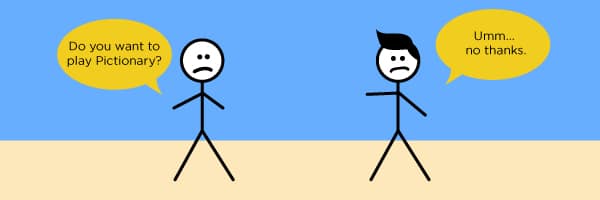
Board game friends? Not anymore—your friend would rather watch the paint dry than play another game of Pictionary. Gym buddies? The most exercise your friend has now is lifting the remote.
- You no longer work together / play on the same sports team / attend the same organization.

What happens when you are no longer obligated to be around your “friends” anymore? “See ya!” If you try to make plans and they ignore you, or even worse… you get the “Sure, maybe next week?” text, maybe it’s a sign to move on.
- Over time, you grew apart.

Real friends stick around to the end. Fake friends will only be there when it’s beneficial to them, and maybe you don’t see eye-to-eye anymore. That’s okay. And that’s another reason to think about exiting.
- You are always walking on eggshells.

Sometimes there are people that make us overthink everything we say. Maybe we don’t want to hurt their feelings. Or maybe we don’t want to look uncool. There are even scientific studies that link uncertainty to stress and even brain damage. If you find yourself always trying to predict your friend’s reaction, you might be in a toxic relationship.
- You are less alike than you originally thought.

Oh, you both work at the same place? And have a cat? And love eating sushi? Wow, you have so much in common! But sometimes the commonalities end there. Unfortunately, sometimes it takes a while to realize how much you aren’t alike.
- You have become different people than when you were younger.

Have you ever heard that science fact that the body replaces itself with new cells every 7 to 10 years? That means we are completely different people than now. And if you think back 7 to 10 years ago, it’s likely we’ve dramatically changed. Oftentimes, being different requires a different standard of friends.
- You have nothing in common anymore.

As a recovering awkward person, I made many awkward friends in my highschool and college years. Some of them got better, but unfortunately, some of them are even more awkward to this day. People change, and so do friends.
- You only hear from them when they ask to use your lawnmower / want to borrow your car / need help with next month’s rent.

Excuses, excuses. How many times have you had a random “friend” ask you for something? Maybe you’ll only hear from them once or twice a year asking for a favor. And if you’ve ever let them borrow something? They simply “forgot” about it. Time to move on.
- “Jokes” are no longer funny anymore.

I’m not talking about a friend who is just a really bad comedian. Sometimes we have friends that are “just kidding,” but in the back of our minds we feel confused: was it supposed to be funny? Is he/she insulting me? Why do I feel bad?
Here’s an easy way to tell if a joke is from a friend or a frenemy: if your friend tells a joke to make you feel happy or cheer you up, that’s great! But if your “friend” tells a joke just for the sake of laughter—regardless of how it makes you feel—you know you’re on the verge of frenemy territory.
- It’s just too emotional.

A relationship with your friend that has really high high’s and really low low’s usually won’t last. And it’s also a sign that it’s a toxic friendship, since those kind of emotions are not sustainable.
Fake friend warning signs can be commonly seen with:
- childhood friends
- colleagues from previous jobs
- college buddies
- exes
- trip or travel acquaintances
- someone who made a really good first impression, but turned out to be less than stellar
- former neighbors
Here’s my big idea:
We absolutely can grow out of friends, just like we grow out of clothes. Sometimes our taste changes, sometimes our size changes.
…And this is not a bad thing.
Can a fake friend become a real friend?
Turning a fake friend into a real one often takes a lot more effort than it’s worth. The longer you spend time with a fake friend, the longer your fake friend boundaries are established, and the harder it becomes to turn a fake friend into a real friend.
Fighting Fake Friends
Did you know that only about half of our friendships are actually mutual? In other words, we are really bad at telling who our real friends are from fake ones.
You deserve to have incredible relationships.
So how can you get rid of the fake friends in your life?
I want to walk you through a step-by-step way to assess your friendships and clear out your relationship clutter.
This is Marie Kondo’s KonMarie Method for relationships.
Are your friendships messy? Every person in your life should #sparkjoy. Here’s how.
Step #1: Know Your True Friends
What is a true friend?
True friends are people who are there for you during life’s up and down moments. They are genuinely happy for you when you succeed, and will be there for you when you ask them for help. Real friends make you feel loved, happy, and supported, unlike fake friends.
Did you know having true friends is one of the biggest keys to happiness? Here’s one mega-study on relationships: Michigan State University conducted a survey of nearly 280,000 people.
Participants of all ages and from nearly 100 countries were asked about their relationships and rated themselves on their health and happiness. Can you guess the result of the study?
There was a direct correlation between participants’ family/friend relationships and their overall health and happiness. And the only relationships that predicted health and happiness at older ages were friendships, not family relationships.
That’s because we can choose to be with enjoyable, happy, and fun friends, unlike our family members who we are born with. But wait! The science doesn’t end there…
In a second study by the same university, friends were found to be influential—if friends offered support, people were happier… but if friends were draining and stressful, people reported more chronic illness.
Here’s the takeaway: when you choose real friends, you have greater happiness and health. And if you have fake friends, it’s best to cut them loose before they put a strain on your life.
These are some signs that you have a genuine friendship, and not a fake one:
- Real friends give us their attention and are present to our needs.
- They support us when we are feeling down.
- True friends are genuine and keep their promises.
- They are there for you even if they can’t get something from you.
- They accept your flaws.
- They actively listen rather than focus on themselves.
- True friends make us want to become better.
Step #2: Identify Your Obligatory Friends
How do fake friends happen? It often starts with the slow decline of a relationship. Does the following story sound familiar to you?
I met Sophie on a writers’ retreat. We bonded immediately—standing in line to get our room keys. I loved her shoes;, she loved my scarf. We both tried to eat vegetarian, but loved bacon. We asked to switch roommates so we could be bunk buddies. She was working on a fiction novel, I was working on the early notes for Captivate. We traded notes, read drafts, and were inseparable for two weeks. When we got home, we decided to have weekly calls to discuss our manuscripts. We promised to visit, but schedules were crazy! Calls were too hard with our busy schedules, so we texted. Texting got hard, so we emailed. She got pregnant and had beautiful twins. She stopped writing. We had less and less to talk about, even in emails. We sometimes sent each other pictures—our babies, our gardens. Texts were slow. After a while, even emailing became tedious. I visited her on my last work trip to her city, and we had almost nothing to talk about. She asked to come visit this summer—I’m dreading it.
This is what happens when a real friend becomes an obligatory friend, and then a fake friend.

What is an obligatory friend?
Obligatory Friend: n Someone you don’t enjoy spending time with, but end up spending time with because you feel guilty. It’s a habit you do not know how to stop.
Over time, obligatory friends end up becoming fake friends. Let me explain how fake friendships happen. It all starts with what I call Spheres of Interest.
Step #3: Identify Your Spheres of Interest
When you first meet someone, you are not sure how many of your interests and their interests overlap. You both have spheres of interest, and you wonder how much overlaps.

Then as you get to know each other, you find more and more commonalities. The areas you have in common are called relevance. The closer your spheres of interest, the more you like someone.

Sometimes ‘interests’ can be points of relevance such as:
- Working at the same company
- Living in the same building
- Going to the same school
- Playing on the same team
- Being a part of the same organization
- Having gone on the same trip
The more commonalities you have, the more relevant someone is to you. In a great relationship, the circles move closer together:

Before a relationship becomes obligatory and then fake, there is usually no movement at all—or your common interests begin to diverge. You never find more common interests. You never get closer. You never fully bond. In fact, with most obligatory friends, your spheres of interest slowly move away from each other…

I call this movement the slow creep.
Step #4: Avoid The Slow Creep
The slow creep is when your spheres of interest slowly creep farther and farther apart.
The problem with fake friends is we often do not realize a friendship is becoming obligatory until it’s already highly unfun to hang out with them—and then it’s hard to break up. You can know someone for years and not realize how much you have changed or that you no longer are enjoying each other’s company.
When your spheres of interest move farther and farther apart, you get closer and closer to becoming ambivalent about the person and your relationship.
And ambivalent relationships are dangerous.
Step #5: Beware of Ambivalent Friends
Our friends can become fake friends when we begin feeling ambivalent about them.
Ambivalent relationships cause the most emotional strain, take the most energy, and are the most toxic.
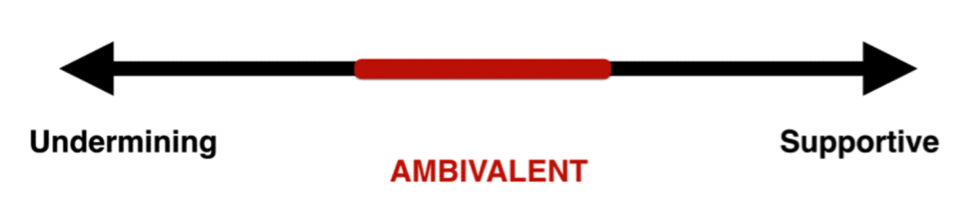
But what is an ambivalent relationship? Here are some questions to self-diagnose your ambivalent relationships. Answer each question by placing someone on the ambivalence spectrum.
Does this person support you or undermine you?
- a) They are supportive.
- b) They are sometimes supportive.
- c) It depends.
- d) They undermine me.
Is spending time with this person fun or draining?
- a) Fun!
- b) Sometimes it’s fun
- c) It depends
- d) Not usually
Is this relationship healthy for you and your life?
- a) Yes, it is healthy
- b) Sometimes it’s healthy
- c) It depends
- d) It’s not usually healthy
Are you sure of your relationship with them?
- a) I know exactly where we stand.
- b) Sometimes I know where we stand.
- c) It depends.
- d) I don’t usually know where we stand.
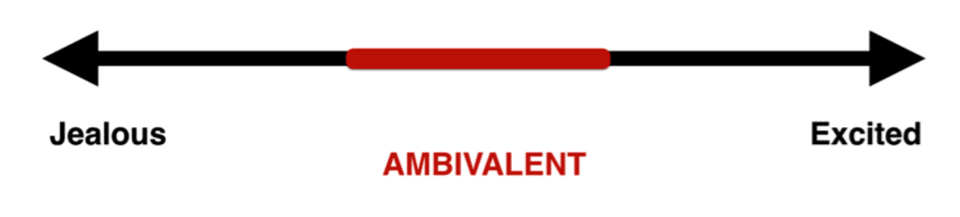
Is this person usually excited for you or jealous of you?
- a) They are excited for me.
- b) Sometimes they are excited for me.
- c) It depends.
- d) They usually can be jealous of me.
Answer Key:
- If you picked mostly A’s and B’s, this person is a good friend!
- If you picked mostly B’s and C’s, you have an AMBIVALENT person in your life! Read on…
- If you picked mostly C’s and D’s, you have a TOXIC person in your life. Read How to Deal With Toxic People.
You might not realize it, but ambivalent relationships are more toxic than toxic ones. Wait! What? I know what you’re thinking, but let me explain:
This is some serious science: Psychologist Bert Uchino found that the more ambivalent relationships you have, the more likely you are to have higher rates of depression, stress, and dissatisfaction in your life.
A researcher at the University of Minnesota named Michelle Duffy wanted to see if frenemies impacted people in the workplace. And not just any workers—police officers. Here’s what she did:
- Surveyed police officers on their levels of stress, absences from work, and how often they were undermined and supported by their closest co-worker.
- Unsurprisingly, she found the more an officer felt undermined, the more unauthorized breaks they took, the more absent they were from work, and the less committed they were to their jobs.
But here’s where it gets interesting…
- What about officers who had colleagues who were sometimes supportive?
- These officers missed even more work, took even more breaks, and felt even less committed.
You read that right: Officers were impacted more negatively when they had ambivalent relationships—even more than toxic ones.
Duffy argued that when police officers have toxic relationships, they can work to keep clear of them. They don’t worry or wonder as much and take as many steps to distance themselves as possible.
But ambivalent relationships were more confusing. It made police officers constantly have to second-guess, be on guard, and grapple with wondering and worrying.
We know we have to get rid of toxic relationships. We worry, grapple with, and second-guess ambivalent ones.
This affects all areas of our lives. In another study, adults rated their relationships with the ten most important people in their lives. They also did two anxiety-provoking tasks:
- Deliver a speech with little time to prep.
- Take a rapid fire math test.
The more ambivalent relationships a person had, the more their heart rate spiked on both tasks.
Bottom Line: Ambivalent relationships stress you out in all areas of your life.
And they can be the most insidious, because you don’t always know how to handle them.
Step #6: Safeguard Your Social Energy
We only have so much social energy. And ambivalence takes more energy.
With toxic relationships, we know we need to cut them out—and often do. Ambivalent relationships are much harder. Guessing, wondering, protecting—those all take a lot more energy. It takes so much physical energy to be on guard.
Fake friends give you guilt.
You know how this goes. Habit. Routine. Guilt.
- You get together because you always get together when you visit home.
- You call each other because you always talk once a month.
- You invite someone because they always come to your holiday party.
But you forget to ask yourself:
Do you actually like spending time with them?

Here’s what happens if you stay on the guilt wave:
- Your interactions become less and less fun.
- Getting together feels more and more like an obligation.
- You dread spending time with them.
- You feel resentful when you do spend time together.
- You agonize over invites, calls, and get-togethers.
Stop. The. Guilt.
I realized that these obligatory friendships were bad for everyone involved.
When you begrudge a friendship, they feel it.
When guilt is the driving force in a relationship, it is doomed to failure.
When you force yourself to spend time with someone or pretend to have a good time, you either are lying to yourself, or lying to them. This is not truthful living.
You are not serving anyone by maintaining this ruse. The hard part is that obligatory friendships do NOT get better. Once spheres of interest start moving apart, they usually don’t stop.
Either you have to pull the plug, or the relationship will keep on draining.
I know. I know. You feel guilty. You feel bad. There is history! But listen up:
Having history with someone is not enough fuel for a friendship.
- Okay, so you were best friends in elementary school. How is maintaining a shallow relationship honoring that memory? Do you really think things will change?
- Okay, so you helped each other get through the corporate merger at your last job. How are obligatory monthly phone calls helping either of you now?
- Okay, so you are different now. How is someone from your old life helping you move on in your new one?
It might be time to have a friend break-up.
How to End a Friendship
Let me explain a people puzzle that always has perplexed me:
It’s okay to date.
It’s okay to define a romantic relationship.
It’s okay to re-evaluate a partnership.
It’s okay to break up.
It’s hard in romantic relationships, but it is okay—if not essential — to be able to date around, and then break up when it doesn’t work out. Why can’t we break up with friends?
In romantic relationships, we have break-ups all the time—it is considered an important part of finding the right partner. But could you imagine saying to a new friend:
“Um, yeah. It’s been great seeing each other. But I just don’t think we are meant to be. I want to friend break-up. It’s not you, it’s me.”
No way. I can’t imagine it.
But here’s the thing: Sometimes we have to break up with friends.
This is one of the hardest posts I EVER have written. Partially because it is personal to me…
I had a best friend break up with me, and it broke my heart.
I recently had to break up with a friend, and it felt like death.
It very rarely is talked about.
Okay. So, here I am going to try making the best of this bad situation. Here’s how you know you need to break up with a friend…
How to Know if You Need a Break-Up
These are the warning signs that a friendship needs to end:
- You dread seeing them.
- You feel they undermine you more than support you.
- There is deception in the relationship—they lie to you.
- There is self-deception in the relationship—one of you is lying to yourself.
- You have grown apart, and the relationship is dragging on like a slowly dying animal.
Any of these feel familiar? Keep reading.
Option #1: The Talk
You know how in romantic relationships, you have “The Talk?” That talk is the pinnacle of nerves, awkwardness, and sometimes resolution. “The Talk” usually has a number of goals:
- To clarify boundaries
- To define the relationship
- To see where each person stands
- To talk about a future
Here’s the great thing about having “The Talk” with friends—it can initiate a break-up talk. It can prepare someone for an imminent break-up, or it can resolve having to break up at all.
You owe it to your friendship to put it all out on the table. The entire goal of “The Talk” is bringing everything to the surface:

- Hidden resentments
- Miscommunications
- Old fights
- Jealousy
- Misunderstandings
- Boundaries
Recommendations:
- I recommend doing this in person. — Do not initiate it over text or chat! Everything is better, clearer, and easier in person.
- Go with a goal in mind. — Do you want to clear up something? Do you want to address something? What would your ideal outcome be?
Option #2: The Break
I think friendships sometimes need breaks. Especially if you just had a very difficult talk, you might need some time away. Breaks can serve to:
- Give you a fresh perspective
- Calm down
- Miss each other
- Re-evaluate
Here’s the nice thing about breaks – you can take them for whatever reason you are most comfortable with:
It’s Me: You can say you are really busy and need time.
It’s You: If you feel hurt by your friend’s actions, if you feel there has been jealousy or undermining (see our articles on frenemies and ambivalent relationships), you can say you need time to recover.
It’s Us: Especially after a hard talk, you can tell a friend that you need some distance for both of you to re-evaluate.
Recommendations:
- I do recommend adding a time component to your break. This will help if you have someone who is not good with boundaries. It also will give you time to re-evaluate without wondering if you should text or contact. Just like in a romantic relationship, defined space can let you take a step back.
- The terms of your break can be flexible or rigid. You can say, let’s talk again in two weeks. You can say, let’s see how we feel and check-in when we feel we are ready.
Option #3: The Slow Back-Away
Let’s say you are in a one-sided friendship or you are friends with someone who is not good with boundaries. Then you might not be able to have “The Talk” or an official break. In this case, you can try the slow back-away.
You should use this if:
- You worry they will not accept a break.
- They will not be honest if you have “The Talk.”
- They are bad with boundaries.
- You hate confrontation.
This method is less direct — so it’s not my favorite. BUT it can help gently end a relationship or avoid hurting someone’s feelings. The slow back-away usually is done by just being ‘too busy’ and ’ too hard to reach.’
I hate writing this, but the goal here is having a gentle easing in the relationship. You want them slowly to get the message that you want a different kind of relationship. You don’t want to hurt their feelings. You want them to save face.
Recommendations:
- Text instead of call.
- Engage less on social media.
- Take longer to respond to texts.
- Respond with shorter texts.
- Get together in less intimate settings.
- Get together for shorter, more casual occasions.
- Be too busy to get together.
**Again, this is my least favorite, because it feels like the least honest. But sometimes it is the nicest way to break up with someone.
Option #4: The Burst
There comes a point in some unhealthy, unfulfilling relationships where the friendship bubble needs bursting. The lies. The faking it. The pretending everything is fine. It needs to stop. I believe friendship break-ups should be treated EXACTLY like romantic break-ups. Something like:
Hey, I know we have had trouble getting together over the last few months. I think that is mostly my fault. I have been pulling away. I think last year when X happened, it really hurt my feelings. I have not been able to get over it. I know you are a great person and have been a wonderful friend, but I think our relationship has changed. I do not think we can salvage it after all that has gone on. I am sorry.
Recommendations:
- State needs that are not being met.
- Be gentle and kind.
- Talk about how you feel.
- Don’t assign blame.
- Don’t make excuses.
This is incredibly hard. I know it. But I think that if you feel you have to end a relationship, you have to clear the way.
When we say no to relationships that don’t serve us, we make room for relationships that do.
I challenge you to think about the fake friends in your life. Are there people who you are close with for the wrong reasons? Are there people who you are lying to yourself about? Are there people you dread hanging out with?
Letting them go helps you both.
I know how hard it is to let go of old relationships. I am writing this article as a pep talk for myself as much as for anyone who resonates with this idea.
Guilt is not fuel.
History is not enough.
Feigned closeness is deception.
Be honest.
Have more time for real relationships.
Live in truth and with real friends.
Watch my interview with Tom Bilyeu, where we discuss fake friends, ambivalent relationships, and more: