
Body Language Guide
- 1 Reading Body Language 101
- 2 Body Language at Work
- 3 Body Language of Emotions
- 4 Hidden Opportunities
- 5 Body Language for Rapport
-
6
Head Behavior
- Head Cues
- Facial Microexpressions
- Eye Cues
- Nose Cues
- Mouth Cues
-
Ear Cues
- What Does Touching Your Ear Mean? 7 Body Language Secrets
- What Is Ear Body Language?
- The Vagus Nerve Connection
- 1. Touching the Ears
- 2. Pulling the Earlobe
- 3. Tucking Hair Behind the Ear
- 4. Ear Leaning (The Head Tilt)
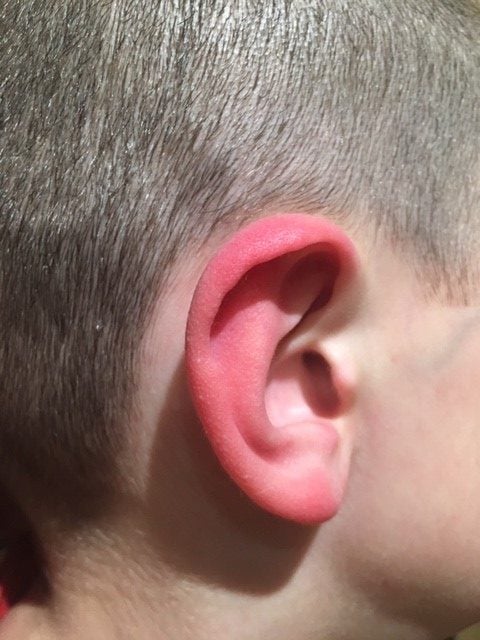
- 5. Red Ears
- 6. Ear Covering or Blocking
- 7. Earrings and Ear Ornamentation
- Reading Ear Cues Accurately
- Listening to Music
- Ear Body Language: Key Takeaways
- Bonus: I’m Ear For You!
- References
- 7 Read The Torso
- 8 Lower Body Language
- 9 Flirting Body Language
Decode ear body language with 7 science-backed cues: ear touching, earlobe pulling, red ears, and more. Learn what these signals really mean.
What Does Touching Your Ear Mean? 7 Body Language Secrets
Ears are often overlooked in nonverbal communication. While most people focus on facial expressions, ears “leak” anxiety, interest, embarrassment, and deception—emotions your face tries to hide.
Researcher Desmond Morris calls this “nonverbal leakage.” Your hands drift to your ears, betraying what your “poker face” is working to conceal1.
Watch our video below to learn how to read people and decode 7 body language cues:

What Is Ear Body Language?
Ear body language encompasses the nonverbal signals—touching, pulling, scratching, leaning, and involuntary blushing—that reveal a person’s emotional state. Desmond Morris classifies these as “auto-contact behaviors”: unconscious forms of self-comfort1.
Most ear cues are pacifying behaviors—self-soothing gestures triggered by stress. Former FBI counterintelligence agent Joe Navarro identifies ear touching as a premier pacifying behavior because it is nearly impossible to fake or suppress2.
The Vagus Nerve Connection
The ear is the only place where the vagus nerve’s auricular branch reaches the skin’s surface3. This “calm down” nerve triggers the parasympathetic nervous system, slowing heart rate and lowering cortisol. The two most nerve-rich areas are the cymba concha (the deep bowl) and the tragus (the flap in front of the ear canal).
When a colleague rubs their ear during a tense meeting, they’re unconsciously performing a primitive version of a clinically studied stress-reduction technique.
The ear is the only place on the body where the vagus nerve reaches the skin’s surface—which is why we instinctively reach for our ears when stressed.

1. Touching the Ears
What It Means: Touching, rubbing, or scratching the ears is a self-soothing gesture used to manage nervousness. According to research done by Dutch biologist Nikolaas Tinbergen4, people generally scratch behind their ears during situations of conflict, as a way to ease tension and stress. Subconsciously, it can act as a physical attempt to “block out” unpleasant information. In conversation, this cue can also signal the listener is ready to speak2.
How to use this: If someone repeatedly touches their ear while you’re talking, pause and ask an open-ended question to give them an opening to share what they might be holding back.
Caveat: Distinguish these cues from habitual fidgeting with jewelry or earrings, which often occurs independently of situational stress. Many women may do this out of habit or even as a fidgeting gesture.

2. Pulling the Earlobe
What It Means: Earlobe pulling typically signals indecision—the person is weighing options or struggling to make a choice1. It can also be a self-soothing gesture that stimulates the vagus nerve. Many women may pull their earlobes, especially out of habit if they had an earring there but removed it.
The most famous earlobe puller was comedian Carol Burnett, who tugged her left earlobe at the end of every episode of The Carol Burnett Show (1967–1978) as a secret “I love you” to her grandmother, “Nanny”5:
Action Step: If someone pulls their earlobe while you present options, slow down and ask: “Would it help if I walked through the pros and cons?”

3. Tucking Hair Behind the Ear
Significance: This is a common “preening gesture”—a subconscious attempt to appear more attractive by exposing the face and neck. However, it may also be a simple practical response to hair being in the way.
How to Interpret: Look for clusters. A hair tuck is a stronger indicator of interest when paired with sustained eye contact, leaning toward you, and smiling. The next time you’re on a date and notice a woman tucking her hair behind her ear, consider using another flirtation cue to see if she reciprocates.

4. Ear Leaning (The Head Tilt)
What It Means: Turning an ear toward a speaker signals intense listening or difficulty hearing6. A slight head tilt also exposes the carotid artery, subconsciously signaling trust and openness.
University of Pittsburgh researcher Bill Acheson found that 71% of women identified a person with a tilted head as a better listener6. Sometimes, ear leaning may be followed by cupping the ear to “collect” more sound.
Action Step: To make others feel heard, tilt your head slightly toward them as they speak. A few degrees signals genuine interest without appearing exaggerated.
5. Red Ears
The Cause: Red ears occur when blood vessels dilate in response to embarrassment, anger, or stress7. Because ear skin is thin, this surge of blood is highly visible. People who are nervous presenters might show signs of red ears—I was a victim of this in high school!
However, red ears might actually be a social asset. Research from UC Berkeley shows that individuals who display visible embarrassment are rated as more trustworthy, generous, and prosocial than those who remain stoic8. Because blushing is involuntary and impossible to fake, it functions as a nonverbal apology—your body credibly signals, “I recognize my mistake,” before you even speak.
Pro Tip: If your ears turn red during a presentation, don’t panic. That visible flush signals authenticity.
6. Ear Covering or Blocking
Meaning: Placing a hand over or near the ear signals a subconscious attempt to “shut out” information. Morris classifies this as a “hear no evil” response, typically occurring when someone strongly disagrees, feels overwhelmed, or is processing bad news.
Professional Application: If you notice this during a pitch, the listener may have an unspoken objection. Ask: “Do you have any specific concerns about this?”

7. Earrings and Ear Ornamentation
Earrings: either you hate ’em or love ’em! Either way, earrings can be a huge attraction signal.
What It Means: Ear ornamentation is very culture specific; it communicates social status, courtship availability, or group identification. It also gives very accurate insight into the background, occupation, social status, heritage, or personality of a person9.
In a 2011 study of 362 female college students, women wearing earrings were perceived to have higher individuality, attractiveness, potency, loveliness, and even elegance than the women without earrings. In short, wear earrings to maximize your attractiveness.
But what about in an interview? A 2003 study by Seiter and Sandry found that while the candidate’s attractiveness ratings were not affected by the type of jewelry worn, credibility decreased when wearing any jewelry, and hireability ratings decreased when a nose ring was added10. So it’s a good idea to skip the jewelry during job interviews and business meetings. Worth noting: this study is over twenty years old, and professional norms have shifted considerably.
Special Note: Fiddling with earrings during conversation is different from wearing them—treat it like any other ear-touching gesture signaling discomfort.
Reading Ear Cues Accurately
Most body language advice oversimplifies by offering rigid meanings (e.g., “ear touch = lie”). To interpret cues accurately, follow the Cluster Rule:
- Analyze clusters, not isolated gestures. A single gesture is often just an itch.
- Establish a baseline. Observe how the person behaves when relaxed.
- Identify mismatches. If someone says “I’m totally fine” while scratching their ear and shifting in their seat, prioritize the physical cues.
- Avoid the Othello Error. Don’t mistake general discomfort for guilt.

Listening to Music
What It Means: What’s your favorite jam? Besides making you more productive, music is highly personal, and you can infer someone’s personality traits from their tastes:
- People high in openness tend to like sophisticated music like classical, operatic, world and jazz pieces, and dislike mellow and contemporary music like soft rock and rap.
- Extroverts tend to like uncomplicated, relaxing, and acoustic music like folk and country.
- Agreeable people like music across the board—more than the average person does.
- Neurotic people are less likely to like music if there’s no specific genre playing.
Music also has the power to trigger our nostalgic memories. For example, when we listen to music from our childhood, it invokes specific emotions and scenes. Whenever I hear a jazzy “Winter Wonderland,” it brings me back to sipping on hot cocoa near the fireplace with my family.
Music even has the power to evoke our deepest emotions, even with Alzheimer’s patients:
Ear Body Language: Key Takeaways
- Leverage the vagus nerve shortcut. Ear touching is self-soothing—interpret it as a need for comfort rather than deception.
- Follow the Cluster Rule. Never interpret a single ear gesture in isolation.
- Establish baselines first. Spend the first two minutes of a conversation observing normal behavior.
- Embrace red ears. Research shows blushing builds trust.
- Consider jewelry context. Earrings boost attractiveness socially but can reduce credibility in formal settings.
- Use the head tilt. Leaning an ear toward a speaker signals genuine interest—one of the simplest body language upgrades available.
Bonus: I’m Ear For You!
Did you find this guide helpful? For more body language reading, follow along to the complete guide below!
Side Note: As much as possible we tried to use academic research or expert opinion for this master body language guide. Occasionally, when we could not find research we include anecdotes that are helpful. As more research comes out on nonverbal behavior we will be sure to add it!


