Lots of us have a secret wish to be more interesting. How do I know?
Google told me. One morning I logged on to do my monthly check of our website analytics. While scrolling through our top search terms, I found this phrase near the top of the list: “how to be interesting.”
That intrigued me, because I almost never hear anyone say it out loud. I hear “I want to be more charismatic” or “I want to be more attractive.” But “I want to be more interesting”? It seems to be a secret we tell only to search engines.
Here’s the good news: You are interesting! The biggest barrier is fear, and your fear of being uninteresting is what makes you uninteresting. So below It is exactly how we’re going to conquer the boring social scripts and move into interesting.
Turn Dead-End Answers Into Hooks
Have you ever met a lazy talker? They don’t take ownership of their ideas or the conversation. Here’s what it’s like talking to one:


I call this the Lazy Law. The lazier you are in a conversation, the less interesting you’ll seem. The more you put into it, the more interesting you’ll be! It’s not rocket science

The fix starts with the boring questions you can’t avoid. “What do you do?” and “How was your weekend?” are usually questions you’ll run into all the time. So build a hook into your answer, starting with one true fact, one oddly specific detail, and one door the other person can walk through.
| They ask | Dead end | Hook |
|---|---|---|
| “What do you do?” (at work) | “I’m in accounting.” | “I do accounting for a bakery chain, so I know exactly how many croissants we sold last Tuesday. Ask me anything.” |
| “How was your weekend?” | “Good. Quiet.” | “Quiet, except I tried to fix a squeaky door and now it squeaks in a new key. Did you get up to anything?” |
| “What do you do for fun?” | “Not much.” | “Lately? Losing to my niece at chess. She’s nine. What about you?” |
| “Seen anything good lately?” | “Not really.” | “I just watched a three-hour documentary about salt. I have regrets and also a lot of salt facts.” |
| (Text) “What are you up to?” | “Nothing much u?” | “Trying to assemble a bookshelf with one extra screw left over. Should I be worried?” |
Even an ordinary week has a hook in it. The live version of this article had a reader favorite: “Just yesterday I was cooking this mean spaghetti, but I ran out of tomato sauce and resorted to using ketchup packets instead! I was terrified of how it’d turn out.” Nothing happened much in this story, and it’s still a better answer than “fine.”
Try This: Write a hook answer for “What do you do?” and “How was your weekend?” tonight. Keep each under 25 words and end it with a question back.
Ask the Second Question
Here’s what NOT to do: ask “Where are you from?”, nod at “Denver,” and move straight to “So what do you do?” That’s an interview, and nobody enjoys being interviewed at a barbecue.
The fix is the second question. Whatever they say, ask about that before you change the subject. People who ask more questions, especially follow-ups, get liked more by the person they’re talking to.1 In speed dating, more follow-ups even meant more yeses for a second date. (Oddly, people don’t expect asking questions to make them more likable.)
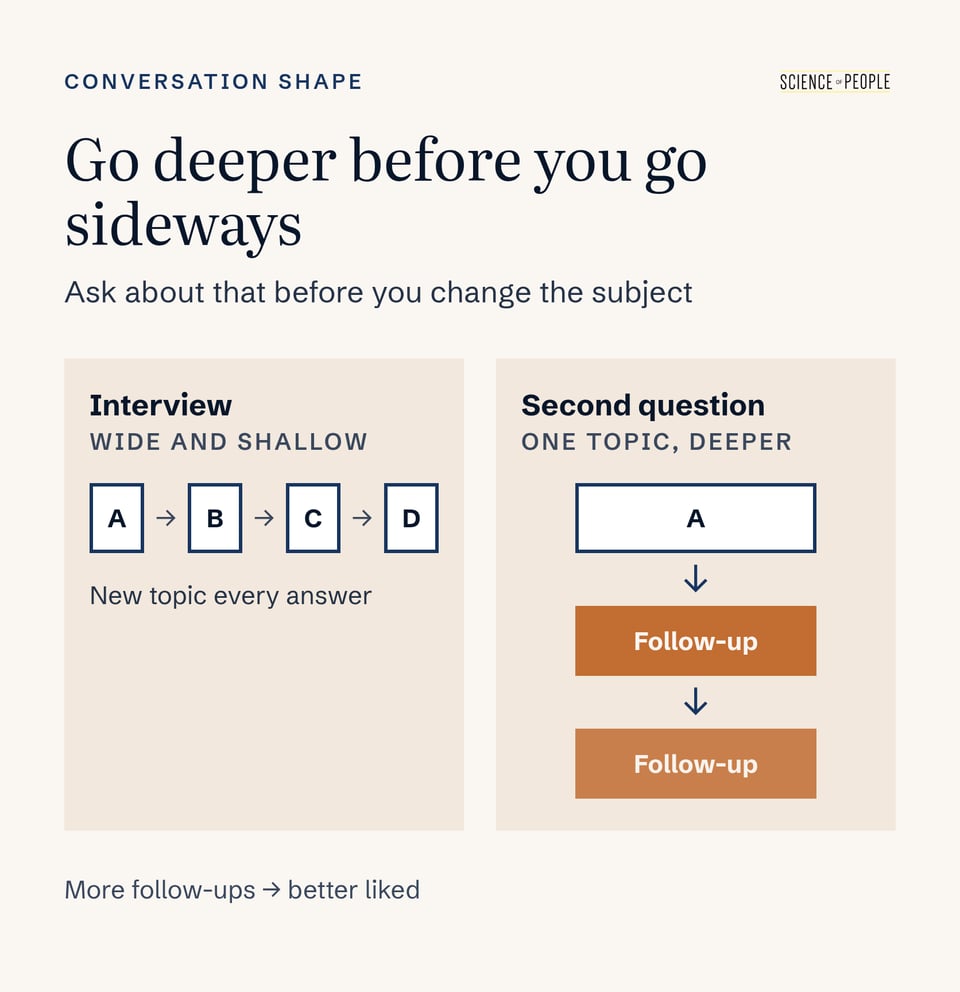
Swap the stock questions you already ask for ones with somewhere to go, then follow up:
| Boring question | Better question | Second question |
|---|---|---|
| “What do you do?” | “What are you working on right now?” | “What’s the hardest part of that?” |
| “How are you?” | “What’s been the best part of your week?” | “Wait, how did that happen?” |
| “Where are you from?” | “What’s something people get wrong about where you grew up?” | “Would you ever move back?” |
| “Seen any good shows?” | “What’s the last thing you couldn’t stop talking about?” | “Who else did you make watch it?” |
A follow-up doesn’t have to be a question, either. “No way. In a canoe?” counts. So does “That sounds exhausting. How did you survive it?”
Action Step: In your next conversation, give yourself one rule. No new topic until you’ve asked at least one follow-up about the last thing they said.
A new book by Vanessa Van Edwards
Every conversation is an opportunity.
If conversations have gotten harder, more awkward or less satisfying, you’re not imagining it. We’re simply out of practice. It’s time to find the joy in talking to each other again.
Play Interesting Detective
Being interesting is about doing interesting things, but the flip side is being interested in other people’s interesting things. You become interesting when you’re interested in other people’s interestingness.
So decide to become an interesting detective.
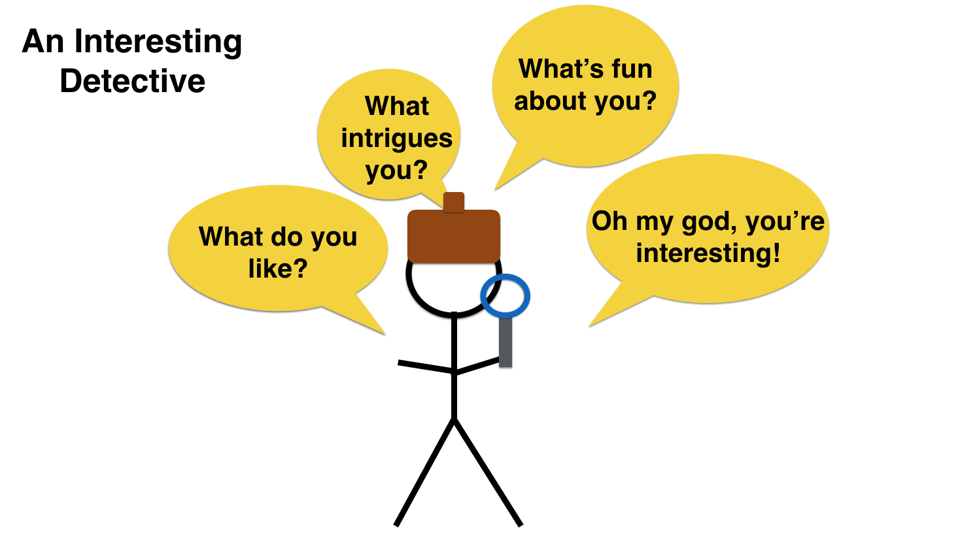
Here’s a little mental trick I use…I assume that every person I meet has a secret back story and I have to write an article about them tomorrow. First, it makes my questions more specific. Second, I assume they’re already interesting. I just need to uncover what it is.
If you expect people to be interesting, they often rise to your expectations.
Curiosity pays off even in boring settings. Curious people felt close to brand-new partners during plain small talk, while less curious people only felt close when they were handed relationship-building exercises.2 In other words, the curious person can have a good conversation in the line for the office microwave.
Clues worth chasing:
| Where | Clues | What to say |
|---|---|---|
| Work | The sticker on their laptop, the odd job title, the meeting they keep getting pulled into | “Okay, I have to ask about the cactus sticker.” |
| Party | How they know the host, the dish they brought | “Did you make this? It’s disappearing fast.” |
| Date | The app prompt they wrote, the drink they ordered without looking | “You didn’t even check the menu. What’s the story there?” |
| Text | The photo they just posted, the place they checked in | “Wait, is that a llama behind you?” |
Try This: At the next event, pick one clue per person and ask about it before you ask what they do.
Show Up With Something to Point At
If starting conversations feels like the hard part, give people something easy to ask you about.
A cactus sticker or a dying office plant already works as a clue when it’s on someone else. You can set up the same kind of opening for yourself. Bring a book with a weird title, a pastry from a place they might know, a pin, or a mug that needs a story. When someone points at it, give them a hook answer and then pause so they can jump in.
“It’s a novel about a clerk who files other people’s dreams. I don’t know if it’s good yet, but the first chapter has a sentence I keep repeating in the shower.”
If carrying a conversation prop feels like too much, use what’s already around you. Sit near the office plant that’s trying to die. Order the menu item with the strange name. Put the unusual snack in the middle of the table.
Action Step: Pick one object you’ll have with you this week that someone could ask about. Practice a two-sentence answer.
Climb One Rung Deeper
Small talk has a ceiling, and a lot of us stay under it on purpose. What if they think it’s weird that I asked?
They probably won’t. Conversations between strangers felt less awkward and more connecting than people predicted, and deep conversations were the ones people misjudged most.3 The other person cares more about what you share than you’d guess.
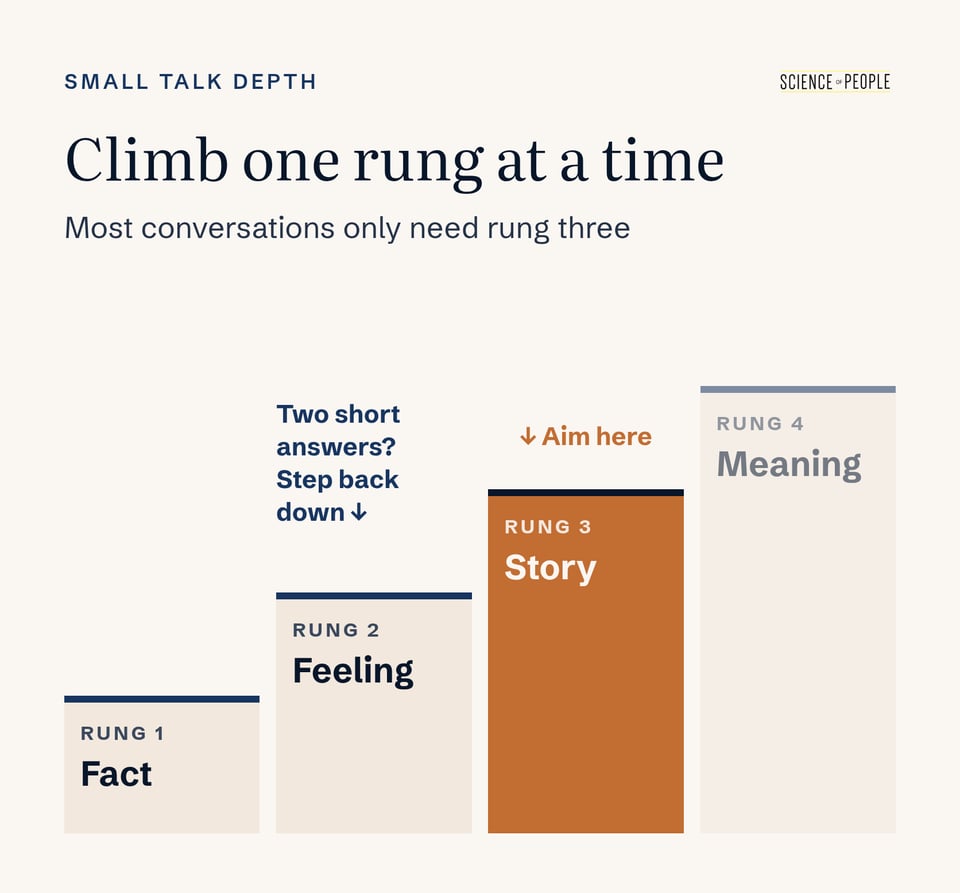
You don’t have to jump to “What’s your greatest fear?” by the snack table. Climb one rung at a time:
- Fact: “What do you do?” (“I’m a nurse.”)
- Feeling: “What do you like most about it?” (“The night shift people. They’re a different species.”)
- Story: “Okay, what’s the strangest night shift you’ve had?”
- Meaning: “Has it changed how you see your own life?”
Most conversations only need to reach rung three. If they give short answers twice in a row, drop back down a rung. That’s just your cue to change lanes. For more questions at every rung, try these deep questions.
Pro Tip Go first. Share something one rung deeper than you’d normally share, then ask. “Honestly, I took this job for the commute. What got you into it?”
Compliment the Choice
Want a compliment that actually gets someone talking? Point to a choice they made, so they have a story ready to tell you.
“Nice shirt” is kind, and it usually ends right there. Try: “Those frames are great. Did you pick them because they look like a comic-book villain, or was that a happy accident?” Now they can tell you how they found them.
| Generic | About the choice |
|---|---|
| “Cool glasses.” | “Those frames are great. Did you pick them because they look like a comic-book villain, or was that a happy accident?” |
| “You’re so good at that.” | “The way you explained the budget without the jargon… I actually followed it. How did you learn to do that?” |
| “Great presentation.” | “That story about finishing next to the dumpster? I keep thinking about it. How did your boss react after?” |
Compliment something they did or picked. Skip the ones that sound like a performance review.
For example, “You’re so talented” is hard to answer, but “The way you explained your idea without complicating it” is easy.
Try This: Give one specific compliment today that they can answer with a story. For more lines, see how to praise someone.
Swap One Default a Week
Oh wow, you watch Netflix? Do you watch it on your iPad or computer? Skip please! This is not interesting. If you come home every day and do the same things as everyone else, it’s hard to have anything new to say.
Experiences give you something to talk about. People talk more about their experiences than their possessions, and enjoy those experiences more because they get to talk about them.4 Skip the product recap. Tell them about the night you and two friends carried that couch up four flights of stairs.
You don’t need to climb Everest, though. Swap one default a week:
| Your default | The swap |
|---|---|
| The lunch spot you always go to | The place you’ve driven past a million times but never tried |
| Whatever the streaming app suggests | A movie your favorite coworker swears by |
| Scrolling at 11 p.m. | A free class or meetup this week (pottery, trivia, salsa) |
| The bestseller table | Your librarian’s favorite book of all time |
| Your usual Saturday | Being a tourist in your own city for an afternoon |

There’s one honest catch. Go too big and it can backfire. People who had an experience far better than their peers’ enjoyed it, then had a worse time in the conversation that followed. They ended up feeling worse than if they’d had an ordinary experience.5 So the micro-adventure often beats the safari. If you do have a big story, tell the short version and hand the conversation back fast.
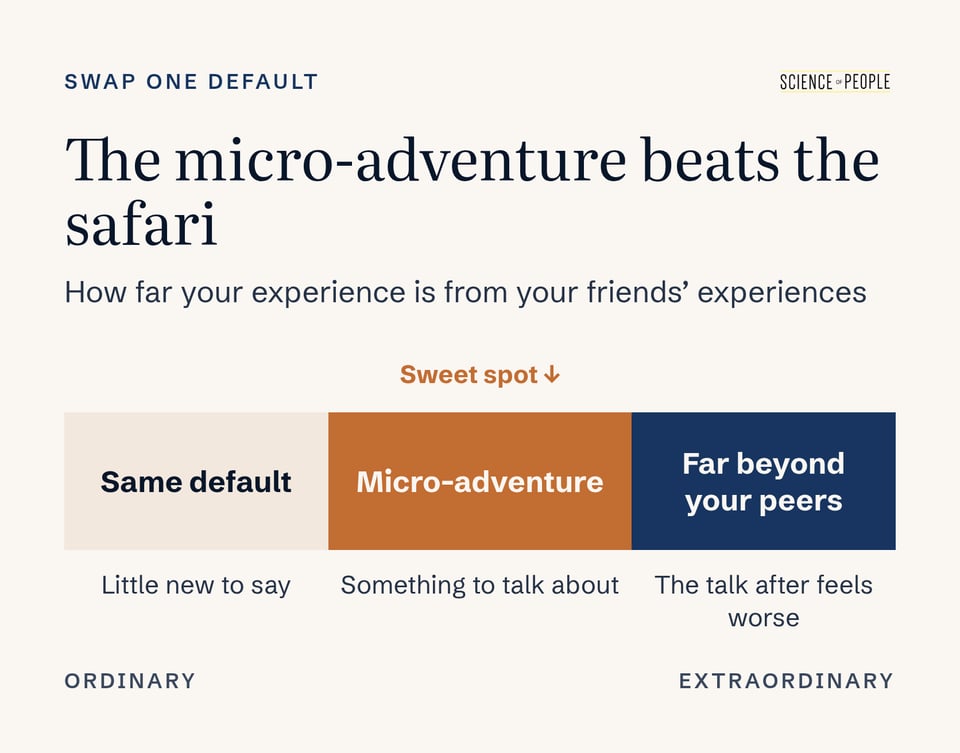
Action Step: Pick one swap from the table and put it on your calendar for this week. If you need more ideas, start a bucket list or browse these hobbies for adults.
Keep a Story File
What good is being a great storyteller if you don’t have any material?
Interesting people usually just notice more. The best stories often come from everyday moments. Think of the wrong name on your coffee cup, or the coworker who brings a whole rotisserie chicken to the 3 p.m. meeting.
Start a note on your phone called “Story File.” Each entry gets three lines. Write what happened, the weird detail, and how it ended. Like this:
The building’s fire alarm went off during my big presentation. Forty of us stood in the parking lot, and my boss said, “So, slide nine?” I finished the presentation next to a dumpster.
Some topics tend to spark conversation, and some tend to stall it:
| Tell more of these | Tell fewer of these |
|---|---|
| Something that went hilariously wrong | Your full daily routine |
| A small win you worked hard for | Complaints and gossip |
| A weird skill or hobby | Long monologues with no point |
| A tradition from your family or culture | Overly technical details |
| A question you can’t stop thinking about | Office drama |
Also ask for other people’s stories. An older relative’s “What was your first job?” can stock your file for a year. Want to tell them better? Check out these tips on how to tell a story people remember.
Action Step: Add your first three entries tonight. Scroll back through this week’s photos if you’re stuck.
Tell the Almost-Disaster Version
Want people to actually stay with you when you tell a story? Give them the part where it almost went wrong.
That fire-alarm presentation is already in your Story File. If you say, “I gave a talk and it went fine,” they smile, nod, and wait for the next topic. Tell them you finished next to a dumpster while your boss called out slide nine. They can picture it. Now they have something to ask you about, which is the whole point.
When you pull a story out of your file, include three beats:
- What you meant to happen
- The moment it went sideways
- How it ended, in one sentence
Then stop. If they want a moral, they’ll ask for it.
Try This: Pick one Story File entry and rewrite it as an almost-disaster in three sentences. Tell it once this week.
Bring a Harmless Hot Take
Interesting people aren’t afraid to go against the grain, but they do it on low-stakes topics. A playful opinion gives a stalled conversation something to push against.
Keep two or three in your pocket:
- “Breakfast is overrated. I’m a strong second-breakfast person.”
- “Comic Sans is fine on a birthday card. I’ll die on this hill.”
- “The sequel was better than the original. Fight me (politely).”
- “Airport food is underrated. You’re never more relaxed than with a boarding pass.”
Stay away from politics, religion, and anything that sounds like a conspiracy theory. There’s a thin line between “interesting person with fun takes” and “the guy nobody sits next to at the reunion.” If someone disagrees, that’s the fun part. Ask them to make their case.
A random fact works the same way, as long as it fits the moment. It’s one thing to know that a group of flamingos is called a “flamboyance.” It’s another to drop it when someone mentions a pink office makeover.
Try This: Write down one harmless hot take you actually believe. Test it at lunch: “Okay, controversial opinion…”
Brag About Your Friends
What should you talk about when you’re tired of talking about yourself or the other person? What about our wonderful friends, absent or not?
I love to use this conversation trick when things get stale. For example, I met someone at a networking event who was into computers and coding. I’m not a huge coding expert, but I know friends who are! I brought up my friend, Chris, who loves developing websites and has worked with big companies like Motley Fool and Google. The tone of the conversation instantly shifted. I went from uninterested to interested, and so did they, all because of my friend!
Your circle counts as part of your interestingness. Let’s quickly take stock:
Who is the most interesting person you know? ____________
Then add the most well-read, the most well-traveled, and the strangest person you know. Those people are your interesting tribe.

Bring them up, then offer to connect: “You’d love my friend Priya. She restores old pinball machines. Want me to introduce you?” These tips on how to introduce someone keep it from getting awkward. Had trouble filling in that blank? Then it’s time to build your tribe. Learn how to make friends as an adult (non-awkwardly).
Try This: Next time a conversation stalls, ask yourself which friend would love this person. Then say it out loud.
Say “Yes, And”
We’ve all experienced the dreaded awkward silence when a conversation reaches a lull. Borrowed from improv comedy, “Yes, And” keeps it moving:
- Accept what the other person says (“Yes…”).
- Build on it with your own idea (“…and”).
It sounds like this:
- Friend: “I’m thinking of taking up knitting.”
- You: “Yes, and you could knit sweaters for penguins! Did you know there’s actually a charity that does that?”
(Assuming, of course, that your friend has some kind of inclination towards penguins.)
At work, it’s the difference between a coworker’s idea dying and growing. “We should do a team lunch” gets “Yes, and we could make it a potluck where everyone brings their grandma’s recipe.” Here’s what NOT to say: “Yeah, but nobody will come.” (Now nobody will.)
Check out this demonstration of comedians practicing the “Yes, And…” technique to sharpen their improvisational skills:
Try This: Use “Yes, and” once in your next meeting or group chat. Agree first, then add one small, specific thing.
Call It Back Later
If you want someone to light up the next time they see you, bring back one specific thing they told you.
“How’ve you been?” is polite, and it also gives them nothing to work with. “Wait, did the sourdough ever stop tasting like sadness?” tells them you were actually listening. Next week you can try, “How did the interview go? I’ve been wondering about the puzzle they made you solve.”
A lot of us walk around feeling like nobody remembers what we said. A callback is how you prove you did. That’s often more interesting than any story you could perform.
Three good times to use it:
- Ten minutes later, in the same conversation
- The next time you see them
- In a text the next day: “I keep thinking about the llama photo. Is there more to that story?”
Action Step: After your next conversation, write down one callback line while you still remember it. Say it or send it the next time you talk.
Ask for a Recommendation, Then Report Back
Want an easy way to become the person they remember after a party? Ask for a recommendation, then come back and tell them how it went.
“Any good restaurants around here?” is a perfectly fine question. The part people remember is when you show up later with the result.
“You told me to try the breakfast tacos at Lupe’s. I went yesterday. You were right about the salsa, and wrong about being able to eat just one.”
Now they get to be the expert, and you already have your next conversation lined up. Ask for something small enough that you’ll actually do it, like a sandwich, a podcast episode, a two-minute video, or a weekend walk.
Then close the loop within a week, before the recommendation goes stale.
Try This: Ask one person for a recommendation today. Set a reminder to report back after you try it.
Pick a Signature Thing
Your “signature quirk” is anything you say or do consistently that makes you a little memorable. It doesn’t have to be a Hollywood-level production. A few ideas:
| Signature | What it looks like |
|---|---|
| An excuse | You forget someone’s name mid-conversation, shrug, and say, “Oh well, it happens to the worst of us…” |
| A toast | “Here’s to surviving another week!” (More ideas in our toasts guide.) |
| A food | You’re the one who brings the weird hot sauce to every potluck, or puts ketchup on burritos and defends it |
| A conversation starter | A bold scarf, a vintage watch, or a unique hobby you’re happy to explain |
The rule is that it has to be true. If you’d feel silly doing it in front of a close friend, skip it. A quirk you have to perform every time gets tiring for you and the people around you.
Action Step: Pick one thing you already do that friends tease you about. That’s your signature. Lean into it once this week.
Plant a Sequel
A good conversation shouldn’t have to start from zero the next time you see each other. Leave them a reason to pick it back up.
- “Text me how the kayak trip goes. I want the unfiltered version.”
- “If you find that hot sauce, I need a picture.”
- “I’m going to try your librarian trick this weekend. I’ll let you know what she recommends.”
“We should hang out sometime” sounds friendly, and then nobody knows what to do next. “I’m at that trivia night on Thursday if you want a teammate” gives them a real next step they can say yes to.
Try This: End your next conversation with one specific next step. Skip the vague “good talking to you.”
Quiet? They Like You More Than You Think
If you’re quiet, shy, or an introvert, here’s a relief. You don’t have to be the loudest person in the room to be interesting. Most of the moves above (the second question, the detective, “yes, and”) work better at a quiet volume.
And the conversation probably went better than it felt. After talking with someone new, people tend to underestimate how much the other person liked them and enjoyed their company.6 That gap showed up between strangers and even lasted for months between new dorm mates.

So that replay loop in your head on the drive home? Why did I say that thing about salt? The other person probably isn’t running it. Here are a few lines that do a lot of work with very little volume:
- “Wait, go back. What happened after that?”
- “I’ve never met anyone who does that. How did you get into it?”
- “I’m more of a listener, so you’re stuck telling me the whole story.”
Try This: After your next conversation, write down one thing the other person seemed to enjoy, instead of one thing you said wrong. For more help, try these tips on how not to be shy.
Frequently Asked Questions (FAQs) on How to Be More Interesting
How do I be more interesting to talk to?
Ask a second question about whatever they just said, then offer one specific detail from your own life. Most conversations go flat because people answer and stop. If someone mentions they went to Portland, ask what they ate, then mention the food cart you still think about. Curiosity plus one real detail beats a polished list of hobbies every time.
What do I say when someone asks what I do for fun and my life feels boring?
Don’t invent a better life. Name one small, specific thing you actually did, like “I spent Saturday trying to get my sourdough to stop tasting like sadness.” Specifics sound interesting. “I just hung out” does not. If the week was quiet, pull a hook from your story file, or ask what they’ve been into lately and follow up on the first concrete thing they mention.
How do I stop conversations from feeling like an interview?
After you ask a question, add a piece of yourself. A string of questions with nothing of yours in between feels like an interrogation. Try: “What do you do? I edit newsletters, which means I now have strong opinions about subject lines.” Then ask a question they can answer with a story beyond a yes or no.
How do I get past small talk without being weird?
Climb one rung deeper than the default question. “How was your weekend?” can become “Did you actually rest, or was it one of those weekends that needs a weekend?” That offers a door they can walk through. If they stay at the surface, climb back down. It’s common to feel relieved when someone makes that extra step.
How do I be interesting if I'm quiet or introverted?
You don’t need to get louder. Quiet people are often liked more than they think, especially when they ask good follow-up questions and wait through a pause. Pick one signature thing you’re happy to talk about, and keep a second question ready. Let other people talk, then add one specific observation so you aren’t only interviewing them.
How do I have more to talk about?
Keep a story file on your phone with three lines after anything even slightly vivid happens. You don’t need a new personality or a new hobby every month. What’s missing is raw material. Swap one default a week, like a different lunch spot or walking route, so you collect small stories instead of waiting for a big adventure to show up.
How do I stop feeling boring?
Treat it as a playback problem, not a personality verdict. You remember your flat answers and forget that the other person left thinking about their own. Write down proof: a conversation that ran long, a question someone asked you twice, a story they repeated later. Then practice turning dead-end answers into hooks so the next chat has somewhere to go.
What makes someone interesting in a conversation?
They’re easy to talk to. They notice a detail, ask about it, and offer something of their own. Interesting is not the same as impressive. A harmless hot take about the office coffee, a story about a friend, or a “yes, and” on someone else’s idea will do more than a résumé of adventures.
How can I be more interesting at work or at a networking event?
Prepare one short hook for “What do you do?” that names a concrete problem you solve, and one question you can ask anyone in the room. When you need a story, brag about a teammate instead of yourself. If you’re quiet in groups, ask the second question and let that be your contribution while you get your footing.
Is being interesting the same as being extroverted?
No. Extroversion is how you get your energy. Being interesting is whether people have something to grab onto when they talk to you. A quiet person with a signature thing and a good follow-up question often leaves a stronger impression than someone who talks a lot and only about themselves.
How to Be More Interesting: Takeaway
You already have plenty that’s interesting about you. The work is getting it into the conversation. Here’s where to start:
- Write hook answers for “What do you do?” and “How was your weekend?” and use them this week.
- Ask one follow-up question before you change the subject.
- Pick one clue about the next person you meet and ask about it.
- Put one swapped default on your calendar, and keep the story short when you tell it.
- Start a Story File and add one entry a day.
- Mention a friend who’d love the person you’re talking to, then offer an intro.
- The next time you see someone, call back one specific thing they told you.
Being interesting is about living a life that’s worth talking about, then letting other people into it. For more ways to keep things lively once you’re talking, try these tips on how to hold a conversation.