
Body Language Guide
- 1 Reading Body Language 101
- 2 Body Language at Work
-
3
Body Language of Emotions
-
Aggressive Cues
- What Is Aggressive Body Language?
- 15 Aggressive Body Language Cues
- 1. Jaw Clench
- 2. Lowered Eyebrows
- 3. Nostril Flaring
- 4. Pursed or Thinning Lips
- 5. Chest Puff
- 6. Pupil Dilation: Hot vs. Cold Aggression
- 7. Clenched Fists
- 8. Blading (The Boxer’s Stance)
- 9. Muscular Rigidity
- 10. Sneering (Aggressive Face)
- 11. Teeth Licking
- 12. Finger-Pointing
- 13. Space Invasion
- 14. Sudden Stillness
- 15. Target Glancing
- Rattling
- The 6 Stages of Anger Escalation
- A Note on Gender and Aggression
- 4 Things to Know About Anger
- Men vs. Women
- Hot Temperature
- Aggressive Displays
- The Anger Effect
- How to De-escalate Aggressive Body Language
- The 20-Minute Rule
- Non-Verbal De-escalation Checklist
- How to Calm Yourself Down
- Key Takeaways
- Frequently Asked Questions
- Confident Cues
- Condescending Cues
-
Aggressive Cues
- 4 Hidden Opportunities
- 5 Body Language for Rapport
- 6 Head Behavior
- 7 Read The Torso
- 8 Lower Body Language
- 9 Flirting Body Language
Spot the telltale signs of aggression before things escalate. Here are 15 body language cues, from jaw clenching to target glancing, and how to de-escalate them.
Last Saturday night, I was at a pool bar with a few friends. One of my friends (let’s call him Dumbo) was shooting pool and really savoring the game—even though there were a few people waiting their turn for a table.
This big biker guy (let’s call him Biker) was really getting annoyed that Dumbo was taking his sweet time. Biker was hovering over the table and started to snort (loudly) every time Dumbo missed a shot.
Then there was a moment—a moment when Biker’s patience ran out. His body language tightened, there was a crackling in the air, and I knew it was not going to end well. I walked over to my friend Dumbo and whispered to him, “Dumbo, I’m pretty sure if you don’t wrap this game up quickly, you are going to get punched in the face.”
He looked at me and laughed, waved me off, and said I was “overreacting” and my “body language instincts” were WAY off.
Dumbo was being pretty obnoxious, so I decided to let it go—a punch in the face might do him some good. Not even 2 minutes later, Dumbo called to the biker, “Want to get me a drink, Dude? I think it’ll be a few more minutes.” Predictably, Biker put down his beer, walked right up to Dumbo, and popped him one in the nose.
Don’t worry, only Dumbo’s face and ego got a little black and blue. While icing the next day, he asked me, “How did you know that guy was going to punch me?”
And that brings me to this post.
- How do you know if someone is going to punch you in the face?
- How can you predict a bar fight?
- What is the body language of violence?
Whether you’re dealing with a drunken bar mate, playing an intense sport, or dating a stranger, you have to know how to recognize the nonverbal behavior of aggression.
(And Dumbo, you know who you are. This is for you.)
Watch our video below to learn how to read people and decode seven body language cues:
What Is Aggressive Body Language?
Aggressive body language is the set of facial expressions, gestures, and postures that show hostility or readiness for confrontation. They often appear before any words are spoken.
When the brain perceives a threat, the amygdala fires before the rational mind can process the event, and adrenaline and cortisol spike. Muscles tense, especially in the jaw, shoulders, and hands. A 2024 Columbia University study found that eight minutes of anger impaired blood vessel function for up to 40 minutes; sadness and anxiety did not produce the same effect.1
15 Aggressive Body Language Cues
1. Jaw Clench
Also known as a chin jut or a jaw clench, this is when someone grits their teeth and shoves their jaw forward in your direction. When we are feeling angry, we naturally grit our teeth—sometimes to control an emotional outburst and sometimes out of pure frustration. This is also a territorial gesture. When someone chin juts at you, they are threatening your space with theirs. It’s a nonverbal way of saying, “Back up!”

The first one is neutral. The second one, with the chin jut, is the one that should irritate you the most. You can’t help but feel that way when someone sneers down their nose at you. The third one, looking up at you, should be the most seductive. Anytime a woman looks up at someone through her lashes, she looks more engaging and curious.
De-escalation: Don’t mirror an aggressive person’s behavior. Keep your own jaw relaxed, and take one step back to show that you are giving them physical and emotional space.
2. Lowered Eyebrows
Tense or lowered eyebrows are usually a very dominant gesture, and someone might express anger by lowering their brows and tilting their head down. Paul Ekman’s Facial Action Coding System identifies the brow lowerer (AU4) as the primary marker of anger, recognized across cultures with 80–90% accuracy.2 That long, hard stare with little to no blinking often comes before aggression.
Even cats stare angrily at each other before getting in a fight! Sometimes this works, and the other cat backs down. But other times…
The features of the anger face may all work together to make a person look physically stronger.
3. Nostril Flaring
The body instinctively increases oxygen intake to prepare for physical exertion. Nostril flaring also widens the mid-face, contributing to the “strength face.” It is possible our nostrils flare before a fight to take in more of the opponent’s smell, as some experts think we can subconsciously smell adrenaline and pheromones. Context matters: nostril flaring also happens during arousal and attraction.
4. Pursed or Thinning Lips
Tightly pressed lips signal that someone is suppressing an outburst. Pursed lips are commonly seen in rhesus monkeys, who raise their brows, fix their gaze, and close their jaws together when disposed to attack.3
De-escalation: Show your palms and offer an explanation if you said something polarizing. You want to show them you are not closed, in case they are disagreeing with you.
5. Chest Puff
Before getting into a fight, our bodies want to get as big as possible. Shoulders go back, chest comes forward.
De-escalation: Don’t cower. While you don’t want to puff up like them (this challenges them), you don’t want to cower either. This will not only make you feel worse, but it might encourage them to see you as a weak opponent. You are much better off standing your ground and holding your hands out and open with your palms up. This is the universal “nonthreatening” gesture and signals to them you don’t want to fight.
6. Pupil Dilation: Hot vs. Cold Aggression
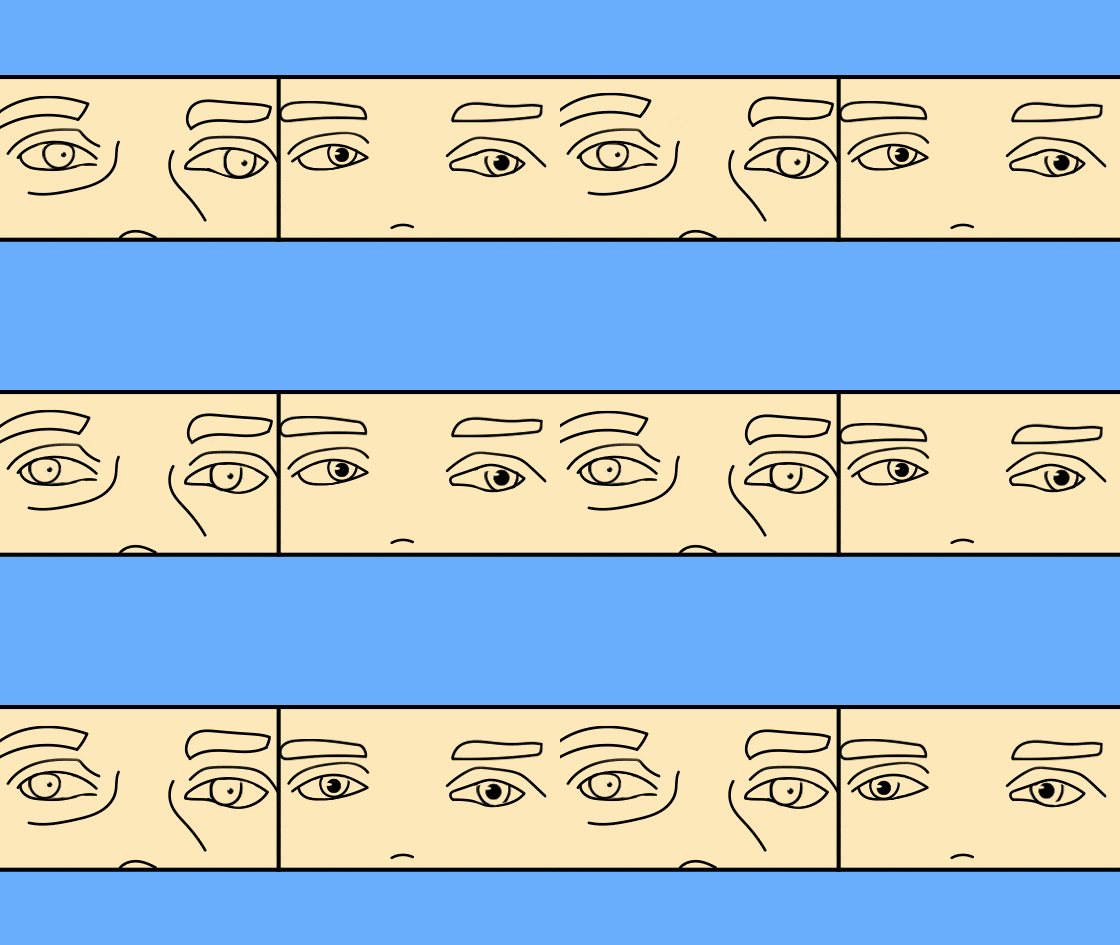
- Reactive (“Hot”) Anger: Intense pupil dilation, wide eyes, flared nostrils, flushed face. When we are under stress, our brain goes into fight, flight, or freeze mode where it needs to assess the environment incredibly quickly.
- Predatory (“Cold”) Anger: Little dilation and a calm, calculated gaze. This type is more dangerous because it lacks typical warning signs.4
Yet again, pupil dilation also happens during arousal. If you take off your clothes in front of someone and their pupils dilate, it’s a good thing. More body language of attraction here.
7. Clenched Fists
Adrenaline causes forearm muscles to contract, pulling fingers into a grip. Watch for rhythmic clenching and unclenching. It suggests the person is struggling to maintain self-control.5 While open fists may indicate openness and acceptance, closed fists can show anger and dismissal. Watch for clenched fists at the side of the body—the harder a person clenches, the more muscle around the forearms you can usually see.
8. Blading (The Boxer’s Stance)
Blading is when you turn your body away from the threat so less of your torso is visible. Instead of facing someone front on, you pull your leg and shoulder back so the opponent can only see and access the side of your body. In boxing, you can see both competitors in the blading position where their dominant leg moves back.

Blading happens for multiple reasons:
- When you blade, fewer of your vital organs are exposed. Your shoulder and arm can take harder hits than your stomach or eyes.
- When you blade in preparation for violence, typically your dominant leg steps back. When the nondominant leg steps back, you are more solid on your feet.
- When you blade, you can punch with more power.
If you see someone step back with their dominant leg and bring their arms up, it’s time to get out of Dodge.
De-escalation: Position yourself at a 45-degree angle, at least six feet away. Go from a frontal position to standing shoulder to shoulder.
9. Muscular Rigidity
Shoulders rise and neck muscles tighten when someone shifts from arguing to getting ready to fight. The brain creates muscular armor around soft tissue to protect vital organs. Have you ever seen those videos of magicians getting punched in the stomach? They are able to do this by clenching their stomach muscles. When someone’s entire body tenses up, they are protecting their vitals and getting increased blood flow to their limbs in order to fight or flee faster.
10. Sneering (Aggressive Face)

A sneer is a disgusted and angry facial expression, and you can spot it by one corner of the lip rising upward. It can mean the person has mentally categorized you as inferior.6 The teeth may be visible during a sneer.
11. Teeth Licking
Licking teeth is a sign of aggression since teeth are a primitive weapon. It can happen right before a fight or when someone enters your comfortable space. You might notice a tiny movement on the jaw area or side of the face.
12. Finger-Pointing
An extended index finger resembles a symbolic weapon, a “stabbing” gesture that invades personal space.7
13. Space Invasion
Edward Hall’s proxemics research defines personal space as 1.5–4 feet.8 Deliberately entering this zone is calculated intimidation.
De-escalation: Take one calm step back: “I can hear you fine from here.”
14. Sudden Stillness
Movement stops all at once. The talking cuts off mid-sentence, the hands stop gesturing, and that lull often comes before the storm. If a loud person suddenly goes quiet, create distance immediately.
15. Target Glancing
Under high stress, an aggressor “telegraphs” intent by repeatedly glancing at specific targets: the intended strike point (chin, throat), their own weapon (pocket, waistband), or the environment (exits, cameras).9
Rattling
You know how a rattlesnake shakes its tail at you to warn you not to step any closer? Humans can sometimes do this to test their limits. This video shows a lot of rattling behavior with tons of touching and shoving:
Before getting violent, perpetrators will sometimes do the following to mess with your space and get you rattled:
- Interaction with your belongings. They push aside your beer. They jangle the strap on your purse. They nudge your backpack with their foot. They take a sip of your drink. These are ways they invade your limits.
- Unwelcome physical touch. They flick the side of your lapel. They fluff your hair. They give you a shove on the shoulder or an unfriendly pat on the back. These are meant to be invasive and to see how you will respond.
Special Note: The human form of rattling could also be the growl. Growling (yes, it happens with humans) is a very primal instinct when responding to a threat. If you hear a voice (especially a man’s) getting really low and gravely, watch out!
The 6 Stages of Anger Escalation
- Annoyance: Slight jaw tension, sighing.
- Frustration: Shallow breathing, restless movements.
- Hostility: Puffed chest, locked stare, clenched fists.
- Rage: “Cognitive tunneling” takes over and the rational brain goes offline.
- Recovery: Adrenaline drops, but a minor trigger can cause re-escalation.
- Aftermath: Guilt, shame, or exhaustion replace the anger.
Anger is easiest to interrupt at annoyance and frustration. Past rage, calming down is mostly a waiting game.
A Note on Gender and Aggression
A common myth is that men are “more aggressive” than women, full stop. Research across many studies found that while men are more likely to express aggression physically, women express aggression at comparable rates through indirect and relational channels.10 When reading body language, don’t assume someone is safe because they’re calm or female, and don’t assume someone is dangerous because they’re male and loud.
4 Things to Know About Anger
Anger is a mysterious emotion, but one that can be explained with science. Here are some more interesting angry body language facts to know:

Men vs. Women
One study by scientists at Southwest Missouri State University who surveyed around 200 men and women found that women got as angry as men. However, men were found to be worse at controlling their anger than women.
Yale and Northwest University also found that women who have angry outbursts in professional settings are seen as having less power, status, and competence than angry men. The thinking goes that anger in women reveals some sort of personal flaw, but anger in men is seen as coming from external circumstances.
Hot Temperature
Hot temperature increases the likelihood of aggressive behavior. Some drivers display aggressive horn honking if there’s a lack of air conditioning in the car. In a simulated-burglary study, officers reported that hot temperature makes them more aggressive and threatening toward a suspect.
Aggressive Displays
In the animal kingdom, fighting is done to establish dominance or defend territory. Most real fights are avoided by displays of power, threats, or counterthreats.
Conor McGregor strutting about like a king
And even though we avoid aggression in real life, we still have outlets for our primal instincts—we watch action on TV and play violent games so we can still get our aggressive “fix” in the modern world.
The Anger Effect
If someone provokes you, but you are afraid to attack them, the anger or aggression may be transferred to someone less intimidating.
Anger ripples out into the world. Cause one person to be angry, and chances are the anger will be passed on.
This negative energy is almost like a kinetic chain effect. For example, a boss yells at his assistant, the assistant yells at the secretary, and the secretary at the office boy. This is where the popular phrase comes in: “and the office boy kicked the cat.”
The same chain shows up in domestic abuse cases. In 1996, more than 2 million cases of battered women were reported in the US. Attacks from male partners were the single biggest cause of injury, and 76% of these aggressive men had been battered as children. Even more shocking is that 50% of women who were battered also battered their own children!
In other cases, anger can also be directed to inanimate objects, such as when someone pounds a desk. This is common in more recent activities that are sometimes known as “rage rooms”:
How to De-escalate Aggressive Body Language
- Reflective Listening. Paraphrase concerns: “It sounds like you feel disrespected.”
- Validate the Emotion. Speak to how they feel rather than what they did: “I can see why you’re frustrated.”
- Softening Language. Instead of “You need to calm down,” try “It seems like this situation might feel unfair.”
- Offer Choices. “Would you like to step outside for a minute, or should we sit down?”
The 20-Minute Rule
When a person’s heart rate climbs above 100 BPM, they hit what’s called emotional flooding and the rational brain goes offline. It takes at least 20 minutes for stress hormones to metabolize.11 Say: “Let’s take a break and return to this in 20 minutes.”
Non-Verbal De-escalation Checklist
- Speak low and slow.
- Keep hands visible. Open palms at waist level.
- Maintain distance. Stand at a 45-degree angle, at least 6 feet away.
- Ensure exit paths. Never block a doorway.
How to Calm Yourself Down
If you’re displaying angry or aggressive body language yourself, you should know how to quickly calm yourself down in any situation. For your next steps, consider one of these guides to ease your anger or other wonky emotions:
- How to Meditate Properly: A 7-Step Guide for Beginners
- How to Get Out of a Funk (5 Ways to Stop Being Depressed)
- Self-Worth: 20 Ideas to Build Self-Esteem
Key Takeaways
- Identify Clusters, Not Cues. A clenched fist combined with blading, a set jaw, and target glancing signals imminent danger.
- Monitor Sudden Stillness. The highest risk is when someone suddenly goes quiet.
- Apply the 45-Degree Rule. Position yourself at an angle, at least six feet away.
- Observe the 20-Minute Rule. Logic fails when someone is physiologically “flooded.”
- Validate to De-escalate. “I see why you’re frustrated” works better than counter-threats.
- Trust Your Instincts. If your fight-or-flight response activates, your brain has likely processed cues your conscious mind missed.
Side Note: As much as possible we tried to use academic research or expert opinion for this master body language guide. Occasionally, when we could not find research we include anecdotes that are helpful. As more research comes out on nonverbal behavior we will be sure to add it!
Frequently Asked Questions
5 warning signs of aggression Clenched fists, blading, jaw clenching, intense unblinking eye contact, and sudden stillness.
4 types of aggression
- Reactive: Impulsive, triggered by provocation.
- Proactive: Calculated, driven by a specific goal.
- Instrumental: Used as a tool to obtain an objective.
- Hostile: Purely emotional, aimed at causing pain.
Passive-aggressive body language Withdrawn eye contact, heavy sighing, the “angry smile,” physical withdrawal, and a sullen demeanor.


