Do you know how to read a script? There’s a way to do this with charisma. Whether you’re reading a toast, a teleprompter, a marketing script, or an interview answer, here are some tips for you:
Why Scripts Sound Robotic (and What the Science Fixes)
Ever recorded yourself reading something out loud and thought, “ugh, who IS that?”
There are two real reasons a script turns you into a hold-music robot.
The first one starts before you open your mouth. Written language and spoken language work differently. When you write, you reach for long, tidy sentences stacked with clauses. When you talk, you use short little phrases, and, this is the big one, you breathe. Read page-written prose out loud and every sentence rises and falls on the same predictable arc. Your audience hears that arc as stiff and rehearsed.
The second reason is even simpler. You freeze. Eyes lock to the page, hands go still, the whole body stops moving. And, as you’ll see in a minute, a still body makes a flat voice.
There’s a third thing, too. When people can SEE you’re reading, they may quietly assume you’re nervous or shaky on the material, even when you’re nailing it.
That’s the usual argument for speaking from a prepared outline (the fancy word is extemporaneous) rather than reading a full manuscript: an outline tends to sound clearer and more spontaneous. Reading word for word has its own advantages, and later in this guide you’ll see where each approach wins.
So do you have to abandon scripts? Nope. You just have to read them differently.
Write for the Ear
The fix happens before you ever open your mouth. Write the script the way you actually talk.
The fastest trick? Dictate it first. Instead of typing your script, say it out loud into a transcription app or your phone’s voice-to-text, then clean up the transcript. Talking first pulls double duty:
- It sounds more fluid, because you’re capturing your real speech rhythm.
- It quietly strips out the words and tangled constructions you’d never actually say.
Then edit for the ear. Swap the fancy words for the ones you’d use with a friend over coffee:
- Instead of “exuberant,” say “excited.”
- Instead of “commence,” say “start.”
- Instead of “an efficient use of valiant effort,” say “hard work.”
Keep your sentences short. Break the script into breath-sized chunks instead of long grammatical sentences. Pros who read for a living format their copy in short lines, each one a single thought you can say in one breath, like this:
- Most people race through a script.
- They forget that real talking has pauses.
- So the words blur together.
One line, one breath, one natural rise and fall. That’s what kills the monotone drone of reading a wall of text.
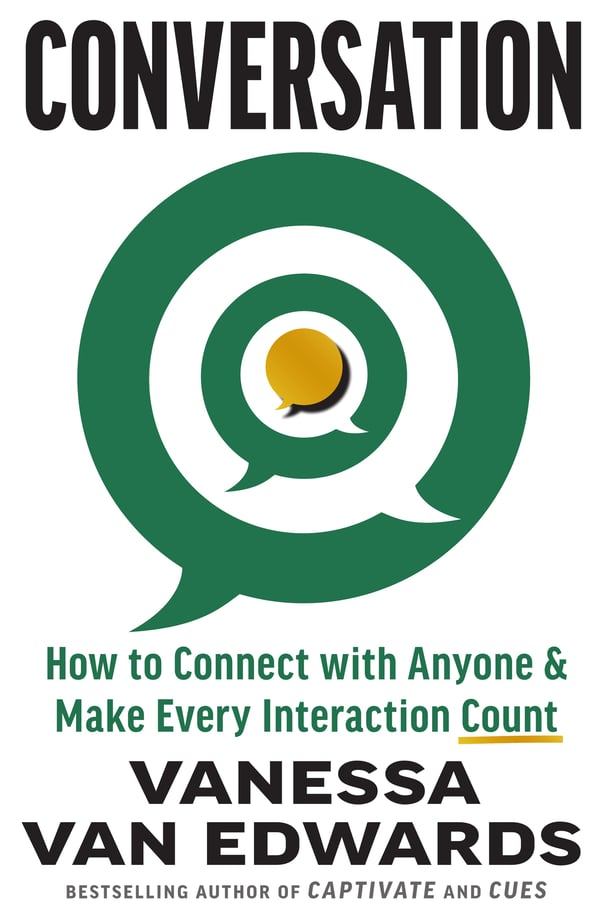
A new book by Vanessa Van Edwards
Every conversation is an opportunity.
If conversations have gotten harder, more awkward or less satisfying, you’re not imagining it. We’re simply out of practice. It’s time to find the joy in talking to each other again.
Put a Smile in Your Voice
Close your eyes and answer a phone call from a friend you haven’t heard from in years. You can hear them grinning before they say your name, can’t you?
That’s not your imagination. A smile changes the actual sound of your voice, and your listeners pick it up whether they can see your face or not.
A 1980 study aptly titled “Happy Talk” found that smiling physically reshapes your vocal tract, raising your voice’s pitch and timbre enough that listeners who heard only the audio, no video at all, could reliably tell when a speaker was smiling.1
One catch. The warmth has to be real. Research on emotional vocalizations found that listeners could separate authentic sounds from acted ones at better-than-chance rates.2 Those were laughs and cries rather than read scripts, so the jump to script delivery is an extension, but the lesson still applies: a forced “smiley” voice that doesn’t match a real feeling risks sounding put on.
So don’t just stretch your lips.
Pro Tip Before a line that needs warmth, prime the feeling instead of faking the face. Picture a specific person you’re happy to talk to, or a real moment that delighted you, and hold it for one breath before you start the line. The warmth rides in on its own. It works wonders in interviews and any time you want a client to trust you.
Free Your Hands to Free Your Voice
Your hands control your voice.
We tend to think of gestures as decoration, something you sprinkle on top of the words. The research says it’s the other way around. The book Hearing Gesture argues that gesture and speech come from one single mental system, so tightly linked that when people are stopped from gesturing, their speech gets more hesitant and less fluent.3
It’s physical, too. Researchers have shown that when your arm moves and then decelerates, that little jolt travels through your torso, compresses your rib cage, and changes the air pressure behind your voice, producing spontaneous spikes in pitch and loudness.4
A gesture can generate vocal emphasis all by itself. Free your hands and your voice gets its variety for free. Pin them to a podium and you’re stuck trying to fake that variety on purpose, which is exactly the thing that sounds artificial.
This lines up with what we found studying the most popular TED talks. The most-viewed speakers used about 465 hand gestures in 18 minutes. The least-viewed? Around 272.5
Try this: if you’re holding a script or a book, set it on a surface or hold it in one hand so your other hand is free to move. And keep your gestures synced to your words, so the peak of each gesture falls right on the word you’re emphasizing. (Want more? See our guide to how to speak with presence.)
Master Your Pace and the Power Pause
Two things control how you sound here: your rate, and your pauses.
First, rate. A classic set of experiments found that speakers who delivered the same message at a faster clip were rated as more knowledgeable, more trustworthy, and more persuasive than the slower ones.6 A brisk pace shows you know your stuff.
But that’s no license to sprint. Push too fast and comprehension drops. The sweet spot for most people is a brisk-but-natural conversational pace, somewhere in the neighborhood of 170 to 190 words per minute: fast enough to sound sharp, slow enough to stay clear. (Honest caveat: this core research dates to the 1970s, and podcasts and video calls may have nudged the ideal since, so treat the range as a rough guide and trust your ear.) And if you slow way down the moment you start reading, read a touch faster than feels comfortable.
Then break that brisk pace with pauses. A silent pause, no “um,” no “uh,” shows confidence and hands your listener a second to actually absorb the point. It’s easy to rush straight through your own punctuation. Skilled speakers stop completely, for a full two or three seconds, after a key line.
Watch Steve Jobs introduce the iPhone and count how long he holds the silence before each reveal:
You can build these right into your script with a simple mark, a double slash wherever you want a beat:
- “And then we found // something surprising.”
- “I want to show you // what we built.”
- “We hit our goal this month // a 20% jump in sales.”
Drop a pause mid-sentence to build anticipation, or at the end of one to let the thought sink in.
Build Charisma Into the Words Themselves
Still feels flat? The problem might be in the writing itself.
The research here is encouraging. Charisma is trainable.
In one study, researchers taught a group of managers a specific set of “charismatic leadership tactics,” then had their coworkers rate them months later. The trained group earned a big, clear jump in charisma ratings over the untrained group.7 These are concrete, learnable verbal moves that anyone can pick up with practice.
Better yet, several of the tactics are things you can write straight into a script, and they more or less force good delivery, because the language itself demands the emphasis.
- Metaphors and analogies make an abstract point vivid, and naturally slow you down so the image lands.
- Contrasts (“We didn’t play it safe; we bet the company”) create a built-in pitch shift between the two halves.
- Three-part lists (“It was faster, cheaper, and ours”) build a rhythm that crescendos.
- Rhetorical questions force a rising tone and a little pause for the answer.
- Stories pull your voice into a warmer, conversational register without you trying at all.
Write these in on purpose, and the delivery usually improves with them. For more, see our guide to charismatic traits and the different charismatic leadership styles.
Channel a Role Model, Carefully
You’ve probably heard the advice: imagine you’re a charismatic speaker you admire, your “inner Steve Jobs,” or Oprah, and you’ll soak up some of their magnetism.
It’s worth doing, though the reason it works is not the one people usually give.
There’s no peer-reviewed study where people were simply told to “channel Steve Jobs” mid-speech and then got rated more charismatic. What the science does back is the mechanism underneath it. Vivid mental rehearsal fires many of the same neural pathways as the real thing. In one study, participants who only imagined a strength exercise measurably increased their muscle strength.8 That was a finger-and-elbow task rather than a speech, so treat the leap to delivery as an extension rather than a proven result. It does suggest that picturing yourself calm and polished gives your body a clear target to copy.
So treat role-model visualization as a warm-up. It boosts your confidence and hands you a clear template: calmer hands, a steadier voice, a bolder posture. It works best layered on top of real rehearsal.
Put Real Emotion Back In
You might have seen someone walk on stage and say, “Hi, I’m so happy to be here,” without showing any happy emotion. Or you asked a coworker how they were doing and got a dead-eyed “I’m great.”
One of the most common script-reading mistakes is stripping out the very emotion the words are supposed to carry. And it usually happens for an innocent reason: we rehearse a line so many times it goes numb.
The fix is to mark your emotional beats before you deliver. Go through the script and jot in the margin what each key part should feel like: excited here, sincere there, a little playful at the end. Some people drop in a quick emoji as a reminder to bring the right energy.
And remember, since listeners can sense a mismatch between your words and your real feeling, don’t fake it. Find the genuine version of the emotion and let it through.
Know When to Ditch the Script
Sometimes the most natural move is to just put the script down. And knowing when matters as much as knowing how to read it.
The research points to a real trade-off. Reading from a script can make you sound precise and credible, but going off-script tends to build more trust and connection, because listeners hear it as spontaneous and real. (The communication-analytics firm Quantified Communications has reported a similar split in its speech analysis, though that’s industry data, not peer-reviewed research, so weigh it as directional.) It’s why public-speaking teachers push extemporaneous delivery for the parts that matter most.
So try the half-and-half approach.
- Script the parts that have to be exact, statistics, quotes, names, legal or compliance language, and read those word for word.
- Speak from bullet points for everything else, your stories, your transitions, your emotional high points.
Handy trick: write a cue like “[my story]” right into your script as a flag to look up, drop the page, and just talk. Those off-script moments are usually where trust and rapport actually get built, so protect them. (For more on building that warmth, see our therapeutic communication techniques.)
Read Any Script Like You Mean It
Sounding natural on a script is a system, and you can stack it piece by piece:
- Write for the ear, dictate first, plain words, breath-sized lines.
- Warm the voice by priming a genuine feeling and letting it smile through.
- Free your hands so gesture drives the vocal variety for you.
- Control the clock, a slightly brisk pace, broken by confident, silent pauses.
- Build charisma into the words with metaphors, contrasts, three-part lists, and stories.
- Script only what must be exact, and speak the rest.
So go pull up that script you’ve got coming. Read it out loud once, right now, and listen for where it sounds written instead of spoken. That’s your first edit. To lock these habits in faster, try our guide on how to learn anything.
- Tartter, 1980, Perception & Psychophysics
- Anikin & Lima, 2018, Quarterly Journal of Experimental Psychology
- Goldin-Meadow, Hearing Gesture, Harvard University Press
- Pouw & Fuchs, 2022, Neuroscience & Biobehavioral Reviews
- Science of People — TED Talk Hand Gesture Analysis
- Miller, Maruyama, Beaber & Valone, 1976, Journal of Personality and Social Psychology
- Antonakis, Fenley & Liechti, 2011, Academy of Management Learning & Education
- Ranganathan et al., 2004, Neuropsychologia