There’s a great point in your head, and you know exactly how it goes. Then it’s your turn, and the words come out too fast, too quiet, or in an order that made perfect sense inside your head and nowhere else. (If this happened in a job interview, welcome. Pull up a chair.)
The good news? Speaking well is a set of small, trainable habits, and you can practice most of them in your car, your kitchen, or the five minutes before a meeting. That matters, because your voice does more work than you might think. Hiring evaluators and professional recruiters judged job candidates as more competent, thoughtful, and intelligent when they heard a pitch than when they read the same words. They were also more interested in hiring them.1
Big Idea: The same pitch tends to sound smarter out loud than on paper. And your voice is something you can practice in the car! Below you’ll find the habits that help most, with drills and scripts for meetings, presentations, and everyday conversation, from the client call to the book club.
Start With the Tip That Fits Your Snag
Which row below sounds most like you? Be honest, nobody’s grading! You’ll improve fastest by fixing the one thing that trips you up most and leaving the rest for later.
| What happens when you talk | What it sounds like to others | Start with |
|---|---|---|
| You ramble and lose the point | “Wait, what are we deciding?” | Know Your MVP, Then Say It First and Last |
| Your words blur or you mumble | “Sorry, can you repeat that?” | Warm Up Your Voice and Your Mouth |
| You go quiet or end statements like questions | “Are they sure about this?” | Speak a Little Louder and a Little Lower |
| You rush, then fill gaps with “um” | “Slow down, I’m lost.” | Find Your Pace, Then Pause on Purpose |
| Your mind goes blank when someone asks you something | Silence, then “So, um, yeah.” | Use the Point-Reason-Example Sandwich |
| Your stomach drops before a presentation | Nothing yet (you’re still in the hallway) | Give Yourself a Pep Talk by Name |
| You trip over certain words | “Did they just say ex-presso?” | Check Your Pronunciation Before It Checks You |
Try This: Circle one row tonight. Do that tip’s drill three times this week before you add another.
Talk About What You Know Cold
When did you last talk for five minutes without notes? Maybe it was about how your team rebuilt onboarding, or why your fantasy league’s trade rules are deeply unfair. Your voice was steadier and your examples came faster. That’s the voice to bring into more rooms, and it comes out when you’re talking about something you actually know cold.
Bluffing has the opposite effect, and listeners can usually hear it. It can make you sound uninformed and like a know-it-all at the same time, which is a tricky double to pull off by accident! Masterful conversationalists are usually comfortable saying, “I don’t know,” and then steering back to what they do know. It sounds like this:
| Situation | What to say |
|---|---|
| At work | “That’s outside my area, but I can tell you how it played out on the client side.” |
| In a meeting with experts | “I’m not the right person on the legal piece. Here’s what I saw in the sales data.” |
| At a party | “I know nothing about cars, but I’ll tell you everything about the worst road trip I ever took.” |
A new book by Vanessa Van Edwards
Every conversation is an opportunity.
If conversations have gotten harder, more awkward or less satisfying, you’re not imagining it. We’re simply out of practice. It’s time to find the joy in talking to each other again.
Read Out Loud, Then Play It Back
Reading well-edited text aloud gives your mouth a workout on sentences that already flow, and over time your own spoken sentences start to borrow that shape. A sentence that looked fine on paper can turn into a tongue twister the second you say it.
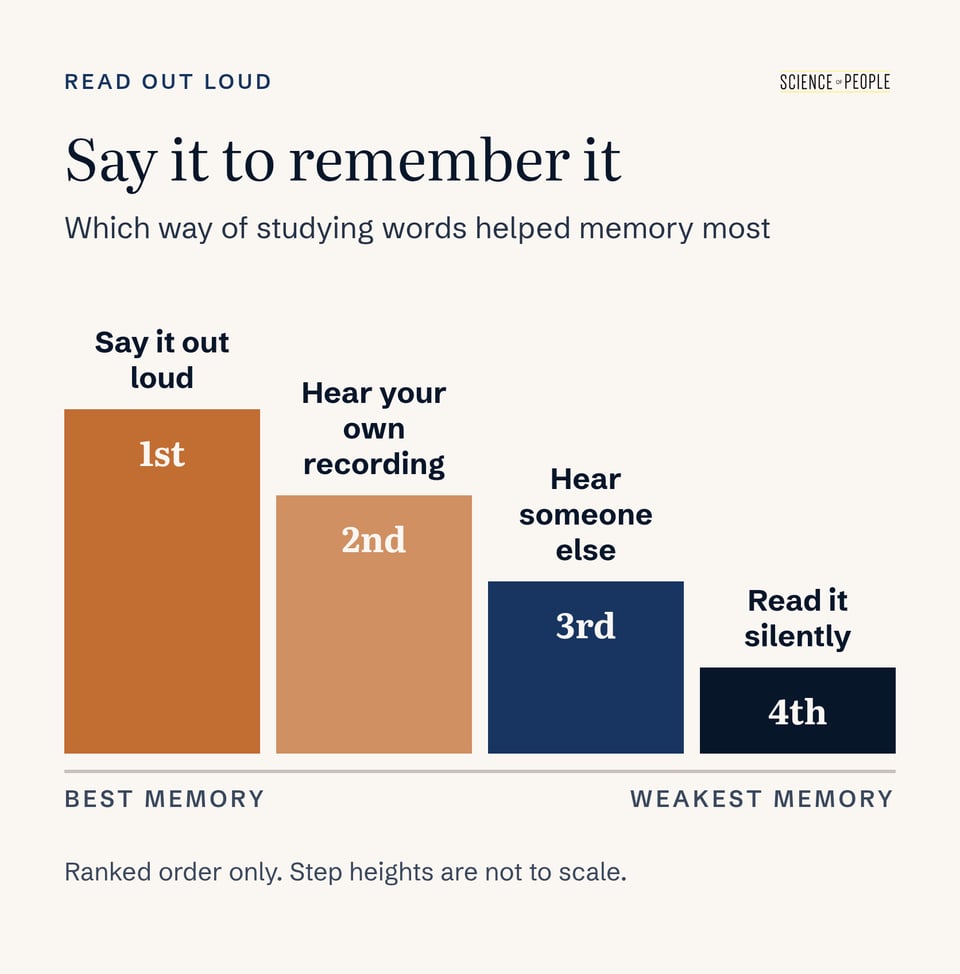
And here’s a memory bonus you might not expect. Saying words out loud helps you remember them better than reading them silently. Hearing a recording of your own voice helps, too, and more than hearing someone else read them.2 So read your notes aloud, and replay your own voice memo instead of just rereading the page.
Try this once a week (or every night, if you’re feeling ambitious):
- Read one page of a book you enjoy out loud, start to finish.
- Mark the words you tripped over and the sentences that sounded awkward.
- Read it again, stressing the important words with a shift in volume or inflection (how high or low your voice goes). If it’s fiction, give each character a slightly different voice, a sneaky way to practice vocal variety.
- Record it on your phone and listen back. Does your voice rise and fall with the meaning, or did it go flat, rush, or curl up at the end of every sentence?
Warm Up Your Voice and Your Mouth
Spend a few minutes warming up, and your first sentence on a listing call comes out steady instead of a croak. The same goes for the moment you finally ask for a raise. It also means fewer people asking, “Sorry, what was that?”
Start with your breath, since that’s often where a shaky voice begins:
- Breathe from your belly. Put a hand on your stomach and breathe in slowly so your hand moves out, then out slowly so it moves in. Five times before a big conversation.
- Exhale first. Instead of a quick gasp right before you speak, let out a long breath, take an easy breath in, and then start talking.
- Hum before you go in. A gentle hum with your lips closed is a quiet way to wake up your voice in a hallway or a bathroom stall.
Then wake up your mouth. Tongue twisters are a little silly on purpose, because a sentence that’s hard to say makes your lips and tongue work harder than any normal sentence will. They’re also a handy drill if English isn’t your first language. Try these:
- Red leather, yellow leather, red leather, yellow leather.
- You know New York, you need New York, you know you need unique New York.
- The fourth-quarter forecast fell flat for five firms.
- Six specific statistics, six specific statistics.
Start slow and exaggerate every consonant, like you’re talking to a friend across a noisy restaurant. Speed up only as fast as you can stay clean, and let yourself laugh when you trip (that’s part of the drill).
Try This: Build a two-minute routine for tomorrow morning: five belly breaths, one long exhale, 30 seconds of humming, and one twister. Do it before your first call. (The person at the next red light will assume you’re on the phone.) For more, try these vocal warm-ups.
Give Yourself a Pep Talk by Name
Here’s a weird tip with research behind it. A change in how you talk to yourself can help you walk into a big conversation calmer and do better once you start. Swap “I” for your own name. (Yes, it feels a little odd the first time. Stick with us.)
Before giving a speech, people who used their own name or “you” in their self-talk performed better than people who used “I.” They also felt less distressed, and that held for socially anxious people, too.3 They also spent less time replaying the speech afterward.
So instead of I’m going to blow this, you say, “Okay, Jordan. This is your material. Start with the budget slide.” It sounds like a coach talking to a player, and that’s exactly the point! A little distance makes the moment feel more like a challenge and less like a threat.
You can use it to rehearse, too. Practice what you’ll say to your boss while you drive to work, or walk around your room going over your key points out loud. And when your inner voice says “You sound stupid,” swap it for something specific and true. (More on silencing your inner critic.)
Try This: Write a three-sentence pep talk that starts with your name, the kind a good friend would give you in the hallway: “Priya, you know this project better than anyone in the room. Lead with the deadline. Then ask for help on the vendor piece.” Say it once before your next meeting.
Borrow Moves From Speakers You Admire
Borrow the delivery you like from speakers you already admire, and keep everything else your own. (The words still need to be yours, of course.)
The easiest way is to shadow a podcast. Play a host you like and repeat what they say a beat behind them, like an echo. Podcasters make great models because they can’t lean on slides or a smile, so everything has to come through their voice. Then pause, say a sentence on your own, and compare. Here’s what to listen for:
| Listen for | What to borrow | Try it in |
|---|---|---|
| Pace | Where they speed up and where they slow down | Your next status update |
| Pauses | The silent beat before a key line | The last sentence of a pitch |
| Pitch | How their voice drops at the end of a statement | Your next “Here’s my recommendation” |
| Word choice | Short, concrete words instead of jargon | An email you’re about to say out loud |
Pick one quality, like a slower pace, and fold it into how you already talk. If you sound exactly like your favorite podcaster, your coworkers will notice, and they’ll ask what you’ve been listening to!
Know Your MVP, Then Say It First and Last
Walking out of a meeting, you realize nobody remembered the one thing you came to say. Decide your MVP, your Most Valuable Point, before you open your mouth, and people are far more likely to remember what you said. It’s the one sentence that matters if everything else you say is forgotten:
- When you ask for a raise: “Over the past six months, my accounts grew 30%, and I’d like to talk about a raise that reflects that.”
- “I’m asking for one more week on the launch so we can fix the checkout bug before customers find it.”
- At tonight’s book club: “I loved the ending, and I want to say why.”
Then put it where memory works hardest. When people try to recall a list, they usually remember the first few items and the last few best, and the middle tends to blur together.4 A talk isn’t a word list, but the lesson travels well. So please don’t bury your best idea on slide 11 between the org chart and the budget!
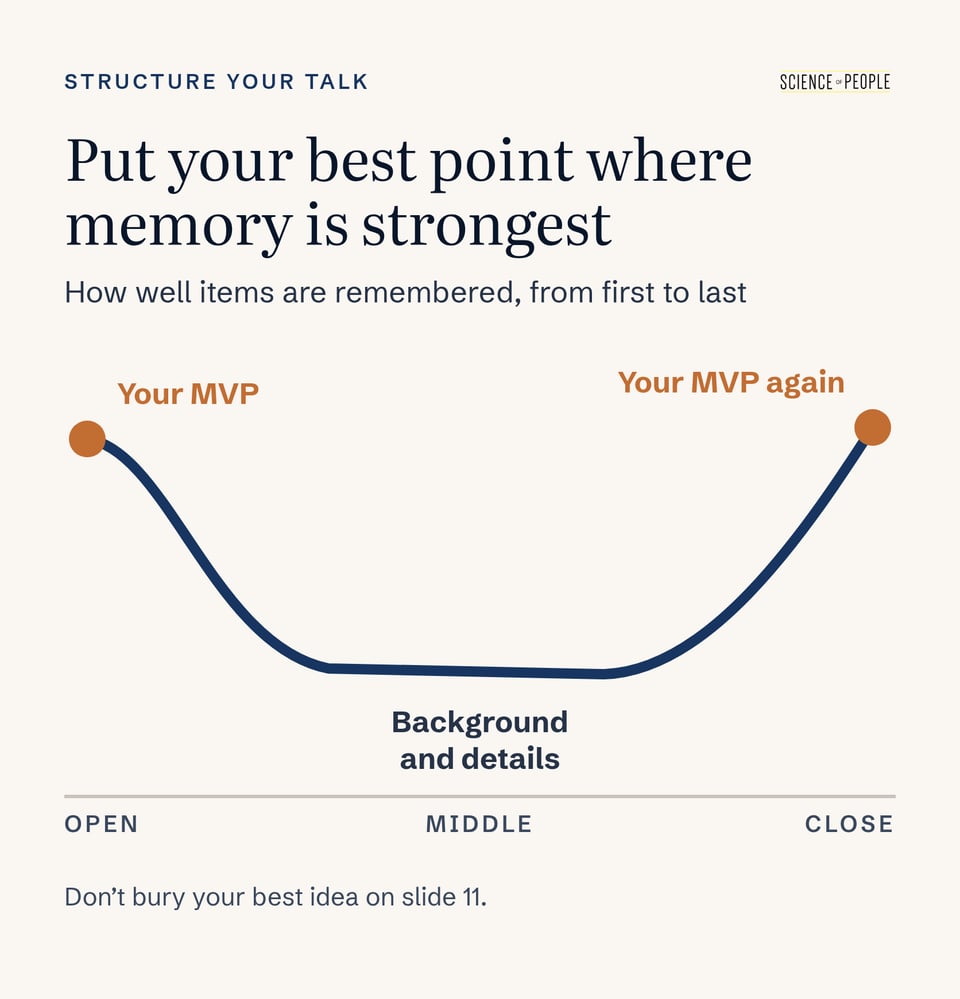
Open with your MVP, put the background and details in the middle, and repeat the MVP at the end in slightly different words. Here’s that order for a pitch to a marketing client:
| Part | What you say |
|---|---|
| Open | “Top Level Agency handles everything in-house, offers 24-hour emergency support, and lets you pay monthly.” |
| Middle | Your introduction, the package details, examples of past work, and the timeline |
| Close | “So you get in-house design, help at 2 a.m. if your site goes down, and no big upfront bill.” |
The same goes for stories. If yours starts with “So, back in 2019, I’d just moved to Denver,” try opening with the payoff, then fill in the backstory. Your listeners will happily sit through Denver once they know there’s a good ending coming.
Action Step: Before your next meeting, write your MVP on a sticky note in 15 words or fewer. Practice your opening and closing lines the most, so even if the middle wobbles, you start and finish strong.
Speak a Little Louder and a Little Lower
An upward lilt at the end of every sentence makes you start doubting the idea before you’ve even heard it. A little more volume and a slightly lower pitch can help people take your idea seriously the first time you say it.
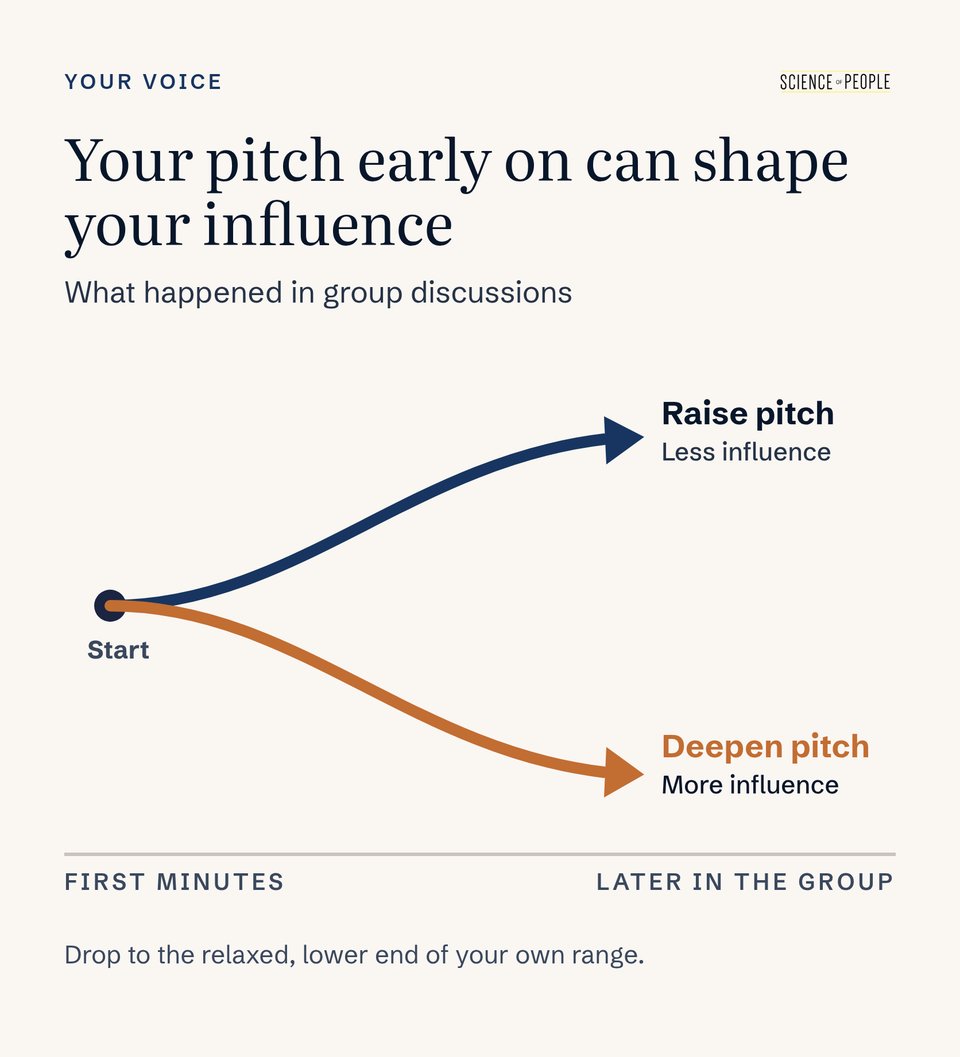
Here’s what researchers found when they tracked pitch in group discussions. People who deepened their pitch early on tended to end up with more influence, and people who raised their pitch tended to end up with less. When listeners heard those same small shifts, it changed how high-ranking and formidable they judged the speaker to be.5
In your next meeting, you can try these adjustments, one at a time:
- Speak a notch louder (no yelling). Nerves shrink your volume. Aim to reach the farthest person in the room. On a video call, that’s normal volume with your microphone close.
- Drop to the lower end of your range. You don’t need a new voice. Hum a comfortable note, then start your sentence on that note.
- End statements on the way down. Say “I recommend we launch on Monday” once rising and once falling, and notice which one you’d trust.
Plenty of first conversations happen on the phone, where your voice is all you’ve got:
Try This: Record yourself saying, “Here’s what I recommend.” If it rises at the end, record it again with a falling finish. For more, read how to speak with confidence, or fix a flat delivery with these tips on a monotone voice.
Find Your Pace, Then Pause on Purpose
Find a pace your listeners can ride along with, and they’ll stay with you all the way to your point. A slow, droning pace makes it hard to keep listening, and a rushed one makes you hard to understand. In an older study from 1976, a faster delivery made speakers more persuasive and seemed to boost their credibility. The same paper noted that speech texts put normal speaking at roughly 120 to 180 words per minute.6 So you don’t need to slow to a crawl to sound smart! Stay clear, and if you’re a rusher, clear comes first.
Curious where you land? Read a paragraph of known length out loud with your phone’s stopwatch going. Divide the words by the seconds, then multiply by 60. Then play the recording for a friend and ask whether it felt rushed, slow, or easy to follow. Their answer is the tiebreaker.
The other half of pacing is the pause. Filler words like “um,” “like,” and “you know” usually pop out when your brain needs a second to catch up. A silent beat does the same job, and it sounds deliberate:
- Record a one-minute answer to “What did you work on this week?”
- Play it back and tally every filler word.
- Record it again. Every time you feel an “um” coming, close your mouth and pause instead.
| Before | After |
|---|---|
| “So, um, the launch is, like, mostly on track, but, uh, we have a checkout bug.” | “The launch is mostly on track. (pause) We have one problem. (pause) The checkout bug.” |
The second version will feel painfully slow to you. To a listener, it usually just sounds calmer! For more, read our guide to filler words.
Action Step: In your next meeting, pause for one full breath before your most important sentence.
Use the Point-Reason-Example Sandwich
Keep a simple structure in your back pocket, and you’ll have an answer ready when someone asks, “What do you think?” No more going blank the second they turn to you. The sandwich has four layers. You give your point in one sentence, add one reason and one concrete example or number, then say your point again in a few words.
“I think we should switch project tools. The current one doesn’t let clients see progress, so we spend every Friday writing status emails. Last week that took me two hours. So yes, I’d switch.”
Here’s the sandwich in a few more settings:
| The question | Your sandwich |
|---|---|
| “Tell me about yourself.” (interview) | “I’m a project manager who loves messy launches. I like turning chaos into checklists. Last year I led a launch across three time zones that shipped on time. So I’m happiest in the middle of a big rollout.” |
| “Any thoughts on the new schedule?” (meeting) | “I like it. It frees up Friday afternoons for deep work. On my old team, that cut our missed deadlines in half. So I’m in.” |
| “Which restaurant should we pick?” (friends) | “The Thai place. It’s the only one with a patio. Last time we sat inside the other place, nobody could hear anyone. Thai place, final answer.” |
If you need a second, buy it out loud: “Good question. Give me a second.” For a short version about your work, build an elevator pitch.
Action Step: Pick one question you expect this week. Write your four-layer answer on your phone and say it out loud twice.
Treat Presentations Like a Short Performance
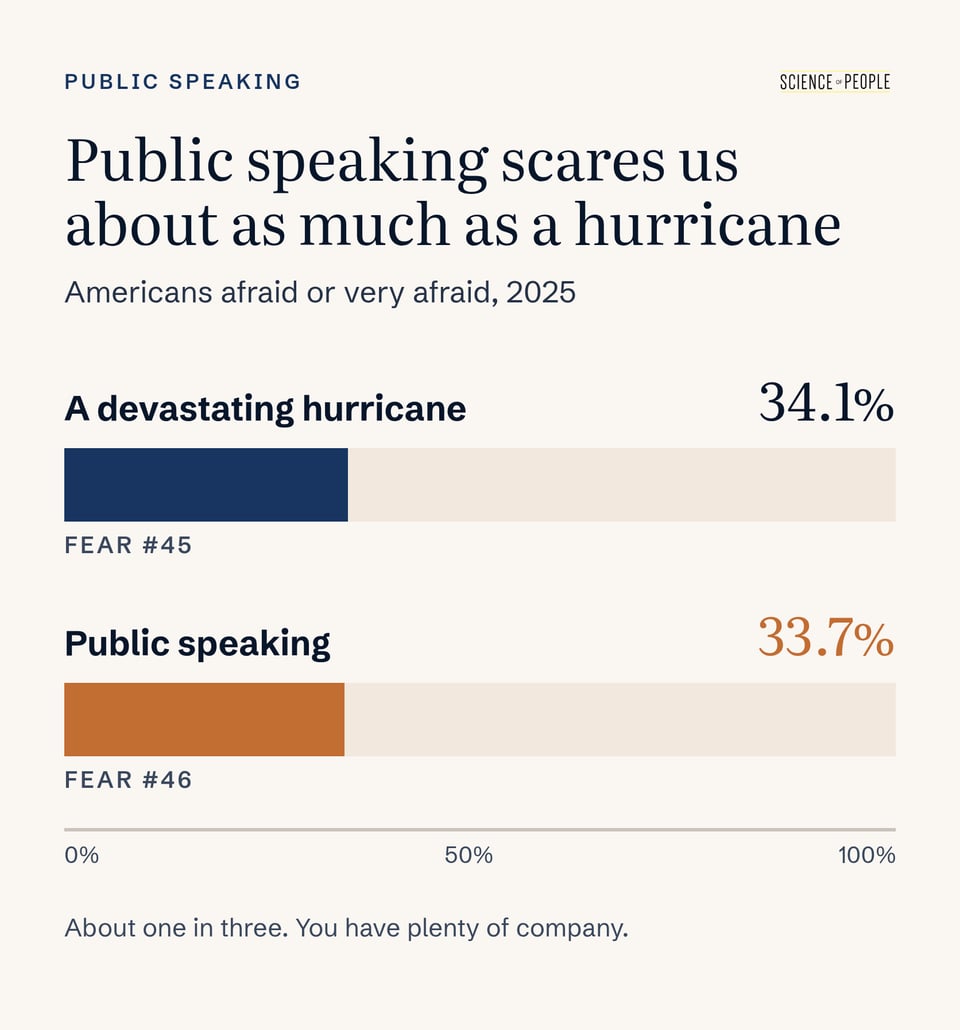
A presentation is a performance you get to rehearse, so you can give a good one without being a born natural. And if presentations scare you, you’re in good company. Quick quiz! Which do Americans fear more, public speaking or a devastating hurricane? Make your guess. In a 2025 survey of American fears, 33.7% of Americans said they were afraid or very afraid of public speaking. That put it at #46 on the list, just behind a devastating hurricane at 34.1%.7 So it’s basically a tie. (A hurricane at least doesn’t ask for questions at the end.)
Three moves tend to make the biggest difference:
- Start with a hook. A surprising one-liner, a short story, or an intriguing question wins the room in the first 30 seconds. Notice how Vanessa Van Edwards opens her TEDx Talk with a funny line about her own awkwardness:
- Cut the extra. Keep only what supports your MVP. If a fact doesn’t help your point, cut it, even if it took you an hour to find.
- Make it interactive. A “raise your hand if…” question, a quick poll, or a two-minute role-play means you’re not carrying the whole thing alone.
After that, pick one stage skill per talk, like stage presence or presentation body language, and practice only that one. If the Q&A keeps you up at night, read up on how to handle presentation Q&A.
Try This: Rehearse your opening 30 seconds out loud five times tomorrow. Time it on your phone.
Let Your Hands Show What Your Words Can’t
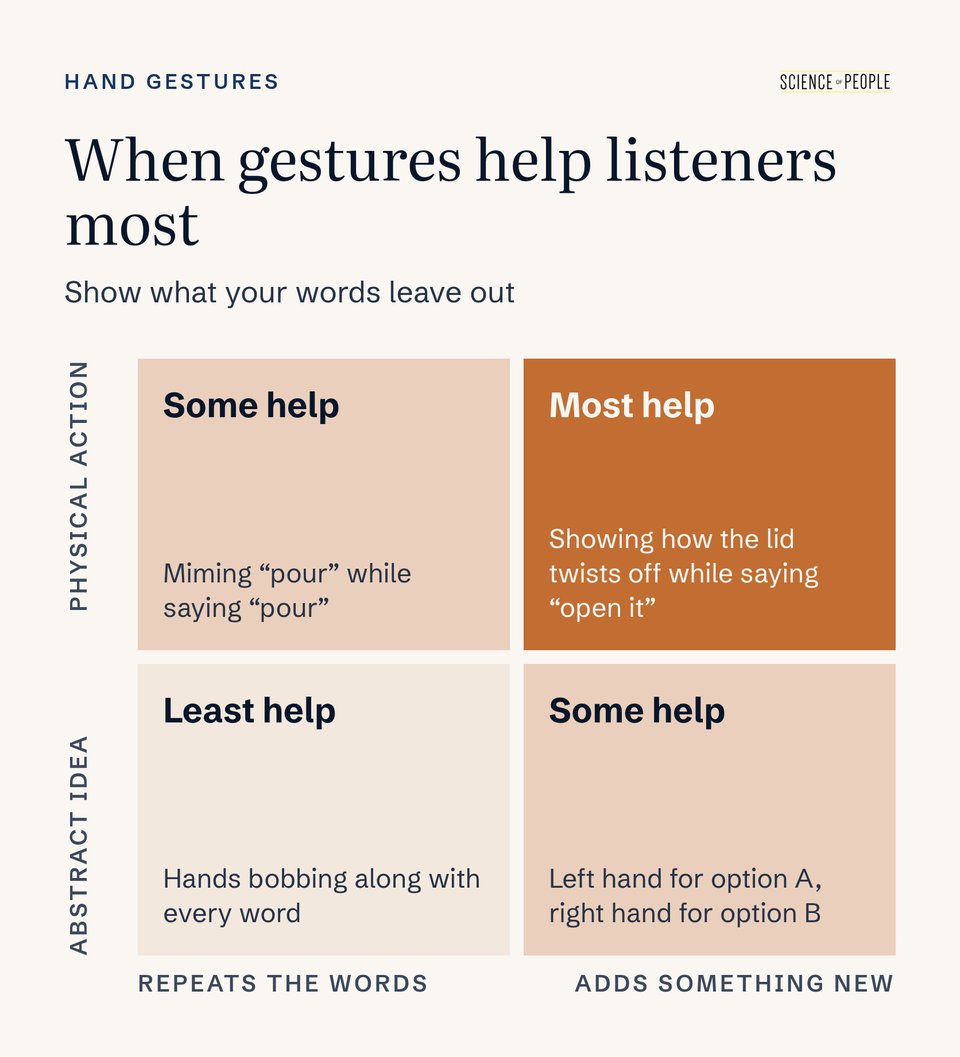
Someone is describing a spiral staircase with their hands pinned to their sides. It’s painful! Across 63 samples, adding gestures to speech gave listeners a moderate boost in understanding the message. The boost was biggest when the gestures showed a physical action, and when they added something the words didn’t already say.8 So a gesture that shows how the box folds open beats one that just bobs along with every word.
When we reviewed popular TED Talks here at Science of People, the most-watched speakers used nearly twice as many hand gestures as the least-watched ones. (We wrote up the full findings in our guide to hand gestures.) So more gestures can help, as long as each one is showing something. A few to try:
- Show the number. When you mention a number, hold up that many fingers.
- Show the size. Say “this is a small problem” with your hands close together.
- Organize left to right. When comparing two options, gesture to one side for the first and the other side for the second.
- Bring things together. When two ideas merge, bring your palms together in the center.
Action Step: Pick one explanation you’ll give this week and plan one gesture that shows something your words leave out, like the order of steps or the size of a change.
Listen and Read the Room
It feels great when someone asks a follow-up that proves they really heard you. The best speakers are often the best listeners, because they know what the other person cares about before they open their mouth. A few habits help most:
- Follow-up questions. Ask about something they actually said: “Wait, you moved to Lisbon for a year? What was the hardest part?”
- The two-second gap. When someone stops talking, count two seconds before you start. Sometimes they’ll add the most interesting part. (“The client meeting was rough.” Pause. “They asked if we’d cut the budget in half.”)
- Eye contact. Put your phone face down and look at them while they talk. Here’s more on making eye contact without making it weird.
And keep watching while it’s your turn to talk. Look for clusters of cues and changes from someone’s usual behavior, not any single cue:
| What you notice | What it might mean | What to say |
|---|---|---|
| Arms fold and the nodding stops | They have a concern | “Before I keep going, what questions do you have so far?” |
| Eyes drift to the clock or phone | You’re running long | “Let me jump to the bottom line.” |
| They lean in and their eyebrows rise | They’re interested | “Should I go deeper on that part?” |
Listening is one of the most valuable social skills, and it pays off every time it’s your turn to talk.
Try This: In your next conversation, ask one follow-up question about something specific the other person said before you share anything about yourself.
Check Your Pronunciation Before It Checks You
That little flash of panic, when a tricky word is coming up in your sentence, goes away once you fix the handful of words you mispronounce. You’ll sound more polished without changing anything else. And if a few words make you nervous, you’re in good company, because these trip up native speakers too:
- Et cetera (not “ek cetera”)
- Espresso (not “expresso”)
- Specific (not “pacific”)
- Epitome, niche, liable, meme
Some words have more than one accepted pronunciation. A good dictionary lists both “neesh” and “nitch” for niche, so either is fine. When you’re unsure, look the word up in an online dictionary and press the audio button.
If you mispronounce a word mid-sentence, correct yourself and keep moving: “Excuse me, espresso.” If you have an accent, keep it. It’s part of how you sound like you, and as long as people understand you, you don’t need to sound like anyone else. If you speak English as a second language, learn how to sound charismatic in a second language.
Action Step: Write down three words you avoid because you’re not sure how to say them. Look each one up today and say it out loud five times.
Get Extra Help for Stuttering or Speech Differences
If you stutter, or speech feels hard for reasons drills don’t touch, a professional can help you find strategies that fit you. Asking for that kind of help is a normal, smart next step. Good places to start:
If anxiety is the bigger hurdle, these tips on speaking anxiety and stage fright are a good next read.
And if you’ve tried drills on your own and they don’t stick, that’s normal! It’s hard to coach yourself. Practicing with real people who give you feedback is the next step. That’s what we do in People School, at whatever pace fits your week.
Frequently Asked Questions (FAQs) About Improving Speaking Skills
How can I improve my speaking skills quickly?
Fix your single biggest snag first and practice it daily for a week. If you ramble, write your Most Valuable Point before every meeting. If you mumble, warm up with two tongue twisters before your first call. If you rush, record a one-minute answer and redo it with pauses. Add the next habit once the first feels automatic.
How can I practice speaking skills at home by myself?
Read one page of a book out loud, record it on your phone, and listen for where you rushed or trailed off. Then read it again with those fixes. Shadowing a podcast host, vocal warm-ups, and a pep talk using your own name all work in a quiet room, too.
How do I stop stumbling over my words when I talk?
Slow down slightly, finish every word’s final sound, and pause between ideas instead of pushing through. Plan your first sentence before you speak so you’re not building it on the fly. If stumbling happens even when you’re relaxed and alone, a speech-language pathologist can check for an underlying pattern.
How do I stop saying "um" and "like" so much?
Replace them with short, silent pauses. It sounds almost too simple, but it usually helps. Record a one-minute answer and count your fillers, then record it again, closing your mouth and pausing each time you feel an “um” coming. The second version will feel slow to you, but it usually sounds calmer to listeners.
How can I sound more confident when I speak?
Speak a little louder, use the lower part of your natural range, and end statements on a falling note. Record yourself saying “Here’s what I recommend” and check that your voice goes down at the end. Before big moments, give yourself a short pep talk using your own name.
How do I think on my feet when someone asks me a question?
Use the Point-Reason-Example sandwich: say your answer, give one reason, add one example, and repeat your answer. If you need a moment, buy it out loud with “Good question. Give me a second.” Practicing the sandwich on questions you expect makes it automatic for the ones you don’t.
What is a good speaking speed?
One your listeners can follow without zoning out or asking you to repeat yourself, often somewhere around 120 to 180 words per minute. Time yourself reading a paragraph of known length, divide the words by the seconds, and multiply by 60. Then ask a friend whether the recording felt rushed or slow.
Does reading out loud improve speaking skills?
Yes! It gives your mouth practice on well-built sentences and lets you work on pace, tone, and pronunciation. Saying words aloud also helps you remember them better than reading silently. Try one page a night, record it, and listen back.
How can I improve my English speaking skills as a non-native speaker?
Shadow podcasts (repeat what the host says a beat behind them to copy their rhythm), read aloud, and check tricky words with an online dictionary’s audio button. Record yourself and compare it with the original. Keep your accent! The goal is to be easy to understand.
What's the difference between speaking skills and public speaking?
Speaking skills cover how you talk in any setting, from a coffee chat to a client call, while public speaking is speaking to a group. Both depend on the same habits, like a clear main point, a steady pace, good volume, and purposeful gestures. Build them in everyday conversations first, then use our public speaking tips when you’re preparing a talk.
How to Improve Speaking Skills Takeaway
You don’t need to fix everything at once (please don’t try!). Pick one of these and start this week:
- Circle your biggest speaking snag in the table at the top and practice that tip for seven days.
- Write your MVP on a sticky note before your next meeting and say it out loud once.
- Record a one-minute answer, count your filler words, and redo it with pauses.
- Give yourself a three-sentence pep talk using your own name before your next big conversation.
- Read one page of a book out loud tonight, then play it back.
To put your ideas into words even more clearly, read our guide on how to explain things better.