Breaking into a group conversation can be hard. When should you do it? What do you say? How do you approach?
No worries!
Why Approaching People Feels So Risky (And Why Your Fear Is Lying)
Approach anxiety: n. the spike of dread you feel in the three seconds right before you walk over and say hello. It’s incredibly common, and the strange thing about it is how badly it mispredicts reality.
Start with the liking gap. After a conversation with someone new, most of us walk away quietly convinced we came across worse than we did. A set of studies on this exact pattern found that people consistently believe their conversation partner liked them less than that partner actually reported, and the gap showed up in short chats, longer ones and even between roommates over the course of a year1.
Then there’s the fear of bothering people at all. Researchers asked Chicago commuters to do something most of us actively avoid: strike up a conversation with a stranger on the train. The people who did it reported a more positive commute than those who rode in silence, even though they had all predicted the opposite before they tried it2. We expect strangers to want to be left alone. Mostly, they don’t.
People also assume that going past surface small talk will feel awkward. In experiments on deeper conversations, the opposite happened. When people were nudged to ask more meaningful questions, the conversations felt less awkward and more connecting than they’d feared3.
So why does the fear feel so real? Part of it is that our brains weight the cost of social rejection heavily, and some people are simply more primed to expect it than others. If that’s you, you’re in good company. The way out is to collect evidence that the fear is wrong, one small interaction at a time.
Pro Tip After your next conversation with someone new, jot down how you think it went for them on a scale of one to 10. The number in your head is almost certainly lower than their real one. Watch that gap show up again and again.
Read the Room Before You Cross It
Not everyone is open to being approached in every moment, and you don’t have to guess. People broadcast their availability all over their body language, and learning to read it takes most of the gamble out of approaching.
Think of it like a traffic light: green means go, red means wait for the next one.
Green lights mean someone’s open:
- An open torso with nothing crossed in front of it
- Eye contact, or eyes scanning the room
- Feet and body angled outward rather than locked into a tight huddle
- A genuine, easy smile
- Visible, relaxed hands
Red lights mean wait or pick someone else:
- Crossed arms or a bag clutched across the chest
- Headphones in and a phone held up as a shield
- Torso and feet turned firmly away
- No eye contact and a closed, focused expression
In a group, look for what I call the croissant feet. When people are deep in a tight conversation, their feet usually point toward each other, closing the circle. But you’ll often spot one person whose feet have drifted outward into a little V, away from the huddle. That person is half-looking for an exit or an addition, and they’re your easiest way in.
Why trust these snap reads? Because impressions form fast and warmth gets clocked first. People form trait judgments from a face in about a tenth of a second, and giving them more time barely changes the verdict4. Decades of work on thin slices of behavior show the same thing: brief glimpses of how someone moves and carries themselves predict a surprising amount5.
Action Step: At your next event, do one slow scan of the room before you approach anyone. Find one person flashing two or more green lights. That’s your opening.
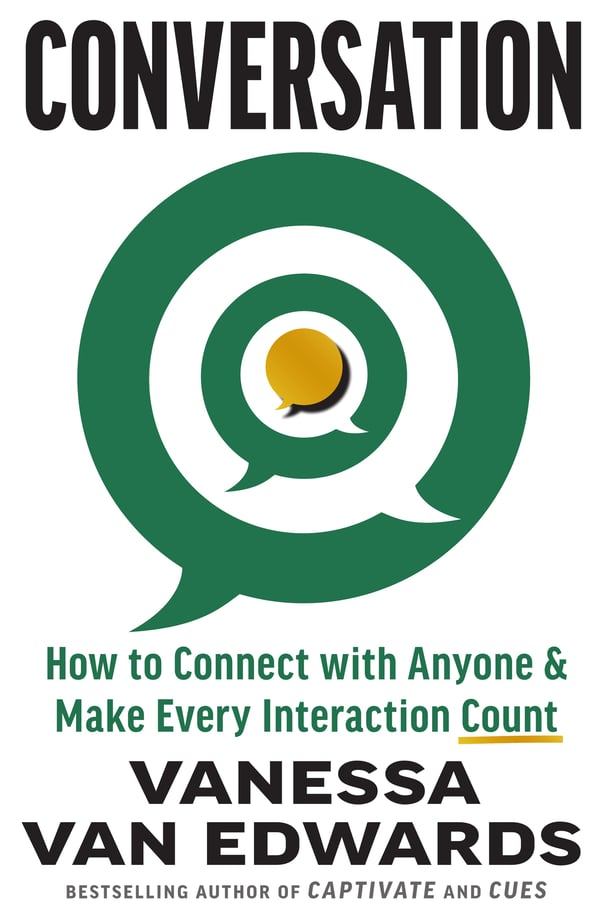
A new book by Vanessa Van Edwards
Every conversation is an opportunity.
If conversations have gotten harder, more awkward or less satisfying, you’re not imagining it. We’re simply out of practice. It’s time to find the joy in talking to each other again.
What to Actually Say (Warmth Beats Clever Every Time)
Most people overthink the opener. They burn an embarrassing amount of energy hunting for something witty, then never use it because nothing ever feels good enough. You almost certainly already know enough to start.
When researchers tested how different opening lines land in a dating context, direct openers that simply showed honest interest beat both the cheesy lines and the safe throwaway remarks6. Romance isn’t networking, but the same lesson applies. Drop the clever line and lead with something genuine.
That fits how impressions work in general. Of the two things we size up in a new person, warmth and competence, warmth tends to weigh more heavily in that opening moment7. Your first few seconds should show warmth first: a real smile, eye contact, an open body and a voice that’s easy rather than tight.
So what do you actually say? Pick whichever of these three fits the moment.
Comment on what you’re both in. The shared environment is the safest material there is. “This venue is gorgeous, have you been here before?” or “The line for coffee is no joke today.” You’re already in the same situation, so commenting on it never feels random.
Ask a question you could almost Google. “Do you know what time the keynote starts?” or “Any idea if there’s parking nearby?” It hands the other person an easy, low-pressure way to say yes and engage.
Just introduce yourself. “Hey, how’s it going? I’m Sam.” Plain, warm and disarming. It works because there’s nothing to see through.
For joining a group, wait for a natural pause, make eye contact with your croissant-feet person, walk over with a small smile and ask, “Hey, mind if I join you?” Asking permission quietly turns that person into your ally, and most of the time they’ll happily wave you in. And if they don’t? No worries. Just go find some more croissant feet.
Try This: Before you walk over, decide on your very first word and say it warmly, from low in your chest. A clear, friendly “Hey” sets the tone for everything that follows. Want a deeper bench of options? Browse our list of killer conversation starters.
Keep It Going: Be an Adder
Once you’re in the group, be an adder.
Adder: n. someone who contributes warmth and energy to a conversation. You don’t have to be the funniest or most interesting person in the circle. You just have to make the people already there glad you showed up.
You add warmth through small cues:
- A nod that says keep going
- A genuine smile
- A light lean in toward the speaker
- Small vocal encouragers like “mmhmm,” “ooh” and “no way”
Each one in action:


You can read more about reading and sending these cues in Cues by Vanessa Van Edwards.
The other half of being an adder is curiosity. Asking good questions, and especially follow-up questions that build on what someone just said, tends to make you more likable in conversation8. People walk away feeling good about the person who was interested in them.
Which is exactly why you want a back-pocket question ready for the inevitable lull. When a topic fizzles and the circle goes quiet, you’ll be so glad you have one of these on hand:
- “Does everyone here know the host?”
- “How do you all know each other?”
- “What brought you out tonight?”
- “Got anything fun planned for the weekend?”
You can keep building from there with our list of 500 fun questions to ask people, or sharpen your staying power with our guide to holding a conversation.
Action Step: Memorize one back-pocket question this week and use it the next time a conversation stalls.
How to Leave Without the Awkward Shuffle
Another fear keeps people in the corner. What if I get stuck? If you don’t know how to leave a conversation, every new one feels like a trap. So learn the exit, and the entrance gets a lot less scary.
A clean exit has three beats: a warm signal, a reason and a genuine close.
First, show you’re wrapping up. A small nod and a “Well…” or “Hey, I’m so glad we got to talk” tells the other person what’s coming, so it never feels abrupt.
Then give a light reason. You don’t owe anyone an essay. “I’m going to grab another drink,” “I promised myself I’d say hi to a few more people tonight,” or “I want to catch the speaker before they leave” all work.
Finally, close with something real. Name one thing you enjoyed and, if it fits, open the door to next time: “I loved hearing about your hike, you’ve got to send me that trail. I’m Sam, by the way.” Then go.
Pro Tip Pair your exit with a small introduction when you can. “Have you met Jordan? You two should talk about that startup.” You leave the conversation and leave a gift behind. People love a connector.
Build the Skill: A Gentle Ladder Out of Approach Anxiety
If approaching people feels genuinely hard, please don’t try to fix it by white-knuckling your way straight into the scariest version. That’s like learning to swim by jumping off the high dive. You build the skill in steps, the way the most effective anxiety treatments do, by starting small and letting reality keep proving your fear wrong9.
Here’s a ladder you can climb over a few weeks, easiest rung first:
- Make a second of eye contact with a stranger, smile and look away.
- Say “good morning” or “thanks, have a great one” to a cashier or barista.
- Ask someone for directions or the time.
- Make a little small talk at the register: “How’s your day going so far?”
- Comment on the shared environment to someone standing near you.
- Give a stranger one genuine compliment: “I love your jacket.”
- Introduce yourself to one new person at a social event.
- Start a two to three minute conversation with someone new, then add a follow-up question.
- Walk up and join a group of two or three people.
Two rules make the ladder work. First, stay in each moment long enough for the nervousness to settle rather than bailing the second it spikes. Second, track your predictions against what actually happens. Write down what you expect (“they’ll think I’m weird”) and what really occurs (“they smiled and we talked for five minutes”).
One caution: the viral “go get rejected on purpose” challenges make for fun videos, but they aren’t a validated treatment, and for anyone dealing with serious anxiety they can do more harm than good. The gentle, progressive ladder is the version with real evidence behind it. And if anxiety is interfering with daily life well beyond social events, a licensed therapist is the right next step.
You won’t climb the whole thing in a night, and you really don’t need to.
You’re More Welcome Than You Think
Strip it all down and approaching people comes to a few moves:
- Read for green lights before you cross the room.
- Lead with warmth and a simple, honest opener.
- Be an adder once you’re in, and exit warmly when it’s time.
- Then trust that the conversation almost certainly went better than the story in your head insists it did.
People want connection, they like you more than you’d ever guess and the worst case you keep rehearsing rarely bothers to show up.
So at your next event, pick one open face, take a breath and walk over.
For more on getting comfortable with new people, read our guides to talking to strangers and talking to anyone.
Frequently Asked Questions About Approaching People
How do you start a conversation with someone you don't know?
Lead with warmth and skip the clever line. Comment on something you’re both experiencing (“This venue is great, been here before?”), ask an easy question (“Do you know when the keynote starts?”) or simply introduce yourself with a smile. Direct, genuine openers tend to work better than rehearsed clever lines.
How do I get over approach anxiety?
Build the skill in small steps instead of forcing the scariest version first. Start with a second of eye contact and a smile, work up to small talk with a cashier, then to introducing yourself at events. Stay in each interaction until the nerves settle and write down what you expected versus what actually happened. Your fear loses power as reality keeps contradicting it.
How do you know if someone is open to being approached?
Read their body language. Green lights include an open torso, eye contact or eyes scanning the room, feet angled outward and a relaxed smile. Red lights include crossed arms, headphones and a phone held up, or a body turned firmly away. In a group, look for the person whose feet have drifted outward from the huddle.
Do strangers really want to talk to me?
More often than you assume. In studies on commuter trains, people told to chat with a stranger reported a more enjoyable trip than those who sat in silence, even though they’d predicted the opposite. People also tend to like you more than you think they do after a conversation, so the awkwardness you fear usually doesn’t materialize.
What do you say to join a group conversation?
Wait for a natural pause, make eye contact with the most open person, walk over with a small smile and ask, “Hey, mind if I join you?” Asking permission turns that person into your ally. Once you’re in, be an adder: nod, smile, ask a follow-up question and keep a back-pocket question ready for any lull.
How do you politely leave a conversation?
Use three beats: signal you’re wrapping (“Well, I’m so glad we talked”), give a light reason (“I’m going to grab another drink” or “I want to say hi to a few more people”), then close with something genuine (“I loved hearing about your hike, send me that trail”). Bonus points for introducing the person to someone else before you go.
References
- The Liking Gap in Conversations
- Mistakenly Seeking Solitude (talking with strangers)
- Overly shallow? Miscalibrated expectations and deeper conversation
- First Impressions: making up your mind after a 100-ms exposure to a face
- Thin slices of expressive behavior as predictors
- Men's perceived effectiveness of pick-up lines used by women
- Forming impressions of personality (warm-cold centrality)
- It Doesn't Hurt to Ask: question-asking and likability
- Cognitive behavioral therapy for anxiety: a meta-analysis