In This Article
Want a party people still talk about on Monday? Here are 18 research-backed steps for the guest list, the peak moment, the food, the lighting, and the follow-up.
I am terrified of nightclubs. I hate loud bars. And I get lost at concerts.
This makes Friday and Saturday nights as a non-80-something-year-old quite… difficult. As soon as it was socially age appropriate, I began to shift people from raves and bar crawls into game nights and dinner parties.
My first dinner party was a quasi-disaster.
There were a ton of appetizers and dessert, but not enough real food. People came really late and left early.
My groups of friends did not mix well. And I ran around like a crazy person.
HOWEVER, there was a hint of goodness. I saw potential in the night and a few of my friends asked when I was going to do it again. BINGO!
If even one person is into something you are doing, then you have something special.
It was time for an informal people experiment. I was going to run a number of different parties all with different variables. Test the outcomes, feel the vibe and learn how to throw the perfect dinner party.
Is it possible to throw the perfect party? I think so. Here are my tricks (and we’ve added the research behind each one).

Why Your Party Is Worth the Trouble
Hosting is a lot of work for one evening. So why bother? The answer is hiding in the health data.
Research across 148 studies and more than 300,000 people found that those with stronger social relationships had about 50% greater odds of survival over the years they were followed.1 The researchers put that alongside health risks most of us already take seriously.
Wait… 50%?! Your friends appear to be doing a lot more for you than keeping you company.
And those friendships are getting scarcer. In 1990, about a third of Americans said they had 10 or more close friends. By 2021 that was down to 13%, and the share reporting no close friends at all had gone from 3% to 12%.2
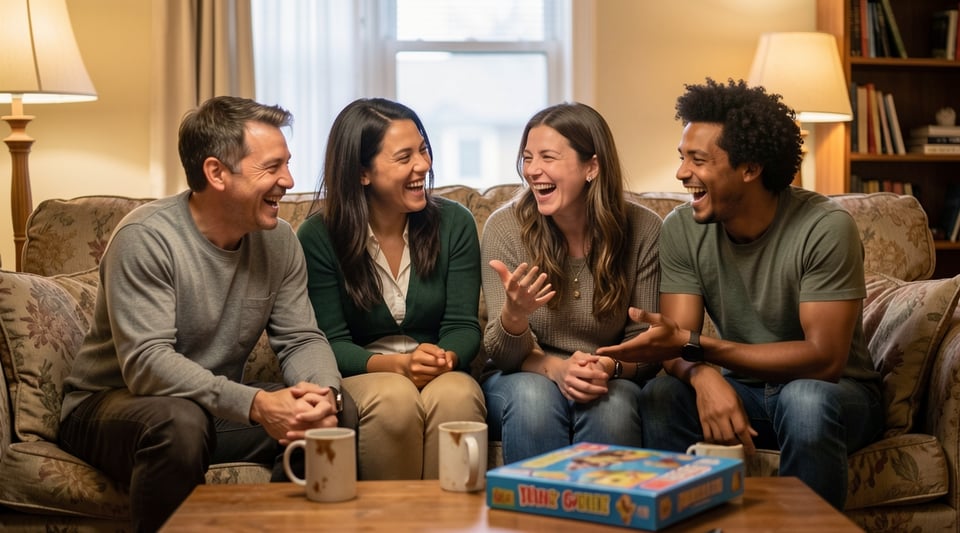
You don’t have to solve that. You can just be the one who has people over!
Action Step: Open your calendar and put a placeholder date six to eight weeks out. You can decide what kind of party it is later.
We are so honored to help you build real connections! If you are struggling with loneliness or isolation, please note that all content on this website is not to be considered professional medical advice. It is always best to consult a doctor or licensed therapist with any questions or concerns about your physical or mental health. For a good resource for therapists, you can check out Mental Health America’s helpful list.
1. Understand What People Actually Remember
Quick quiz! Would you rather hold your hand in painfully cold water for a short time… or for longer?
Short, obviously. Right?
A 1993 study in Psychological Science asked people to hold a hand in painfully cold water two different ways. One trial was short. The other was longer, and ended with the water warmed slightly. Most people said they would rather repeat the longer one.3
Yep. MORE total discomfort, remembered as the better option, because of how it finished.
That’s the peak-end rule. When we look back on an experience, we judge it mostly by its most intense moment and by its ending. How long it lasted barely registers.
For a host, that’s great news. It tells you exactly where to spend your energy!
So your party needs just three things:
- The first five minutes. What happens as people walk in. Make those first moments feel easy and welcoming.
- The peak. One genuine highlight. Without a planned one, people tend to remember the worst moment instead.
- The last five minutes. How people leave shapes how they rate the entire night.
Everything else? It can be pleasant and totally unremarkable. That’s allowed!
Action Step: Before your next party, write down one specific thing you’ll do in each of those three windows. Rough plans beat no plans.
2. Nail Your Event’s First Impression
“Wait… do I just walk in? Who do I even talk to?”
Most people arriving at a party are feeling some version of social anxiety. They’re scanning the room, wondering where to stand and who to talk to… and whether they should have come at all.
Your job as host is to flip every guest from anxious to excited, FAST. Think of it as your first impression as a host. The formula:
Comfort + Excitement = Buzz
This is surprisingly logistical:
- Remove arrival friction. Put up a sign that the door is unlocked. Send clear parking instructions in advance. Post signs on the gate showing how to get in. People want to get inside as quickly as possible, so make this effortless.
- Start on a high. The best of all worlds is to greet people as they enter. I usually plant myself very close to the door so I can be a warm welcome. If not, you can also have a clear welcome area. Sometimes I put up a silly piece of paper that says, “Take off your shoes & coats and feel free to put on jammies. Grab a mint in the bowl below and come on in!” A simpler version works too: “Take off your shoes and coats, grab a drink from the table, and come on in!”
- Put a drink in their hands immediately. A drink in their hand and food nearby helps people relax fast. I always have drinks out and ready to be grabbed instantly. I usually have apple cider in the winter and a blended cocktail of some kind in the summer. It is a great opening question and gets people excited. You have no idea how happy people get when I say, “Would you like some spiced apple cider or hot cocoa?!”
A guest decides how the night is going before they’ve taken their coat off. The door is the cheapest fix in hosting.
Pro Tip: I am a big fan of chalkboard signs. Put them near the entrance and by the food with a fun quote, the evening’s “menu,” or a playful instruction. They double as conversation starters.
3. Build Your Guest List Using Dunbar’s Layers
Who you invite matters more than almost anything else you’ll plan. (Yes, even more than the food!)
When researchers looked at how people actually cluster, they found humans settle into groups of preferred sizes that step up by a factor of about three each time.4
The commonly used version of those layers looks like this:
| Group Size | Relationship Level | Best Party Type |
|---|---|---|
| 5 | Your inner circle | Intimate dinner party |
| 15 | Close friends | Game night, small house party |
| 50 | Casual friends | Birthday party, cocktail party |
| 150 | Acquaintances | Large celebration, open house |
How to use this for party planning:
- For deep connection, keep the guest list at 15 or fewer. Smaller groups let everyone participate in the same conversation, which creates the bonding moments that make a night memorable.
- For energy and variety, aim for 30 to 50 guests. At this size you get enough social range for interesting conversations without losing the ability to read the room. Strong people skills help you manage a group this size.
- For large events (50+), create sub-groups. Set up different zones: a conversation nook, a game area, a food station. Large parties without structure turn into hours of awkward mingling.
The mixing strategy: Invite at least two to three people from different areas of your life. Your college friend and your work colleague have never met, and that’s the POINT, because new combinations make for better conversations. Want to deepen those connections further? Check out our guide on how to make friends.
Action Step: Before sending invitations, write down every guest’s name and draw a line connecting people you think would enjoy meeting each other. Then plan to introduce those pairs early in the night.
4. Pick the Date and Time on Purpose
Most of us pick a party date by finding the first free Saturday. Guilty! But the date and the start time are doing more than you’d think.
Your start time is secretly a decision about what KIND of night you want:
- A 6:00 or 6:30 start gets you a dinner party. People arrive hungry, eat together, and the whole thing has a shape. It also means parents and early risers can actually come.
- An 8:00 start gets you a drinks-and-mingling party. Guests have eaten, so food becomes a snack rather than an event, and the night goes later.
- A 2:00 Sunday start gets you the most relaxed version of all of it, and it’s the easiest one to say yes to. Very few people have plans at 2:00 on a Sunday.
You’ll see advice online that parties should always start by 5:00 PM. Says who?! The right start time depends on whether you’re feeding people, who you’re inviting, and how late you want to be awake.
Two other things worth deciding on purpose:
- Put an end time on the invitation. “7 to 10” is a gift to every guest who has ever sat in a living room wondering whether it’s rude to leave. It also means nobody spends the evening planning their own exit.
- Avoid the crowded weekends. The Saturday before a holiday, the weekend of a big local event, the last weekend of the school year. You’ll get more “wish I could” replies than you deserve.
Action Step: Write your date and your end time into the invitation before you write anything else. Both are harder to change later than you think.
5. Send Invitations That Build Anticipation
Your party starts before anyone walks through the door… it starts the moment someone opens your invitation.
A good one does four things. It uses the person’s actual name and gives them a reason to come. It answers the questions that would otherwise become excuses, and it sounds like a human being who WANTS them there.
- Use confident framing. “We’d love to have you” works better than “Hope you can make it.” The first signals warmth and inclusion. The second shifts responsibility to the recipient and gives them an easy exit.
- Create gentle scarcity. “We’re keeping this one small—just 20 people” taps into the desire for recognition and belonging without being manipulative.
- Give a reason beyond “hanging out.” Even something simple changes the invitation: “We’re celebrating the end of summer with a build-your-own taco night” gives people a shared purpose. The Art of Gathering by Priya Parker makes the case that a specific purpose is what separates a forgettable get-together from a real event.
- Include logistics that reduce anxiety. Parking, dress code (even “come as you are”), start and end times, and whether food will be served. Every unanswered question is a reason someone might not come.
Pro Tip: Send the invitation two to three weeks before casual parties, four to six weeks before larger events. Follow up three days before with a warm reminder that includes one exciting detail: “Can’t wait for Saturday—found an incredible recipe for homemade s’mores dip.”
6. Engineer Your Peak Moments
The biggest mistake hosts make is assuming people will have fun doing the same thing all night. Hours of unstructured mingling is torture for introverts and draining for almost everyone.
Three hours of standing around a kitchen island? Even with great food and great people, that wears most guests down.
It is better when you can break the party up into what I call highlights. A typical party flows like this:
Arrivals → Mingling → Food → More Mingling → People Start Leaving
Your job is to insert at least one peak moment, the one that gives the whole night its defining memory. Remember the peak-end research? People hang their memory of a night on its single best or worst moment.
Leave that slot empty… and the worst moment fills it.
Typical worst moments at parties (what happens without a planned peak):
- Not knowing who to talk to
- Having an awkward conversation with someone they barely know (here’s how to move past small talk)
- Looking at their watch and wondering when it’s acceptable to leave
- Not knowing where to sit or eat
- Running out of food or drinks
Here are the ones I go for:
- Revealing a special dessert or food item: surprise s’mores! Fondue! Flaming cake!
- A performance-based cocktail: flaming margaritas, a build-your-own martini bar
- Playing a favorite group game
- Trying a new game nobody has played before
- A fun group experiment or conversation starter
- Watching a short, funny video together
- A funny toast from the host or a guest
These don’t need to be elaborate. A peak moment is any point where the whole group focuses on one thing together and it gets smiles, laughs, or genuine surprise.
At small events this is actually pretty easy. At big events I have been known to plant bowls of conversation starters around the room to allow for smaller peak moments.

Action Step: Choose one peak moment for your next party and schedule it roughly one hour in, when energy naturally starts to dip.
7. Recruit a Co-Host and Give Them Something Real
Spend the whole evening in the kitchen, and you’ve basically missed your own party. Worse, the first job to get dropped while you’re plating food is introductions. That’s the ONE job nobody else can do, because you’re the only person in the room who knows everyone.
So recruit one other person and give them a defined territory they own for the night. A helper who keeps asking what you need is one more thing to manage. (Lovely, but exhausting!)
Four jobs you should hand over:
- The door. Someone greets, takes coats, points at the drinks. This one matters most, because it’s the job you can’t do while you’re doing anything else.
- Drinks. Keeping the pitcher full, the ice topped up, and the non-alcoholic options visible.
- The reset. Clearing plates, wiping the counter, running the dishwasher once mid-party. A kitchen that stays visibly manageable keeps you from panicking at 9 PM.
- The camera. One person taking a handful of photos through the night. You’ll want them for the follow-up, and you will absolutely forget.
Keep introductions for yourself. Then ask directly and ask early: “Would you come at 6 and run the door for the first hour?” A specific request with a start time and an end point is easy to say yes to. “Can you help out?” is not.
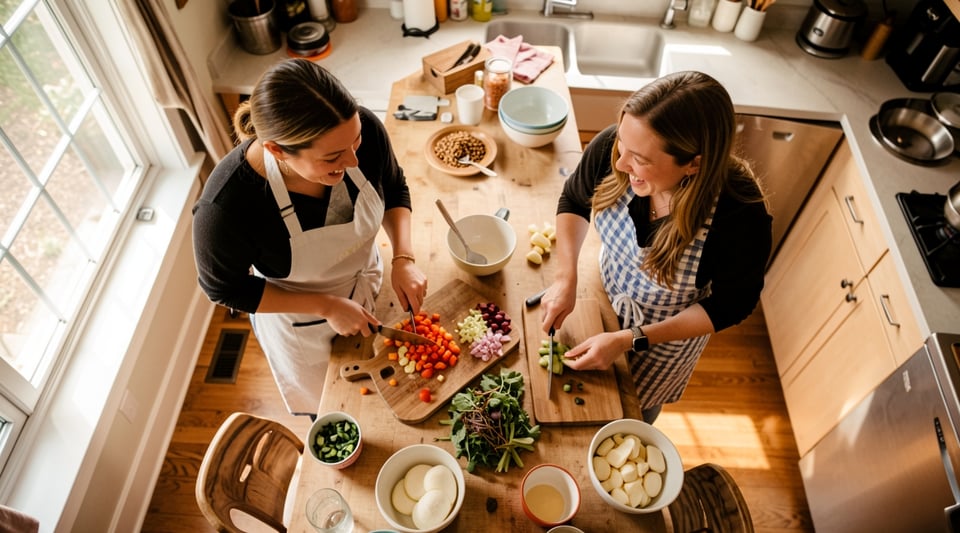
Pro Tip: Prep with your co-host. An hour of chopping vegetables together the afternoon of the party is its own small gathering, and it means two people know where everything is.
8. Master the Recency Effect
So… how does your party END?
Whatever happens last gets outsized weight in how the whole night is judged. Guests do their evaluating on the drive home, or in the car with their partner on the way out, and the ending is the part they evaluate from. If the last thing they experienced was good, it colors everything before it.3
This is why party favors work so well. EXCEPT when they’re placed at everyone’s seat at the beginning!
Weddings that put favors on chairs waste the ending entirely. A basket by the exit does far more.
I have found that people typically want to leave at specific times:
- After the first hour: Introverts, people with another event, or anyone having a rough time. That’s OK! Prepare for this. It happens often.
- After the last course is served: If you’re serving dinner and dessert, some people will leave after dessert regardless of the time.
- On the hour: People make deals with themselves or their partners: “We’re leaving at 10 PM!”
How can you optimize those last moments? I have strong opinions about this after lots of testing. Here’s how I feel, let me know if you agree.
- Don’t pressure anyone to stay. I actually want people to feel welcome to leave if they need to. The WORST thing you can do is guilt someone into staying longer. That becomes their low moment and the memory they take home. At the beginning of the night, set expectations: “We’ll do dinner, then dessert, then take it easy.” This lets people plan their exit.
- Signal phase changes. Let people know when you’re transitioning to games, serving food, or revealing a surprise. This helps guests see the night’s structure and choose natural exit points.
- Create permission exits. At the end of each phase, say something like: “We’re going to play a game next! You don’t have to play, but wanted to give you a heads up!” or “Let’s play one more round before dessert.” This gives people an easy, graceful out and lets you say a warm goodbye.
The worst thing you can do is guilt someone into staying longer. That becomes their low moment and the memory they take home.
Pro Tip: Sometimes if I have lots of leftovers I will quickly bag up some dessert and hand ziplocks to people leaving, “here are some munchies for the road!” It’s a small gesture, and it becomes the last thing they remember about your party.
9. Be the Connector Who Introduces Everyone
The single best thing you can say all night as a host:
“Hey! Have you met ___? I would love to introduce you!”
The Art of Gathering calls this generous authority. The best hosts don’t try to be everyone’s best friend or personal entertainer. They take clear ownership of the gathering by actively connecting people and setting the tone.
After a conversation, people consistently underestimate how much the other person liked them and enjoyed talking to them.5 It’s called the liking gap, and it isn’t a first-meeting jitter that wears off. Researchers found it between strangers in a lab, between members of the public at a workshop, and between first-year college students getting to know their dorm mates, where it lasted several months.
Several MONTHS!
What that means for you: your guests almost certainly like your party more than you think. That little voice saying “Ugh, this is awkward…” or “Nobody’s having fun” is usually wrong. And it’s wrong in a predictable direction!
So be openly warm, and be obvious about it. Greet every guest by name and tell people you’re glad they came. Keep scanning the room for anyone standing on their own, and go make them an introduction.
Your introductions matter more than they feel like they do. When you introduce two people and tell them why they should talk, you’re handing them the reassurance they won’t give themselves. Learning how to work a room makes this easier. It’s the same skill that gets people noticed at work… so why not practice on your friends first?
How to make great introductions:
- Walk up to the person who looks a little lost
- Say: “Come with me, there’s someone I want you to meet”
- Introduce them with a hook: “Sarah, this is Marcus. Marcus just got back from a month in Japan, and Sarah, you’ve been wanting to plan a trip there, right?”
- Stay for 30 seconds to make sure the conversation takes off, then circulate
Action Step: Before the party, think of three to five specific introductions you want to make. Pair people who share an interest, a career path, or a sense of humor.
10. Create Collective Effervescence
Sociologists have a term for the electric feeling a group gets when everyone experiences something at the same instant: collective effervescence. It was coined to describe religious ritual, and it’s the reason a stadium erupts.
I have noticed that when events have a “group think” moment EVERYONE likes the event more. I think it is because it is a bonding moment… but I am not sure.
How to engineer it:
- Give a toast, or invite one. If you need help, check out our guide on how to be funny. A brief, heartfelt, or humorous toast focuses the entire room’s attention on one moment. It doesn’t need to be long. Even 30 seconds of genuine warmth works.
- Play group games. I am a huge fan of formal or casual game nights. They’re one of the most reliable ways to create shared energy, and even at large house parties, you can create a game moment. Make a toast thanking everyone, then challenge the group: “Someone at this party just got back from a trip to Iceland—first person to find them wins a prize!” This generates buzz and gets people talking to strangers.
- Use food as a bonding activity. There is a reason I really like serving s’mores and fondue at my parties. Those and build-your-own taco bars work so well because they encourage everyone to gather around and do the same activity at the same time.
- Use props. I have a couch guest book that my friends Stephen and Christine gave me, and I often ask everyone to sign it before they go, then read from it. Wine charms and interesting napkins work the same way: they give people something to comment on.
The test? Look around the room and count how many separate conversations are happening. If the answer is ONE… you’ve got it!
11. Craft a Strategic Playlist
Is your party playlist someone’s phone on shuffle, adjusted by whoever happens to be nearest? Try three phases instead.
The Three-Phase Playlist:
- Arrival phase (first 60 to 90 minutes): Moderate-tempo background music at a volume low enough for easy conversation. Think jazz, indie folk, or acoustic covers. The goal is ambiance. Keep it at “restaurant volume”: audible but not competing with voices.
- Peak phase (mid-party): Gradually increase tempo and energy. Upbeat songs people recognize but don’t need to sing along to. This is where you shift the room from conversational to celebratory.
- Late phase (final hour): If your party is a dance party, this is where you go all out with crowd-pleasers. If it’s a dinner party, bring the volume back down to something warm and intimate for the wind-down.
You’ll sometimes read that party music should just stay quiet. We disagree!
Volume is a dial you turn as the night changes. A room that’s still at library volume at 10 PM has quietly told everyone it’s time to go home.
Practical tips:
- Build the playlist in advance. Shuffling through your phone mid-party kills your hosting momentum.
- Avoid songs with loud or distracting lyrics during dinner. Instrumental versions of popular songs work well.
- Keep the speaker in a central location rather than blasting from one corner. Even sound distribution prevents the “loud zone” problem where half the room can’t hear each other.
Action Step: Create three separate playlists labeled “Arrival,” “Peak,” and “Wind Down.” Queue them in order so you can transition without touching your phone.
12. Master Your Lighting
Want the biggest payoff for the least effort? Lighting is the highest-return 10 minutes in hosting.
Three things matter:
- Warm light instead of white light. Soft yellow and amber bulbs look like evening. If you’re buying bulbs, the number on the box to look for is 2700K to 3000K. Save cool, blue-white light for the office.
- Light sources below eye level. Table lamps, candles, and string lights make a room feel informal. Overhead lighting feels formal and exposing, which is a strange thing to do to someone holding a paper plate.
- Less light overall. Go dimmer than feels normal. A softly lit room feels relaxed, which is most of what you’re after.
The practical lighting checklist:
- Turn off overhead lights (or dim them to 30%)
- Place candles on tables and counters (battery-operated ones work if you’re worried about fire)
- String lights along a wall, porch railing, or above a dining area
- Use a lamp with a warm bulb in conversation corners
- Keep the kitchen or food area slightly brighter so people can see what they’re eating

Big Idea: Changing your lighting takes 10 minutes and costs nothing (turn off the overheads, light some candles), but it changes the feel of your space more than any decoration you could buy.
13. Set Up Your Space for Connection
Your furniture can push people together… or push them apart. Here’s how to use it:
- The 90-degree rule. Set chairs at right angles to each other. Straight across can feel like an interview, and side by side makes eye contact awkward. Arrange seating in small L-shaped clusters.
- Pull furniture away from walls. Pushing everything to the perimeter creates a cold, empty center that nobody wants to stand in. Moving furniture inward into small clusters creates energy and intimacy throughout the room.
- Create zones. Standing-height surfaces (a kitchen counter, a bar cart) for “floating” conversations that are easy to enter and exit. Soft seating areas for deeper talks. A central focal point like a coffee table with snacks or a fireplace naturally anchors conversation clusters.
Make key areas obvious:
- The bathroom. Put up signs, make it easy to find, and stock it with extra toilet paper and soap. More than you think you need.
- Food stations. Lots of guests have food sensitivities. Make it easy by labeling what’s gluten-free, vegan, or contains common allergens. A simple chalkboard sign does the job and shows guests you thought about their comfort.
- Encourage location changes. This might sound odd, but I have found that people will often stay longer and have a better time if I encourage location changes. Set up appetizers in a different spot than dinner and dessert in yet another area. When people move through different zones, they circulate, meet new people, and the party feels more dynamic. If you have a porch, balcony, or backyard, make it a “stop” in the party circuit.
Action Step: Before guests arrive, sit in every seating area and ask: “Can I easily make eye contact with someone? Can I reach a drink? Can I exit this conversation gracefully?” Adjust furniture accordingly.
14. Decide Where People Sit
“Um… is this seat taken?”
At a seated dinner, the worst 30 seconds of the evening happen before anyone eats. Eight people hover behind chairs, working out who they’re allowed to sit next to without seeming rude.
You can delete that moment entirely. Just decide in advance!
Assigning seats means:
- Nobody performs the calculation about where they’re permitted to sit
- The two people you most wanted to meet each other actually do
- Couples get split up, which is the single most reliable way to make a table talk
- The person who knows nobody is sitting next to your warmest friend, somewhere in the middle of the table
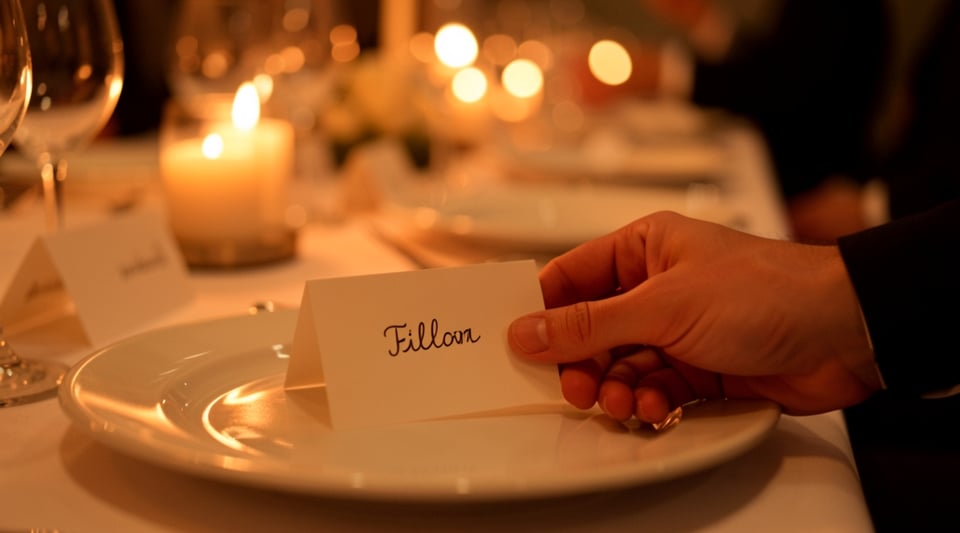
You don’t need calligraphy. Index cards folded in half, written at the kitchen counter an hour before, will do. Write the name big enough to read from standing.
Put the shyest guest in the middle of a long side rather than at an end, where conversation only comes from one direction. Put yourself near the kitchen so getting up doesn’t disrupt anyone.
Got a guest who tends to hold the floor? Seat them next to someone who enjoys that, rather than across from someone who doesn’t.
Try This: Write the cards, then move two of them. The second pass is where you notice you’ve accidentally put all the quiet people together.
15. Use the Pratfall Principle
Perfect food, perfect timing, perfect conversation? Lots of hosts believe they need all three. A well-known finding points the other way… with one catch.
In the original experiment, a person who came across as clearly capable became more attractive to observers after committing a clumsy blunder. The same blunder made an average performer less attractive. The researchers’ explanation was that someone impressive can seem remote, and a small stumble makes them human.6
That catch is the whole thing. A small slip makes a capable person look human. It can’t make an unprepared one look capable.
Good news for hosts: you’ve already shown you’re capable, just by having people over and feeding them! The burnt bruschetta is happening to someone who is visibly pulling it off. So go ahead and laugh at it.
That laugh does something for the room, too. When you’re visibly relaxed about a small mishap, you give everyone else permission to stop performing.
How to apply this:
- If something goes wrong (and something usually does), acknowledge it with humor instead of stress. “Well, the bruschetta is extra crispy tonight” gets a laugh and puts everyone at ease.
- Share a brief, self-deprecating moment early in the evening. It sets the tone that this is a space where people don’t need to perform.
- Don’t apologize for your home, your cooking, or your party. Constant apologies make guests feel like they should be disappointed, and they turn one small thing into the theme of the night.
What NOT to do: This doesn’t mean intentionally creating chaos or mess. Deliberately creating disorder triggers anxiety, especially for guests who are already socially uncomfortable.
Pro Tip: Genuinely worried about hosting? Pick one thing you’ll do well and let the rest be good enough. Hate cooking? Order in or do potluck. Not crafty? Skip the decorations and spend the effort on lighting and a playlist.
16. Remember Every Guest’s Name
“Hmm… is it Dana? Or Diana?”
Have you ever met someone at the beginning of a party, run into them again two hours later, and had no idea what their name was? It’s super awkward.
Names really are harder to remember than, say, someone’s job. In one study, people learned the jobs and surnames of 16 unfamiliar faces. Names were much harder to recall than jobs, even for words that could be either one.7
It’s called the Baker-Baker paradox. It’s easier to remember that someone is a baker than that someone is named Baker… same word!
Think of it this way: the job drags flour, ovens, and warm bread along with it. The name is a label attached to nothing.
So the fix is to give the name something to hold onto. Look, Snap, Connect:
- Look. Give the person your full attention when they say their name. Most “forgetting” is actually “never heard it,” because your brain was busy planning what to say next. Pause for about four seconds while looking at them before you respond.
- Snap. Take a mental snapshot of one distinctive feature: their glasses, their laugh, their hair.
- Connect. Build a vivid link between the name and that feature. The more absurd or visual, the better.
For example, I met someone named Sura. I’ve never met someone with that name before, so I couldn’t associate them with anyone else.
Instead, their name reminded me of Syrah wine and they said they liked wine. So, whenever I see Sura, I remember the wine and their name.
Difficult or unfamiliar name? Ask them to spell it or say it again. People appreciate the effort, and those extra seconds are exactly what help it stick.
Action Step: At your next party, practice the four-second pause. When someone says their name, resist the urge to immediately respond. Look at them, let the name register, then say: “Great to meet you, [name].” For more on this, see our guide on how to remember names.
17. Master the Greeting
How you physically greet someone sets the emotional tone for the whole interaction, and the handshake does something measurable. When people watched recordings of business greetings, the versions that included a handshake left them rating the people involved more warmly than the same greeting without one.8
That said, the best greeting is still the one the other person already reached for.
Learning to read body language cues makes this much easier:
- If someone opens their arms wide, they want a hug. Match their energy.
- If someone extends a hand, go for the handshake. Don’t force a hug on a handshaker.
- If someone hangs back or waves, respect that boundary. Put your hand up for a wave and say: “Hey, great to see you!” Some people are uncomfortable with physical contact from people they don’t know well, and respecting that makes them feel safer at your party.
The read takes about a second, and you’re already doing it. Just be willing to abandon your plan mid-reach when their body says something different!
The basics of a good handshake, if that’s where you land:
- Keep your hand fully vertical, neither palm-up nor palm-down
- Match the other person’s grip strength
- One to two pumps: “Good to see you.” Two to three pumps: “I’m really glad you’re here.”
Action Step: Pay attention to the greeting cues your guests give you. Arms open? Hug. Hand extended? Shake. Hanging back? Wave warmly. Matching their preferred greeting is one of the fastest ways to make someone feel comfortable.
18. Plan Your Food and Drinks for Connection
Food at a party is a bonding ritual, and there’s decent evidence for taking that literally. People who eat socially more often report feeling happier, being more satisfied with life, trusting other people more, being more engaged with their local community, and having more friends to lean on.9 Evening meals did the most work, and the things that predicted feeling closer afterward were specific: how many people were at the table, how much laughter there was, how much reminiscing, and whether there was a drink.
Shared formats beat individual plates. Shared platters, build-your-own taco bars, fondue, and charcuterie boards create more bonding than individually plated meals. Why? They make people reach across each other and cooperate over a serving spoon.
The strategic food timeline:
- Appetizers out when guests arrive. People need something to do with their hands and something to talk about. Cheese, crackers, dips, and finger foods serve both purposes.
- Main food 60 to 90 minutes in. This gives latecomers time to arrive and gives everyone a natural transition point.
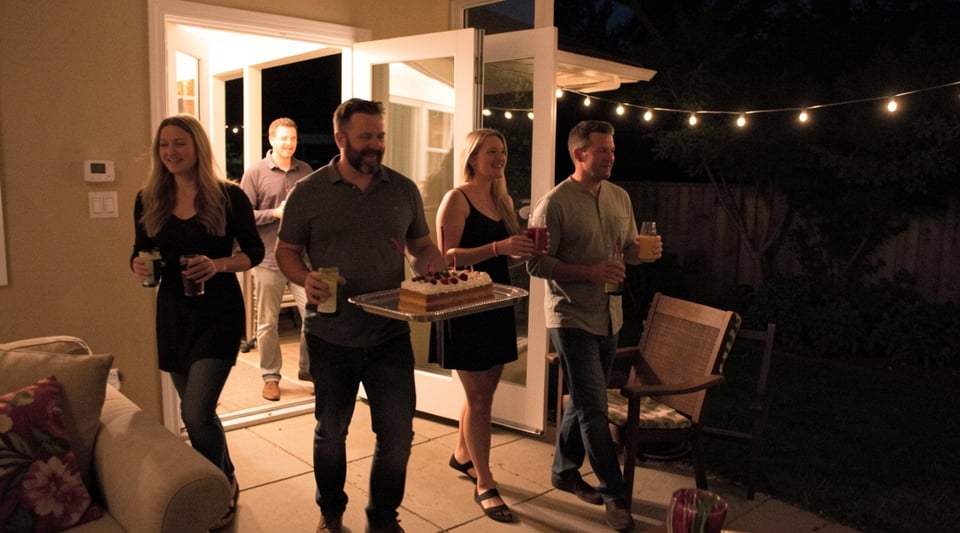
- Dessert as a peak moment. Reveal it with a little fanfare. Surprise s’mores, a fondue station, or even a dramatic cookie platter creates a collective moment.
On drinks:
When 720 social drinkers were put into groups of three strangers with a drink in hand, the groups given a moderate dose of alcohol showed more of the behaviors that go with good mood, fewer of the ones that go with bad mood, and reported feeling more bonded.10
Inclusive hosting also means offering REAL non-alcoholic options, well beyond soda. Cucumber-mint coolers, espresso tonics, or non-alcoholic spritzes tell non-drinking guests you thought about them rather than tolerated them.
Shared platters make people reach across each other and cooperate over a serving spoon. That’s the part that does the bonding.
Pro Tip: Set up a simple drink station where guests can serve themselves. A pitcher of a signature cocktail, a pitcher of the non-alcoholic version, and clearly labeled cups. This reduces your workload and keeps the drinks flowing without you playing bartender all night.
When the Party Goes Flat
“Uh oh… is this party dying?”
It’s 9:15, and the evening has gone quiet. The conversation has thinned out, two people are on their phones, and somebody has started stacking plates without being asked.
First, a reassurance, courtesy of the liking gap: it’s almost certainly less flat than it feels from where you’re standing. Hosts are the worst-placed people in the room to judge the room.
But if it really has gone quiet, pushing harder at the same thing won’t fix it. A dip needs a change of state. Here are four moves, roughly in order of how little effort they take:
- Change the physical arrangement. Ask everyone to move to another room, or outside, or just say “come sit down” to people who’ve been standing for an hour. Moving bodies resets conversations, because the groups reshuffle on the way.
- Put food or drink in the middle of it. Dessert, a fresh pot of coffee, a plate of something that needs assembling. It gives everyone a reason to stand up and a legitimate excuse to change who they’re talking to.
- Break the big group into smaller ones. A room of 12 half-heartedly sharing one conversation is much worse than four groups of three. Games do this automatically, which is most of why games work.
- Shift the music up a notch. Tempo first, volume second. It’s the cheapest possible signal that the evening has entered a new phase.
Whatever you do, don’t announce the problem! “Is everyone having fun?” and “I feel like this is dying” tell the room to start evaluating the party, and evaluating a party is the opposite of enjoying one. Just make the change and let people follow it.
Try This: Keep one thing in reserve that you didn’t mention in the invitation: a game, a dessert, a bottle of something. Not for the schedule. For the 9:15 moment.
The Pre-Party Checklist
A timeline kills last-minute panic, so you can actually enjoy the night you planned. Here’s the countdown:
2 to 3 weeks before:
- Set the date, end time, and purpose of the party (Section 4)
- Build your guest list using Dunbar’s layers (Section 3)
- Send personalized invitations with logistics and a specific reason (Section 5)
- Ask one person to co-host and tell them which job is theirs (Section 7)
1 week before:
- Plan your peak moment: what’s the one highlight? (Section 6)
- Create your three-phase playlist: Arrival, Peak, Wind Down (Section 11)
- Plan your food timeline: appetizers on arrival, main at 60–90 min, dessert as the peak (Section 18)
- Identify 3 to 5 introductions you want to make (Section 9)
Day of:
- Rearrange furniture: pull away from walls, create L-shaped seating clusters (Section 13)
- Write the place cards if you’re doing a seated dinner (Section 14)
- Set up distinct zones: food station, conversation area, activity space
- Prep your lighting: overhead lights off, candles and string lights on (Section 12)
- Put out clear signage: bathroom, parking, entrance, food labels
- Set up the drink station so guests can serve themselves
1 hour before:
- Put appetizers and drinks out and ready to grab
- Start your Arrival playlist
- Do a walkthrough: sit in each seat and check for comfort and eye-contact lines
- Set aside one thing in reserve for a mid-party lull
- Take a breath. Your guests are rooting for you.
During the party:
- Station yourself near the door for the first 20 minutes, greet every guest
- Circulate and make introductions (don’t get trapped in one conversation)
- Launch your peak moment ~1 hour in
- Signal phase transitions so guests can find natural exit points
- Hand out leftovers or favors as people leave
Hosting on a Small Budget
Good news: the cost of a party and the quality of a party are barely related! Most of the moves that matter in this guide are free.
Lighting, a playlist, moving the furniture, greeting people at the door: all free. And that greeting is the highest-value thing you’ll do all night! Place cards on index cards cost about a dollar.
Where the money actually goes, and how to spend less of it:
- Make it a potluck, but assign categories. “Bring a dessert” gets you six desserts. “You’re on dessert, you’re on bread, you’re on something green” gets you a dinner. People like being given a job.
- Cook one thing in a big pot. Chili, curry, pasta, soup. One pot feeds 12 for roughly the cost of two restaurant entrées, and it can be made the day before, which is worth more than the savings.
- Buy drinks in bulk and make one thing. A box of wine, a case of beer, and one large pitcher of something mixed will cover almost any group. Make the same pitcher without the alcohol and you’ve covered everyone else.
- Skip the decorations entirely. They’re the most expensive thing on the list and the least remembered. We’ve yet to hear anyone go home raving about the bunting.
Big Idea: If your budget is genuinely tight, spend it on the food and borrow the rest. A bowl of chili in a warm room with good music beats a catered spread under an overhead light.
Post-Party: Keep the Connection Going
Last guest gone? Dishes in the sink? The party isn’t over yet!
Most hosts skip what comes next entirely… and the connections made at their party quietly fade back to acquaintance level.
Friendships need the unglamorous stuff: staying in contact, being open, being supportive, actually spending time together. Lose regular contact, and a friendship tends to fade. No amount of goodwill from a great evening can stand in for a message.
So here’s what we recommend, while the night is still fresh for everyone:
Within 24 to 48 hours:
- Send a brief group message: “Last night was so fun, thanks for coming!” Add a photo from the evening if you have one.
- Message anyone you introduced to each other: “Did you and Marcus end up talking about Japan? You two should grab coffee.”
Within the week:
- Follow up individually with the two or three people you connected with most. “Let’s do lunch” or “Want to check out that restaurant we talked about?” is what converts a party acquaintance into a friend.
- If you took photos, share them.
The long game:
The best hosts build a rhythm: a monthly dinner, a quarterly game night, a seasonal thing everyone starts expecting. Consistency is what turns a list of guests into a group of people who know each other.
If making and keeping friends is something you want to get better at, hosting regularly is one of the fastest routes. Your second party is easier than your first. By the fifth, you’ll have people who show up and bring friends of their own!
How to Throw a Party for Someone Who Doesn’t Like Parties
Some of the best people you know avoid parties because the standard format drains them: loud music, big crowds, and unstructured mingling with no exit in sight. If you’re an introvert yourself, you already know the feeling from the inside.
Luckily, the fixes are small… and they make the night better for everyone else too!
- Keep it small. Six to eight people is the sweet spot. Everyone can be in one conversation without raising their voice.
- Give it structure. A dinner, a game night, a cooking activity: anything that gives people something to do instead of generating conversation from nothing. Structure is the single biggest kindness here.
- Set a clear end time. “Dinner from 7 to 10” answers the one question a quiet guest would otherwise wonder about all evening.
- Create a quiet zone. If the party is larger, have one room, porch, or corner where someone can decompress for 10 minutes without it looking like they’re sulking.
- Tell them who’s coming. “It’ll be you, Sarah, Marcus, and two of my work friends” lets someone mentally prepare, which is most of the battle.
- Give them a job. This one’s underrated. A person who’s manning the grill or refilling drinks has a legitimate role, a reason to talk to everyone briefly, and a graceful way out of any conversation. Quiet guests often love it.
Pro Tip: Tell a quiet guest who else is coming a day or two before, while they still have time to picture the evening. Knowing there are two people they already like in the room is often what gets someone out of the house.
How to Plan a Party for Beginners
Never hosted before? The whole thing can feel like a LOT. Here’s the stripped-down version… seven decisions, and you’re done!
- Pick a date and a reason. Even “celebrating Friday” counts. A reason gives people a motivation to show up.
- Invite 8 to 12 people. Small enough to manage, large enough to feel like a party. Expect a few people to cancel, so invite a couple more than you need.
- Handle food simply. A build-your-own taco bar, a big pot of chili, or ordered pizza plus a good dessert. Don’t attempt a five-course meal your first time.
- Set up one activity. A card game, trivia, or a set of party games. One is enough. It’s your backup for when conversation lulls.
- Adjust your lighting. Overheads off, candles and lamps on. This single change transforms any space.
- Make a playlist in advance. Two to three hours of it, so you never have to think about music during the party.
- Relax. Your guests want to have a good time, and they’re rooting for you.
The best hosts don’t try to be everyone’s entertainer. They take ownership of the gathering by connecting people and setting the tone.

Frequently Asked Questions
How do you throw a party on a budget?
Cheaply, because the parts that cost money are the ones guests remember least. Everything that actually shapes the night is free: the greeting at the door, the introductions you make, the lights you turn off, the playlist, and the one moment you plan. Where money does go, let other people carry some of it. A potluck with assigned categories gets you a dinner instead of six desserts, and one big pot of something beats a spread every time. The section on hosting for a small budget above has the specifics.
What makes a party fun for adults?
Three things: active participation rather than standing around, at least one shared group moment, and feeling genuinely welcomed by the host. The biggest killer of adult parties is unstructured mingling that runs too long. Break the night into phases, plan at least one group activity, and actively introduce people who don’t know each other. Adults have more fun when someone else takes the social pressure off them.
How do you keep guests entertained at a house party?
The key is variety and transitions. Don’t rely on one activity for the whole night. Start with appetizers and conversation, transition to a group game around the one-hour mark, serve dinner, then wind down with dessert and relaxed conversation. Place conversation starter cards on tables for people who get stuck in small talk. And circulate. The single most impactful thing a host can do is introduce people to each other.
What do you do when a party gets awkward or quiet?
Change the state rather than pushing harder at the same thing. Move people to a different room or outside, put out food or dessert, break one large group into smaller ones, or shift the music up a notch in tempo. All four work because they reshuffle who is talking to whom. One thing to avoid: announcing it. Asking “is everyone having fun?” makes the room start evaluating the party instead of enjoying it. Also worth knowing that hosts tend to underestimate how well things are going, so it’s usually less flat than it feels.
Should you have a co-host?
If you can, yes. A host stuck in the kitchen has effectively missed their own party, and the first job to get dropped is introductions, the one thing only the host can do, because you’re the only person who knows everybody. Hand one other person a defined territory for the night: the door, the drinks, the mid-party kitchen reset, or the photos. Ask specifically and with a time attached (“Can you come at 6 and run the door for the first hour?”) rather than asking them to help out.
What are fun party games for adults that don't involve drinking?
Trivia written about the group, Two Truths and a Lie, Codenames, party games like PowerPoint Night where each guest presents three slides on an absurd topic, charades with a twist, or a murder mystery game. The key is choosing games where everyone participates and nobody gets put on the spot. Always offer an opt-out for people who would rather watch.
How do you throw a party for someone who doesn't like parties?
Keep it to six to eight people, give the evening clear structure (a dinner or game night rather than open-ended mingling), set a defined end time, and tell them who’s coming in advance. Giving them a small job (the grill, the drinks) helps more than people expect, because it provides a role and a graceful exit from any conversation.
What is the secret of a successful party?
People tend to judge an experience by its most intense moment and by how it ended, rather than by how long it lasted. So you don’t need a perfect party from start to finish. You need a warm greeting when people arrive, one genuinely memorable moment in the middle, and a good send-off. Get those three windows right and the quiet stretches in between won’t count against you.
How do you make a small party not awkward?
Small parties feel awkward when guests don’t know each other and there’s no structure. Fix both: make introductions with a hook (“you two both love hiking”), have a group activity ready within the first 30 minutes, and keep food and drinks moving so people always have something to do. Assigning seats at dinner helps more than it sounds like it would, because it removes the hovering. Dim the lights too, so the room feels relaxed.
How do you throw a good housewarming party?
A housewarming has a built-in peak moment: the tour. Give it in small groups, pointing out your favorite features and the things you’re still working on. Set up food in the kitchen, drinks in the living room, and a conversation area on the porch or patio so guests explore the space rather than clustering in one room. Keep the list to people you want to see regularly now that you live here. This one is about building your local circle.
How to Throw a Party Takeaway
It comes down to a plan for three moments, the willingness to introduce people, and one message the next morning. Everything else is detail.
Here’s where to start:
- Put a date on the calendar in the next two weeks and send the invitation before you plan anything else. The date is what makes the rest real.
- Write the guest list from the inside out, starting with the people you’d call on a bad day, and stop at the number that matches the night you want.
- Pick your one peak moment now and schedule it for roughly an hour in, when energy dips on its own.
- Recruit a co-host and hand them the door before the day arrives, so you’re free to do the introductions.
- Do the 10-minute lighting pass last, overheads off and lamps and candles on, right before people arrive.
- Send the group photo and two individual messages the morning after, while the night is still fresh.
- Book the next one before you finish cleaning up. The second party is where hosting stops feeling like a performance.
I never thought being the source of fun and merriment could make ME so happy. It might sound like a lot of work to throw a great party, and it can be. But there is nothing better than providing a fun, comfortable, open setting for the people in your life.
Make your party work for you. Hate cooking? Order in or do potluck! Hate games? Blast music and make it a dance party. Not crafty? No worries! Skip the decorations and put it all into lighting. If you have fun FIRST, others are much more likely to join in.
Want to level up your hosting further? Developing your people skills and learning to be more social will make every gathering you host feel easier than the last.